


Repeat Customer
A repeat customer is a shopper who has made more than one purchase from the same store, as opposed to a new or first-time customer buying for the first time. Repeat customers are a core indicator of brand loyalty and are typically far cheaper to sell to again than acquiring a new customer from scratch.
Definition of Repeat Customer
A repeat customer is a shopper who has completed more than one purchase from a given store. The term is deliberately simple and behavioral — it doesn’t require any particular emotional attachment or brand preference, just a second (or later) transaction. Repeat customers sit at the center of most ecommerce growth strategies because they represent proof that a store’s product, experience, and value proposition were compelling enough to bring someone back, rather than relying entirely on a constant stream of new customer acquisition to sustain revenue.
How Repeat Customer Rate Is Measured
Repeat customer rate is usually calculated over a defined period as:
Repeat Customer Rate = (Customers With More Than One Order ÷ Total Customers) × 100
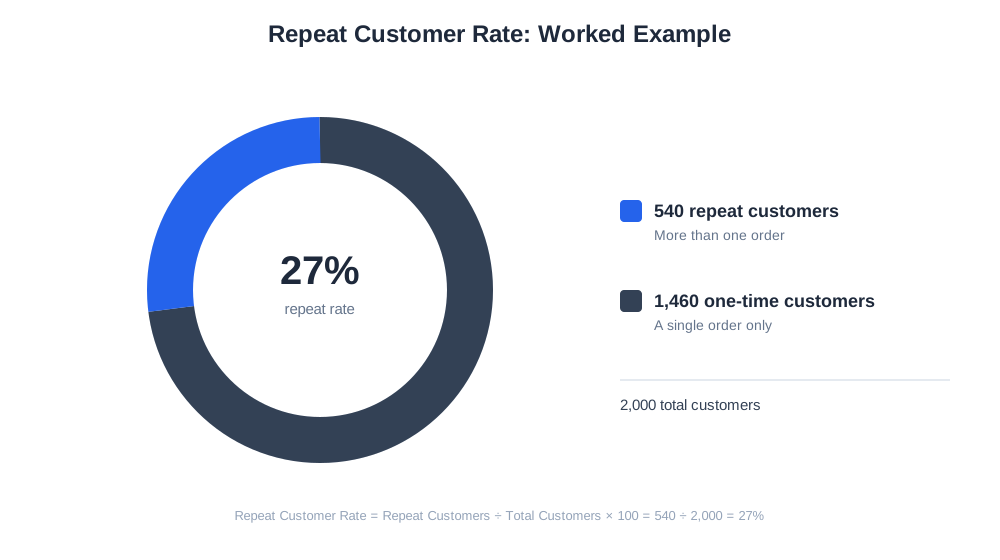
Consider a store that acquired 2,000 total customers over the past year, of which 540 made a second or later purchase within that same window. That store’s repeat customer rate is 27%. This figure varies enormously by category — a store selling consumable products people reorder regularly (coffee, skincare, pet food) would typically expect a much higher repeat rate than a store selling durable, infrequently replaced goods (mattresses, major appliances), where a “repeat” purchase might reasonably take years to occur.
Businesses often refine this basic calculation by adding a time window (a second purchase within 12 months, for instance) to avoid counting a customer who bought once years apart as meaningfully “repeat” in an active sense, and by segmenting the rate by acquisition channel or first-purchase cohort to see which channels or campaigns bring in customers who actually come back, versus those that bring in one-time buyers only.

Ready to Monitor Your AI Visibility?
Track how AI chatbots mention your brand across ChatGPT, Perplexity, and other platforms.
Why Repeat Customers Matter for E-commerce Brands
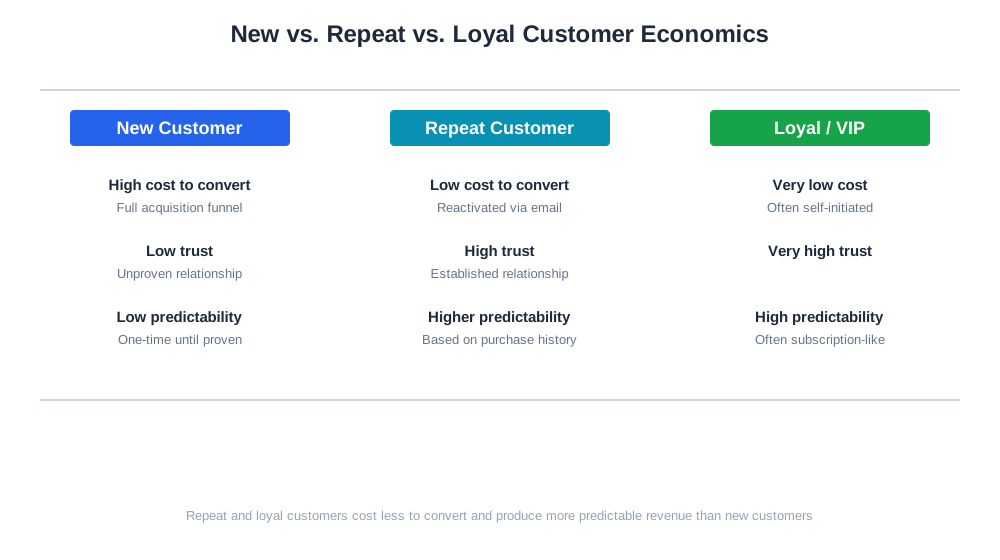
Repeat customers matter because of a basic economic asymmetry: acquiring a new customer typically requires marketing spend to reach and persuade someone with zero prior relationship to the brand, while a repeat customer already knows the product, trusts the checkout process, and often needs less persuasion — sometimes just a well-timed email or a restock notification — to buy again. This generally makes the marginal cost of generating a repeat sale lower than the cost of an equivalent new sale, which means a store with a healthy repeat customer base can often sustain profitability even as paid acquisition costs rise. Repeat customers also tend to have a higher average order value over time as they become more familiar with a store’s full catalog, and they’re a natural source of reviews, referrals, and word-of-mouth that reduce the acquisition cost of bringing in the next new customer.
| Customer Type | Marketing Cost to Convert | Typical Trust Level | Revenue Predictability |
|---|---|---|---|
| New customer | High (requires full acquisition funnel) | Low, unproven relationship | Low, one-time until proven |
| Repeat customer | Low (often reactivated via email/retargeting) | High, established trust | Higher, based on purchase history |
| Loyal / VIP customer | Very low (often self-initiated) | Very high | High, often subscription-like |
Repeat Customers and AI-Driven Commerce
As AI shopping assistants become more involved in product discovery and comparison, first-time customer acquisition through those channels is likely to keep growing, which makes it more important, not less, for brands to have a clear read on which of those newly acquired customers actually convert into repeat buyers rather than one-time purchasers driven purely by novelty or a single AI recommendation. Distinguishing genuine repeat behavior from a one-off AI-influenced purchase requires clean order-level data tied to a consistent customer identity over time. AmICited’s eshop_get_repeat and eshop_get_order_mix tools provide exactly this view directly from a store’s own order history, showing what share of revenue and order volume comes from new versus returning customers, which lets a merchant see whether AI-driven traffic is converting into durable repeat relationships or just a spike of first-time sales.
Stay Updated on AI Visibility Trends
Get the latest insights on AI mentions, brand monitoring, and optimization strategies.
Best Practices for Growing Repeat Customers
- Track repeat customer rate by acquisition channel to see which channels bring in customers who actually return
- Use post-purchase email sequences to re-engage customers at a realistic interval based on typical reorder timing
- Segment repeat customers by purchase frequency and value to prioritize retention efforts where they matter most
- Make reordering frictionless for consumable or replenishable products with saved payment and shipping details
- Reward repeat behavior explicitly through a loyalty program rather than treating it as something that happens on its own
- Monitor repeat rate trends over time, not just as a single snapshot, since it shifts with product mix and seasonality
Common Repeat Customer Mistakes
A frequent mistake is measuring overall repeat customer rate without segmenting by acquisition channel or first-purchase cohort, which hides the fact that some channels reliably bring in one-time buyers while others bring in customers who return repeatedly — without this breakdown, marketing budget often keeps flowing to channels that look fine on a new-customer basis but perform poorly on repeat conversion. Another common issue is treating all repeat customers as equally valuable, when in practice a small share of repeat customers usually drives a disproportionate share of repeat revenue; without frequency or value-based segmentation, retention efforts get spread too thinly. Some businesses also under-invest in the post-purchase experience, assuming a satisfied first purchase alone will bring a customer back, when a well-timed reorder reminder or loyalty incentive at the right interval measurably increases the odds of a second purchase. Comparing repeat customer rate across fundamentally different product categories without adjusting for natural reorder cycles is another frequent analytical error — a low repeat rate on a durable good bought once every few years isn’t a problem in the way the same rate would be for a consumable product meant to be reordered monthly. Finally, some stores focus so heavily on new customer acquisition metrics that repeat customer data gets reviewed rarely or inconsistently, missing early warning signs of eroding loyalty until churn has already become a larger problem.