


Loyalty Program
A loyalty program is a structured marketing system that rewards customers for repeat purchases or engagement, typically through points, tiers, discounts, or exclusive perks. It's designed to increase repeat purchase rate and customer lifetime value by giving existing customers a tangible reason to keep buying from the same brand instead of a competitor.
Definition of Loyalty Program
A loyalty program is a formal system that rewards customers for continuing to buy from — or engage with — a brand, typically through accumulated points, membership tiers, or exclusive perks. Rather than relying on a customer to remember and choose the brand out of habit, a loyalty program creates a visible, cumulative incentive: points sitting unredeemed, a tier almost within reach, or a member-only discount that isn’t available to new shoppers. The underlying goal is straightforward — increase the odds that an existing customer’s next purchase happens with this brand rather than a competitor.
How Loyalty Programs Work
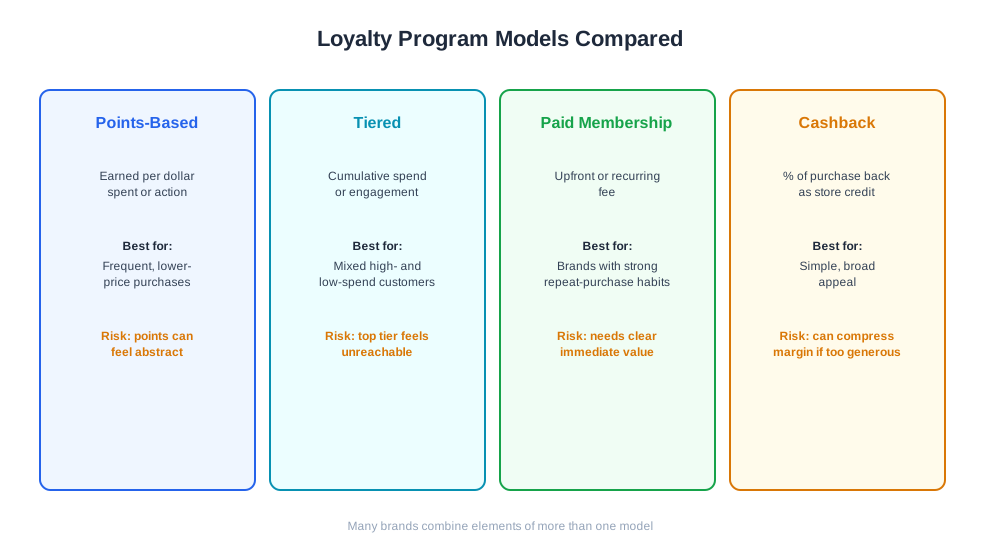
Most e-commerce loyalty programs fall into a few common structures, often combined:
- Points-based — customers earn points per dollar spent (and sometimes per action, like leaving a review or referring a friend), redeemable for discounts, free products, or shipping
- Tiered — customers unlock progressively better benefits (free shipping, early access, bigger discounts) as their cumulative spend or engagement crosses set thresholds
- Paid / subscription — customers pay a recurring fee for immediate benefits, similar to a membership club
- Cashback — a percentage of each purchase is returned as store credit for future use
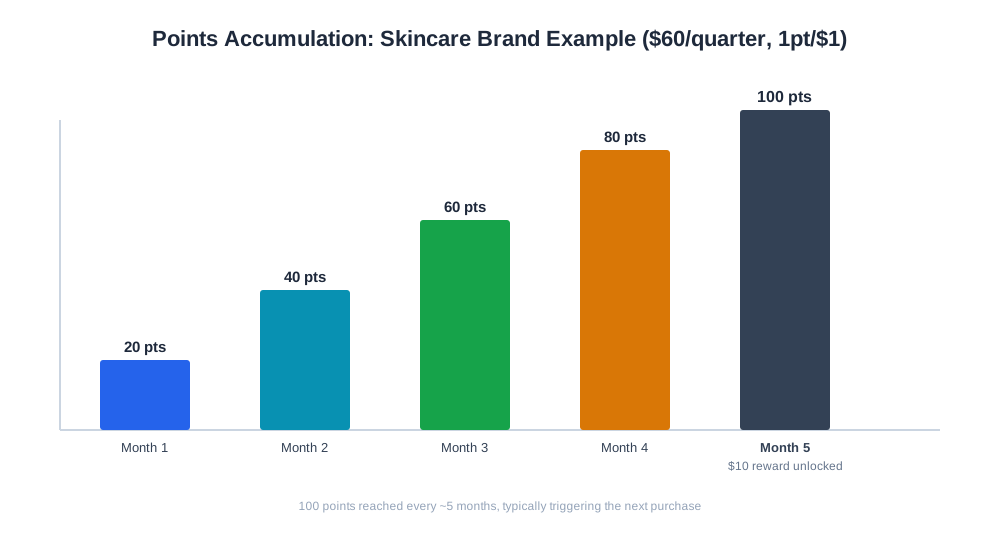
Worked example: a skincare brand launches a points program where customers earn 1 point per dollar spent, redeemable at 100 points for $10 off. A customer who spends $60 a quarter accumulates 100 points roughly every five months, triggering a redemption that typically coincides with — and often triggers — their next purchase. Over a year, that customer’s purchase frequency and average order value both tend to edge up compared to a similar customer with no points to redeem, since the near-complete reward creates a mild pull to buy sooner rather than later.

Ready to Monitor Your AI Visibility?
Track how AI chatbots mention your brand across ChatGPT, Perplexity, and other platforms.
Why Loyalty Programs Matter for E-commerce Brands
Acquiring a new customer is consistently more expensive than retaining an existing one, which makes repeat purchase behavior one of the highest-leverage levers in e-commerce economics. A loyalty program is one of the few retention tools that scales without requiring a human touch per customer — the reward structure runs automatically once it’s built, unlike, say, personalized outreach.
Loyalty programs also generate a useful side effect: ongoing behavioral data. Enrollment, redemption patterns, and tier progression reveal who’s genuinely engaged and who’s quietly drifting away long before that customer fully churns, giving marketing teams a chance to intervene with a targeted offer while the relationship is still salvageable rather than after it’s already lost.
Loyalty Program Models Compared
| Model | How Rewards Are Earned | Best For | Main Risk |
|---|---|---|---|
| Points-based | Per dollar spent or per action | Frequent, lower-price purchases | Points can feel abstract if redemption is unclear |
| Tiered | Cumulative spend or engagement thresholds | Brands with a range of high- and low-spend customers | Top tier can feel unreachable for casual buyers |
| Paid membership | Upfront or recurring fee | Brands with strong repeat-purchase habits already | Requires clear, immediate value to justify the fee |
| Cashback | Percentage of each purchase | Simple to explain, broad appeal | Can compress margin if the rate is set too generously |
Stay Updated on AI Visibility Trends
Get the latest insights on AI mentions, brand monitoring, and optimization strategies.
Loyalty Programs and AI-Driven Commerce
As more product discovery shifts to AI shopping assistants like ChatGPT Shopping and Perplexity Shopping, a strong loyalty program becomes a reason for a customer to return directly to a brand’s own site rather than starting a fresh, assistant-mediated search each time they need something similar. A shopper who has accumulated points or reached a meaningful tier has a concrete reason to type the brand’s name back into an AI assistant or search bar, rather than letting the assistant recommend whichever competitor ranks best in that moment.
Identifying who to enroll and how to structure tiers works best when it’s grounded in actual purchase behavior rather than guesswork. AmICited’s eshop_get_segments tool surfaces RFM-style customer segments — including a “champions” segment of a store’s most frequent, highest-value, most recent buyers — giving merchants a natural starting audience for a loyalty program launch and a benchmark for what “top tier” behavior actually looks like in their own customer base, rather than an arbitrary spend threshold picked without data.
Best Practices for Loyalty Programs
- Make the value of rewards easy to understand at a glance — vague or overly complex point systems get ignored
- Set the first reward threshold low enough that new members see a payoff quickly, building the habit early
- Use real segment data (not guesses) to decide which customers to target first and what tier thresholds are realistic
- Communicate progress proactively — remind customers when they’re close to a reward or tier upgrade
- Review redemption rates regularly; a program with low redemption isn’t actually driving the intended behavior
- Avoid discounting so generously that the program’s cost outweighs the incremental repeat-purchase revenue it generates
Common Loyalty Program Mistakes
A common mistake is launching a program with a reward structure so complex that customers can’t easily tell what they’re earning or how close they are to redeeming it — complexity kills the psychological pull that makes loyalty programs work in the first place. Another frequent issue is setting the first reward threshold too high, so new members never experience an early win and disengage before the program has a chance to build a habit. Some brands launch a loyalty program without segmenting their existing customer base first, spending equally on outreach to one-time buyers and genuine repeat customers, when the latter group would respond far better to a well-targeted invitation. It’s also common to track enrollment numbers as a success metric while ignoring redemption rates and actual repeat-purchase lift, which can mask a program that looks popular on paper but isn’t changing customer behavior. Finally, some merchants set reward generosity without modeling the margin impact, discovering only later that the effective discount rate across redemptions is eating into profit faster than the retention benefit justifies.