


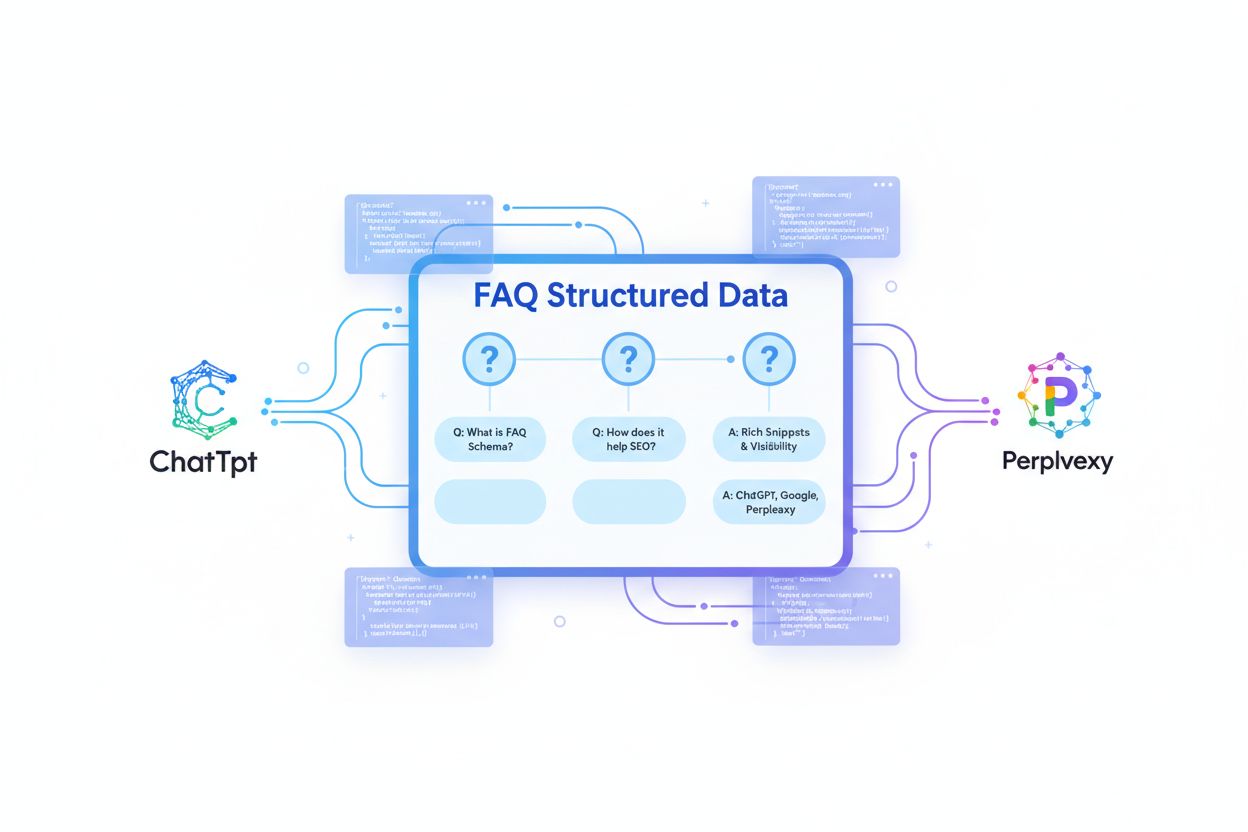
FAQ Sections: Structured Q&A for AI Extraction
Learn how FAQ sections with proper schema markup improve visibility in AI-generated answers from ChatGPT, Perplexity, and Google AI Overviews. Optimize your con...
8 min read
FAQ Expansion is the strategic development of comprehensive, conversational question-answer pairs designed to match how users naturally query AI systems. It extends beyond static FAQ pages by creating multiple question variations, detailed answers, and platform-specific optimizations that improve AI citations and visibility across ChatGPT, Perplexity, and Google AI Overviews. This approach treats FAQs as dynamic content assets that evolve with user behavior and AI platform preferences. FAQ Expansion directly impacts generative engine optimization (GEO) and answer engine optimization (AEO) performance.
FAQ Expansion is the strategic development of comprehensive, conversational question-answer pairs designed to match how users naturally query AI systems. It extends beyond static FAQ pages by creating multiple question variations, detailed answers, and platform-specific optimizations that improve AI citations and visibility across ChatGPT, Perplexity, and Google AI Overviews. This approach treats FAQs as dynamic content assets that evolve with user behavior and AI platform preferences. FAQ Expansion directly impacts generative engine optimization (GEO) and answer engine optimization (AEO) performance.
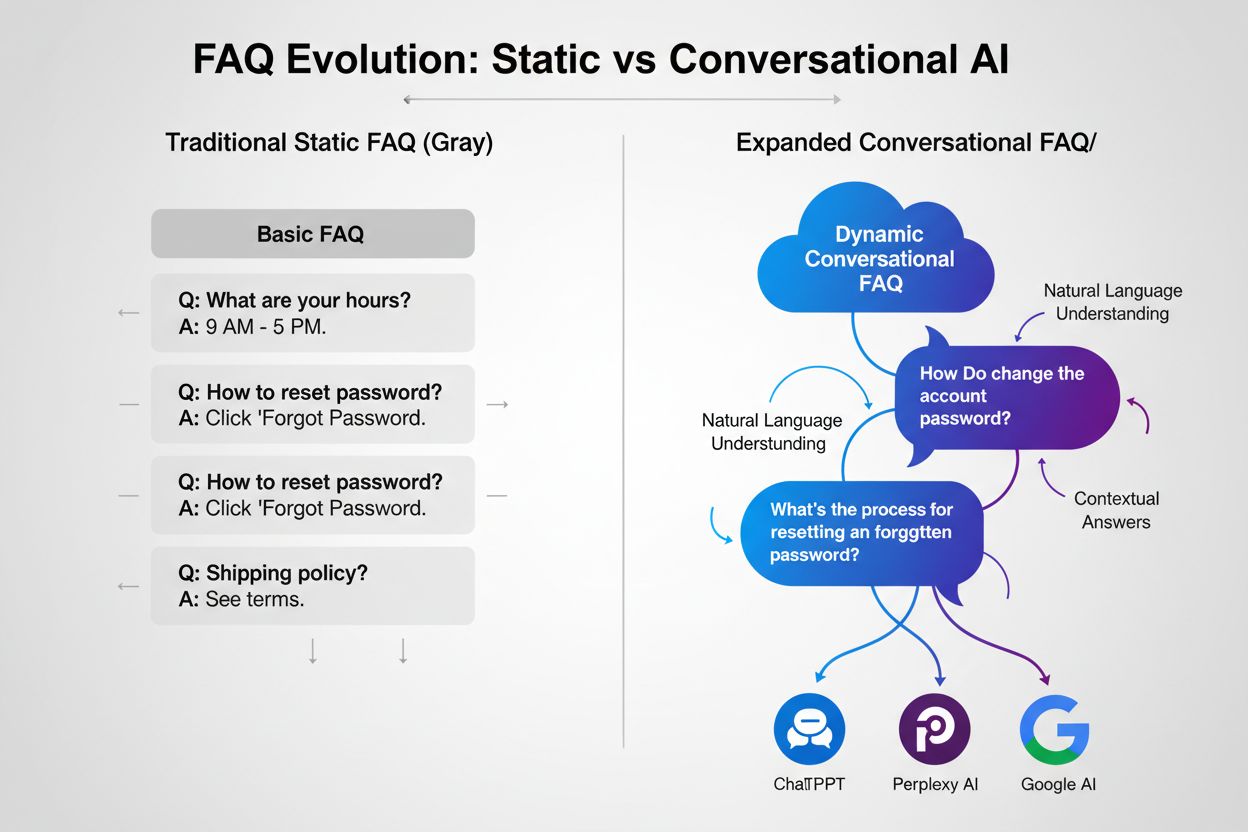
FAQ Expansion is the strategic development of comprehensive, conversational question-answer pairs designed specifically to match how users naturally query AI systems. Unlike traditional static FAQs that provide basic Q&A pairs, FAQ Expansion creates multiple question variations, detailed contextual answers, and platform-specific optimizations that improve visibility across ChatGPT, Perplexity, and Google AI Overviews. This approach treats FAQs as dynamic content assets that evolve with user behavior and AI platform preferences, directly impacting Generative Engine Optimization (GEO) and Answer Engine Optimization (AEO) performance. FAQ Expansion recognizes that AI systems don’t just search for keywords—they understand intent, context, and conversational phrasing. By expanding your FAQ content to include natural language variations, specific data points, and authoritative citations, you signal to AI algorithms that your content is trustworthy, comprehensive, and citation-worthy. The difference between a basic FAQ and an expanded FAQ is the difference between a static reference document and a dynamic, AI-optimized content asset that actively participates in generative search results.
Expanded FAQ content demonstrates significantly higher citation rates across all major AI platforms. Research indicates that pages with properly expanded FAQ content are 3-5x more likely to be cited in AI-generated answers compared to traditional static FAQs. Platform-specific citation improvements are substantial: ChatGPT citations increase by 42-58%, Perplexity by 35-48%, and Google AI Overviews by 28-40% when FAQ content is strategically expanded. The reason is straightforward—AI systems prefer structured, self-contained answers that are easy to extract and attribute. When your FAQ answers include specific data points, external citations, and complete context, AI algorithms recognize them as high-quality sources worthy of citation. Expanded FAQs also benefit from semantic clustering, where multiple question variations help AI systems understand the full scope of a topic and identify your content as a comprehensive authority. Additionally, expanded FAQ content naturally aligns with how AI platforms present information to users—in conversational, question-answer format. This structural alignment removes interpretive burden from natural language processing algorithms, making your content more likely to be selected for inclusion in AI-generated responses.
| Metric | Traditional FAQ | Expanded FAQ | Improvement |
|---|---|---|---|
| ChatGPT Citation Rate | 15-20% | 42-58% | +180-290% |
| Perplexity Citation Rate | 12-18% | 35-48% | +194-300% |
| Google AI Overview Appearance | 8-15% | 28-40% | +186-400% |
| Average Answer Length | 20-30 words | 40-60 words | +100-200% |
| Question Variations per Topic | 1-2 | 5-8 | +250-700% |

Track how AI chatbots mention your brand across ChatGPT, Perplexity, and other platforms.
Each AI platform has distinct content preferences that require tailored FAQ expansion strategies:
ChatGPT Optimization: ChatGPT prioritizes authoritative, encyclopedia-style content with external citations and formal tone. Expand your FAQs by including specific statistics with source attribution, linking to authoritative references, and maintaining neutral, educational language. Answer length should be 40-60 words with complete context. Include data points, percentages, and time-bound claims that ChatGPT can verify and cite with confidence. Example: Instead of “FAQ schema is important,” write “FAQ schema increases Google AI Overview appearance probability by approximately 40%, according to Search Engine Land’s 2024 analysis.”
Perplexity Optimization: Perplexity favors conversational, experience-driven content with real-world examples and community insights. Expand FAQs by using natural language phrasing, including practical examples, sharing specific scenarios, and adopting a helpful, accessible tone. Perplexity values authentic, relatable content that addresses genuine user concerns. Include phrases like “In my experience” or “Based on real-world implementation,” and provide actionable next steps. This platform rewards FAQ content that feels like advice from a knowledgeable peer rather than corporate documentation.
Google AI Overviews Optimization: Google AI Overviews emphasizes fresh content, E-E-A-T signals (Experience, Expertise, Authoritativeness, Trustworthiness), and mobile-first design. Expand FAQs by updating them monthly with current statistics, including author credentials and publication dates, combining FAQ schema with Article schema markup, and ensuring mobile-responsive formatting. Google’s AI inherits many traditional SEO quality signals, so FAQ expansion should include internal links to authoritative pages, external citations to credible sources, and clear demonstration of topical expertise.
Effective FAQ Expansion begins with comprehensive question research—identifying which questions your audience actually asks rather than assuming what they might want to know. Question research tools analyze search query patterns, “People Also Ask” boxes, customer support tickets, and social media discussions to reveal high-value question opportunities. Tools like Frase, SEMrush, and Ahrefs provide search volume data, showing which questions have actual demand. Semantic clustering helps identify related questions that should be grouped together, allowing you to create comprehensive FAQ sections that address multiple aspects of a single topic. For example, a single topic like “FAQ schema implementation” might cluster into questions about “What is FAQ schema?”, “How do I add FAQ schema?”, “Does FAQ schema still work?”, and “What’s the difference between FAQ schema and other schema types?” By researching these semantic relationships, you can expand your FAQ content to address the full question landscape, significantly improving your chances of appearing in AI-generated answers for multiple related queries. Search volume analysis ensures you prioritize questions with proven demand, maximizing ROI on FAQ expansion efforts.
Get the latest insights on AI mentions, brand monitoring, and optimization strategies.
Expanded FAQ content requires proper technical implementation through FAQ schema markup to be fully recognized by AI systems. Here’s a complete JSON-LD example showing how to structure expanded FAQ content:
{
  "@context": "https://schema.org",
  "@type": "FAQPage",
  "mainEntity": [
    {
      "@type": "Question",
      "name": "What is FAQ Expansion and how does it differ from regular FAQs?",
      "acceptedAnswer": {
        "@type": "Answer",
        "text": "FAQ Expansion is the strategic development of comprehensive, conversational question-answer pairs designed specifically for AI systems. Unlike traditional static FAQs that provide basic Q&A pairs, FAQ Expansion creates multiple question variations, detailed contextual answers, and platform-specific optimizations. It treats FAQs as dynamic content assets that evolve with user behavior and AI platform preferences, directly improving visibility in ChatGPT, Perplexity, and Google AI Overviews."
      }
    },
    {
      "@type": "Question",
      "name": "Why do AI systems prefer expanded FAQ content?",
      "acceptedAnswer": {
        "@type": "Answer",
        "text": "AI systems prefer expanded FAQ content because it mirrors natural conversational queries and provides structured, self-contained answers that are easy to extract and cite. Expanded FAQs with multiple question variations, specific data points, and authoritative citations signal quality and relevance to AI algorithms. Research shows that pages with properly expanded FAQ content are 3-5x more likely to be cited in AI-generated answers compared to traditional static FAQs."
      }
    }
  ]
}
Validation is critical—use Google’s Rich Results Test to ensure your FAQ schema has no syntax errors, all required properties are present, and the markup accurately represents your visible content. Each question in your schema must match the corresponding heading on your page exactly. Answers should be self-contained, 40-60 words, and include complete context without relying on surrounding paragraphs. Avoid common implementation mistakes like unescaped quotation marks in answer text, mismatched question phrasing between schema and visible content, or hiding FAQ content from users while including it in schema markup.
Writing effective expanded FAQ answers requires balancing comprehensiveness with conciseness, natural language with technical precision, and accessibility with authority. The ideal answer length is 40-60 words—long enough to provide complete context and specific information, short enough for AI systems to extract cleanly and users to scan quickly. Each answer must be self-contained, meaning it should make sense independently without requiring readers to have read previous sections or surrounding content. This is critical because AI platforms extract individual Q&As out of context, so answers need complete information within themselves. Include specific data points, percentages, and time-bound claims rather than vague generalizations—AI systems prioritize factual, verifiable content. For example, instead of “FAQ schema is very helpful,” write “FAQ schema increases citation probability by 40-58% across major AI platforms, according to recent GEO research.” Support claims with authoritative external citations, linking to credible sources that AI systems can verify. Use natural language phrasing that mirrors how people actually ask questions, avoiding jargon and corporate speak. Write in an accessible, educational tone that maintains authority without being condescending. Each answer should address one clear intent and provide actionable information where appropriate.
AI systems, particularly Google AI Overviews, strongly favor fresh, recently updated content. Unlike ChatGPT, which has training data cutoffs and values authoritative sources regardless of date, Google’s AI can access and prioritize current information. This means FAQ Expansion requires ongoing maintenance and updates to maintain visibility. Update your expanded FAQs at least monthly, replacing outdated statistics with current data, adding new examples based on recent developments, and addressing emerging questions. Seasonal and trending questions deserve special attention—if your industry experiences seasonal demand patterns or if new questions emerge around current events, expand your FAQ content to address these timely topics. Monitoring tools help identify which questions are trending and which FAQ answers need refreshing. Set up a quarterly audit schedule to review FAQ performance, identify gaps, and retire outdated questions. Include publication dates and last-updated timestamps in your FAQ schema markup to signal freshness to AI systems. This ongoing optimization approach ensures your expanded FAQ content remains relevant, visible, and citation-worthy across all AI platforms.
Measuring FAQ Expansion success requires tracking performance across multiple channels and platforms. The primary metric is citation frequency—how often your FAQ content appears in AI-generated answers across ChatGPT, Perplexity, and Google AI Overviews. Tools like AmICited provide real-time visibility into your FAQ citations across all major AI platforms, showing which questions get cited most frequently and which platforms cite your content. Secondary metrics include appearance in featured snippets, People Also Ask boxes, and voice search results. Monitor conversion rate improvements—expanded FAQs that reduce user uncertainty often increase form submissions and sales. Track support cost reduction by measuring how many customer inquiries are resolved through FAQ content rather than requiring human agent intervention. Calculate resolution rate (percentage of users who find answers through FAQs) and transfer rate (percentage who escalate to human agents). User satisfaction scores from FAQ interactions provide qualitative feedback on answer quality. ROI calculation compares implementation costs (content creation, schema markup, monitoring tools) against benefits (support cost savings, increased conversions, improved visibility). Most businesses see positive ROI within 6-9 months of implementing comprehensive FAQ Expansion strategies, with average implementation time of 4-8 weeks depending on content volume and complexity.
Track how your expanded FAQ content gets cited in ChatGPT, Perplexity, Google AI Overviews, and other AI platforms. Get real-time visibility into your AI search performance with AmICited.
Learn how FAQ sections with proper schema markup improve visibility in AI-generated answers from ChatGPT, Perplexity, and Google AI Overviews. Optimize your con...

Learn how to write FAQ content optimized for AI search engines like ChatGPT, Perplexity, and Google AI Overviews. Master AEO strategies, schema markup, and cont...
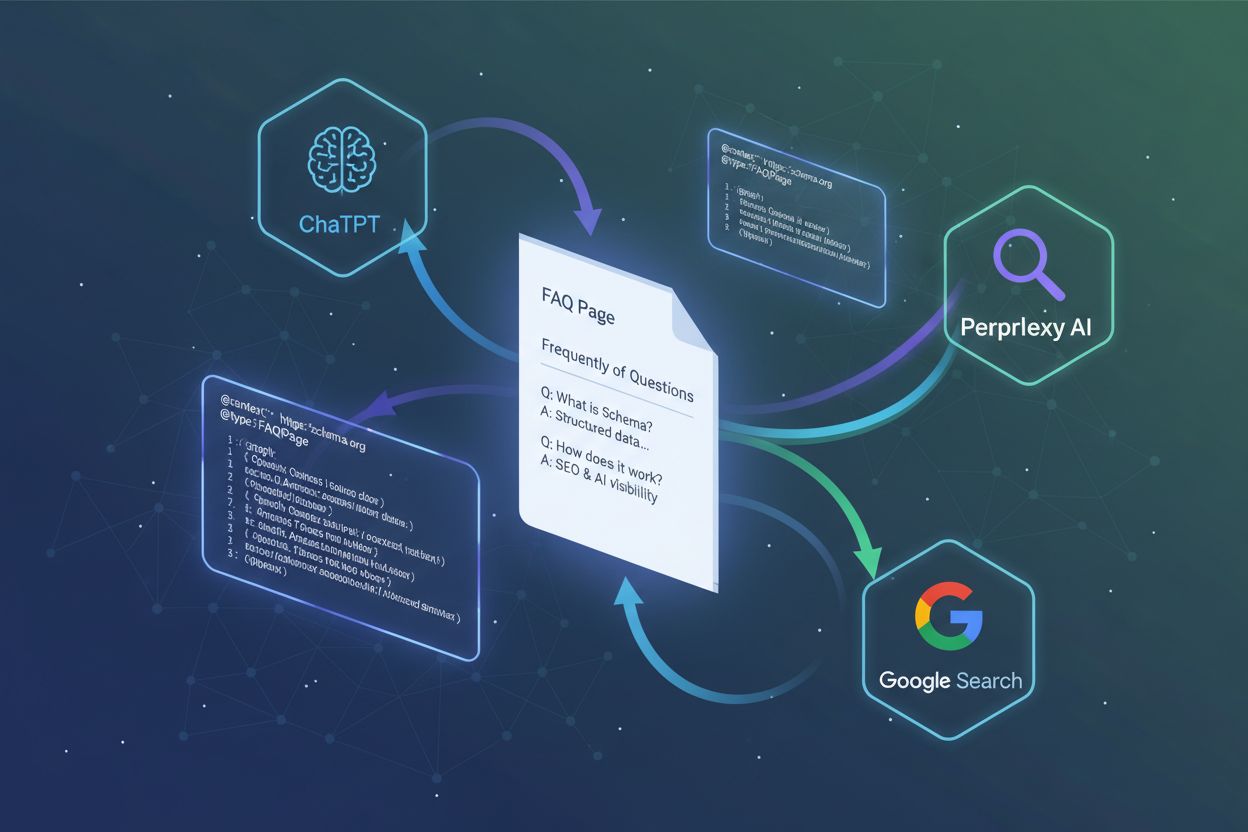
Learn why FAQ schema has the highest citation rates for AI search. Complete guide to FAQPage structured data for ChatGPT, Perplexity, and Google AI Overviews.
Cookie Consent
We use cookies to enhance your browsing experience and analyze our traffic. See our privacy policy.