


Landed Cost
Landed cost is the total cost of getting a product from a supplier into a merchant's warehouse and ready to sell, including the purchase price, freight, insurance, customs duties, and handling fees. It gives a more accurate picture of true per-unit profitability than the supplier invoice price alone. For brands importing internationally, landed cost can differ substantially from the quoted product price.
Definition of Landed Cost
Landed cost is the fully loaded cost of getting a product from a supplier into a merchant’s own warehouse, ready to be sold, rather than just the price quoted on a supplier invoice. It includes the base product price plus every cost incurred along the way: international and domestic freight, insurance, customs duties and tariffs, currency conversion costs, and handling or brokerage fees charged by freight forwarders or customs agents. For a brand sourcing domestically from a nearby supplier, landed cost might closely match the invoice price. For a brand importing containers of product from overseas manufacturers, landed cost can differ from the invoice price by a meaningful margin, and ignoring that gap is one of the most common ways e-commerce brands miscalculate true profitability.
How Landed Cost Is Calculated
The general formula is:
Landed Cost = Product Price + Freight + Duties & Taxes + Insurance + Handling Fees
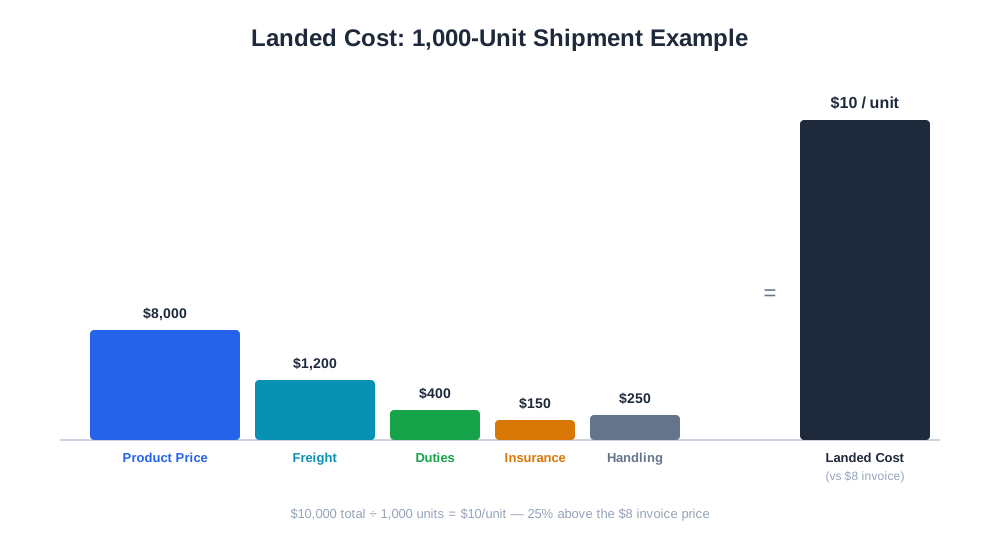
To get a usable per-unit figure, each of these components needs to be allocated across the units in a shipment. As a worked example: a brand imports 1,000 units of a product at $8 per unit ($8,000 total), pays $1,200 for international freight, $400 in customs duties, $150 for insurance, and $250 in handling and brokerage fees. Total landed cost for the shipment is $8,000 + $1,200 + $400 + $150 + $250 = $10,000. Dividing by 1,000 units gives a landed cost of $10 per unit — 25% higher than the $8 invoice price alone.
This gap matters directly for pricing. If the brand had priced the product assuming an $8 cost, its actual margin on every unit sold would be lower than planned by exactly that 25% gap, potentially turning what looked like a healthy margin into a much thinner one.

Ready to Monitor Your AI Visibility?
Track how AI chatbots mention your brand across ChatGPT, Perplexity, and other platforms.
Why Landed Cost Matters for E-commerce Brands
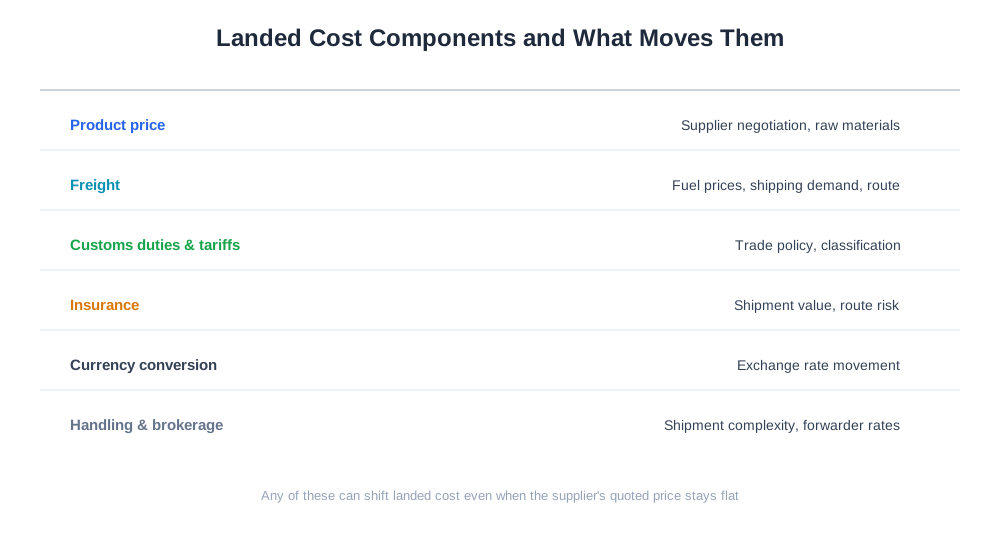
Pricing decisions, discount strategy, and even which products to keep in the catalog all depend on knowing true per-unit cost. A brand that prices off the supplier invoice alone is effectively pricing with a blind spot — freight rates fluctuate with fuel prices and shipping demand, tariffs change with trade policy, and currency movements affect the cost of anything priced in a foreign currency. Any of these can shift landed cost meaningfully between one purchase order and the next, even when the supplier’s quoted price stays flat.
Landed cost is also essential for accurate margin reporting across a catalog with mixed sourcing — some products made domestically, others imported. Comparing gross margin across these products using invoice price alone can make imported products look artificially more profitable than they really are, skewing decisions about where to invest marketing spend or expand the catalog.
Landed Cost Components
| Component | What It Covers | Typically Fluctuates With |
|---|---|---|
| Product price | Base cost paid to the supplier | Supplier negotiation, raw material cost |
| Freight | Shipping the product to the warehouse | Fuel prices, shipping demand, route |
| Customs duties & tariffs | Government import charges | Trade policy, product classification |
| Insurance | Coverage for goods in transit | Shipment value, route risk |
| Currency conversion | Cost of paying in a foreign currency | Exchange rate movement |
| Handling & brokerage | Fees for customs clearance and handling | Complexity of shipment, forwarder rates |
Stay Updated on AI Visibility Trends
Get the latest insights on AI mentions, brand monitoring, and optimization strategies.
Landed Cost and AI-Driven Commerce
As AI shopping assistants increasingly compare prices across merchants in real time, brands need pricing that’s grounded in accurate cost data rather than a stale invoice price, since an AI-surfaced price comparison doesn’t care whether a brand’s margin assumptions are outdated. A brand that unknowingly prices below true landed cost to stay competitive in an AI comparison is selling at a loss without realizing it until the numbers are reconciled much later.
Getting landed cost right at the per-product level, and keeping it current as freight and duty rates shift, is exactly the kind of ongoing calculation that’s easy to let go stale in a spreadsheet. AmICited’s eshop_list_product_costs and eshop_get_cost_mix tools track these per-product cost components from a connected store, giving merchants a current view of true landed cost rather than relying on a periodic manual recalculation.
Best Practices for Landed Cost
- Recalculate landed cost whenever a major input changes — a new freight contract, a currency shift, or a tariff update — rather than on a fixed annual schedule
- Allocate shared shipment costs (freight, insurance) proportionally by weight, volume, or value across all products in a shipment, not evenly per unit
- Track landed cost separately for each supplier and shipping lane if a product is sourced from more than one location
- Compare landed cost trends over time by product line to catch a slow cost creep before it erodes margin unnoticed
- Build a buffer into pricing for known landed cost volatility, especially for products sourced from regions with unpredictable freight or tariff conditions
Common Landed Cost Mistakes
A common mistake is pricing products using only the supplier’s quoted invoice price, ignoring freight, duties, and handling entirely. This consistently overstates margin, sometimes by a significant percentage on imported goods, and the gap only becomes visible when someone reconciles actual bank costs against the assumed product cost much later.
Another frequent issue is allocating shared shipment costs evenly per unit regardless of product size or value, which distorts landed cost for a mixed shipment. A small, light accessory shipped alongside a large, heavy item will absorb an unfairly large share of the freight cost under an even split, when a weight- or value-based allocation would represent true cost far more accurately.
Some brands also fail to update landed cost after a known input change, such as a new tariff on an import category, continuing to price against the old cost basis for months. The fix is treating landed cost as a living calculation tied to known trigger events, not a number set once and left alone.