


New Customer Rate
New customer rate is the percentage of a store's orders (or revenue) that come from first-time buyers rather than returning customers, over a given period. It's tracked alongside repeat purchase rate to understand whether growth is driven by acquisition, retention, or both.
Definition of New Customer Rate
New customer rate measures the share of a store’s orders, or revenue, that come from customers making their first-ever purchase, as opposed to customers who have bought before. It’s calculated by dividing first-time-buyer orders (or revenue) by total orders (or revenue) over a given period. On its own, new customer rate is a neutral number — neither inherently good nor bad — but read alongside repeat purchase rate, it becomes one of the clearer indicators of whether a store’s growth is driven primarily by continuous new customer acquisition, by a healthy base of returning buyers, or some balance of both.
How New Customer Rate Is Calculated
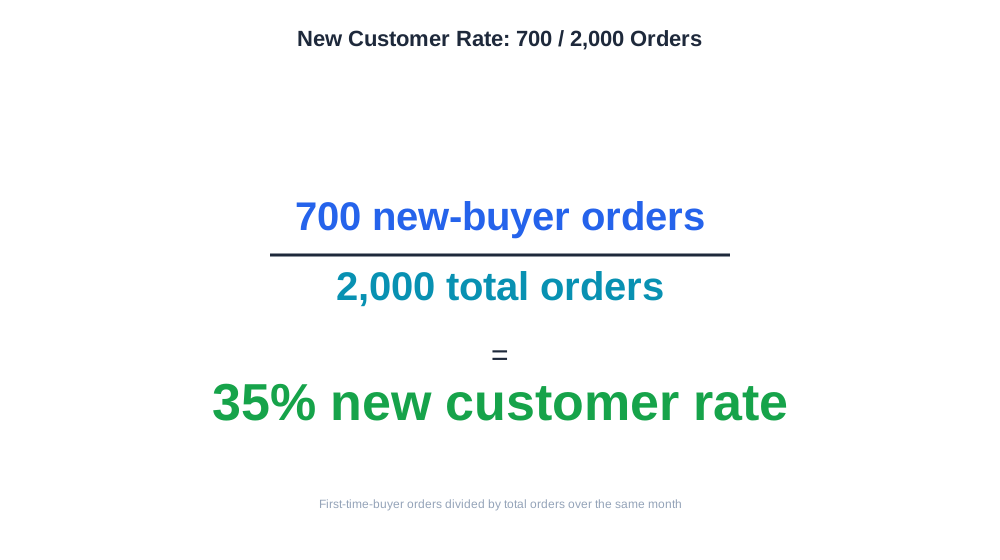
The formula is straightforward: new customer orders divided by total orders over the same period, expressed as a percentage. A worked example: a store processes 2,000 orders in a month, and its order data shows 700 of those orders came from customers whose order history shows no prior purchase. That’s 700 divided by 2,000, a 35% new customer rate — meaning 65% of the month’s order volume came from returning customers.
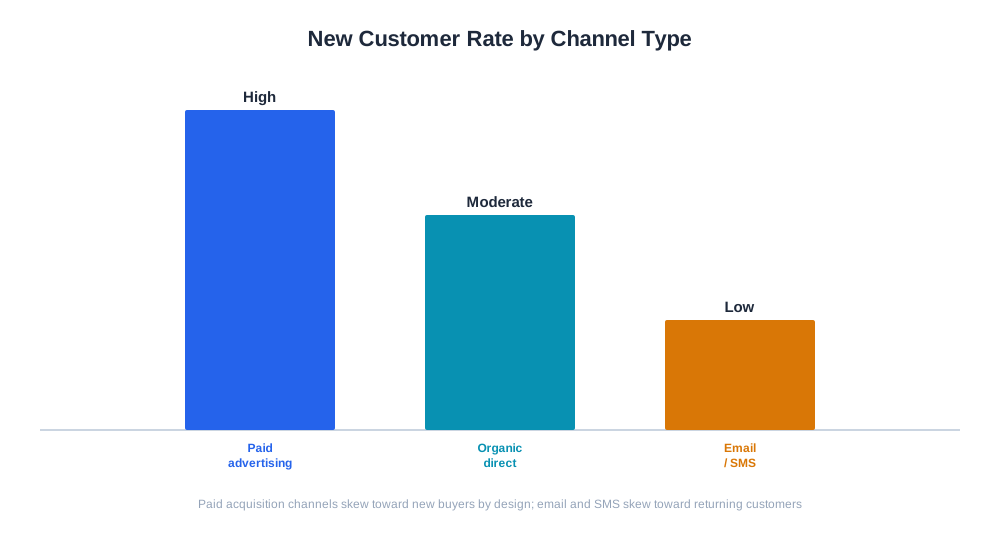
This figure is most useful segmented by channel. Paid advertising campaigns typically drive a higher new customer rate by design, since they’re often targeting audiences who haven’t previously purchased, while email and SMS campaigns sent to an existing customer list typically skew heavily toward returning buyers. Blending all channels into one store-wide new customer rate can hide the fact that a particular channel is underperforming at either acquisition or retention specifically.

Ready to Monitor Your AI Visibility?
Track how AI chatbots mention your brand across ChatGPT, Perplexity, and other platforms.
Why New Customer Rate Matters for E-commerce Brands
New customer rate matters because it frames how a store should interpret its own acquisition spending and retention efforts. A store with a persistently high new customer rate and low repeat rate is effectively running on a treadmill — continuously spending to acquire customers who churn quickly, rather than building compounding value from a growing base of repeat buyers. That pattern makes the store far more sensitive to rising customer acquisition cost, since a larger share of revenue depends on constantly winning new buyers rather than retaining existing ones.
Conversely, a store with a very low new customer rate may be healthy in terms of retention but stagnant in terms of growth, relying almost entirely on its existing customer base without meaningfully expanding it. Neither extreme is automatically a problem, but both call for different strategic responses — one needs stronger retention programs, the other needs renewed acquisition investment.
New Customer Rate and AI-Driven Commerce
As AI shopping assistants like ChatGPT Shopping and Perplexity Shopping increasingly influence where new customers first discover a brand, new customer rate becomes a useful signal for evaluating whether AI-driven discovery channels are actually converting new visitors into first-time buyers, separate from their effect on existing customers who already know the brand. A store seeing new customer rate rise specifically among traffic referred from AI shopping surfaces has some evidence that those channels are functioning as genuine top-of-funnel discovery, rather than simply reaching an audience that would have found the store anyway.
Seeing this split clearly requires order-level data that distinguishes new from returning buyers reliably. AmICited’s eshop_get_order_mix report splits orders by buyer type alongside payment method and order status, giving a consistent view of new-versus-returning composition that a merchant can track over time or by channel without manually cross-referencing customer history for every order.
Stay Updated on AI Visibility Trends
Get the latest insights on AI mentions, brand monitoring, and optimization strategies.
Best Practices for Tracking New Customer Rate
- Track new customer rate by channel, not just store-wide, since acquisition and retention channels behave very differently by design.
- Pair new customer rate with repeat purchase rate to judge whether growth is balanced or overly dependent on constant acquisition.
- Watch new customer rate trends over time rather than a single-period snapshot, since seasonal promotions can temporarily skew the mix in either direction.
- Use new customer rate alongside CAC when evaluating whether acquisition spend is sustainable relative to the retention behavior of those newly acquired customers.