


Private Label
Private label refers to products manufactured by a third-party contractor but sold under a retailer's own brand name. Unlike white label goods, private label products are typically custom-formulated or specified by the retailer, giving the brand exclusive control over the recipe, design, or packaging while outsourcing manufacturing.
Definition of Private Label
Private label describes products manufactured by a third-party contractor but sold exclusively under a retailer’s own brand name, packaging, and specifications. The retailer that sells the product typically does not own or operate the factory; instead, it works with a contract manufacturer to produce goods to a custom formula, design, or set of specifications that only that retailer controls. This distinguishes private label from generic manufacturing arrangements: the retailer isn’t just slapping a logo on an off-the-shelf item, it is directing some meaningful part of what the product actually is. Private label is extremely common in grocery retail — think of a supermarket’s own-brand pasta or cleaning supplies — but it is equally widespread in direct-to-consumer e-commerce, where founders build entire brands around a private-label supplement, skincare line, or apparel collection manufactured by a factory they never publicly name.
How Private Label Differs from White Label and Dropshipping
The three models sit on a spectrum of control versus effort. White label is the least differentiated: a factory makes one generic product and sells the identical formula or design to any brand willing to slap a label on it, with no customization beyond branding. Private label sits in the middle: the retailer specifies some unique element — a proprietary scent, a modified ingredient ratio, custom tooling for a product shape, or exclusive packaging — that competitors sourcing from the same factory can’t replicate exactly. Dropshipping is a separate axis entirely, describing who holds inventory and fulfills orders rather than who owns the product specification; a private label brand can dropship its own branded goods, though most hold inventory to protect quality and margin. A useful way to think about it: white label answers “who put the label on it,” private label answers “who specified what’s inside the label,” and dropshipping answers “who’s holding the box when the order ships.”

Ready to Monitor Your AI Visibility?
Track how AI chatbots mention your brand across ChatGPT, Perplexity, and other platforms.
Why Private Label Matters for E-commerce Brands
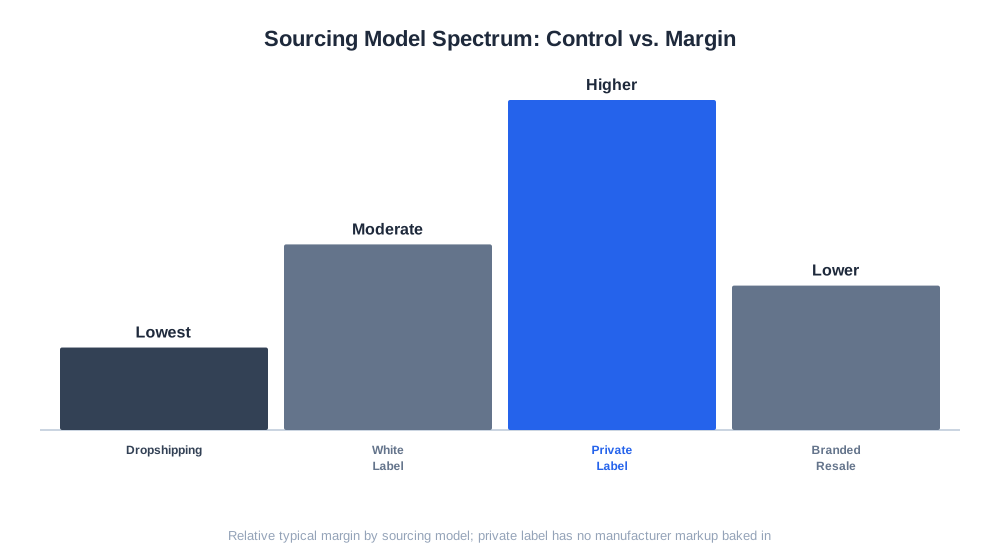
Private label businesses can achieve meaningfully better margins than resellers of established brands, because there’s no manufacturer’s brand markup baked into the wholesale cost — the retailer is effectively both the brand owner and the first link in the resale chain. That margin headroom gives private label sellers more room to invest in advertising, packaging, or promotions while still protecting profitability. Private label also gives a brand full control over positioning: pricing isn’t constrained by a manufacturer’s suggested retail price or by direct product-page comparison against the same item sold by ten other resellers, which is a persistent problem for brands reselling recognizable third-party products. The tradeoff is that private label brands start with zero built-in trust — customers have never heard of the brand name — so building credibility through reviews, content, and consistent quality becomes the brand’s job rather than something inherited from a recognized manufacturer.
Private Label vs. Other Sourcing Models
| Model | Who Controls Formulation/Design | Who Holds Inventory | Typical Margin | Brand Recognition Needed |
|---|---|---|---|---|
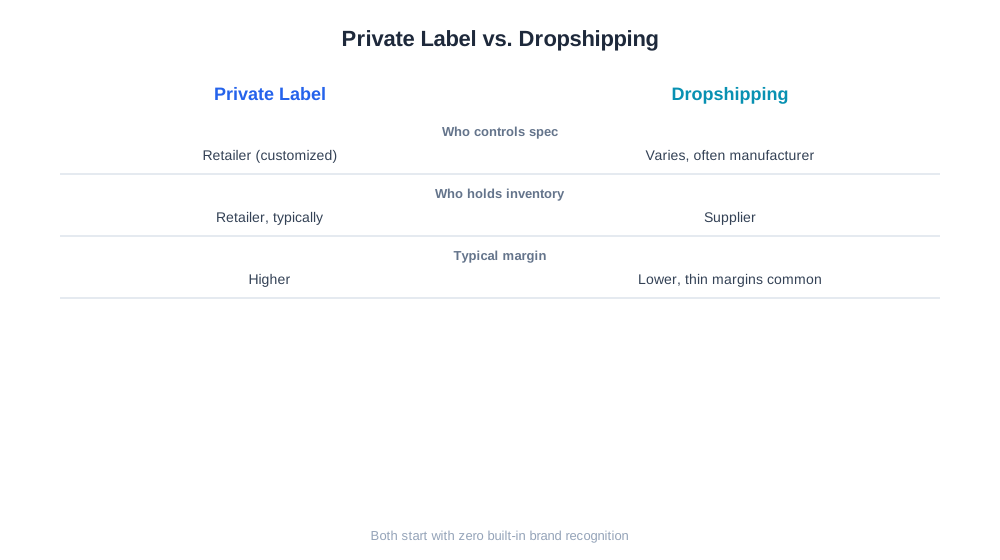
| Private Label | Retailer (customized spec) | Retailer, typically | Higher | Built from scratch |
| White Label | Manufacturer (generic) | Retailer, typically | Moderate | Built from scratch |
| Dropshipping | Varies, often manufacturer | Supplier | Lower (thin margins common) | Built from scratch |
| Branded Resale | Original brand manufacturer | Retailer | Lower (manufacturer markup embedded) | Inherited from the brand |
Stay Updated on AI Visibility Trends
Get the latest insights on AI mentions, brand monitoring, and optimization strategies.
Private Label and AI-Driven Product Discovery
Private label brands face a specific visibility challenge as AI shopping assistants like ChatGPT Shopping, Perplexity Shopping, and Amazon’s Rufus become a bigger part of how customers discover products: unlike household-name brands with years of press coverage and backlinks feeding these systems’ training and retrieval data, a new private label brand has to earn that same visibility from a much smaller footprint of reviews, articles, and structured product data. This makes tracking whether an AI assistant recognizes and recommends a private label product an especially useful signal, since it indicates the brand has built enough of a digital footprint to be treated as a legitimate, citable option rather than an unknown reseller. On the operations side, private label businesses live and die by margin discipline because manufacturing minimums tie up capital in inventory, which makes granular margin tracking essential. AmICited’s eshop reporting tools break profitability down by product and by cost line, letting a private label operator see whether a given SKU’s landed manufacturing cost, freight, and packaging still support a healthy margin after a price increase from the factory — a scenario private label brands hit more often than resellers, since they typically negotiate manufacturing contracts directly rather than buying at a fixed wholesale price.
Best Practices for Building a Private Label Business
- Negotiate manufacturing minimum order quantities carefully; overcommitting to inventory before demand is proven is one of the most common cash-flow killers in private label businesses.
- Invest in quality control processes, since the brand’s name — not the factory’s — is what customers associate with any defect or inconsistency.
- Build a distinctive formulation, design, or packaging element early rather than launching a near-identical copy of an existing product, since differentiation is the main defense against being undercut by competitors using the same factory.
- Track landed cost per unit closely, including freight and duties, since private label margins can erode quickly if manufacturing or shipping costs rise without a corresponding price adjustment.
- Build organic and AI-visible content around the brand from day one — reviews, comparison content, and structured product data — since a private label brand has no inherited recognition to fall back on.
Common Private Label Mistakes
A frequent early mistake is ordering the manufacturer’s minimum quantity without validating demand first, which leaves a founder holding thousands of units of unsold inventory and tying up capital that could have funded marketing instead. Another common problem is treating private label as identical to white label — launching a product that is functionally indistinguishable from what five other sellers offer from the same factory, then being surprised when price becomes the only competitive lever and margins get squeezed. Quality control gaps are also common: because the retailer, not the factory, absorbs reputational damage from a defective batch, skipping inspection steps to save time or money can produce a wave of returns and negative reviews that are far more expensive than the inspection would have cost. Some private label brands also underestimate how long it takes to build organic trust and search visibility from a zero-recognition starting point, launching aggressive paid acquisition before the brand has enough reviews or content to convert that traffic efficiently — a mismatch that shows up as a high customer acquisition cost relative to a resold, already-trusted brand. Finally, private label sellers sometimes fail to renegotiate pricing when manufacturing costs rise, quietly eroding margin for months before anyone notices the gross margin percentage has drifted downward.