


Same-Day Delivery
Same-day delivery is a fulfillment option where a customer's order is delivered on the same calendar day it was placed, typically within a few hours of checkout. It requires tightly coordinated warehousing, local courier networks, and order cutoff times to be operationally viable. Same-day delivery is most common in dense urban markets and for categories like groceries, pharmacy, and urgent household goods.
Definition of Same-Day Delivery
Same-day delivery is a fulfillment service in which an order is delivered to the customer on the same calendar day it was placed, typically within a window of a few hours rather than the one-to-several-day window of standard shipping. It represents the fastest tier of delivery speed a retailer can realistically offer, sitting above next-day and standard shipping options. Same-day delivery is operationally demanding: it requires inventory to be physically close to the customer, an order-processing system fast enough to release the item for picking almost immediately, and a courier network capable of last-mile delivery within hours rather than days. As a result, it tends to be concentrated in dense urban and suburban markets where the logistics distance is short enough to make the economics work, and in categories like groceries, pharmacy, and urgent household items where customers place a genuine premium on speed.
How Same-Day Delivery Works
Same-day delivery generally depends on four operational pieces working together. First, inventory needs to be stored close to the customer — either in a local fulfillment center, a micro-warehouse, or even a retail store location — since long-distance shipping cannot be compressed into hours no matter how efficient the courier. Second, retailers set a strict order cutoff time, commonly somewhere around midday, after which orders roll over to next-day delivery instead, since there isn’t enough time left in the day to pick, pack, and deliver. Third, the picking and packing process has to be prioritized and expedited compared to standard orders, often routed to a dedicated same-day queue. Fourth, delivery itself is usually handled by a local courier service or gig-economy delivery platform rather than a national parcel carrier, since those networks are built for exactly this kind of short-distance, time-sensitive delivery.
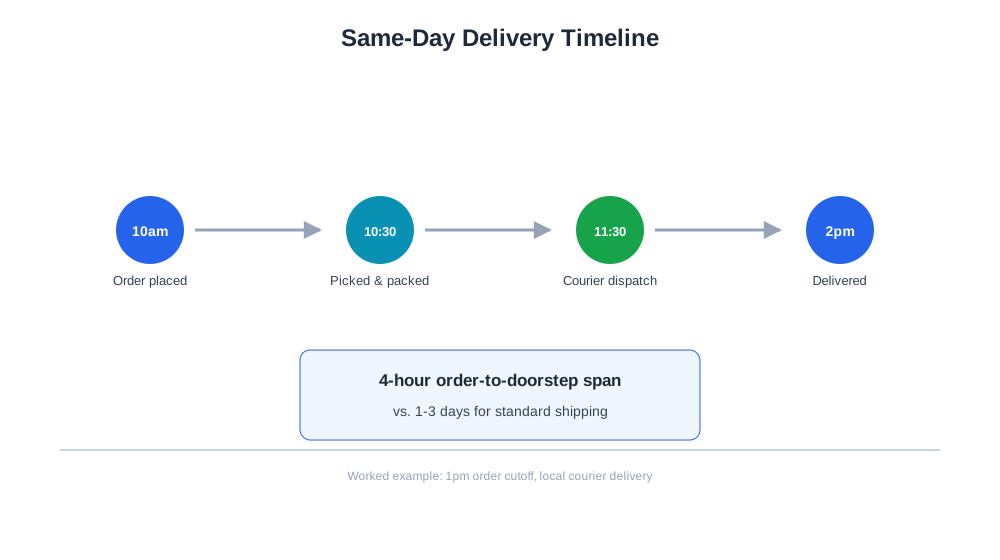
Worked example: a customer orders a phone charger and a few grocery items at 10 a.m. from a retailer offering same-day delivery with a 1 p.m. cutoff. The order is released to a local fulfillment center immediately, picked and packed within 30 minutes, and handed to a local courier by 11:30 a.m. The courier delivers the package by 2 p.m. — a four-hour span from order to doorstep, compared to one to three days for standard shipping on the same order.

Ready to Monitor Your AI Visibility?
Track how AI chatbots mention your brand across ChatGPT, Perplexity, and other platforms.
Why Same-Day Delivery Matters for E-commerce Brands
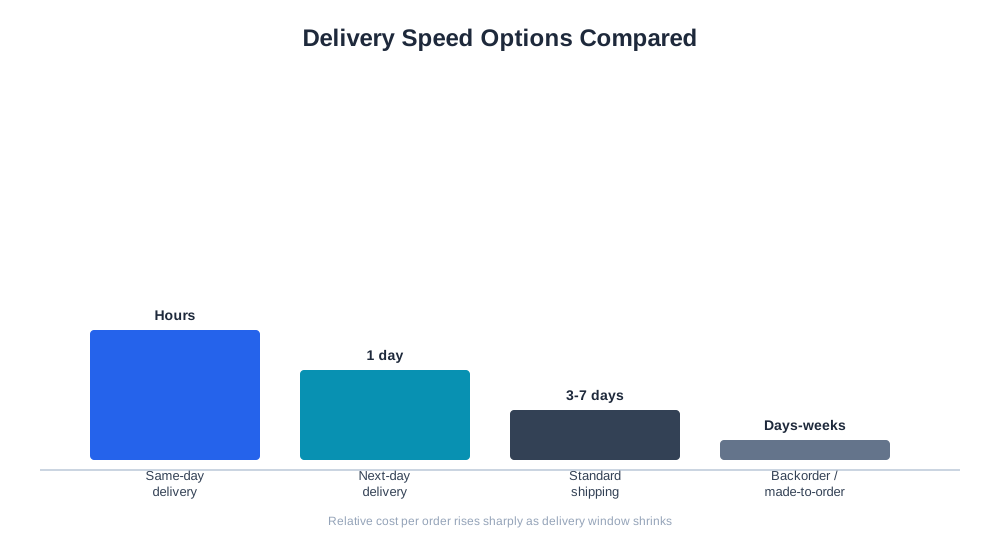
Same-day delivery can be a meaningful competitive differentiator in categories where speed is a genuine purchase driver, particularly groceries, convenience items, and last-minute needs where a customer’s alternative is simply going to a physical store instead. Offering it can reduce cart abandonment for time-sensitive purchases and support higher order frequency in categories like groceries where same-day availability effectively replaces a trip to a local store. However, it comes at a real cost: last-mile courier delivery is considerably more expensive per order than consolidated standard shipping, and the infrastructure required — local warehousing, a courier network, expedited picking — represents a significant investment that only pays off if there’s enough order density in a given delivery area to make routes efficient.
| Delivery Option | Typical Timeline | Relative Cost | Best Suited For |
|---|---|---|---|
| Same-day delivery | Within hours of order | Highest per-order cost | Groceries, pharmacy, urgent needs |
| Next-day delivery | 1 business day | High | Time-sensitive but not urgent purchases |
| Standard shipping | 3-7 business days | Lowest | Most general merchandise |
| Backorder / made-to-order | Days to weeks | Varies | Custom, seasonal, or supply-constrained products |
Same-Day Delivery and AI-Driven Commerce
AI shopping assistants such as ChatGPT Shopping, Perplexity Shopping, and Amazon Rufus increasingly factor delivery speed into product comparisons, which means same-day delivery availability can influence which retailer an AI assistant surfaces first for an urgent or time-sensitive need. A retailer’s ability to accurately communicate real-time delivery windows, rather than a generic shipping estimate, becomes more valuable as more purchase decisions get filtered through these comparison layers. AmICited’s eshop analytics connect fulfillment and shipping-option performance to downstream metrics like conversion rate and repeat purchase behavior, helping merchants see concretely whether an investment in same-day delivery infrastructure is actually improving the numbers that matter for a given category and market, rather than adding cost without a measurable return.
Stay Updated on AI Visibility Trends
Get the latest insights on AI mentions, brand monitoring, and optimization strategies.
Best Practices for Offering Same-Day Delivery
- Limit same-day delivery to markets and product categories where local logistics genuinely support it, rather than offering it store-wide
- Set a clear, conservative order cutoff time and honor it consistently, since a missed same-day promise is often worse than not offering the option at all
- Use local fulfillment centers or store-based inventory rather than trying to run same-day delivery from a distant centralized warehouse
- Charge a delivery fee or set a minimum order value that reflects the real cost of last-mile courier delivery
- Monitor delivery success rate and courier reliability closely, since same-day has far less buffer to recover from a delay than standard shipping
- Test demand in a limited market or category before scaling same-day delivery infrastructure broadly
Common Same-Day Delivery Mistakes
Offering same-day delivery in markets without the local courier density to support it. Promising a delivery window that the local logistics network can’t reliably meet produces missed promises more often than successful ones, which damages trust more than simply not offering the service. Underpricing same-day delivery relative to its true cost. Last-mile courier delivery is expensive, and absorbing that cost without a delivery fee or minimum order value can quietly erode margin on every same-day order, especially in low-margin categories. Setting an order cutoff time too close to the actual delivery deadline. A cutoff that doesn’t leave enough buffer for picking, packing, and courier dispatch creates a fragile promise that breaks under any minor delay, such as a busy warehouse day or courier shortage. Rolling out same-day delivery storewide instead of piloting it in a focused category or market first. Same-day economics vary enormously by product type and geography, and a broad rollout without piloting can expose a retailer to unprofitable delivery costs in categories where customers never valued the speed in the first place. Not tracking whether same-day delivery is actually converting or retaining customers. Without measuring conversion rate and repeat purchase impact specifically for same-day orders, it’s easy to keep funding an expensive service based on assumption rather than evidence that customers are responding to it.