


Wholesale Ecommerce
Wholesale ecommerce is the online sale of products in bulk quantities, typically at discounted per-unit pricing, from a manufacturer or distributor to other businesses such as retailers. It differs from standard consumer ecommerce in order size, pricing structure, and the buyer relationship, which is often ongoing rather than a one-off transaction. Many brands run wholesale ecommerce alongside a direct-to-consumer storefront rather than as a replacement for it.
Definition of Wholesale Ecommerce
Wholesale ecommerce is the online sale of products in bulk, at discounted per-unit pricing, from a manufacturer, brand, or distributor to other businesses — typically retailers or resellers buying inventory to sell onward, rather than individual consumers buying for personal use. It’s a subset of B2B ecommerce specifically focused on bulk product transactions. Wholesale ecommerce shares underlying infrastructure with consumer ecommerce — product catalogs, checkout, payment processing — but differs meaningfully in order size, pricing structure, buyer relationship, and often payment terms. A brand’s wholesale channel and its consumer-facing storefront frequently coexist, serving different buyer types with different pricing and account requirements.
How Wholesale Ecommerce Works
A wholesale ecommerce setup typically starts with a separate storefront or portal, sometimes password-protected or requiring account approval, distinct from a brand’s public retail site. Buyers apply for or are granted wholesale access, at which point they see wholesale pricing — usually structured in tiers based on order volume — rather than standard retail prices.
Orders in wholesale ecommerce are usually placed in bulk, often subject to a minimum order quantity (MOQ) the seller sets to make the lower per-unit margin worthwhile. Payment terms also commonly differ: rather than paying by card at checkout as a retail customer would, wholesale buyers are often extended net payment terms, such as net-30, where payment is due a set number of days after delivery rather than at time of order.
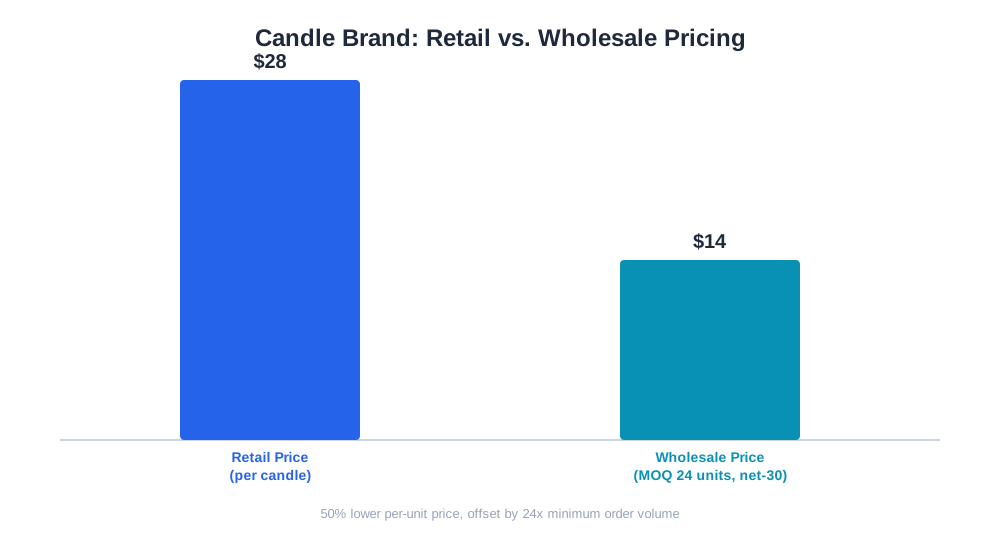
As an example: a candle brand sells individual candles to consumers at $28 each through its retail site. Through its wholesale portal, the same candle is available to approved retail buyers at $14 per unit, with a minimum order of 24 units per style and payment due within 30 days of shipment. The lower unit price reflects both the volume discount and the reduced marketing and customer service cost of serving a business buyer instead of an individual consumer.

Ready to Monitor Your AI Visibility?
Track how AI chatbots mention your brand across ChatGPT, Perplexity, and other platforms.
Why Wholesale Ecommerce Matters for Brands
Wholesale ecommerce gives a brand a second growth channel that doesn’t compete directly for the same marketing dollars as direct-to-consumer acquisition. Instead of spending on ads to reach individual consumers one at a time, a brand can reach an entire retail location’s customer base through a single wholesale account — trading a lower per-unit margin for significantly larger order volume and reduced acquisition cost per unit sold.
It also diversifies revenue risk. A brand overly dependent on its own direct-to-consumer traffic is exposed to changes in ad costs or platform algorithms; a wholesale channel that places product in other retailers’ stores provides a source of revenue less tied to that single funnel.
Wholesale vs. Retail Ecommerce
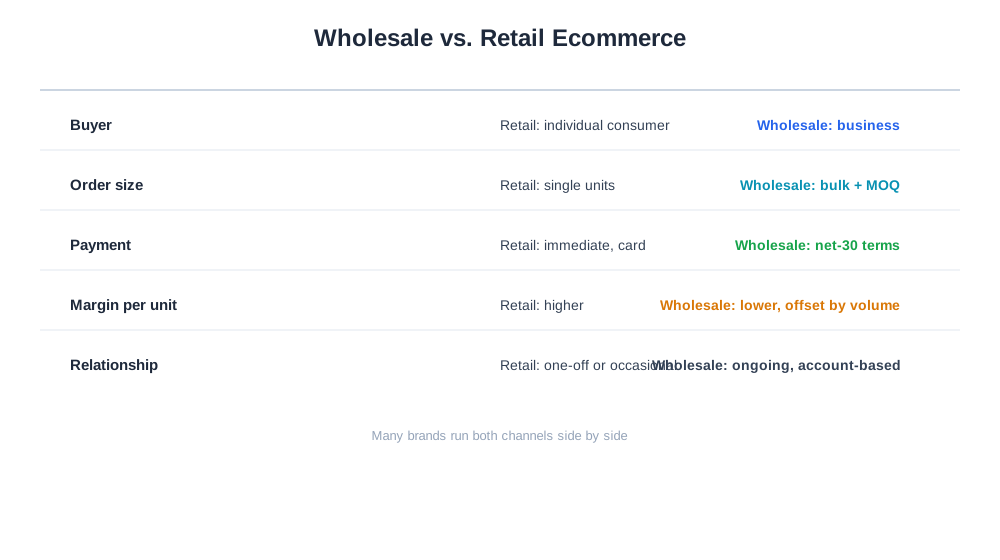
| Aspect | Retail Ecommerce | Wholesale Ecommerce |
|---|---|---|
| Buyer | Individual consumer | Business (retailer, reseller) |
| Order size | Single units or small quantities | Bulk, often with a minimum order quantity |
| Pricing | Full list price | Discounted, often tiered by volume |
| Payment | Immediate, card-based | Often net terms (e.g., net-30) |
| Margin per unit | Higher | Lower, offset by volume |
| Relationship | Often one-off or occasional | Often ongoing, account-based |
Stay Updated on AI Visibility Trends
Get the latest insights on AI mentions, brand monitoring, and optimization strategies.
Wholesale Ecommerce and AI-Driven Commerce
AI shopping assistants like ChatGPT Shopping and Perplexity Shopping are built primarily around individual consumer purchase decisions, so wholesale ecommerce sits somewhat outside their direct scope today. That said, the same underlying brand visibility that helps a product get surfaced to consumers — clear product data, consistent pricing signals, strong online presence — also supports a brand’s credibility with prospective wholesale buyers doing their own research before requesting an account, since a retailer evaluating a new brand to carry will often check its consumer-facing presence and reputation first.
Where AmICited’s eshop tools become directly useful for a brand running both channels is in separating and comparing performance: understanding true margin and cost mix on wholesale orders against retail orders side by side, so a brand can see which channel is actually contributing profit rather than just topline volume.
Best Practices for Wholesale Ecommerce
- Set minimum order quantities based on true per-unit margin at wholesale pricing, not an arbitrary round number
- Keep wholesale and retail pricing structurally separate to avoid channel conflict, such as a wholesale buyer’s retail customers seeing a lower price directly from the brand
- Vet and approve wholesale accounts deliberately rather than opening bulk pricing to any buyer, to protect brand positioning and avoid unauthorized resale channels
- Track wholesale order economics (true margin after volume discount) separately from retail, since blended reporting can hide a wholesale channel that’s underpriced relative to its true cost
- Offer net payment terms cautiously and factor payment risk into wholesale account approval, since delayed payment affects cash flow differently than immediate retail transactions
Common Wholesale Ecommerce Mistakes
A frequent mistake is setting wholesale pricing without fully accounting for landed cost and fulfillment overhead, resulting in wholesale orders that look like healthy revenue but carry a much thinner margin than retail once true costs are applied. The fix is calculating wholesale price floors from actual per-unit cost, not simply discounting the retail price by a flat percentage.
Another common issue is allowing channel conflict to go unmanaged — a wholesale buyer undercutting the brand’s own retail pricing in the same market, which erodes both the brand’s direct-to-consumer margin and its relationship with other wholesale accounts. Clear minimum advertised pricing policies communicated to wholesale buyers upfront help prevent this before it becomes a dispute.
Some brands also extend net payment terms to new wholesale accounts without any credit vetting, exposing the business to payment risk that a simple upfront deposit or shorter initial payment term for new accounts would have mitigated.