


25 Best AI Visibility Tools for 2026
Comprehensive guide to the 25 best AI visibility tools in 2026. Compare features, pricing, and capabilities of Profound, Am I Cited, Peec AI, Otterly, Semrush A...
22 min read
Compare 15 AI search visibility platforms by pricing, engine coverage, free plans, and ideal use case. See verified 2026 figures in this buyer’s matrix.
When a prospect asks ChatGPT “what’s the best project management tool for a remote team” or queries Perplexity for “top CRM software for startups,” the AI doesn’t return ten blue links. It returns one answer. Sometimes with citations. Sometimes without. And if your brand isn’t in that answer, you don’t exist for that user.
AI search visibility is the practice of monitoring, measuring, and improving how often, and how favorably, your brand appears in responses generated by large language models (LLMs) like ChatGPT, Perplexity, Gemini, Claude, and Google AI Overviews. It is a fundamentally different discipline from traditional SEO (a separate category of its own), and it demands a different set of tools.
The numbers are impossible to ignore. ChatGPT now processes over 2 billion queries daily. Google AI Overviews reaches 2 billion monthly users. Gartner predicts traditional search engine volume will decline by 25% by 2026, with brands losing 50% or more of organic search traffic by 2028. AI referral traffic grew 527% year-over-year in 2025 alone.
Yet only 22% of marketers actively track their AI visibility. The gap between where users are searching and where brands are monitoring represents one of the largest blind spots in modern marketing.
Key Insight: AI search traffic converts at 4.4x the rate of traditional organic search. Visibility in AI-generated answers isn’t just a brand metric: it’s a revenue channel.
These terms are often used interchangeably, but they describe different things. Understanding the distinctions matters because it determines which platform you need.
| Discipline | Focus | What It Optimizes For | Primary Tools |
|---|---|---|---|
| SEO (Search Engine Optimization) | Ranking in traditional search results (Google, Bing) | Keywords, backlinks, technical structure | Ahrefs, Semrush, Moz |
| AEO (Answer Engine Optimization) | Appearing in AI-generated answers to direct questions | Structured content, authority signals, entity recognition | Profound, Otterly, HubSpot AEO |
| GEO (Generative Engine Optimization) | Being cited as a source in generative AI outputs | Citations, source attribution, content that LLMs trust | Promptwatch, UltraScout, Scrunch |
In practice, the terms overlap. AEO focuses on being the answer. GEO focuses on being the source. Both track brand mentions in AI outputs, but GEO platforms tend to emphasize citation analytics, crawler logs, and the full pipeline from monitoring to content generation. SEO tools, by contrast, were built for a world of ranked links, not synthesized answers.
An AI visibility platform answers five core questions:
Traditional analytics cannot answer any of these questions. Google Analytics doesn’t tell you what ChatGPT said about your brand. Semrush rank tracking doesn’t reveal whether Perplexity cited your competitor’s blog post instead of yours. AI visibility platforms fill this gap.
The AI visibility market is crowded and noisy. Nearly every SEO and content marketing tool has added some form of AI search tracking. Many platforms that primarily do traditional SEO now market themselves as “AI visibility tools” because they show a column of Google AI Overview data. This creates confusion.
To cut through it, we applied a consistent evaluation framework across all 16 platforms.
| Criterion | Weight | What We Looked For |
|---|---|---|
| AI Engine Coverage | 25% | Number of AI platforms tracked (ChatGPT, Perplexity, Gemini, Claude, Google AI Overviews, Copilot, Grok, DeepSeek, Meta AI) |
| Citation & Mention Tracking | 20% | Ability to detect brand mentions, source citations, and attribution accuracy |
| Competitive Intelligence | 15% | Share of voice, competitor benchmarking, gap analysis |
| Reporting & Integrations | 10% | White-label reports, API access, Looker Studio/GA4 integrations |
| Content Optimization | 10% | Does the platform stop at monitoring, or does it help you close the gap? |
| Pricing Transparency | 10% | Clear, public pricing vs. “contact sales” only |
| Usability & Support | 10% | Onboarding experience, documentation, customer support quality |
The 16 platforms fall into three distinct categories:
Dedicated AI Visibility Monitors: Built from the ground up for AI search tracking. They go deep on monitoring but most stop at reporting. Examples: Profound, Otterly, Peec AI, ZipTie, Visiblie.
Full-Stack GEO/AEO Platforms: Monitor, analyze, and generate content to close visibility gaps. These cover the full loop from discovery to execution. Examples: UltraScout AI, Promptwatch, Scrunch AI, Pixis Visibility, AthenaHQ.
SEO Suites with AI Visibility Add-Ons: Traditional SEO platforms that added AI tracking as a feature. Convenient if you already use the suite, but the AI layer is often narrower and priced as an add-on. Examples: Semrush, BrightEdge, Conductor, Ahrefs, HubSpot AEO.
Understanding which category a platform belongs to prevents the most common buying mistake: purchasing a monitor when you need an execution platform, or paying enterprise prices for engine coverage you don’t need.
The table below provides a side-by-side comparison of all 16 platforms across the dimensions that matter most when making a purchasing decision.
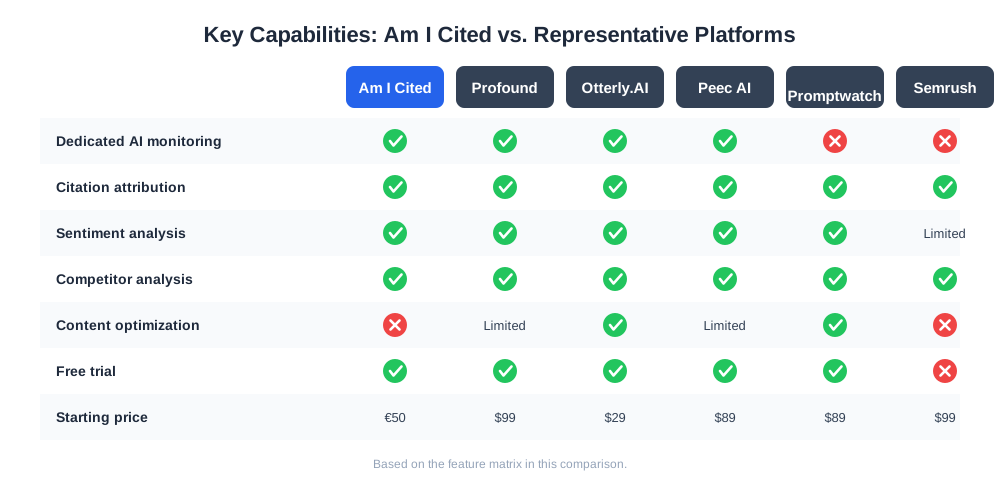
| Platform | Category | AI Engines Tracked | Starting Price | Free Trial | Citation Tracking | Sentiment Analysis | Competitor Analysis | Content Optimization | Best For |
|---|---|---|---|---|---|---|---|---|---|
| Am I Cited | Dedicated Monitor | 8 (ChatGPT, Perplexity, Gemini, Claude, Google AI Overview, Google AI Mode, Grok, DeepSeek) | €50/mo | Yes | Yes | Yes | Yes | Yes (recommendations) | Most teams wanting a focused, affordable monitor |
| Profound | Dedicated Monitor | 10+ (ChatGPT, Perplexity, Gemini, Claude, Grok, Copilot, AI Overviews, DeepSeek, Meta AI, Mistral) | $99/mo (Starter) | Yes | Yes (deep) | Yes | Yes | Limited (insights only) | Enterprise monitoring, high query volume |
| Otterly.AI | Dedicated Monitor | 4 (ChatGPT, Perplexity, Google AI Overviews, Gemini) | $29/mo (Lite) | Yes | Yes | Yes | Yes | Yes (GEO audits) | Budget-conscious teams, SMBs |
| Peec AI | Dedicated Monitor | 3–4 (ChatGPT, Perplexity, Google AI Overviews, Gemini) | $89/mo | Yes | Yes | Yes | Yes | Limited | Mid-market, multilingual tracking |
| ZipTie | Dedicated Monitor | 5+ (ChatGPT, Perplexity, Gemini, Claude, Copilot) | $79/mo | Yes | Yes (deep) | Yes | Yes | No | Deep analysis, reporting-heavy teams |
| Visiblie | Dedicated Monitor | 4 (up to 8 on Enterprise) | €79/mo (Starter) | 14 days | Yes | Yes | Yes | Yes (recommendations) | Best value for comprehensive monitoring |
| UltraScout AI | Full-Stack GEO | 6 (ChatGPT, Gemini, Claude, Perplexity, Copilot, AI Overviews) | $99/mo | Yes | Yes | Yes | Yes (Zero Coverage detection) | Yes (GEO/AEO content generation) | Full-stack AI visibility with content execution |
| Promptwatch | Full-Stack GEO | 6+ (ChatGPT, Perplexity, Gemini, Claude, Copilot, AI Overviews) | $89/mo | Yes | Yes (page-level) | Yes | Yes | Yes (AI-powered content agents) | B2B SaaS, teams needing attribution |
| Scrunch AI | Full-Stack GEO | 5+ (ChatGPT, Perplexity, Gemini, Claude, AI Overviews) | $250/mo | Yes | Yes | Yes | Yes | Yes (AXP + CDN-edge content) | Agencies, enterprise, AI shopping tracking |
| Pixis Visibility | Full-Stack GEO | 5+ (ChatGPT, Perplexity, Gemini, Claude, AI Overviews) | $99/mo per site | Yes | Yes (multi-session sampling) | Yes | Yes | Yes (gap → brief → draft → publish) | Teams wanting monitoring + execution |
| AthenaHQ | Full-Stack GEO | 5+ (ChatGPT, Perplexity, Gemini, Claude, Copilot) | $295/mo | Yes | Yes | Yes | Yes | Yes (Shopify revenue attribution) | E-commerce brands, revenue-focused teams |
| Semrush AI Toolkit | SEO Suite Add-On | 5 (Google AI Overviews, ChatGPT, Bing Copilot, Perplexity, Gemini) | $99/mo (add-on) | No | Yes | Limited | Yes | No (SEO-only optimization) | Existing Semrush users |
| BrightEdge AI Catalyst | SEO Suite Add-On | 5+ (AI Overviews, ChatGPT, Copilot, Gemini, Perplexity) | Custom (Enterprise) | Demo only | Yes | Yes | Yes | Yes (enterprise content) | Fortune 500, large enterprises |
| Conductor Intelligence | SEO Suite Add-On | 4+ (AI Overviews, ChatGPT, Perplexity, Gemini) | $25,000+/yr | Demo only | Yes | Limited | Yes | Yes (content intelligence) | Mid-market to enterprise content teams |
| Ahrefs Brand Radar | SEO Suite Add-On | 3 (ChatGPT, Perplexity, Google AI Overviews) | $199/mo per index | No | Yes (brand mentions) | No | Yes | No | Existing Ahrefs users |
| HubSpot AEO | SEO Suite Add-On | 4+ (ChatGPT, Perplexity, Google AI Overviews, Gemini) | Free (basic) / Paid tiers | Yes (free tier) | Yes | Yes | Yes | Yes (AEO recommendations) | HubSpot users, inbound marketing teams |
These platforms were built from scratch for AI search tracking. They excel at monitoring and reporting but generally stop at showing you the gap rather than helping you close it.
Profound is the category leader in scale, tracking 10+ AI engines with a database of 1.5 billion+ user prompts. Its AEO scoring system provides a standardized metric for AI visibility. The platform is strongest for enterprise teams that need broad engine coverage and deep historical data. However, pricing escalates quickly beyond the $99 Starter tier, and it lacks native content generation, so you’ll need a separate content stack to act on the insights.
Otterly.AI offers the lowest entry price in the market at $29/month, making it the most accessible option for SMBs and startups. It tracks four core engines, provides GEO audits, and includes sentiment analysis. The trade-off is limited prompt volume (15 prompts on the Lite plan) and less depth in competitive intelligence compared to enterprise-tier tools.
Peec AI stands out for multilingual tracking and a clean user experience. Its mid-market positioning ($89/month) fills the gap between budget tools and enterprise platforms. It offers solid competitor benchmarking and share of voice analytics across Google AI Overviews, ChatGPT, and Gemini. The platform is lighter on content optimization features.
ZipTie prioritizes deep analysis and reporting. It tracks 5+ AI engines and provides detailed citation analytics, making it a strong choice for reporting-heavy teams and agencies. Its weakness is the absence of content optimization features: it’s purely a monitoring and analysis tool.
Visiblie offers the most comprehensive value in the monitoring category. At €79/month (Starter), it tracks 4 engines with 50 prompts per week and includes optimization recommendations, accuracy tracking, and 9 free tools. Enterprise plans expand to 8 LLMs. The platform’s transparency about its own limitations builds trust, though it may not satisfy teams needing native content generation.
These platforms cover the complete loop: monitor brand mentions, analyze competitive gaps, and generate content to close those gaps. They’re the closest thing to an all-in-one AI visibility solution.
UltraScout AI pioneered the AI Share of Voice metric and Zero Coverage gap detection. It tracks 6 AI platforms and includes native GEO/AEO content generation. At $99/month, it’s competitively priced against monitoring-only tools while offering execution capabilities. The platform is purpose-built for AI visibility from the ground up, not adapted from an SEO tool.
Promptwatch is the only platform with page-level visibility tracking, AI crawler logs, and ChatGPT Shopping data in the same dashboard. Its content agents ship pages designed to be cited by AI models. For B2B SaaS companies that need attribution and strategic intelligence, Promptwatch delivers the full AEO stack. The platform’s complexity can be overwhelming for teams new to GEO.
Scrunch AI targets agencies and enterprises with multi-engine citation monitoring, an Agent Experience Platform (AXP), and AI-optimized content served at the CDN edge. Its AI Shopping module tracks product-level visibility, making it uniquely suited for e-commerce. Pricing starts at $250/month, positioning it in the mid-to-upper tier.
Pixis Visibility distinguishes itself by pairing multi-engine, multi-session citation tracking with a content pipeline that runs from gap identification to brief to draft to published page. At $99/month per site, it’s one of the few platforms that genuinely closes the loop between monitoring and execution. Its primary limitation is that it’s part of a larger Pixis ecosystem, which may not suit teams seeking a standalone tool.
AthenaHQ is the strongest option for e-commerce brands, with Shopify revenue attribution that connects AI visibility directly to sales. At $295/month, it’s priced above most competitors but offers unique commerce-focused features. The platform covers 5+ AI engines and includes sentiment analysis, competitor tracking, and content optimization.
These platforms are traditional SEO tools that added AI visibility tracking as a feature. They’re convenient if you already live in the ecosystem, but the AI layer is typically narrower and priced separately.
Semrush AI Visibility Toolkit is a natural choice for existing Semrush users. For $99/month (on top of a Semrush subscription), you get tracking across 5 AI engines. The integration with Semrush’s keyword research, site audit, and competitor analysis tools is seamless. The limitation is that AI visibility is an add-on, not the core product: features like sentiment analysis and content optimization for AI search are less developed than in dedicated platforms.
BrightEdge AI Catalyst serves Fortune 500 enterprises with custom pricing and 4 billion data points. Its AI visibility module is part of a much larger enterprise SEO and content platform. For large organizations already invested in BrightEdge, the AI Catalyst add-on provides governance-heavy deployment. For everyone else, the cost and complexity are prohibitive.
Conductor Intelligence positions itself for mid-market content teams, with AI visibility as one module inside a content intelligence platform. Starting at $25,000+/year, it’s enterprise-grade. The platform’s strength is connecting AI visibility data to content workflows and editorial calendars. Smaller teams will find the price point and feature set misaligned with their needs.
Ahrefs Brand Radar tracks brand mentions across ChatGPT, Perplexity, and Google AI Overviews at $199/month per index. It’s a lightweight addition for teams already using Ahrefs for traditional SEO, but it lacks sentiment analysis, content optimization, and the engine coverage of dedicated platforms. Think of it as a visibility supplement, not a standalone GEO solution.
HubSpot AEO offers a free tier that provides basic AI visibility monitoring, making it the most accessible entry point for teams already using HubSpot. The paid tiers add competitive intelligence and AEO recommendations. Its integration with HubSpot’s CRM and marketing automation creates unique opportunities to connect AI visibility to leads and pipeline, though the AI-specific features are less mature than dedicated platforms.
Not all AI platforms are equally important for every business. Your engine coverage needs depend on where your audience searches. The table below shows which platforms track which AI engines.
| Platform | ChatGPT | Perplexity | Gemini | Claude | Google AI Overviews | Copilot | Grok | DeepSeek | Meta AI | Mistral |
|---|---|---|---|---|---|---|---|---|---|---|
| Am I Cited | ✅ | ✅ | ✅ | ✅ | ✅ | ❌ | ✅ | ✅ | ❌ | ❌ |
| Profound | ✅ | ✅ | ✅ | ✅ | ✅ | ✅ | ✅ | ✅ | ✅ | ✅ |
| Otterly.AI | ✅ | ✅ | ✅ | ❌ | ✅ | ❌ | ❌ | ❌ | ❌ | ❌ |
| Peec AI | ✅ | ✅ | ✅ | ❌ | ✅ | ❌ | ❌ | ❌ | ❌ | ❌ |
| ZipTie | ✅ | ✅ | ✅ | ✅ | ✅ | ✅ | ❌ | ❌ | ❌ | ❌ |
| Visiblie | ✅ | ✅ | ✅ | ✅ | ✅ | ❌ | ❌ | ❌ | ❌ | ❌ |
| UltraScout AI | ✅ | ✅ | ✅ | ✅ | ✅ | ✅ | ❌ | ❌ | ❌ | ❌ |
| Promptwatch | ✅ | ✅ | ✅ | ✅ | ✅ | ✅ | ❌ | ❌ | ❌ | ❌ |
| Scrunch AI | ✅ | ✅ | ✅ | ✅ | ✅ | ❌ | ❌ | ❌ | ❌ | ❌ |
| Pixis Visibility | ✅ | ✅ | ✅ | ✅ | ✅ | ❌ | ❌ | ❌ | ❌ | ❌ |
| AthenaHQ | ✅ | ✅ | ✅ | ✅ | ❌ | ✅ | ❌ | ❌ | ❌ | ❌ |
| Semrush AI Toolkit | ✅ | ✅ | ✅ | ❌ | ✅ | ✅ | ❌ | ❌ | ❌ | ❌ |
| BrightEdge | ✅ | ✅ | ✅ | ❌ | ✅ | ✅ | ❌ | ❌ | ❌ | ❌ |
| Conductor | ✅ | ✅ | ✅ | ❌ | ✅ | ❌ | ❌ | ❌ | ❌ | ❌ |
| Ahrefs Brand Radar | ✅ | ✅ | ❌ | ❌ | ✅ | ❌ | ❌ | ❌ | ❌ | ❌ |
| HubSpot AEO | ✅ | ✅ | ✅ | ❌ | ✅ | ❌ | ❌ | ❌ | ❌ | ❌ |
What to prioritize: ChatGPT, Perplexity, and Google AI Overviews are the essential three. Together they cover the majority of AI search traffic. Add Gemini, Claude, and Copilot as your needs grow. Grok, DeepSeek, Meta AI, and Mistral are emerging platforms that matter primarily for specific industries or global markets. (Am I Cited also tracks Google AI Mode alongside the eight engines in the table above.)
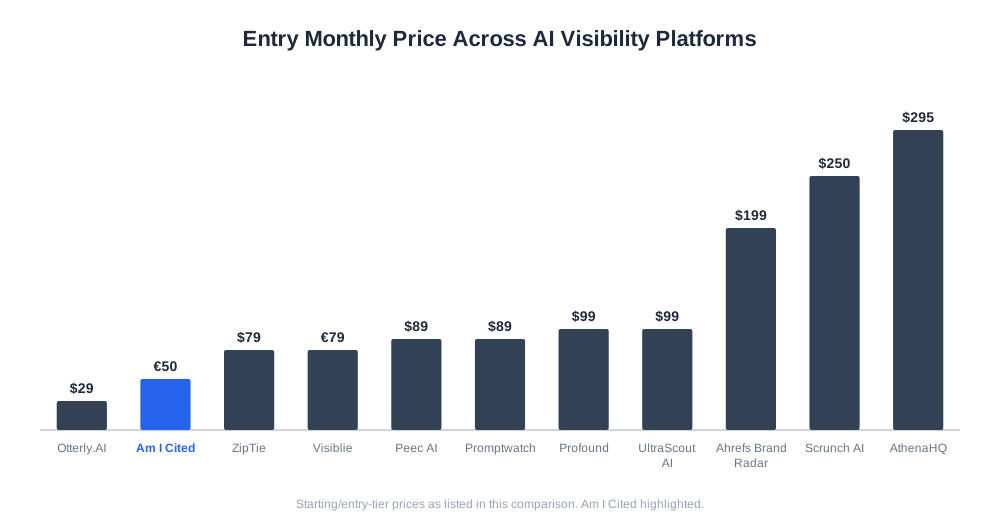
AI visibility platform pricing spans a wide range, from $29/month to $25,000+/year. The table below breaks down actual pricing tiers across all 16 platforms.
| Platform | Entry Tier | Mid Tier | Top Tier | Custom Enterprise |
|---|---|---|---|---|
| Am I Cited | €50/mo | — | — | No |
| Profound | $99/mo (Starter) | $499/mo (Pro) | Custom | Yes |
| Otterly.AI | $25–29/mo (Lite) | $79/mo (Pro) | $219/mo (Agency) | No |
| Peec AI | $89/mo | €165/mo | Custom | Yes |
| ZipTie | $79/mo | $199/mo | $399/mo | Yes |
| Visiblie | €63–79/mo (Starter) | €159/mo (Pro) | €399/mo (Agency) | Yes |
| UltraScout AI | $99/mo | $249/mo | Custom | Yes |
| Promptwatch | $89/mo | $199/mo | $399/mo | Yes |
| Scrunch AI | $250/mo | $499/mo | Custom | Yes |
| Pixis Visibility | $99/mo per site | Custom | Custom | Yes |
| AthenaHQ | $295/mo | $599/mo | Custom | Yes |
| Semrush AI Toolkit | $99/mo add-on | Included in higher plans | N/A | Yes |
| BrightEdge | N/A | N/A | N/A | Custom only |
| Conductor | N/A | N/A | N/A | $25,000+/yr |
| Ahrefs Brand Radar | $199/mo per index | N/A | N/A | No |
| HubSpot AEO | Free (basic) | Included in Marketing Hub | N/A | Yes |
Otterly.AI ($29/mo) is the most affordable dedicated AI visibility tool, suitable for startups and small businesses that need basic monitoring. HubSpot AEO’s free tier provides a no-cost entry point for HubSpot users. Visiblie (€79/mo) and ZipTie ($79/mo) offer the best feature-to-price ratio for comprehensive monitoring. Profound ($99/mo) and UltraScout AI ($99/mo) provide the most functionality at the entry level, with UltraScout adding content generation at the same price point.
This tier is where most teams will land. Promptwatch ($199/mo) and Scrunch AI ($250/mo) offer full-stack GEO capabilities. Pixis Visibility ($99/mo per site) and ZipTie ($199/mo) provide strong monitoring depth. Semrush AI Toolkit ($99/mo add-on) is cost-effective if you already subscribe to Semrush. Ahrefs Brand Radar ($199/mo) serves existing Ahrefs users. AthenaHQ ($270/mo) targets e-commerce specifically.
Profound Enterprise, BrightEdge, and Conductor occupy the enterprise tier, with Conductor starting at $25,000+/year. These platforms offer custom data volumes, dedicated support, and advanced integrations. The enterprise tier is appropriate for organizations with large-scale monitoring needs, multiple brands, or complex reporting requirements. For most teams, the mid-market tier provides sufficient capability without the enterprise price tag.
Pricing Reality Check: The entry price is rarely the final price. Most platforms charge based on prompt volume, engine count, and feature tiers. A $99/month plan may cover 50 prompts per week across 3 engines. Scaling to 500 prompts across 8 engines can push costs above $500/month. Always map your actual monitoring needs (number of queries, competitors, and engines) before comparing prices.
The right platform depends on your team size, budget, existing tool stack, and whether you need monitoring alone or monitoring plus execution. Here is a decision framework organized by use case.
Agencies need multi-client management, white-label reports, and the ability to onboard new brands quickly. Pitch environments (where you can audit a prospect’s AI visibility before a sales call) are a high-value differentiator.
Top picks: Profound (Agency mode), Scrunch AI (agency-focused features), Pixis Visibility (per-site pricing scales well). ZipTie and Visiblie offer strong reporting at lower price points.
What to look for: Client workspaces, white-label reporting, API access for Looker Studio or Tableau, partnership programs with lead generation, and per-client pricing that doesn’t escalate unpredictably.
Enterprises need broad engine coverage, high query volumes, governance features, and integrations with existing martech stacks. SOC 2 compliance, SSO, and dedicated support are table stakes.
Top picks: BrightEdge AI Catalyst (enterprise SEO + AI), Profound Enterprise (10+ engines, 1.5B+ prompts), Conductor Intelligence (content intelligence integration). Semrush AI Toolkit can work for enterprises already standardized on Semrush.
What to look for: Security certifications, API depth, historical data retention, custom reporting, and a clear roadmap for emerging AI platforms.
Smaller teams need affordable pricing, intuitive interfaces, and actionable insights without requiring a dedicated GEO specialist. The goal is to start tracking AI visibility without overcommitting budget.
Top picks: Am I Cited (€50/mo, the best all-round value for a dedicated, easy-to-run monitor), Otterly.AI ($29/mo), HubSpot AEO (free tier), Visiblie (€79/mo). Promptwatch ($89/mo) offers a strong upgrade path as needs grow.
What to look for: Transparent pricing, free trials, easy setup, and clear recommendations that don’t require technical expertise to act on.
E-commerce brands need product-level visibility tracking, AI shopping insights, and, ideally, revenue attribution that connects AI visibility to sales.
Top picks: AthenaHQ (Shopify revenue attribution), Scrunch AI (AI Shopping module), Pixis Visibility (product-level tracking). Profound provides the broadest engine coverage for brands that sell across multiple channels.
What to look for: SKU-level tracking, product placement analytics, AI shopping engine coverage, and revenue attribution reporting.
Teams that produce high volumes of content need platforms that don’t just identify gaps but help fill them, ideally with AI-powered content generation designed to earn citations.
Top picks: UltraScout AI (GEO/AEO content generation), Promptwatch (content agents), Pixis Visibility (gap → brief → draft → publish pipeline). Scrunch AI provides CDN-edge content delivery for technical teams.
What to look for: Content gap analysis, automated briefs, AI-generated drafts, and optimization recommendations that go beyond surface-level tips.
The AI visibility market is young, and the buying process is riddled with pitfalls. Here are the most common mistakes and how to avoid them.
It’s tempting to choose the platform that tracks the most engines. But if your audience primarily uses ChatGPT, Perplexity, and Google, tracking 10+ engines adds cost without adding value. Start with the essential three (ChatGPT, Perplexity, Google AI Overviews) and expand as your needs grow.
How to avoid it: Audit where your referral traffic actually comes from before evaluating engine coverage. If Claude and Grok represent less than 2% of your AI traffic, you don’t need them in your monitoring stack yet.
The biggest gap in the AI visibility market is the one between seeing the problem and fixing it. Many platforms will tell you exactly where you’re invisible (which queries competitors own, which engines never cite you) and then stop. A citation gap you can see but cannot close is just a more precise description of the problem.
How to avoid it: Before buying, ask the vendor: “What happens after I see the gap?” If the answer is “export to CSV” or “talk to your content team,” you’re buying a monitor. If the answer involves content briefs, optimization recommendations, or AI-generated drafts, you’re buying an execution platform. Decide which you need.
Even the best AI visibility platform can’t replace a content production engine. If your team produces two blog posts per month, a platform that identifies 50 citation gaps per week will create frustration, not results. The platform’s output must match your team’s capacity to act.
How to avoid it: Estimate your content production capacity before evaluating platforms. If you can produce 4–8 optimized pieces per month, a platform that identifies your top 10 gaps weekly is sufficient. If you can produce 20+ pieces, you may benefit from a full-stack GEO platform with automated content generation.
The AI visibility landscape is evolving rapidly. Three developments will reshape the category in the next 12–18 months.
AI-powered shopping is emerging as a distinct channel. ChatGPT Shopping, Perplexity’s shopping features, and Google’s AI-powered product recommendations are creating new discovery surfaces where brands either appear or don’t. Platforms like Scrunch AI and AthenaHQ are already tracking product-level visibility, and this will become a standard feature across the category.
Today, no platform can reliably connect an AI citation to a closed deal. The technology isn’t there yet. But the platforms that are investing in GA4 integration, UTM parameter tracking for AI referral traffic, and first-touch attribution models are laying the groundwork for closed-loop analytics. Expect revenue attribution to be the major battleground of 2027.
Profound has already shipped autonomous Agents and MCP (Model Context Protocol) support. Promptwatch and AirOps are following with agent-based content generation. The next evolution is autonomous GEO agents that monitor, analyze, generate, publish, and measure, all within a single platform, with human oversight rather than human execution. This will fundamentally change the skill set required for AI visibility work.
The AI search visibility platform market is simultaneously overcrowded and underserved. The tools split into three categories (monitors, full-stack platforms, and SEO suite add-ons), and the right choice depends entirely on your use case.
The single most important question to ask before buying is not “which platform is best?” but “do I need monitoring, execution, or both?” Answer that first, and the shortlist writes itself.
Next steps: Audit your current AI visibility using a free tool like HubSpot AEO. Shortlist 3-5 platforms that match your use case, with Am I Cited as a strong starting point for focused, affordable monitoring. Run trials, and don’t wait: the brands that secure AI citations today are building moats that will be expensive to cross tomorrow.
Arshia is an AI Workflow Engineer at FlowHunt. With a background in computer science and a passion for AI, he specializes in creating efficient workflows that integrate AI tools into everyday tasks, enhancing productivity and creativity.

Am I Cited tracks how ChatGPT, Perplexity, Gemini, Claude, Grok, DeepSeek, Google AI Overview, and Google AI Mode cite your brand from a focused, lower-cost starting point. Compare it against the field on a free trial.
Comprehensive guide to the 25 best AI visibility tools in 2026. Compare features, pricing, and capabilities of Profound, Am I Cited, Peec AI, Otterly, Semrush A...

Compare AI search visibility tracking tools for ChatGPT, Perplexity, and Google AI Overviews. Learn how to monitor brand mentions, citations, and rankings.
Compare enterprise AI search visibility tools by pricing, features, and buyer fit, including Profound, Peec AI, Semrush, Ahrefs, and more.
Cookie Consent
We use cookies to enhance your browsing experience and analyze our traffic. See our privacy policy.