5 Quick Wins for Immediate AI Visibility Improvement
Discover 5 actionable quick wins to improve your AI visibility in 30-90 days. Learn how to optimize Google Business Profile, create conversational content, build reviews, ensure platform consistency, and implement schema markup for immediate results.
AI answers now appear in over 1 billion Google searches monthly, fundamentally changing how your business gets discovered. Unlike traditional SEO, which can take 6-12 months to show results, AI visibility improvements can deliver measurable gains in just 30-90 days. Quick wins matter because they build momentum—early improvements boost your confidence while establishing the foundation for long-term AI dominance. For beginners, focusing on achievable, high-impact actions prevents the overwhelm that comes with trying to overhaul your entire digital presence at once.
Quick Win #1: Optimize Your Google Business Profile
Your Google Business Profile (GBP) is one of the fastest ways to improve AI visibility because Google’s AI systems prioritize verified, authoritative business information. When you optimize your GBP with complete details, high-quality images, and regular posts, you signal to AI systems that your business is active and trustworthy. Start with these essential actions:
Complete all profile sections (business description, hours, services, attributes)
Add 10-15 high-quality images showing your products, team, and location
Post weekly updates about promotions, events, or company news
Respond to all reviews within 24-48 hours
Add service areas if you serve multiple locations
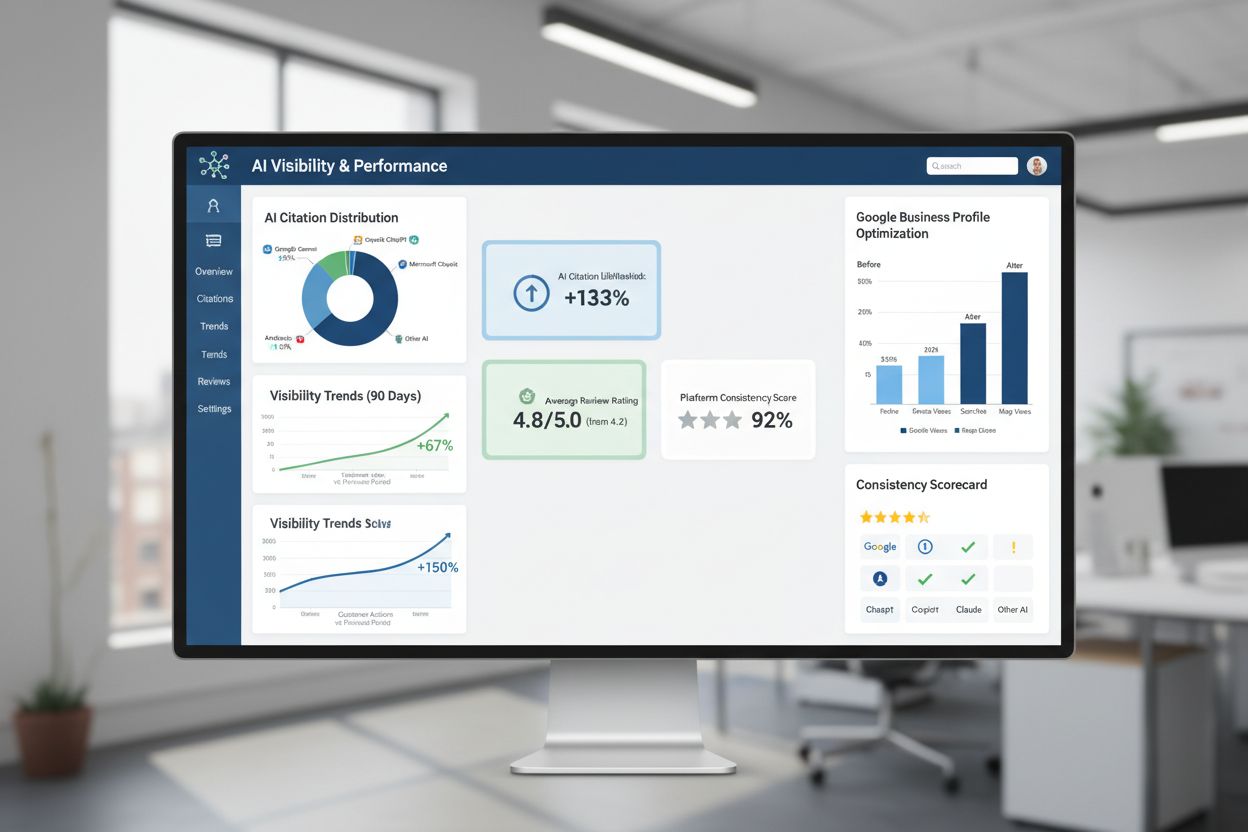
Metric
Before Optimization
After Optimization
Expected Increase
Profile Views
150/month
250-300/month
67-100%
Customer Actions
20/month
35-50/month
75-150%
AI Citation Likelihood
15%
25-35%
67-133%
You can expect a 20-40% increase in local AI visibility within 30 days of implementing these changes, especially if your competitors haven’t optimized their profiles yet.
Ready to Monitor Your AI Visibility?
Track how AI chatbots mention your brand across ChatGPT, Perplexity, and other platforms.
AI systems like Google’s AI Overviews favor conversational, question-based content because it mirrors how people actually search and speak. Rather than writing for keywords, write for the questions your customers ask in real conversations. Here’s your step-by-step approach:
Identify 10-15 common customer questions (check your support emails, reviews, and social media)
Create blog posts or FAQ pages that answer each question in natural, conversational language
Use the question as your heading and answer it in the first 2-3 sentences
Include follow-up questions that address related concerns
Optimize for voice search patterns by using contractions and natural phrasing
Update existing content to be more conversational if it’s currently keyword-focused
This approach typically shows results within 60-90 days because AI systems need time to crawl, index, and evaluate your new content. The key is consistency—publish one conversational piece every 1-2 weeks rather than rushing to create everything at once.
Quick Win #3: Build Review and Testimonial Strategy
Reviews and testimonials are authority signals that AI systems use to determine which businesses deserve prominent placement in AI Overviews. More importantly, 70% of users don’t read beyond the first third of AI Overviews, so appearing in that prime real estate requires strong social proof. Implement this systematic approach:
Ask satisfied customers for reviews immediately after purchase or service completion
Create a simple review request process (email, text, or QR code)
Respond to every review with personalized, helpful replies
Highlight specific achievements in testimonials (e.g., “saved us 10 hours per week”)
Encourage detailed reviews that mention specific benefits or results
You can realistically expect a 15-25% increase in positive reviews within 60 days if you’re actively requesting them. This boost directly correlates with improved AI visibility because AI systems weight recent, detailed reviews more heavily than older ones.
Stay Updated on AI Visibility Trends
Get the latest insights on AI mentions, brand monitoring, and optimization strategies.
Quick Win #4: Ensure Platform Information Consistency
Inconsistent business information across platforms confuses AI systems and damages your credibility. When your business name, address, phone number, and description vary across different platforms, AI systems struggle to verify which information is accurate. Audit and standardize your presence on these critical platforms:
Google Business Profile (your primary source of truth)
Apple Maps and Bing Places
Industry-specific directories (Yelp, LinkedIn, industry associations)
Social media profiles (Facebook, Instagram, LinkedIn)
Your website’s contact and about pages
Consistency improvements typically show results within 30-45 days because AI systems continuously crawl these platforms. Use a spreadsheet to track your business information across all platforms, then systematically update any inconsistencies. This is one of the easiest quick wins because it requires minimal content creation—just verification and standardization.
Quick Win #5: Implement Structured Data and Schema Markup
Structured data (schema markup) is code that tells AI systems exactly what information on your page means, making it easier for them to understand and cite your content. Without schema markup, AI systems have to guess whether a number is a price, a rating, or a phone number. Implement these key schema types:
Organization Schema: Your company name, logo, contact info
LocalBusiness Schema: Address, phone, hours, service areas
Product/Service Schema: Name, description, price, availability
Review/AggregateRating Schema: Star ratings, review counts
FAQPage Schema: Questions and answers in structured format
Adding schema markup typically improves AI citation likelihood by 25-40% because it removes ambiguity. You don’t need to be a developer—tools like Google’s Structured Data Markup Helper or Yoast SEO can generate the code for you. Once implemented, Google Search Console will validate your markup and show you any errors within 1-2 weeks.
Implementation Timeline and Prioritization
You don’t need to implement all five quick wins simultaneously—a phased approach prevents overwhelm and lets you measure what’s working. Here’s a realistic 90-day roadmap that prioritizes high-impact, low-effort actions first:
Timeline
Priority Actions
Expected Results
Effort Level
Days 1-30
GBP optimization + Platform consistency audit
20-30% visibility increase
Low-Medium
Days 31-60
Conversational content creation + Review strategy
35-50% cumulative increase
Medium
Days 61-90
Schema markup implementation + Content expansion
50-70% cumulative increase
Medium-High
Start with Quick Wins #1 and #4 because they require minimal content creation and deliver fast results. By day 30, you’ll have momentum and data showing what’s working, which helps you stay motivated for the more time-intensive wins. Realistic expectations matter here—you won’t see 100% improvement, but 50-70% cumulative visibility gains in 90 days is achievable for most businesses.
Measuring Success and Tracking AI Visibility
You can’t improve what you don’t measure, so establish baseline metrics before implementing any changes. Track these key indicators to know if your quick wins are actually working:
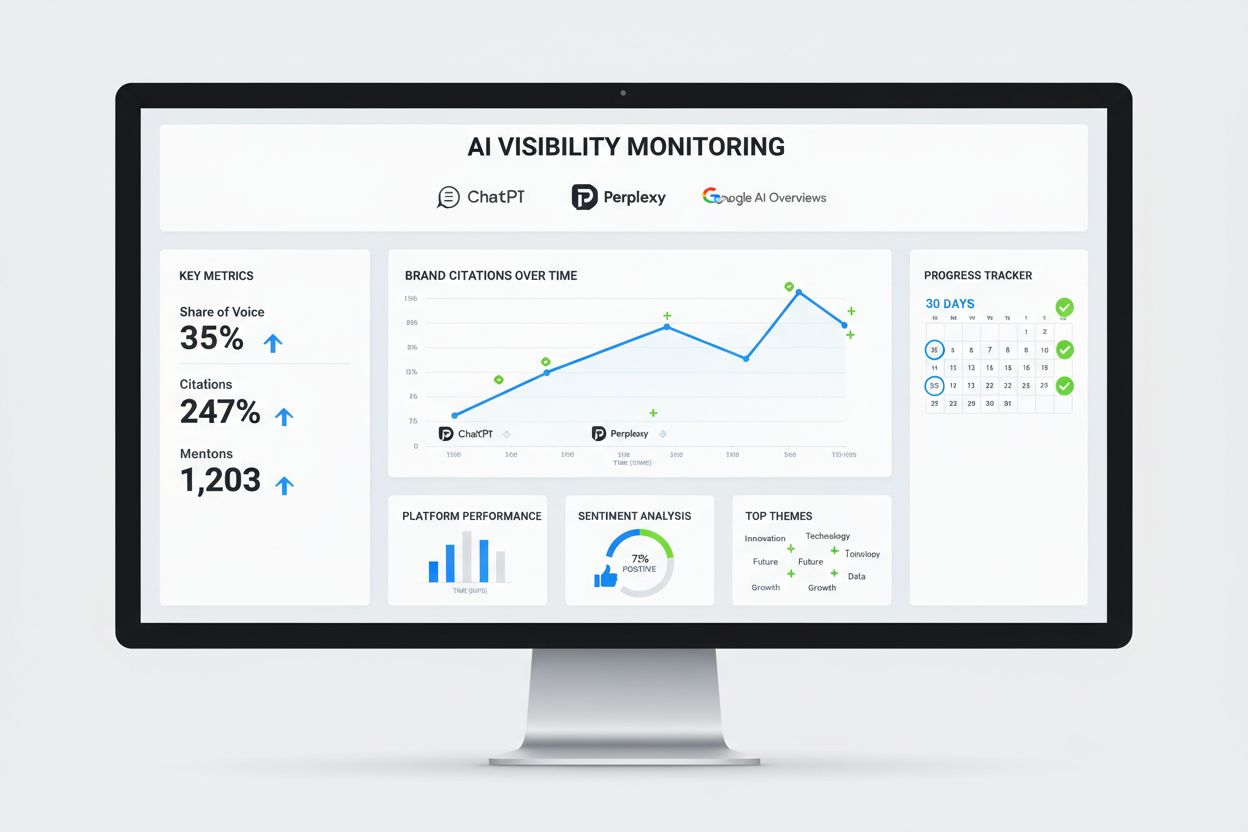
Share of Voice (SOV): What percentage of AI citations mention your brand vs. competitors
Citation Count: Total number of times AI systems mention your business
Mention Sentiment: Percentage of positive vs. negative mentions
Traffic from AI Overviews: Clicks coming directly from Google’s AI answers
Review Count and Rating: Growth in quantity and average star rating
Use AmICited.com to monitor your AI visibility metrics automatically—it tracks citations, mentions, and competitive positioning so you don’t have to manually check Google daily. Set up weekly reports to see trends, and adjust your strategy if metrics aren’t improving after 30 days. Most businesses see measurable improvement within 45 days if they’re implementing changes consistently.
Common Mistakes to Avoid
Even with the best intentions, beginners often sabotage their AI visibility improvements by making these preventable mistakes. Avoid these pitfalls to maximize your quick wins:
Expecting immediate results: AI systems need 2-4 weeks to crawl and evaluate changes
Neglecting maintenance: Optimizing once then ignoring your profiles kills momentum
Ignoring platform-specific needs: Each platform (Google, Apple, Bing) has different requirements
Not measuring progress: You can’t know if something’s working without baseline metrics
Spreading efforts too thin: Trying all five quick wins simultaneously dilutes your impact
The most common mistake is abandoning strategy after 30 days because results aren’t “perfect” yet. Remember that 50-70% improvement over 90 days is exceptional—most businesses see 20-30% gains in the first month alone. Stay consistent, measure weekly, and adjust based on data rather than assumptions.
Next Steps and Continuous Improvement
These five quick wins aren’t a one-time project—they’re the foundation for a sustainable AI visibility strategy that compounds over time. Once you’ve implemented these initial improvements, the next phase is continuous optimization: updating content based on new customer questions, maintaining review momentum, and expanding schema markup to more pages. Set a calendar reminder to review your metrics monthly using AmICited.com, and plan quarterly strategy sessions to identify new opportunities. The businesses that dominate AI Overviews aren’t the ones who optimize once; they’re the ones who treat AI visibility as an ongoing priority. Start with Quick Win #1 this week, and you’ll be amazed at what 90 days of consistent effort can achieve.
Frequently asked questions
Most businesses see measurable improvements within 30-45 days of implementing quick wins, with significant gains visible by 90 days. Quick Win #1 (Google Business Profile optimization) typically shows results within 2-4 weeks, while conversational content takes 60-90 days as AI systems need time to crawl and evaluate new pages.
Traditional SEO focuses on keyword rankings and click-through rates from search results. AI visibility is about getting cited and mentioned inside AI-generated answers. Brand mentions matter more than keywords, and you need structured data and entity clarity for AI systems to understand and reference your content.
Absolutely. Small businesses often have an advantage because they can move faster and implement quick wins more efficiently than large enterprises. By focusing on niche topics and building strong topical authority, small businesses can dominate AI visibility in their specific markets within 90 days.
Not necessarily. These five quick wins are designed for beginners and don't require specialized expertise. However, if you lack bandwidth or want faster results, working with an AI visibility specialist can accelerate your progress. Many agencies offer fractional services starting at 10-15 hours per month.
Update your most important pages quarterly with fresh statistics, examples, and insights. For Google Business Profile and review responses, maintain weekly activity. Conversational content should be refreshed every 6 months to stay relevant. Use AmICited.com to identify which pages are losing visibility and prioritize those for updates.
Start with Quick Win #1 (Google Business Profile optimization) because it requires minimal content creation and delivers fast results within 2-4 weeks. Once you see early wins, you'll have momentum and confidence to tackle the more time-intensive quick wins like conversational content creation.
You can manually check by asking questions on ChatGPT, Perplexity, and Google Search that relate to your business. For systematic tracking, use AmICited.com which monitors your citations, mentions, and competitive positioning across all major AI platforms automatically.
Yes, but you need to optimize it differently. SEO content focuses on keywords and backlinks, while AI visibility content emphasizes conversational language, clear structure, and entity clarity. The best approach is to create content that serves both purposes: keyword-optimized for SEO and conversational for AI systems.
Viktor Zeman is a co-owner of QualityUnit. Even after 20 years of leading the company, he remains primarily a software engineer, specializing in AI, programmatic SEO, and backend development. He has contributed to numerous projects, including LiveAgent, PostAffiliatePro, FlowHunt, UrlsLab, and many others.
Viktor Zeman
CEO, AI Engineer
Start Monitoring Your AI Visibility Today
Track how AI systems like ChatGPT, Perplexity, and Google AI Overviews cite your brand. Get real-time insights into your AI visibility and competitive positioning.
My AI visibility score is terrible - what's the fastest way to improve it?
Community discussion on improving AI visibility scores. Marketing professionals share quick wins, systematic approaches, and real results from optimization effo...
Does Google Business Profile Affect AI Visibility? Complete Guide for 2025
Learn how Google Business Profile impacts your visibility in AI search engines like ChatGPT, Perplexity, and Google Gemini. Discover optimization strategies for...
12 min read
Cookie Consent We use cookies to enhance your browsing experience and analyze our traffic. See our privacy policy.