Key Takeaways
- Agentic commerce is AI agents discovering, comparing, and completing purchases on a shopper’s behalf, from Amazon’s “Buy for Me” to Google’s checkout in AI Mode.
- Four standards carry the weight today: ACP (OpenAI + Stripe) and UCP/AP2 (Google, Shopify and others) handle product feeds and payment; Shopify’s agentic storefronts and WebMCP let an agent operate a store directly.
- One analyst projection, from Edgar, Dunn & Company , has the market growing from roughly $136 billion in 2025 to $1.7 trillion by 2030; estimates vary widely.
- OpenAI retired ChatGPT Instant Checkout in March 2026 and moved checkout back to merchants’ sites, so agentic commerce today is as much about being discovered as about in-chat payment.
- Being well-ranked and being agent-ready are different things: a brand can be frequently cited by AI and still lose the sale if an agent cannot complete checkout without leaving the conversation.
- Readiness comes down to four things: a complete, machine-readable product feed; a checkout an agent can reach programmatically; consistency between that feed and your site’s own schema; and a way to monitor whether agents are actually citing and buying from you.
- Bottom line: this is arriving faster than most merchant roadmaps account for. The brands that publish a feed and a checkout protocol now will be the ones an agent can actually transact with when the shopper asks.
What Is Agentic Commerce?
Agentic commerce is the shift from a person browsing, comparing, and clicking “buy” themselves to an AI agent doing some or all of that on their behalf. Amazon’s “Buy for Me,” launched in April 2025, is the clearest early example: it lets an agent purchase items from third-party sites directly inside the Amazon app, within spending limits and preferences the user set in advance. ChatGPT’s Instant Checkout was the other early reference point: a purchase completed inside a chat conversation, with no redirect to the merchant’s website. OpenAI retired it in March 2026, about six months after launch, and now focuses ChatGPT on product discovery while merchants handle checkout. Google’s checkout in AI Mode and the Gemini app, built on UCP, is the clearest live example of in-assistant purchasing today.
The distinction that matters is agency. A recommendation engine says “you might like this.” A shopping chatbot answers a question and points toward a product page. An agent says “I bought this for you, within the budget you gave me.” Most real deployments today sit somewhere on a spectrum rather than at either extreme: some agents stop at a shortlist for a human to approve, others complete the purchase outright once preferences are set. As checkout protocols mature, expect that line to keep moving toward full autonomy.
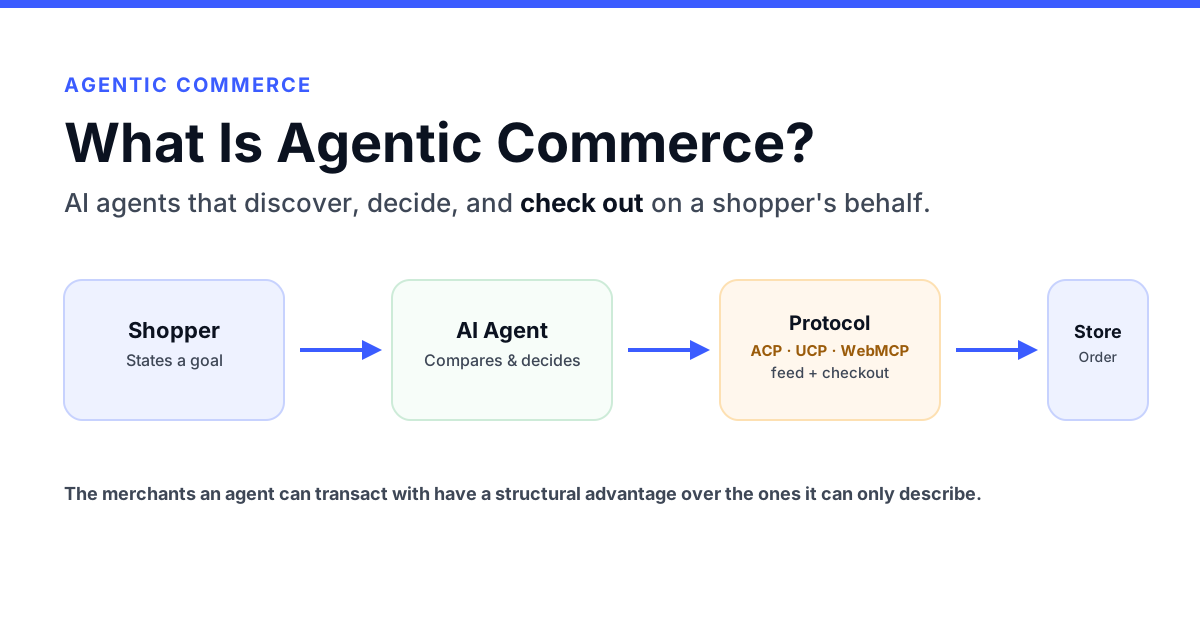
None of this works without three pieces of underlying infrastructure: product discovery and comparison (an agent searching catalogs and matching specs against a goal), goal-driven transaction logic (negotiating terms, picking the option that actually fits the stated constraint), and end-to-end purchasing (a checkout and fulfillment path the agent can complete without a human handoff). The protocols below are what carry that infrastructure in production today.

Ready to Monitor Your AI Visibility?
Track how AI chatbots mention your brand across ChatGPT, Perplexity, and other platforms.
The Protocols Powering Agentic Commerce
Four names come up repeatedly, and they solve two different problems: getting an agent into a store, and letting it pay.
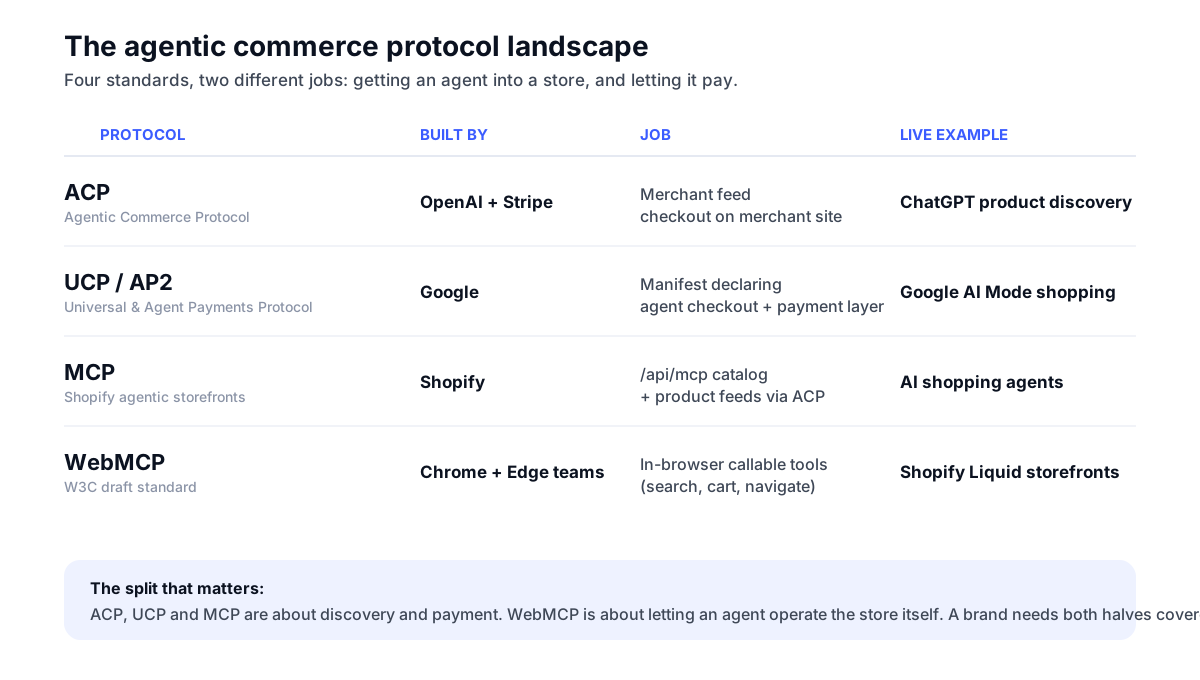
ACP (Agentic Commerce Protocol), built by OpenAI with Stripe, is the standard behind how ChatGPT ingests merchant product data. Merchants publish a structured product feed, required fields are a unique product ID, title, description, current price, and real-time availability, plus optional fields like reviews, ratings, and custom variants that act as tie-breakers between similar products. ACP’s checkout layer handles payment through tokenization: a merchant never sees a shopper’s actual card details, and the token is authorized only for a specific amount at a specific merchant. ACP powered ChatGPT’s Instant Checkout until OpenAI retired it in March 2026. Product data still flows into ChatGPT through ACP feeds from retailers such as Walmart, Target, Best Buy, and Sephora.
UCP (Universal Commerce Protocol) is an open standard launched by Google on January 11, 2026 , co-developed with Shopify and supported by Etsy, Wayfair, Target, and Walmart. It is designed to work alongside AP2 (Agent Payments Protocol), MCP, and A2A, and per PYMNTS it powers checkout in Google’s AI Mode in Search and the Gemini app in the U.S. (Etsy and Wayfair first, with Shopify, Target, and Walmart to follow). Functionally it solves the same two problems ACP does, letting an agent discover what a merchant sells and check out, without parsing a rendered webpage the way a browser does. A site advertising ACP or UCP is signaling it has built the plumbing for agent-led checkout, not merely agent-led reading.
Shopify’s agentic storefronts cover both layers for Shopify merchants specifically: Shopify co-developed UCP for the checkout and payment side (it also had an ACP-based Instant Checkout integration with OpenAI, retired in March 2026), and separately rolled out, more quietly, of WebMCP across Liquid-theme storefronts for the interaction side. That second piece matters on its own: Shopify injected a WebMCP script across its storefronts exposing roughly ten callable tools, split into “answer” tools (search the catalog, fetch product details, read store policies) and “act” tools (navigate, manage the cart, start checkout). Payment itself was deliberately left out of WebMCP’s tool set and still requires explicit user confirmation through the checkout protocol.
WebMCP itself is the more general standard underneath that Shopify rollout: a browser-based specification, currently a W3C Web Machine Learning Community Group draft with editors from Chrome and Edge, that lets any website expose callable tools instead of forcing an agent to simulate clicks on a rendered page. Traditional agent automation reads the page like a human and clicks through it, which is brittle and breaks whenever a layout changes. WebMCP instead gives the agent a stable, machine-readable contract: named tools with defined inputs and outputs. The practical split to remember: ACP and UCP are about discovery and payment; WebMCP is about letting an agent operate the store itself. A brand needs both halves covered, because being recommended and being transactable are different capabilities, and a shopper’s agent can run into either gap independently.
ChatGPT Instant Checkout and the Product Feed Spec
Instant Checkout is worth understanding even though it is gone, because the feed that powered it is still how ChatGPT learns about products. OpenAI launched it in September 2025, letting shoppers buy from Etsy and Shopify merchants via a “Buy” button inside the chat. In March 2026, about six months later, OpenAI retired it. The company said the initial version “did not offer the level of flexibility that we aspire to provide,” so merchants now use their own checkout experiences while ChatGPT focuses on product discovery, according to reporting by Hypotenuse and Forklog . Adoption was limited: reportedly only about 30 Shopify merchants went live, versus the million-plus announced (Stellagent ).
What survives is the discovery layer. A customer asks ChatGPT a shopping question, Shopping Research surfaces options drawn from merchant feeds, and the shopper clicks through to the merchant to buy. Retailers such as Walmart, Target, Best Buy, and Sephora still feed live product data into ChatGPT through the Agentic Commerce Protocol.
The feed underneath that experience has a specific shape. Required fields, a unique product ID, title, description, current price, real-time availability, product weight, and seller information, form the baseline every listing needs. Optional fields, customer reviews, star ratings, video URLs, 3D models, and up to three custom variant categories, are where differentiation happens: when two products are otherwise equally relevant, these act as tie-breakers in which one an agent surfaces first. Feeds can be submitted as TSV, CSV, XML, or JSON, and the system supports refresh cycles as frequent as every 15 minutes, so price and inventory changes can reach recommendations within minutes rather than overnight. During Instant Checkout, fees ran on a small referral model charged only on completed sales; with checkout back on merchants’ own sites, merchants handle fulfillment, customer service, and returns as they would for any direct purchase.
Stay Updated on AI Visibility Trends
Get the latest insights on AI mentions, brand monitoring, and optimization strategies.
What Merchants Must Actually Do
Readiness for agentic commerce is less about any single protocol and more about four pieces of groundwork, done in roughly this order.
Build a machine-readable, complete product feed. This is the foundation everything else sits on. Beyond the required fields, dimensions, materials, compatibility, certifications, and fulfillment options all help an agent match your product to a precise query rather than a generic one. Incomplete data does not just rank lower, missing required fields can disqualify a product from appearing at all.
Make your checkout reachable programmatically. A feed gets you discovered; a checkout protocol gets you paid. Whether that means integrating ACP directly, adopting UCP, or using a platform-native path like Shopify’s checkout, the goal is the same: an agent needs to be able to complete a transaction through a structured API, not by navigating a rendered web form. Brands that only solve discovery and skip this step end up recommended but not bought from.
Keep your feed and your site schema in agreement. Consistency between your submitted feed and your website’s own JSON-LD (Product, Offer, AggregateRating schemas) matters almost as much as the feed itself. When an agent cross-checks your site against your feed and finds a mismatch, for example a feed price of $99.99 against a site schema price of $89.99, that discrepancy reads as unreliable data and reduces confidence in everything else you’ve submitted.
Keep inventory and pricing genuinely real-time. Agents operate at machine speed and don’t tolerate stale data gracefully: a recommended product that turns out to be out of stock or mispriced teaches the system to deprioritize you for the next query. A 15-minute refresh cycle is the baseline most protocols support; high-velocity categories benefit from tighter synchronization.
Two more things worth having in place once the basics are solid: an llms.txt file or equivalent signal that tells crawlers and agents your content is available for retrieval, and genuinely agent-accessible pages, meaning product and policy pages that don’t require JavaScript rendering or block known agent user agents to display their core information. Neither replaces a proper feed, but both remove friction for agents working the open web rather than a dedicated feed integration.
How to Measure Whether It’s Working
None of the protocols above ship with a dashboard, which means measurement has to be assembled rather than read off a single report.
On the demand side, track whether your brand is actually being cited and recommended for the buying-intent prompts your customers would ask, “best running shoes for flat feet under $150,” “Shopify SEO app,” “AI product description generator,” run on a schedule across ChatGPT, Perplexity, Gemini, and Google AI Mode. A prompt set like the one AmICited tracks shows not just whether you’re mentioned, but whether you’re the top recommendation or an afterthought, and how that compares to named competitors for the same query.
On the revenue side, the core problem is that last-click attribution treats almost all AI-assisted purchases as “direct” traffic, because the shopper arrived at checkout without a referring search click to credit. If you sell through Shopify, connecting order data lets AI-referred sessions and orders show up as attributed revenue instead of disappearing into that bucket, which is the only way to answer the question every finance team eventually asks: did any of this agentic commerce work actually produce a sale.
Put together, those two signals, citation frequency and attributed revenue, are what separate “we think agents like us” from a number you can put in a board deck.
The Market, the Players, and Where This Is Headed
The numbers behind this shift are large, but they are forecasts, and they vary widely by how the market is defined. One analyst estimate, from Edgar, Dunn & Company , puts the market at roughly $136 billion in 2025, growing to $1.7 trillion by 2030, a compound annual growth rate above 60%. On the enterprise side, KPMG’s Q1 2025 AI Pulse survey found 65% of organizations piloting AI agents, up from 37% the previous quarter, while the share actually deploying agents stayed flat at 11%. PayPal has said it expects 20-30% of its customers to start shopping through AI agents and tools within five years. And Stripe’s 2024 annual letter reported $1.4 trillion in payment volume and more than 700 AI agent startups launching on its platform that year, a sign that infrastructure investment is running ahead of mainstream consumer awareness.
The competitive landscape spans retail platforms, payment networks, and protocol authors simultaneously. Amazon built “Buy for Me” directly into its own ecosystem. Shopify co-developed UCP with Google and ran the WebMCP rollout described above. Stripe ships an Agent Toolkit alongside its ACP work. Google is pushing UCP and AP2 while its Gemini-powered shopping features expand. Payment networks are moving in parallel: Visa’s Intelligent Commerce program, Mastercard’s Agent Pay, and PayPal’s own Agent Toolkit all target the same agent-initiated transaction layer from the card-network side.
Consumer trust remains the real constraint on how fast this moves, not the technology. Surveys consistently find a meaningful share of shoppers uncomfortable sharing shopping data with an agent, even while a larger share are comfortable with agents making purchase recommendations. That gap narrows as agents prove themselves on routine, low-stakes purchases first, restocking a known product, grabbing the cheapest version of a commodity item, while higher-involvement, more personal categories (fashion, home decor, gifts) stay human-driven for longer. The practical read for merchants: agentic commerce is not a wholesale replacement for how people shop, it’s a new, fast-growing channel stacking on top of the ones you already run, and the readiness work above is what determines whether you’re transactable on it when a shopper’s agent comes looking.