Key Takeaways
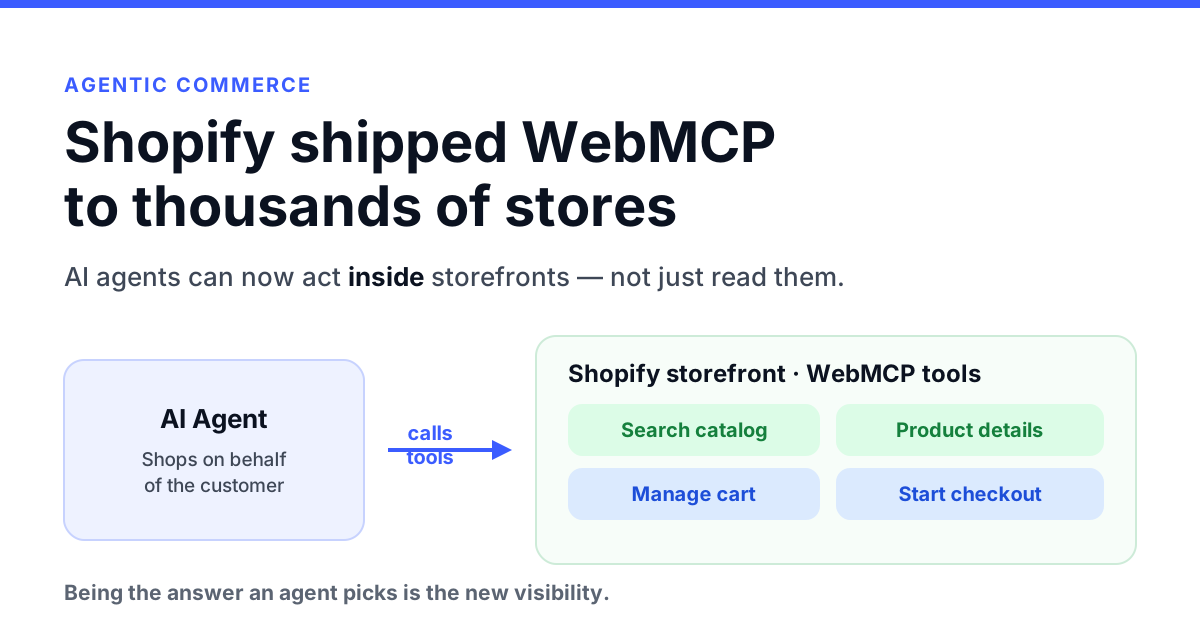
- Shopify quietly shipped WebMCP, a browser-based standard, across thousands of storefronts, letting AI agents call structured tools (search catalog, manage cart, checkout) instead of simulating clicks.
- Payment (“transact”) tools were deliberately left out, so purchases still require explicit human confirmation, even as browsing and cart actions become fully agent-operable.
- WebMCP is a W3C draft backed by Chrome and Edge, not a Shopify-only trick, so this pattern is likely to spread to every storefront over time.
- Whether your brand gets surfaced by a shopping agent depends on clean, machine-readable product data and how well AI systems already describe your brand elsewhere on the web.
- Bottom line: Treat AI agents as a new class of visitor now, keep your product and policy data accurate and structured, and track how AI systems represent your brand with a tool like Am I Cited so you know where the gaps are before an agent decides for a shopper.
Shopify Made a Quiet Move That Changes AI Shopping
While most of the industry was still debating whether AI agents would ever buy anything, Shopify shipped the plumbing to let them. As reported by nekuda, Shopify rolled out WebMCP across thousands of its storefronts, including verified major brands such as Reebok, Alo Yoga, Fenty Beauty, and Salt & Straw, without an announcement. If you sell on Shopify, an AI agent may already be able to browse your catalog and fill a cart through a structured interface you never explicitly turned on.
For a brand, this is not a niche developer detail. It is an early signal of how product discovery and purchasing are going to work, and it has direct implications for AI visibility: how, and whether, your brand shows up when an AI does the shopping.

Ready to Monitor Your AI Visibility?
Track how AI chatbots mention your brand across ChatGPT, Perplexity, and other platforms.
What WebMCP Actually Is
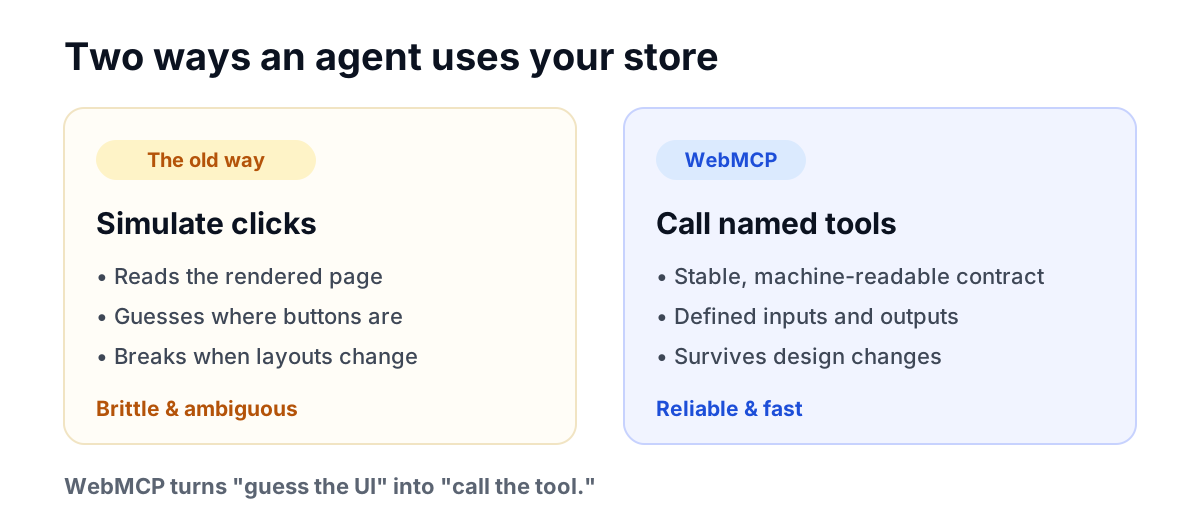
WebMCP is a browser-based standard that lets AI agents interact with a website through callable tools rather than by simulating clicks. Instead of an agent screen-reading your page and guessing where the “Add to cart” button is, the page publishes a set of named tools, and the agent calls them directly.
The article describes this as co-browsing: an agent operating inside the storefront alongside the customer, able to take real actions rather than just describe them. It is the difference between a bot that fumbles through your UI and one that has a clean, documented contract for what it can do.
This matters because brittle “click simulation” has been the single biggest reason agentic shopping stayed a demo. Give agents stable tools and the reliability problem largely goes away.
The Standard Underneath: MCP, Now in the Browser
WebMCP didn’t come from nowhere. It’s the browser-native descendant of the Model Context Protocol (MCP), the open standard Anthropic introduced in late 2024 to give AI models a consistent way to call external tools and data: think of it as a USB-C port between an AI and the outside world. MCP uses a client–server model: a tool provider runs a server, and the AI application connects to it as a client.
WebMCP moves that idea into the page itself. Instead of a separate server, the website is the server: when an agent lands on a WebMCP-enabled page, the page advertises its tools through a browser API (navigator.modelContext), each described with a name, a description, and a JSON schema for its inputs. It’s being developed in the open as a W3C Web Machine Learning Community Group draft, with editors from Google’s Chrome and Microsoft’s Edge teams, and early support has begun landing in Chromium.
The takeaway for brands: this is not a Shopify-proprietary trick. Shopify is shipping an early, production-scale implementation of a standard the browser vendors themselves are building, and standards get adopted broadly. If co-browsing becomes a browser-level capability, every storefront eventually becomes agent-operable, not just Shopify’s.
Stay Updated on AI Visibility Trends
Get the latest insights on AI mentions, brand monitoring, and optimization strategies.
What Shopify Shipped
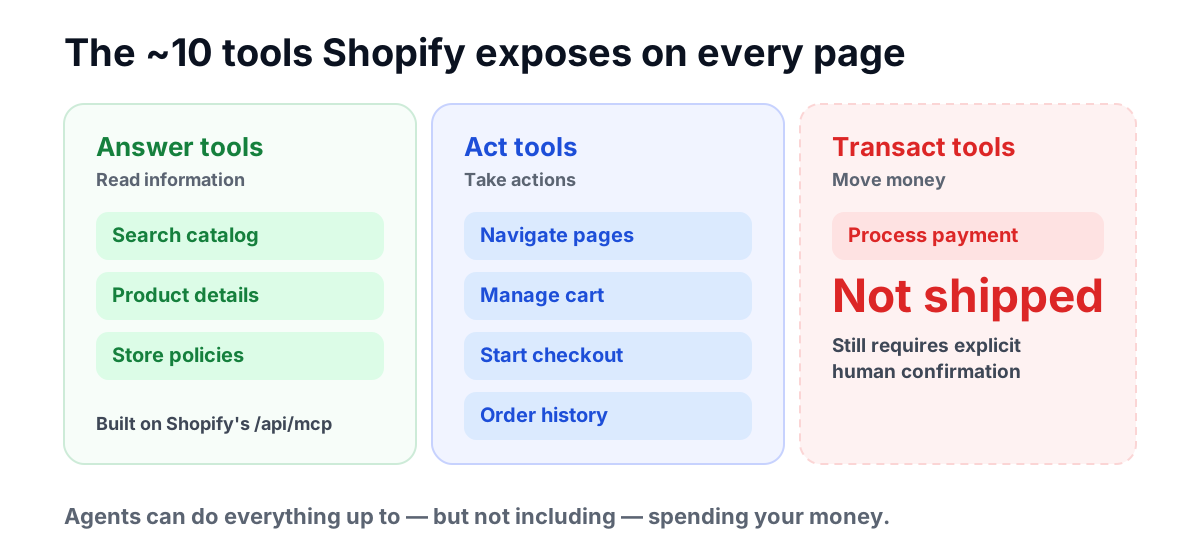
Per the reporting, Shopify injected a script (webmcp-0.0.3.js, served from cdn.shopify.com) across its Liquid-theme storefronts, exposing about ten tools on every page, in two categories:
- Answer tools: search the catalog, retrieve product details, and read store policies. These build on Shopify’s existing
/api/mcpinfrastructure rather than a new system. - Act tools: navigate pages, manage the cart, initiate checkout, and display order history.
Conspicuously absent are transact tools: actual payment processing still requires explicit user confirmation. That boundary (agents can do everything up to, but not including, spending your money without a human nod) is the sensible line, and it tells you where the ecosystem is drawing its trust threshold today.
A few details worth noting for anyone thinking strategically:
- It reuses existing infrastructure. Shopify layered WebMCP on top of the MCP server architecture it already had, which is why it could roll out so broadly, so quietly.
- Every page serves the same toolset. WebMCP technically supports page-scoped tools, but Shopify chose deployment simplicity over per-page customization, a classic “ship the default everywhere first” move.
- Hydrogen is included. Shopify added WebMCP support to Hydrogen, its open-source headless framework, though merchants there have to update and redeploy manually.
The takeaway: this is Shopify positioning itself as the pace-setter for agentic commerce. Whatever defaults Shopify sets, a large share of the e-commerce ecosystem tends to copy.
Shopify Isn’t Alone: The Agentic-Commerce Standards Race
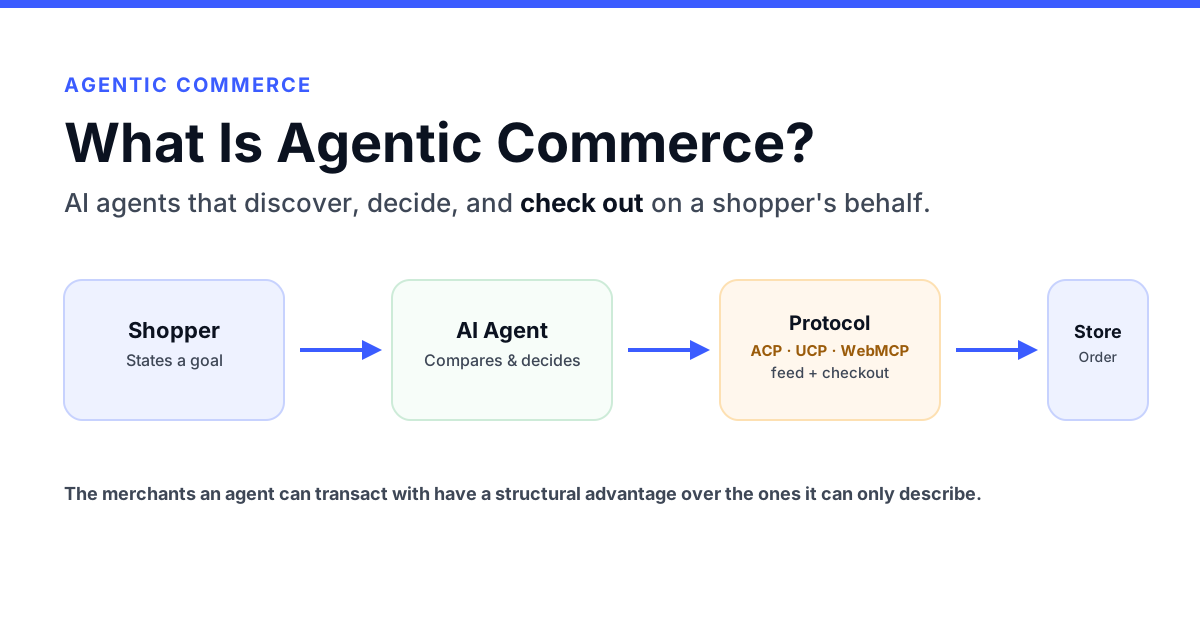
WebMCP governs how an agent operates a store. A parallel set of standards governs how an agent pays, and they’re arriving just as fast:
- Agentic Commerce Protocol (ACP): co-developed by OpenAI and Stripe (with Meta) which powered Instant Checkout in ChatGPT until OpenAI retired that feature in March 2026 (ACP still carries merchant product data into ChatGPT). Merchants who process payments on Stripe can turn on agent-driven purchases with roughly a single line of code, and the specification is open source under Apache 2.0.
- Agent Payments Protocol (AP2): announced by Google with 60+ partners including Mastercard, PayPal, and American Express. It hands an agent a cryptographically signed “mandate” proving a human authorized a specific purchase, and is designed to extend MCP and Google’s Agent2Agent protocol.
Stack the layers and the next few years come into focus: an interaction layer (WebMCP) that lets agents act inside stores, and a payment layer (ACP, AP2) that lets them pay with verifiable authorization. Shopify wiring WebMCP into thousands of storefronts is one piece of a much larger convergence. Brands that treat it as a curiosity will keep optimizing for human shoppers, while their competitors quietly get chosen by the agents shopping on those humans’ behalf.
Why This Is an AI Visibility Story, Not Just an E-commerce One
Here is the shift that matters for anyone thinking about discovery. For twenty years, being “findable” meant ranking in a list of blue links a human scrolled. Then it meant being cited by AI answer engines like ChatGPT and Perplexity. WebMCP pushes it one step further: being retrievable and actionable by an agent that is actually completing the task.
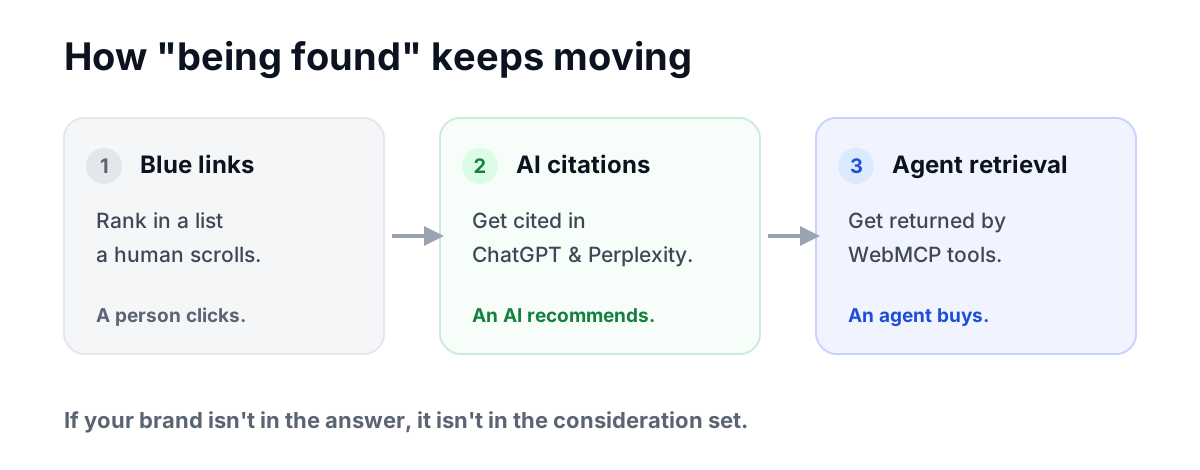
When an AI shopping agent searches a catalog through WebMCP answer tools, the agent, not a person, decides which products surface, which get compared, and which make it into the cart. Your storefront’s job is no longer only to persuade a human; it is to be the source an agent trusts and selects.
That reframes three things:
- Discovery moves upstream. The moment of decision is increasingly “which product did the agent return,” not “which link did the shopper click.” If your brand isn’t in the answer, you’re not in the consideration set.
- Data quality becomes a ranking factor. Clean, accurate, machine-readable product data, policies, and comparisons are what let an agent represent you correctly. Ambiguity gets you skipped.
- Off-store representation still drives on-store selection. Agents don’t form preferences in a vacuum. How your brand is described across the web, review platforms, and AI answers shapes which products an agent trusts when it does call a storefront’s tools. This is exactly the agentic-commerce dynamic we’ve written about, and it’s why preparing for agentic commerce is now a near-term priority rather than a futures exercise.
How an Agent Actually Decides What to Buy
It helps to be concrete about where an agent’s choice comes from, because each source is something you can influence:
- What the tools return. When an agent calls a “search catalog” tool, your product data (titles, attributes, availability, price) determines whether you match the query and how you’re described back to the model. Incomplete or ambiguous data is the fastest way to get filtered out before the shortlist even forms.
- What the model already believes. Agents don’t arrive blank. They carry a prior, shaped by training data and live retrieval, about which brands are credible for “durable trail-running shoes” or “fragrance-free skincare.” That prior is built from how you’re represented across the web, in reviews, and in AI answers long before any storefront tool is called.
- How machine-readable you are. Structured data such as schema.org/Product markup, clean product feeds, and consistent specifications make it trivial for an agent to parse and trust your listings. Human-friendly-but-messy pages force the agent to guess, and guessing favors whichever competitor is cleaner.
The through-line: agent selection is generative engine optimization applied to the checkout. You win by being both retrievable (clean, structured, in stock) and trusted, meaning well-represented across the sources the model already reads.
What Brands Should Do Now
You can’t control Shopify’s rollout, but you can control whether AI systems represent you accurately and choose you often. A practical checklist:
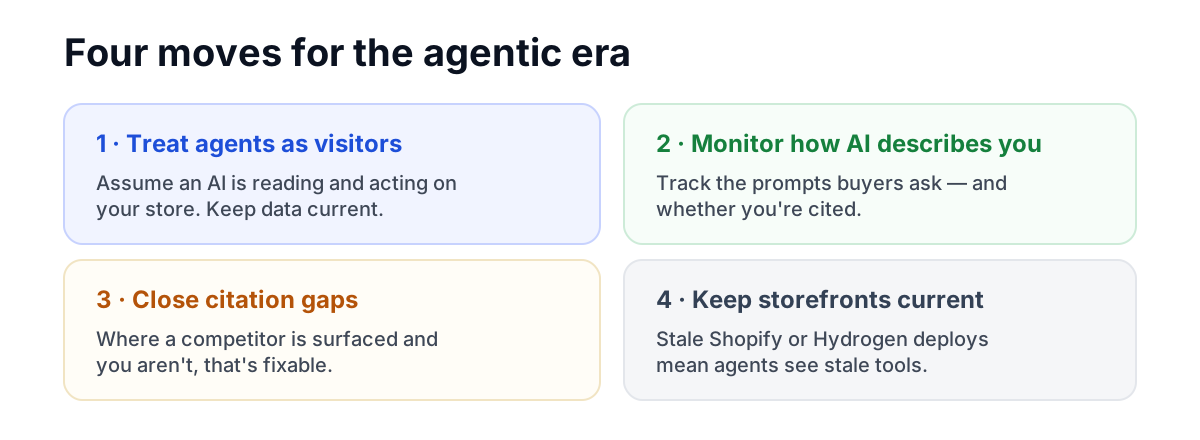
- Treat agents as a new class of visitor. Assume an AI is reading and acting on your store. Make product data, pricing, availability, and policies unambiguous and current.
- Monitor how AI describes and recommends you. Track the prompts and product queries where buyers (and their agents) are asking for what you sell, and see whether you’re cited. This is the core of generative engine optimization: being the source AI reaches for.
- Close citation gaps against competitors. If a competitor is surfaced for “best [your category]” and you aren’t, that’s a fixable content and authority problem, not a permanent state.
- Keep your Shopify and Hydrogen storefronts current. Since WebMCP tools ride on your store’s infrastructure, an out-of-date theme or headless deployment can mean agents see stale or missing tools.
The Bottom Line
Shopify didn’t just add a feature; it set a default for how AI agents will shop. Answer tools decide whether your products are even seen; act tools decide how smoothly they move to checkout. Both run on data and representation you influence today.
The brands that win the agentic-commerce era won’t be the ones that fought the shift. They’ll be the ones that made themselves the obvious, trusted answer whenever an AI goes looking. Understanding where your brand stands in AI answers right now is the first step, and it’s exactly what Am I Cited is built to measure.
 LinkedIn