


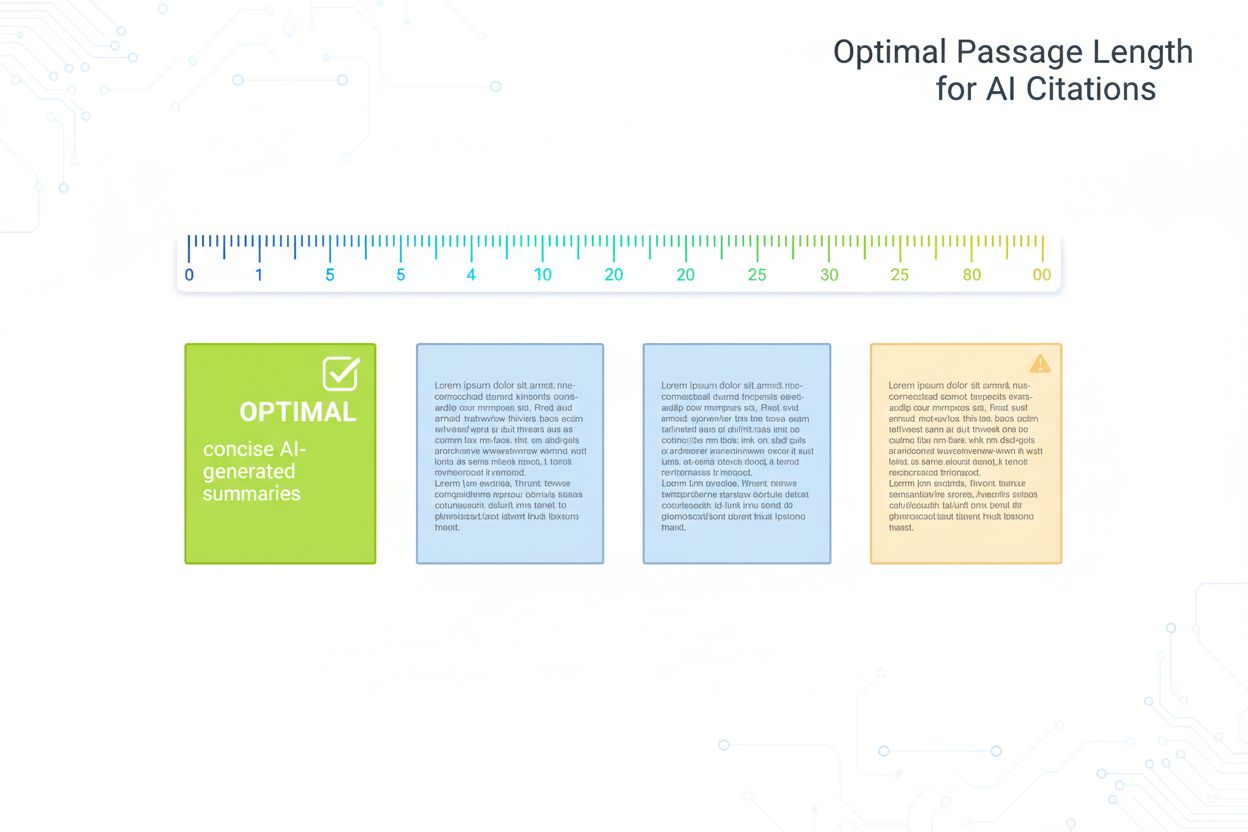
The Ideal Passage Length for AI Citations: Word Counts by Content Type
Data-backed word-count targets for AI citations by content type — FAQ, how-to, comparison, and research content — plus answer-nugget formatting, schema markup, ...
8 min read
A technical breakdown of how AI content-chunking algorithms work: fixed-size vs. semantic vs. sliding-window methods, why token and embedding-window limits constrain chunk size, and how to build a chunking pipeline.
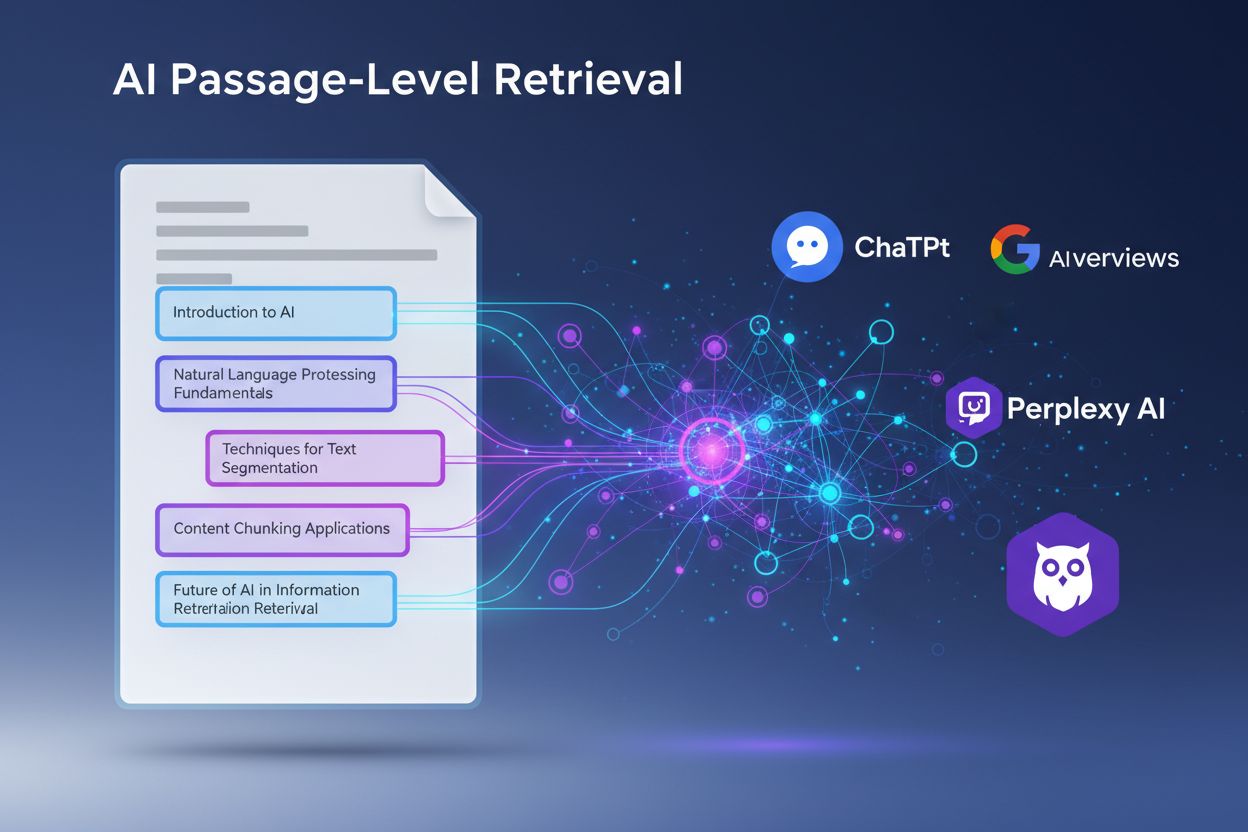
Every AI system that cites your content — ChatGPT, Google AI Overviews, Perplexity — first has to break it into retrievable pieces. That splitting process is content chunking, and it’s a mechanical, algorithmic step that happens before any citation decision is made. This guide opens the hood on how chunking algorithms actually work: the methods used to decide where to cut, why token and embedding-window limits shape chunk size, and how to build a chunking pipeline. Chunking is the mechanical layer beneath the broader question of how to structure content for AI citations. If you’re looking for concrete word-count targets by content type instead, see our companion guide to optimal passage length , which covers the data-backed recommendations this piece doesn’t.
Content chunking is the process of breaking down larger pieces of content into smaller, semantically meaningful segments that AI systems can process, retrieve, and cite independently. Unlike a plain paragraph break, a well-formed chunk is a deliberately bounded unit that preserves contextual integrity while staying small enough for a retrieval system to handle efficiently. Effective chunks share four properties: semantic coherence (the chunk expresses one complete idea), optimal token density (typically 100-500 tokens), clear boundaries (a logical start and end point rather than an arbitrary cut), and contextual relevance (the chunk can answer a specific query on its own, without needing the surrounding page). Chunks with genuine content depth, that cluster with what AI actually cites, are the ones that get retrieved instead of skipped — getting these four properties right is what separates a chunk an AI system can confidently cite from one it has to paraphrase or ignore.
Different chunking algorithms make different tradeoffs between speed, coherence, and retrieval accuracy.
| Chunking Method | Chunk Size | Best For | Citation Rate | Retrieval Speed |
|---|---|---|---|---|
| Fixed-Size Chunking | 200-300 tokens | General content | Moderate | Fast |
| Semantic Chunking | 150-400 tokens | Topic-specific | High | Moderate |
| Sliding Window | 100-500 tokens | Long-form content | High | Slower |
| Hierarchical Chunking | Variable | Complex topics | Very High | Moderate |
Fixed-size chunking splits text at a set token interval regardless of meaning — it’s the fastest to compute but can cut a sentence or idea in half at the boundary. Semantic chunking uses NLP to detect topic shifts and splits there instead, producing chunks that stand on their own; research from Pinecone found semantic chunking outperforms fixed-size approaches by roughly 40% in retrieval accuracy. Sliding window chunking creates overlapping fixed-size segments so that information near a boundary appears in more than one chunk, which is useful for long-form content where ideas span multiple sections. Hierarchical chunking combines multiple chunk sizes at once — pairing atomic facts with the larger sections that contextualize them — and tends to produce the highest citation rates because it gives a retrieval system options at every granularity.

Track how AI chatbots mention your brand across ChatGPT, Perplexity, and other platforms.
The relationship between chunk size and retrieval performance comes down to how language models process text. Models operate within a fixed context window — typically 4,000 to 128,000 tokens — and must balance how much of that window a passage consumes against how much relevant information it can hold. As a rule of thumb, 1 token ≈ 0.75 words, so a 300-word chunk is roughly 400 tokens and a 1,000-word chunk is roughly 1,333 tokens:
Example Token Calculation:
- 100-word passage = ~133 tokens
- 300-word passage = ~400 tokens
- 500-word passage = ~667 tokens
- 1,000-word passage = ~1,333 tokens

Practical Context Window Allocation:
- System context window: 8,000 tokens
- Reserved for query + instructions: 500 tokens
- Available for passages: 7,500 tokens
- Optimal passage size: 256-512 tokens (fits 14-29 passages)
When a chunk exceeds roughly 500 tokens, it eats into this budget disproportionately and dilutes the signal-to-noise ratio a retrieval system relies on to identify what’s actually relevant. When a chunk is too small (under about 75 words), it often lacks the surrounding context a model needs to cite it with confidence rather than paraphrasing it broadly. NVIDIA’s research on page-level chunking found that passages in the 100-500 token range provide the best balance of retrieval accuracy and attribution — the technical basis for the “optimal range” figure you’ll see cited across chunking literature. In practice, this token budget is what decides how thorough a chunk needs to be: enough context to stand alone, not so much that it crowds out everything else competing for the same window.
Beyond raw size, where information sits inside a chunk matters. Transformer-based models exhibit a phenomenon known as context rot: attention mechanisms naturally weight the beginning (primacy effect) and end (recency effect) of an input sequence more heavily than the middle. In passages exceeding roughly 1,500 tokens, information buried in the middle is measurably more likely to be overlooked when a model generates a citation — independent of how relevant that information actually is. This is a direct consequence of how attention layers allocate weight across a sequence, not a content-quality issue. The practical mitigation is structural: front-load the most critical information at the start of a chunk, repeat key points near the end, and use clear section headers to create natural chunk boundaries rather than letting a single chunk sprawl across multiple ideas. Keeping chunks within the 100-500 token range referenced above is itself one of the most effective ways to sidestep this problem, since it rarely gives the “middle” enough room to hide anything important.
Get the latest insights on AI mentions, brand monitoring, and optimization strategies.
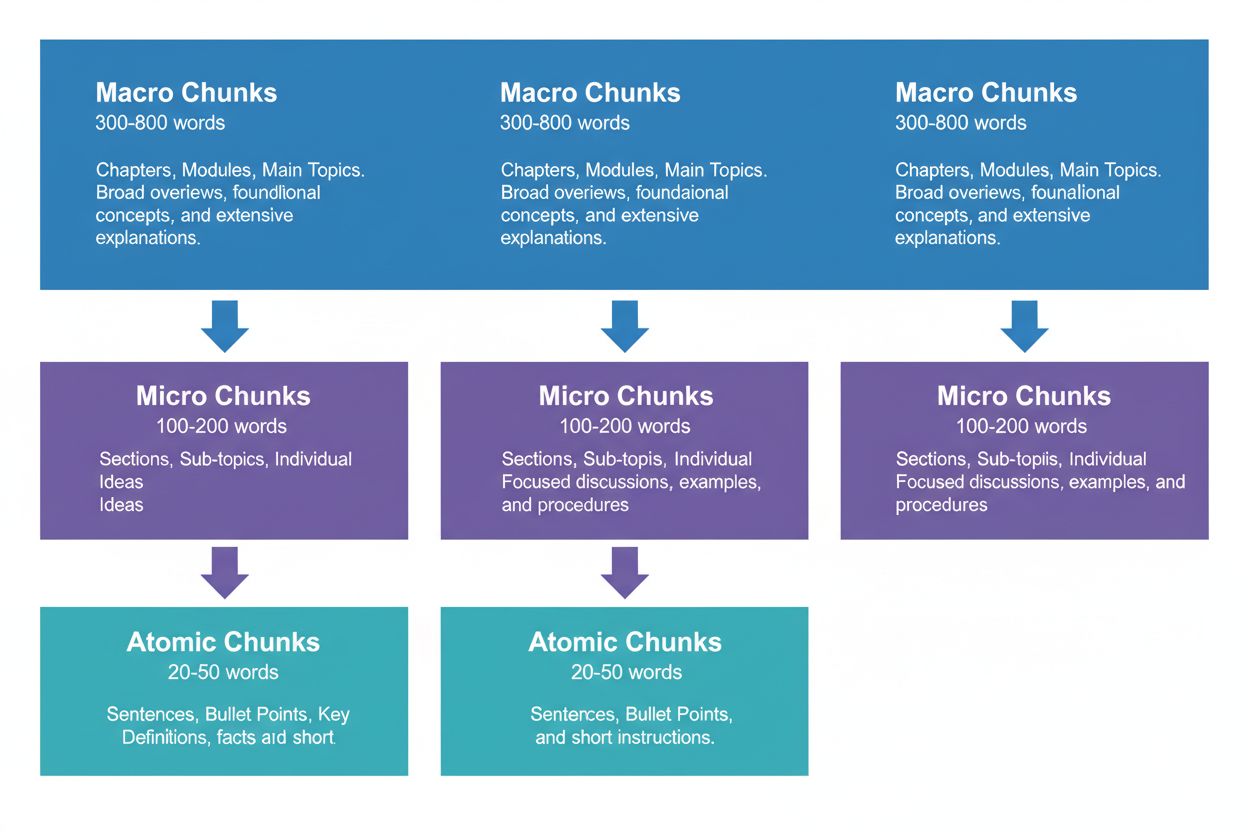
Effective chunking strategy operates on three hierarchical levels, each serving a different role in the retrieval pipeline. Macro chunks (300-800 words) represent complete topic sections — the “chapters” of your content. They establish comprehensive context and are what AI systems draw on for longer, multi-faceted responses; a macro chunk might be an entire section on “How to Optimize Your Website for Core Web Vitals,” providing full context without external references. Micro chunks (100-200 words) are the primary units retrieved for direct citations and featured snippets — they answer one specific question or provide one actionable step, such as a single best practice within that Core Web Vitals section. Atomic chunks (20-50 words) are the smallest meaningful units: individual data points, statistics, or definitions, often extracted for quick answers or folded into AI-generated summaries. Structuring content so all three levels exist — rather than relying on one chunk size throughout — increases overall citation volume; in our monitoring data, well-structured hierarchies see roughly 45% more citations than flat, single-level content.
Beyond the four base algorithms, several refinements can meaningfully improve retrieval and citation performance. Overlapping chunking shares 10-20% of content between adjacent chunks, creating context bridges that help a model understand how ideas connect — particularly useful for topics where concepts build on each other. Contextual chunking embeds a short metadata or summary note inside a chunk so a model can categorize it without an external lookup — for example, a chunk about “Cumulative Layout Shift” might carry a note like “[Context: Part of Core Web Vitals optimization].” Hierarchical semantic chunking combines the macro/micro/atomic structure described above with semantic boundary detection at each level, preserving relationships between levels rather than treating them as independent passes. Dynamic chunking adjusts chunk size in response to content complexity and observed query or retrieval patterns, which requires ongoing monitoring rather than a one-time setup. Organizations applying these combined strategies typically see citation-rate gains of 60-85% over basic fixed-size chunking, with the largest gains showing up in citation specificity rather than raw frequency.
Most chunking failures trace back to a handful of implementation errors. Inconsistent chunk sizing — mixing 150-word and 600-word chunks within the same piece — confuses retrieval systems and produces unpredictable citation behavior. Over-chunking, splitting content into pieces under roughly 75 words, strips away the context a model needs to cite confidently. Under-chunking, leaving passages over 500 tokens intact, wastes context-window budget and dilutes relevance signals, compounding the lost-in-the-middle problem described above. Misaligning boundaries with arbitrary word counts instead of semantic transitions produces chunks that don’t correspond to a complete idea, which confuses both retrieval systems and human readers. Applying one chunk size to every content type ignores that FAQs, tutorials, and research content have fundamentally different natural structures. Never testing or iterating on chunk boundaries after initial setup means a pipeline stays static even as AI systems’ retrieval behavior evolves. Correcting these implementation mistakes alone tends to lift citation rates by roughly 52% in our audits.
Building a chunking pipeline is easier with the right tooling. Pinecone’s chunking utilities provide pre-built functions for semantic chunking, sliding-window approaches, and hierarchical chunking, with documentation that specifically recommends the 100-500 token range and tools to validate chunk quality. NVIDIA’s embedding and retrieval frameworks target enterprise-scale content volumes, with particular strength in page-level chunking accuracy. LangChain offers flexible chunking implementations that integrate with popular LLMs, letting developers experiment with strategies and measure performance directly. Semantic Kernel (Microsoft’s framework) includes chunking utilities built specifically for citation-oriented retrieval scenarios. Yoast’s readability tools help confirm chunks remain accessible to human readers even as you optimize for AI retrieval, and Semrush’s content intelligence platform shows how your existing content performs in AI Overviews and other AI-driven results. AmICited.com’s native chunking analyzer integrates directly with your CMS, automatically analyzing passage lengths, suggesting boundary adjustments, and tracking how each chunk performs across ChatGPT, Perplexity, Google AI Overviews, and other platforms — closing the loop between a chunking decision and its actual citation outcome.
Turning this into a working pipeline is a systematic process:
This systematic approach typically produces measurable citation improvements within 60-90 days, as AI systems re-index restructured content and your pipeline’s boundary choices are validated against real retrieval data.
Yasha is a talented software developer specializing in Python, Java, and machine learning. Yasha writes technical articles on AI, prompt engineering, and chatbot development.

AmICited.com tracks which passages AI systems cite across ChatGPT, Google AI Overviews, and Perplexity, so you can validate your chunking strategy against real citation data.
Data-backed word-count targets for AI citations by content type — FAQ, how-to, comparison, and research content — plus answer-nugget formatting, schema markup, ...

Learn how AI search indexing converts data into searchable vectors, enabling AI systems like ChatGPT and Perplexity to retrieve and cite relevant information fr...

A practical, six-phase framework for restructuring web content so AI systems can extract and cite it.
Cookie Consent
We use cookies to enhance your browsing experience and analyze our traffic. See our privacy policy.