The Ideal Passage Length for AI Citations: Word Counts by Content Type
Data-backed word-count targets for AI citations by content type — FAQ, how-to, comparison, and research content — plus answer-nugget formatting, schema markup, and before/after examples.
How long should a passage be to get cited? This guide answers that with numbers: word-count targets by content type, backed by citation data rather than guesswork. It assumes you already know what a “chunk” is and roughly 0.75 words per token — for the mechanics of how chunking algorithms decide where those boundaries fall, see our companion guide to how AI content chunking works
. Here, the focus is entirely on what length to write and why.
The Data Behind Optimal Passage Length
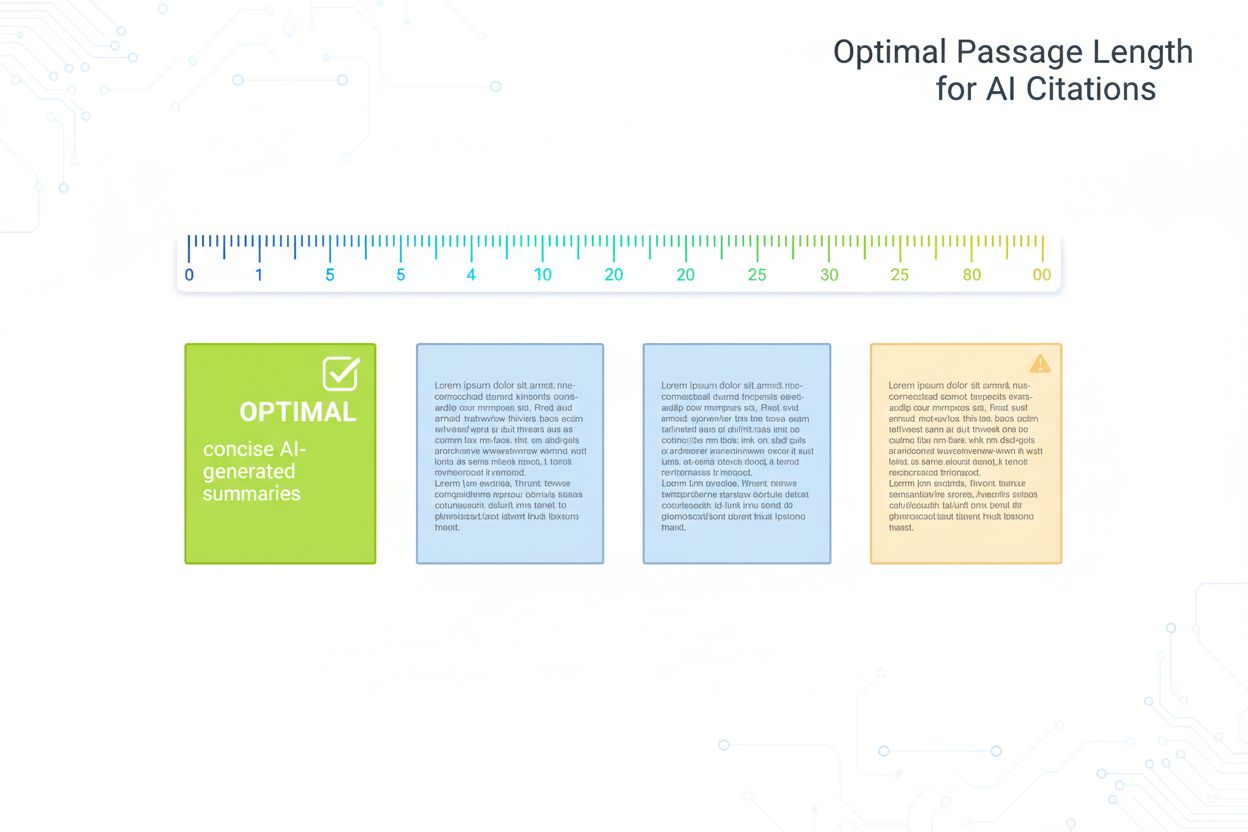
Research consistently shows that 53% of content cited by AI systems is under 1,000 words, challenging the assumption that longer, more exhaustive content earns more citations. This preference for shorter content follows from how AI models evaluate relevance and extractability — concise passages are easier to parse, contextualize, and cite accurately. Critically, studies show a near-zero correlation between word count and citation position: longer content doesn’t rank higher in AI citations. Content under 350 words tends to land in the top three citation spots more frequently, suggesting brevity combined with relevance — not depth for its own sake — is what makes a passage citation-worthy.
Length also affects citationquality, not just frequency. Properly sized passages let AI systems cite you with more specificity and confidence — often as a direct quote rather than a broad paraphrase. Research on passage-based retrieval found well-sized passages are 4.2x more likely to receive citations that include direct attribution and a source link, and separate analysis of AI Overviews (which now appear in roughly 13% of searches) found correctly sized content appears in 8.7% of AI Overview results, compared to 2.1% for poorly sized content. A thousand vague citations are worth less than a hundred specific, attributed ones that actually drive traffic.
Optimal Word Counts by Content Type
Different content types call for different word-count targets — and different amounts of content depth — so matching content to its type consistently outperforms a single blanket target.
FAQ content performs best at 120-180 words per question-answer pair — enough for a complete answer, short enough for quick retrieval.
How-to guides work best as 30-50 word individual steps, grouped into 150-200 word complete procedures.
Definitions and glossary entries should keep the definition itself to 20-40 words, with a 100-150 word expansion for context.
Comparison content needs 200-250 words to fairly represent multiple options and their trade-offs — shorter tends to feel one-sided.
Research and data-driven content performs best around 180-220 words that fold methodology, findings, and implications together rather than separating them.
Tutorial and educational content benefits from a mix: atomic-length steps for individual concepts, 150-200 word passages for complete lessons, and longer sections for full courses.
News and timely content should stay to 100-150 words to support rapid AI indexing while the story is still current.
Content that matches these type-specific targets sees roughly 3.2x more citations than content using a single word-count target across every format.
Ready to Monitor Your AI Visibility?
Track how AI chatbots mention your brand across ChatGPT, Perplexity, and other platforms.
An answer nugget is a concise, self-contained summary — typically 40-80 words — that directly responds to a specific question. Nuggets are the format AI systems most reliably extract for citation because they deliver a complete answer without surrounding noise. Placement matters as much as length: position the nugget immediately after the heading or topic introduction, before any supporting detail, so an AI system encounters the answer first. Here’s what a well-structured nugget looks like in practice:
Question: "How long should web content be for AI citations?"
Answer Nugget: "Research shows 53% of AI-cited content is under 1,000 words, with optimal passages ranging from 75-150 words for direct answers and 256-512 tokens for semantic chunks. Content under 350 words tends to rank in top citation positions, suggesting brevity combined with relevance maximizes AI citation likelihood."
This nugget is complete, specific, and immediately usable — exactly what an AI system is looking for when it needs to generate a citation rather than a paraphrase.
Schema Markup and Structured Data
JSON-LD schema markup gives AI systems explicit instructions about your content’s structure, which measurably improves citation likelihood. The most impactful types for AI optimization are FAQ schema for question-and-answer content and HowTo schema for procedural content — FAQ schema in particular mirrors how AI systems already process information, as discrete question-answer pairs. Pages implementing appropriate schema markup are 3x more likely to be cited by AI systems than unmarked content, because the markup removes ambiguity about what constitutes the answer.
{
  "@context": "https://schema.org",
  "@type": "FAQPage",
  "mainEntity": [
    {
      "@type": "Question",
      "@id": "https://example.com/faq#q1",
      "name": "What is optimal passage length for AI citations?",
      "acceptedAnswer": {
        "@type": "Answer",
        "text": "Research shows 53% of AI-cited content is under 1,000 words, with optimal passages ranging from 75-150 words for direct answers and 256-512 tokens for semantic chunks."
      }
    }
  ]
}
Implementing schema markup turns unstructured text into machine-readable information, signaling exactly where an answer exists and how it’s organized — pairing a properly sized passage with schema markup compounds both effects. This is exactly how publishers put this into practice at scale, rather than resizing passages and leaving structure to guesswork.
Stay Updated on AI Visibility Trends
Get the latest insights on AI mentions, brand monitoring, and optimization strategies.
Snack Strategy vs. Hub Strategy
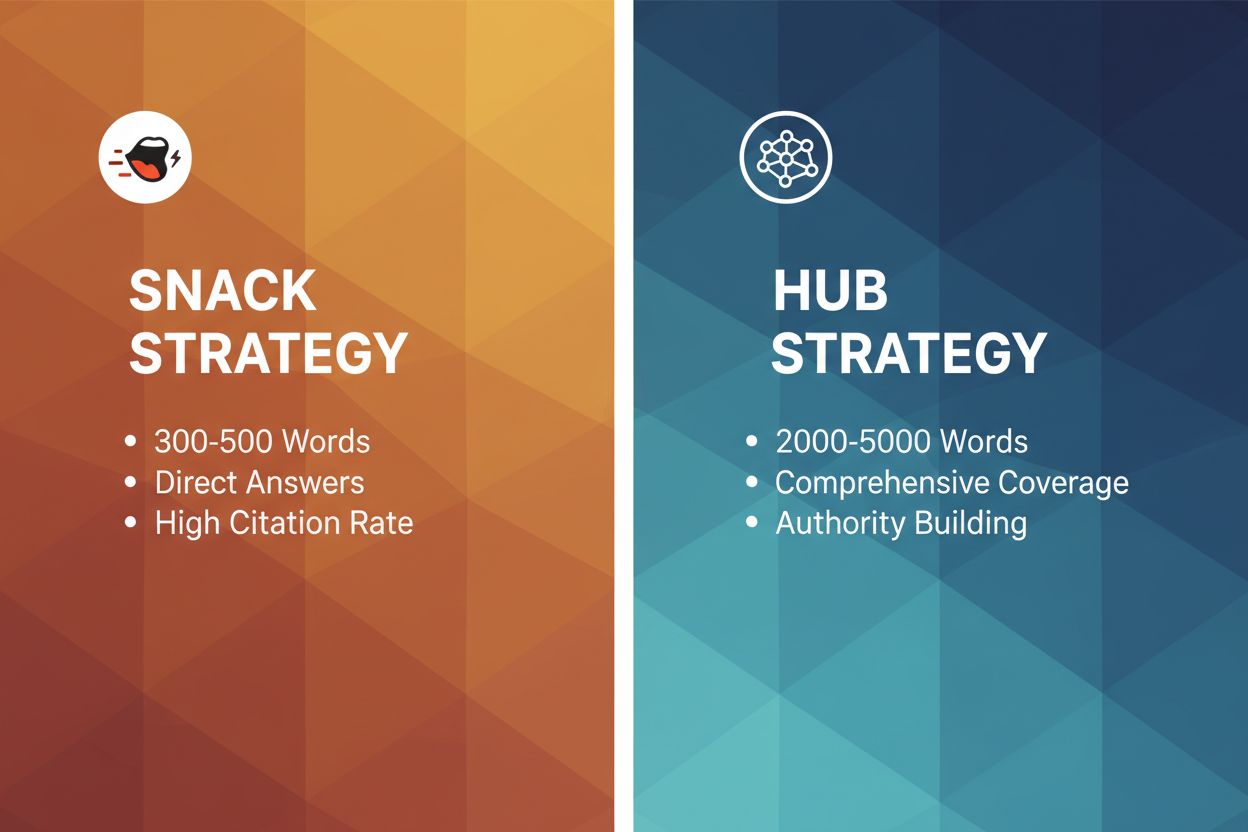
The “Snack Strategy” optimizes for short, focused content (75-350 words) that answers a specific query directly. It excels for simple, straightforward questions because it matches the answer-nugget format AI systems naturally extract. The “Hub Strategy” creates comprehensive, long-form content (2,000+ words) that explores a complex topic in depth — establishing topical authority, capturing multiple related queries, and providing context for more nuanced questions. These strategies aren’t mutually exclusive: the most effective approach creates focused snack content for specific questions, then develops hub content that links to and expands on those snacks internally. This hybrid approach captures both direct AI citations (through snacks) and comprehensive topical authority (through hubs). Query intent decides which to lean on: simple, factual questions favor snacks, complex or exploratory topics favor hubs, and most content libraries need both.
Before/After: Restructuring a Passage for Citation
Length targets are only useful once you see them applied. Take a typical “before” passage — a 340-word paragraph that opens with company background, moves through three unrelated points, and buries the actual answer in sentence six. An AI system scanning that passage has to work to extract anything citable, and is more likely to paraphrase broadly than quote directly.
The “after” version applies the targets above: a 68-word answer nugget leads with the direct answer, followed by a 150-word supporting passage that expands on one idea only, formatted with FAQ schema so the question-answer boundary is explicit. Nothing in the after version is longer than necessary for its role — the nugget answers the question, the supporting passage adds context, and neither tries to do the other’s job. That’s the practical version of “brevity combined with relevance”: each passage is exactly as long as its function requires, no longer.
Measuring Passage Performance and Iterating
Tracking passage performance means monitoring the metrics that actually indicate citation success. Citation share measures how often your content appears in AI-generated responses; citation position tracks whether your passages appear first, second, or later among cited sources. Tools like SEMrush, Ahrefs, and specialized AI monitoring platforms now track AI Overview appearances and citations directly. From there, A/B test: create multiple versions of a passage at different lengths or with different schema implementations, and monitor which version generates more citations over 30-60 days. Metrics worth tracking:
Citation frequency (how often your content is cited)
Citation position (ranking among cited sources)
Query coverage (which queries trigger your citations)
Click-through rate from AI citations
Passage extraction accuracy (whether AI cites your intended passage, not a neighboring one)
Schema markup implementation rate
Regular monitoring reveals which lengths and formats resonate with AI systems for your specific content, so targets can be refined rather than applied as a fixed rule forever.
Common Content-Structuring Mistakes That Hurt Citations
Several structural mistakes routinely undercut otherwise well-sized content. Burying the answer deep in a passage forces an AI system to search through irrelevant context before finding anything citable — put the most important information first, always. Excessive cross-referencing creates dependency on other sections, making a passage hard to extract and cite independently. Vague, non-specific language lacks the precision AI systems need for confident citation — use concrete numbers and clear statements instead of generalities. Poor section boundaries let a passage span multiple topics or incomplete thoughts, so no single AI-retrievable unit exists at all. Skipping schema markup forfeits the citation-likelihood gains described above for content that would otherwise qualify. A handful of smaller mistakes compound these: inconsistent terminology across passages, mixing multiple questions into one passage, leaving outdated information in place, and overloading a passage with promotional language that reduces its citation value. Correcting the structural mistakes — burying answers, poor boundaries, and missing schema — has the largest single impact on citation rates, ahead of any further length fine-tuning.
Frequently asked questions
Research shows 75-150 words (100-200 tokens) is optimal for most content types. This length provides sufficient context for AI systems to understand and cite your content while remaining concise enough for direct inclusion in AI-generated answers. Content under 350 words tends to land in top citation positions.
No. Research demonstrates that 53% of cited pages are under 1,000 words, and there's virtually no correlation between word count and citation position. Quality, relevance, and structure matter far more than length. Short, focused content often outperforms lengthy articles in AI citations.
It varies by format: FAQ answers perform best at 120-180 words per question, individual how-to steps at 30-50 words grouped into 150-200 word procedures, definitions at 20-40 words with a 100-150 word expansion, and comparison content needs 200-250 words to fairly represent multiple options. Content matching these type-specific targets sees roughly 3.2x more citations than one-size-fits-all passages in our data.
An answer nugget is a concise, self-contained summary — typically 40-80 words — that directly answers a specific question. Placed immediately after a heading, before supporting detail, it's the format AI systems most reliably extract for direct citation.
Yes, significantly. Pages with comprehensive JSON-LD schema markup (FAQ, HowTo, ImageObject) are 3x more likely to appear in AI Overviews. Schema helps AI systems understand and extract your content more effectively, making it easier for them to cite your passages accurately and confidently.
Use both. Write short, focused content (300-500 words) for simple, direct queries using the 'Snack Strategy.' Write longer, comprehensive content (2,000-5,000 words) for complex topics using the 'Hub Strategy.' Within long content, structure it as multiple short, self-contained passages to capture both direct citations and topical authority.
Track citation share (percentage of AI Overviews linking to your domain) using tools like BrightEdge, Semrush, or Authoritas. Monitor which specific passages appear in AI-generated answers and adjust your content structure based on performance data. AmICited also provides specialized monitoring for AI citations across multiple platforms.
Yasha is a talented software developer specializing in Python, Java, and machine learning. Yasha writes technical articles on AI, prompt engineering, and chatbot development.
Yasha Boroumand
CTO, FlowHunt
Track Which Word Counts Get Cited
AmICited.com shows exactly which passage lengths ChatGPT, Perplexity, and Google AI Overviews cite from your content, so you can validate these word-count targets against your own data.
How long should content be for AI citations? Is there a word count sweet spot?
Community discussion on optimal content length and depth for AI citations. Real data on what works for getting cited by ChatGPT, Perplexity, and Google AI Overv...
What's the ideal content length for AI search? Does word count even matter anymore?
Community discussion on optimal content length for AI search visibility. Writers and strategists share data on what length gets cited and whether word count mat...
How long should content be for AI search? Seeing conflicting advice on comprehensive vs. concise
Community discussion on ideal content length for AI visibility. Real experiences from content creators testing comprehensive vs. concise content for AI citation...
2 min read
Discussion
Content Strategy
+1
Cookie Consent We use cookies to enhance your browsing experience and analyze our traffic. See our privacy policy.