



How Law Firms Show Up in AI-Generated Legal Answers
Most law firms are invisible in AI-generated legal answers. Here's why, how ChatGPT, Perplexity, Gemini, and Google AI Overviews decide which firms to cite, and...
25 min read

A governance framework for law firms adopting AI: ABA Formal Opinion 512 obligations, confidentiality protocols, hallucination safeguards, and the policies, training, and verification workflows that keep AI use compliant.
Attorneys, paralegals, and marketing staff at most firms are already using AI daily, drafting memos, summarizing depositions, generating marketing copy, researching case law, often faster than firm leadership can write policy to govern any of it. This gap between adoption and governance is where the real risk lives. A firm doesn’t need to be careless to get burned; it just needs one associate pasting client details into a free chatbot, or one partner submitting a brief without checking the citations, to trigger a confidentiality breach or a court sanction. Governance is not a brake on AI adoption. It is the structure that lets a firm use AI aggressively without betting the firm’s reputation on every individual staff member making the right judgment call, unsupervised, every time.
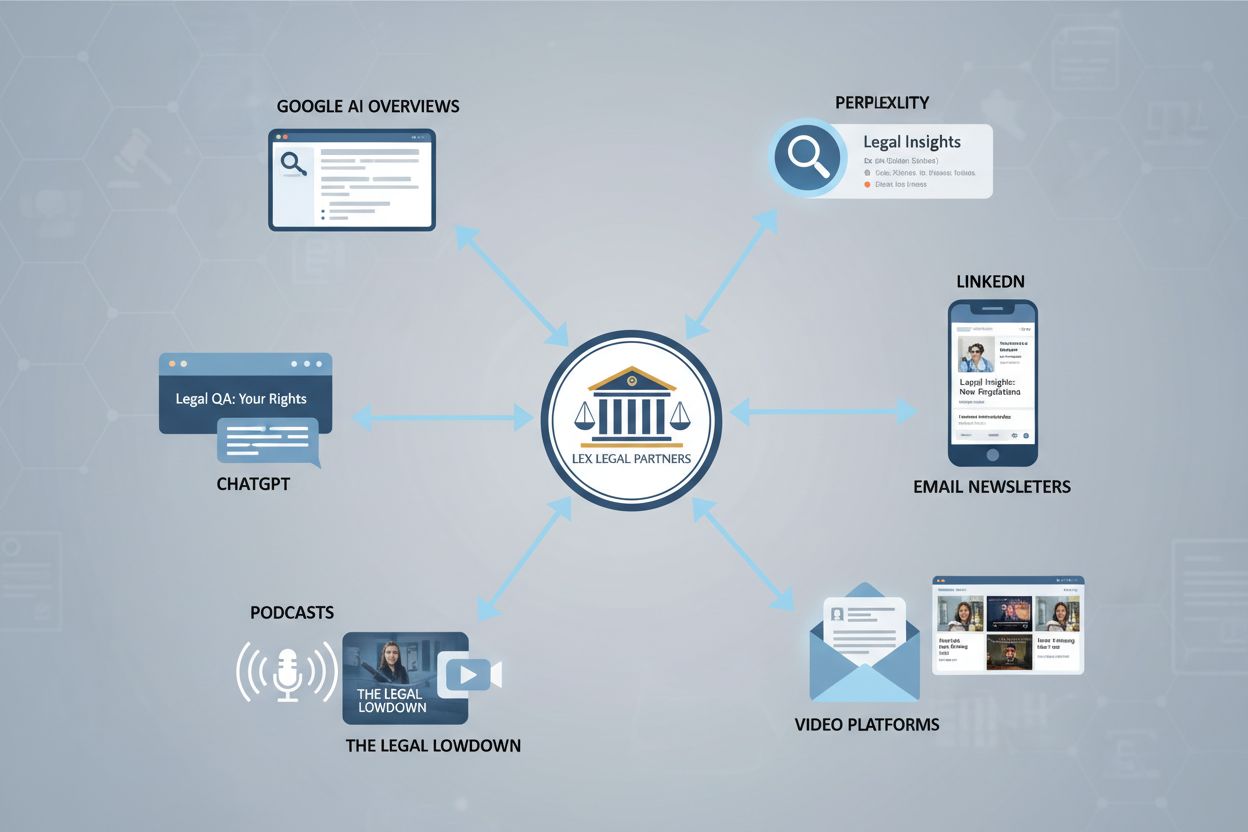
This article is about that internal governance question: what the ABA requires, how to protect client confidentiality, how to catch hallucinations before they reach a client or a court, and how to build the policies and verification workflows that make AI use defensible. It is not about whether AI engines cite your firm in a prospective client’s search engine query, that’s a separate, largely external question. Law firms that want the citation and answer-engine side of the picture should read our companion piece on how firms show up in AI-generated legal answers; this one stays focused on what happens inside the firm before anything reaches a client or the public.
The American Bar Association’s Formal Opinion 512, issued in July 2024, provides critical guidance on how attorneys must approach AI tools while maintaining ethical obligations. This landmark opinion establishes that lawyers remain fully responsible for AI-generated work product, regardless of whether they personally drafted the content or delegated it to an AI system. The opinion identifies seven core ethical obligations that intersect with AI use: competence in understanding AI capabilities and limitations, maintaining client confidentiality, candor to tribunals, proper supervision of subordinates using AI, charging reasonable fees, communicating with clients about AI use, and ensuring claims remain meritorious. Each obligation carries specific implications for how law firms can ethically leverage AI internally. The competence requirement means partners must understand not just how to use AI tools, but their accuracy rates, hallucination risks, and appropriate use cases. Confidentiality obligations require careful vendor selection and data handling protocols to ensure client information never becomes training data for third-party AI systems. Candor to tribunals means any AI-generated citations or legal analysis must be verified before submission, as courts have already sanctioned attorneys for presenting fabricated case law generated by AI.
| Ethical Obligation | AI Implication | Law Firm Action |
|---|---|---|
| Competence | Must understand AI capabilities, limitations, and accuracy rates | Conduct training on AI tools; establish competency standards before deployment |
| Confidentiality | Client data risks with third-party AI providers and LLM training | Vet vendors thoroughly; use on-premise or private AI solutions; sanitize data |
| Candor to Tribunal | AI-generated citations and legal analysis must be verified | Implement mandatory verification protocols; never submit unverified AI work |
| Supervision | Responsibility for subordinates’ AI use and outputs | Create firm-wide AI policies; monitor usage; establish approval workflows |
| Reasonable Fees | AI efficiency may require fee adjustments | Communicate AI use to clients; adjust billing to reflect efficiency gains |
| Client Communication | Clients deserve transparency about AI involvement | Disclose AI use in engagement letters; explain how it affects their matter |
| Meritorious Claims | AI must not be used to advance frivolous arguments | Verify all AI-generated legal theories; maintain independent judgment |

Track how AI chatbots mention your brand across ChatGPT, Perplexity, and other platforms.
Client confidentiality represents the most critical ethical consideration when deploying AI tools inside a law firm. Many popular AI platforms, including free versions of ChatGPT and other large language models, use submitted data to train future iterations of their systems, creating an unacceptable risk that confidential client information could be exposed or inadvertently referenced in responses to other users. The Maryland State Bar Association and similar regulatory bodies have issued specific guidance warning attorneys against inputting any client-identifying information, case details, or privileged communications into third-party AI systems without explicit contractual protections. Law firms must implement rigorous vendor vetting processes that examine data handling practices, encryption standards, data retention policies, and contractual guarantees that information will not be used for model training. Sanitization protocols become essential—any client information used in AI-assisted work must be thoroughly anonymized, with identifying details removed and replaced with generic examples. Licensing agreements with AI vendors should explicitly address data ownership, usage rights, and liability for breaches, with preference given to enterprise solutions that offer on-premise deployment or private instances. Firms should also establish clear policies distinguishing between public-facing content (where AI assistance is generally acceptable) and confidential work product (where AI use requires heightened scrutiny and client consent). Regular audits of AI tool usage help ensure compliance, and staff training must emphasize that not all AI applications are appropriate for legal work, regardless of efficiency gains.
AI hallucinations—instances where language models generate plausible-sounding but entirely fabricated information—represent a serious threat to law firm credibility and client outcomes when they slip into internal work product: briefs, memos, discovery responses, client advice letters. A hallucination occurs when an AI system confidently presents false information as fact, such as inventing case citations, misquoting statutes, or creating fictional legal precedents that sound authentic but do not exist. The legal profession has already experienced painful lessons: in 2023, two New York attorneys were sanctioned and faced potential disbarment after submitting a brief containing six fabricated cases generated by ChatGPT, and in 2024, a Texas attorney faced similar consequences for relying on AI-generated citations that had no basis in law. These incidents underscore that hallucinations are not theoretical risks but documented problems that have resulted in professional discipline and damaged client cases. Thomson Reuters research indicates that current large language models hallucinate at rates between 3-10% depending on the task complexity, meaning even seemingly reliable AI outputs require verification. Law firms must implement mandatory human-in-the-loop verification protocols where any AI-generated legal analysis, citations, or factual claims are independently verified by qualified attorneys before use in client work or court filings. This is distinct from the risk of an AI engine hallucinating about your firm when answering a prospective client’s question, that outward-facing failure mode is covered in our piece on AI-generated legal answers. Here, the concern is the firm’s own output: fabricated statistics, misquoted statutes, or invented precedent in something your firm produced and put its name on.
Get the latest insights on AI mentions, brand monitoring, and optimization strategies.
Firms that use AI to accelerate content production still need every output to pass through the same verification discipline, regardless of format. A single well-researched article on employment law can become the foundation for a video explainer, an audiogram for LinkedIn, a podcast episode, social media snippets, and email newsletter content—AI tools excel at accelerating this repurposing process: they can generate video scripts from articles, draft social captions, and develop outline variations for different audience segments. The efficiency gain is real, but it introduces a governance problem that a single-format workflow doesn’t have: five content formats mean five separate places an error, an overstated claim, or an unverified statistic can slip through if review only happens on the source article. Every derivative format needs its own review checkpoint, not an assumption that verifying the original article covers everything downstream. Developing prompt templates for common content types—such as “create a 3-minute video script explaining [legal topic] for business owners with no legal background”—enables consistent, efficient production while keeping a human reviewer in the loop for each output. Firms should assign clear ownership for AI-assisted drafting and human review per format, and treat “reviewed and approved” as a status that has to be earned separately for the article, the video script, and the social captions, not inherited automatically from the source content.
Effective AI governance requires formal policies that establish clear standards for how attorneys, paralegals, and support staff can use AI tools in their work. A comprehensive AI policy should address acceptable use cases, prohibited applications, approval workflows, and consequences for non-compliance, ensuring that enthusiasm for AI efficiency does not override ethical obligations. The policy must clearly distinguish between different categories of AI use: content creation and marketing (generally acceptable with review), legal research and analysis (requires verification and attorney oversight), client communication (requires disclosure and approval), and confidential work product (requires heightened scrutiny and often client consent). Supervision obligations under ABA Formal Opinion 512 mean that partners bear responsibility for ensuring subordinates use AI appropriately, requiring monitoring mechanisms and regular training updates. Non-attorney staff require specific guidance on which AI tools they can access, what types of information they can input, and which tasks require attorney review before completion. Technology competence standards should specify that attorneys using AI tools must understand their capabilities, limitations, and accuracy rates—this may require formal training, certifications, or demonstrated competency before independent AI use is permitted. Policies should also address how the firm will handle AI tool updates, new platforms, and emerging risks, establishing a process for regular policy review and revision as the technology landscape evolves. Documentation of policy implementation, staff training, and compliance monitoring creates evidence of good faith efforts to maintain ethical standards, which becomes important if regulatory bodies ever question the firm’s AI practices. These governance policies work only if someone owns enforcement: designate a partner or committee responsible for updates, exceptions, and incident review, rather than leaving the policy as a document nobody revisits.
Governance only works if the firm can tell whether it is actually working, and that requires different metrics than the ones used to measure external AI visibility. Policy Adoption Rate tracks what percentage of staff have completed required AI training and formally acknowledged the firm’s AI use policy. Verification Completion Rate measures what percentage of AI-assisted work product, filings, client communications, marketing content, has a documented human review checkpoint before release. Incident Rate tracks confidentiality near-misses, hallucination catches, and policy exceptions, not to punish reporting but to identify where the process is breaking down. Time-to-Verification measures how long AI-assisted content sits before a qualified reviewer signs off, flagging bottlenecks that create pressure to skip the review step. These governance metrics give you visibility into how consistently attorneys and staff actually follow the verification protocols the policy requires, as opposed to whether the policy merely exists on paper.

Key Governance Metrics for Law Firms:
These internal metrics are a different thing from the citation-facing visibility metrics, Share of Voice, mention frequency, citation rate, that measure whether AI engines actually recommend your firm to prospective clients; that side of the measurement problem belongs to a dedicated AI visibility strategy rather than a governance policy. Establish a baseline for each governance metric when the policy launches, then review quarterly alongside training refreshers so gaps get caught before they become incidents rather than after.
Law firms ready to formalize AI governance should adopt a structured four-pillar implementation approach: policy, training, verification infrastructure, and ongoing audit. The Policy pillar starts with drafting the firm-wide AI use policy described above, covering acceptable use, prohibited applications, and approval workflows, and getting partner sign-off before rollout. The Training pillar ensures every attorney and staff member understands the policy, the accuracy limitations of the specific AI tools the firm has approved, and their individual verification responsibilities; this typically requires a formal session plus a recertification cycle, not a one-time email. The Verification Infrastructure pillar builds the actual checkpoints, review assignments, sign-off logs, escalation paths for disputed content, that turn “verify before use” from a principle into a repeatable process. The Audit pillar establishes the cadence for reviewing governance metrics, checking vendor compliance, and updating the policy as new AI tools and use cases emerge.
Actionable rollout steps include: drafting the AI use policy and circulating it for partner and risk-committee review; running a firm-wide training session and requiring signed acknowledgment; standing up verification checkpoints for each category of AI-assisted output (filings, client communications, marketing content); vetting AI vendors for data handling and confidentiality guarantees before approving new tools; and scheduling quarterly governance reviews to catch drift between what the policy says and what staff actually do. Pair this rollout with your firm’s broader AI visibility roadmap once the internal governance work is solid, since a firm with airtight confidentiality and verification practices is also in a stronger position to publish the kind of attorney-authored, well-sourced content that earns AI citations. Firms that treat governance as infrastructure rather than paperwork build a durable advantage: they can adopt new AI tools faster than competitors because the guardrails are already in place, and they avoid the reputational and disciplinary costs that have already caught firms who moved fast without them.
Yasha is a talented software developer specializing in Python, Java, and machine learning. Yasha writes technical articles on AI, prompt engineering, and chatbot development.

Governance policies reduce risk from the inside. Am I Cited shows you the outside view: what ChatGPT, Perplexity, and Google AI Overview actually say about your firm, so inaccurate or non-compliant claims get caught early.
Most law firms are invisible in AI-generated legal answers. Here's why, how ChatGPT, Perplexity, Gemini, and Google AI Overviews decide which firms to cite, and...

Learn what Legal AI Visibility means for law firms. Discover how to optimize your presence in AI-generated legal answers, manage citation metrics, and build aut...

Community discussion on how law firms can improve visibility in AI-generated responses. Real experiences from legal marketers tracking AI citations and optimizi...
Cookie Consent
We use cookies to enhance your browsing experience and analyze our traffic. See our privacy policy.