


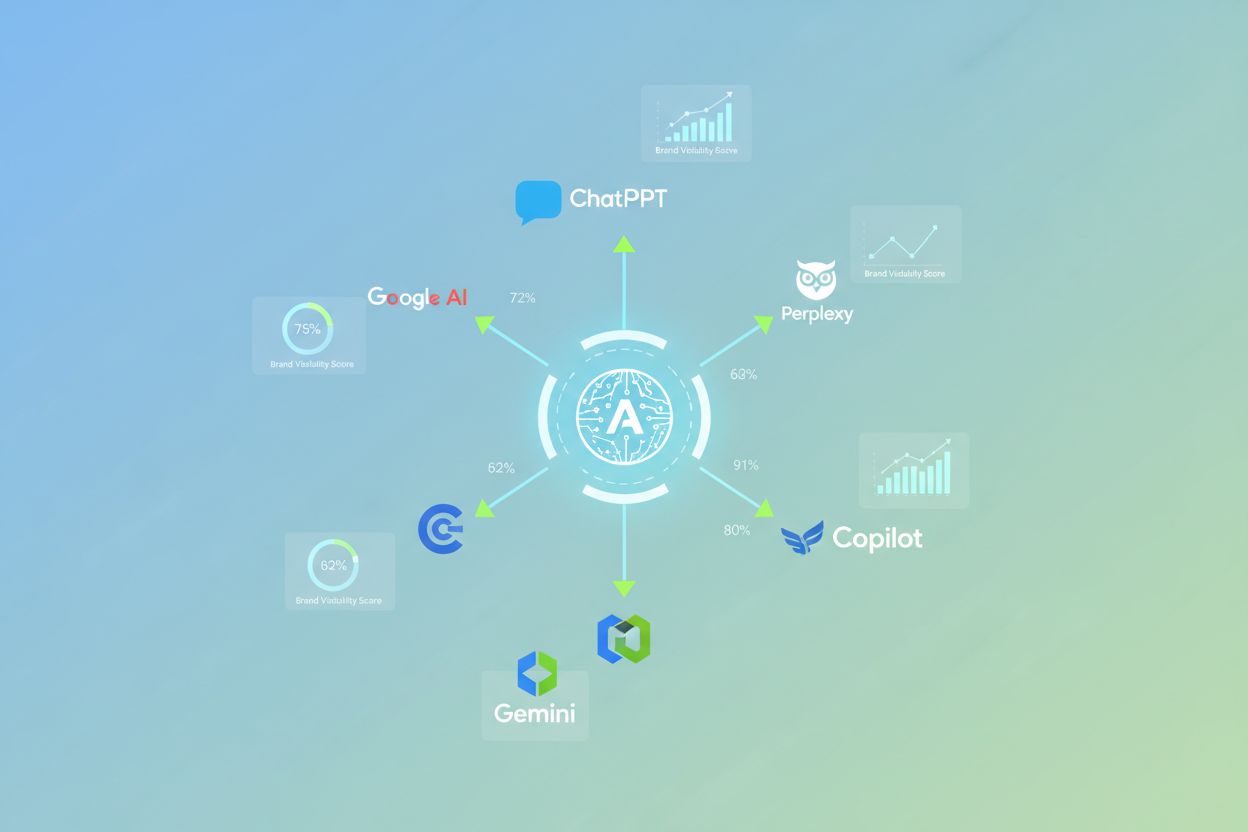
Tracking Your Brand Across 6+ AI Platforms: The Multi-Platform Approach
Learn how to monitor your brand across ChatGPT, Perplexity, Google AI Overviews, and 6+ other AI platforms. Discover multi-platform monitoring strategies, key m...
10 min read

Learn how agencies and enterprises can effectively manage brand visibility across multiple AI platforms with proven strategies, tools, and best practices for scaling AI monitoring.
Managing brand visibility across multiple AI platforms has become a critical necessity for modern organizations. Multi-brand AI visibility refers to the practice of monitoring and optimizing how your brands appear in responses generated by large language models like ChatGPT, Perplexity, Gemini, and Claude. With AI-powered search and discovery accounting for over 40% of product discovery queries, the stakes have never been higher. The challenge intensifies dramatically when organizations manage multiple brands simultaneously—each requiring distinct positioning, messaging, and monitoring strategies across different AI platforms. Agencies managing dozens of client brands and enterprises with multiple product lines face exponential complexity in tracking, analyzing, and optimizing their collective AI presence.

Digital agencies face unique challenges when managing AI visibility for multiple clients simultaneously. Each client requires white-label reporting, separate brand tracking, and customized insights that reflect their specific competitive landscape and target audiences. Agencies must balance the need for comprehensive portfolio-level oversight with the requirement to maintain strict data separation and confidentiality between clients. The ability to deliver branded, client-ready reports efficiently becomes a competitive advantage, as does the capacity to offer AI visibility as a new service offering to retain and grow client relationships.
Key requirements for agency AI management platforms include:

Track how AI chatbots mention your brand across ChatGPT, Perplexity, and other platforms.
Enterprise organizations managing multiple brands, product lines, or regional variations require fundamentally different approaches to AI visibility management. Enterprise AI visibility demands seamless integration with existing marketing technology stacks, robust API access for custom workflows, and the ability to support unlimited brands without per-brand licensing constraints. Security, compliance, and governance become paramount considerations, with enterprises needing granular permission controls, audit trails, and data residency options. The scale of enterprise operations—potentially monitoring hundreds of brands across dozens of markets—necessitates sophisticated analytics capabilities that can aggregate insights across portfolios while maintaining the ability to drill down into individual brand performance.
Selecting the right platform for multi-brand AI visibility management requires understanding the critical features that enable effective monitoring and optimization at scale. Beyond basic brand mention tracking, leading platforms must provide comprehensive capabilities that address the unique needs of managing multiple brands simultaneously.
Essential features for multi-brand AI visibility platforms:
Get the latest insights on AI mentions, brand monitoring, and optimization strategies.
The market for multi-brand AI visibility platforms has matured significantly, with several leading solutions addressing different organizational needs and budgets. Riff Analytics leads the market for comprehensive multi-brand management with unlimited brand support and query-volume-based pricing that scales efficiently. TryProfound excels in export flexibility with 15+ format options and white-label capabilities ideal for agencies. LucidRank serves enterprise clients requiring deep system integration and unlimited brand support with comprehensive API capabilities. BrandRadar specifically targets agencies with multi-region prompt tracking and recommendation engines. Profound AI provides the most comprehensive enterprise solution with advanced features like shopping insights and conversation explorer capabilities.
| Platform | Max Brands | Best For | Starting Price |
|---|---|---|---|
| Riff Analytics | Unlimited | Comprehensive portfolio management | $199/month |
| TryProfound | 20 | Client reporting agencies | $199/month |
| LucidRank | Unlimited | Enterprise integrations | $399/month |
| BrandRadar | Unlimited | Agency multi-region tracking | Custom pricing |
| Profound AI | Unlimited | Enterprise all-in-one needs | $82.50/month |
Successful implementation of multi-brand AI visibility management requires a structured approach that balances efficiency with customization. Agencies should begin by conducting a comprehensive audit of their current client portfolio, identifying which brands would benefit most from AI visibility monitoring and establishing baseline metrics for comparison.
Recommended implementation steps for agencies:
Enterprise implementation of multi-brand AI visibility management requires careful attention to integration with existing systems, governance structures, and team workflows. Organizations should map their current marketing technology stack and identify integration points where AI visibility data can enhance existing analytics, content management, and campaign optimization processes. Enterprise integration typically involves API connections to data warehouses, marketing automation platforms, and business intelligence tools, enabling AI visibility metrics to flow seamlessly into existing dashboards and reporting systems. Establishing clear governance around who can access which brands, how data is used, and what actions can be taken ensures alignment across marketing, product, and executive teams.
Organizations beginning with single-brand AI visibility monitoring often discover the need to expand to multiple brands as they recognize the competitive advantages of comprehensive AI presence management. Scaling from one brand to ten, fifty, or hundreds of brands requires more than simply adding brands to a platform—it demands systematic approaches to prompt selection, competitive benchmarking, and insight prioritization. Automation becomes critical at scale, with workflows that automatically generate reports, flag significant changes, and surface optimization opportunities reducing manual effort and enabling teams to focus on strategic decisions rather than data collection. Successful scaling also involves establishing clear processes for onboarding new brands, maintaining consistent monitoring standards, and evolving strategies as AI platforms and user behaviors continue to evolve.

Demonstrating the business value of multi-brand AI visibility management requires connecting monitoring activities to measurable business outcomes. Organizations should establish baseline metrics before implementation, then track progress against these benchmarks to quantify the impact of their AI visibility efforts.
Key metrics for measuring multi-brand AI visibility ROI:
Run this audit before deciding whether to add brands, switch platforms, or change how you allocate monitoring budget. First, list every brand, client, or product line you currently manage and check whether each has recorded baseline metrics—share of voice, sentiment score, and visibility trend—since organizations without a baseline can’t tell whether a platform change actually improved anything. Second, check your platform’s brand separation and access controls against your actual client or business-unit boundaries; agencies especially should verify that no client can see another client’s data through shared dashboards or exported reports. Third, review your reporting cadence against the daily monitoring recommended for competitive tracking—if you’re only pulling reports monthly, you’re likely missing the visibility swings that daily alerts are designed to catch. Fourth, compare your current platform’s brand limit and pricing against your growth trajectory using the comparison table above; a platform capped at 20 brands charging per-brand fees becomes expensive fast once you cross that threshold, while unlimited-brand platforms make more sense if you’re actively onboarding new clients. Fifth, check whether your AI visibility data actually flows into your existing marketing stack via API, or whether someone is still manually copying numbers into spreadsheets—that manual step is usually the first thing to break as brand count grows. Finally, revisit which prompts and keywords you’re tracking per brand; portfolios that haven’t updated their tracked queries in six months are often measuring stale search behavior instead of what customers currently ask AI systems.
Yasha is a talented software developer specializing in Python, Java, and machine learning. Yasha writes technical articles on AI, prompt engineering, and chatbot development.

Discover how AmICited helps agencies and enterprises track and optimize their presence across ChatGPT, Perplexity, Gemini, and other AI platforms with comprehensive multi-brand management.
Learn how to monitor your brand across ChatGPT, Perplexity, Google AI Overviews, and 6+ other AI platforms. Discover multi-platform monitoring strategies, key m...
Learn what an AI Visibility Dashboard is and how it tracks your brand's citations across ChatGPT, Perplexity, Claude, and Google AI. Discover key metrics, top t...
Learn how to automate AI visibility monitoring across ChatGPT, Perplexity, and Google AI. Discover tools, workflows, and best practices for tracking brand menti...
Cookie Consent
We use cookies to enhance your browsing experience and analyze our traffic. See our privacy policy.