



Domain Authority for AI Search: Why DA Doesn't Matter for AI Citations
Learn how domain authority affects AI search visibility. Discover why ChatGPT, Perplexity, and Claude prioritize expertise over DA scores and what metrics actua...
11 min read
Something strange is happening and I need a sanity check.
The situation:
We have a client in the cybersecurity space. They have a DA of 45. Their main competitor has a DA of 90 - major industry publication, millions of backlinks, been around for 20 years.
The strange part:
When I test queries in ChatGPT and Perplexity, our client gets cited MORE often for certain technical topics than the DA 90 competitor.
Our client: Cited in 65% of relevant queries DA 90 competitor: Cited in 40% of the same queries
This breaks everything I know about SEO.
Questions:
I’ve built my career on DA being a primary authority signal. Am I wrong?
You’re not wrong about traditional SEO. You’re just discovering that AI search operates on completely different principles.
The research is clear:
Semrush analyzed over 100 million AI citations. Key finding: AI search engines do not use Domain Authority in their ranking or citation algorithms.
Reddit and Wikipedia were among the most-cited domains despite having moderate DA scores. Many high-DA sites received minimal citations.
Why DA doesn’t transfer to AI:
Domain Authority measures:
AI systems evaluate:
The disconnect:
DA is a domain-level metric. AI evaluates at the page and author level.
A DA 90 site can have mediocre individual pages. A DA 20 site can have exceptional pages on specific topics.
Your client is winning because:
Their content likely demonstrates deeper topical expertise on those specific cybersecurity topics. The DA 90 competitor probably has broader but shallower coverage.
Based on the research, here’s what correlates with AI citations:
Factors that matter:
Topical Authority (High impact)
Content Recency (High impact)
Structural Clarity (Medium-high impact)
Demonstrated Expertise (Medium-high impact)
Entity Recognition (Medium impact)
Accuracy & Cross-reference (Medium impact)
What to track:
Am I Cited and similar tools track these AI-specific metrics rather than traditional SEO metrics.
I’ve seen this pattern repeatedly. Let me share some examples:
Case 1: Technical Documentation
A developer’s personal blog (DA 15) consistently gets cited for programming questions over Stack Overflow (DA 90+) for certain niche frameworks. Why? The blog has deeper, more current documentation.
Case 2: Industry Analysis
A boutique consulting firm (DA 35) gets cited more than McKinsey (DA 95) for specific market analyses. Why? They publish detailed, sector-specific research rather than broad thought leadership.
Case 3: Product Comparisons
A small review site (DA 25) beats CNET (DA 95) for certain product categories. Why? They test products themselves and provide more comprehensive comparisons.
The pattern:
Depth beats breadth. Specificity beats generalism. Recency beats legacy authority.
The implication:
Stop chasing DA. Start building topical depth on your core subjects. That’s what drives AI citations.
Let me explain WHY DA doesn’t translate to AI:
How DA works:
How AI evaluation works:
The fundamental mismatch:
DA measures “This domain is trusted by other websites.” AI measures “This specific content answers this specific question accurately.”
Example:
A DA 95 news site might have one article about cybersecurity written by a general reporter.
A DA 25 security blog has 50 articles on the topic written by a CISO with 20 years experience.
For a cybersecurity query, AI will evaluate the content and author - not the domain’s overall backlink profile.
The new mental model:
Think of it like asking for restaurant recommendations:
Which would you trust for a restaurant recommendation?
Here’s how we’ve adapted our client strategy:
Old metrics we tracked:
New metrics we focus on:
AI Citation Frequency
Topical Authority Score
Entity Strength
Content Freshness Index
Author Authority
The reporting shift:
Clients used to ask “What’s our DA?” Now they ask “What’s our AI share of voice?”
We still track DA for traditional SEO, but it’s no longer the north star metric.
I did a quantitative analysis on this. Here are the numbers:
Dataset: 5,000 AI responses with citations analyzed
DA correlation with AI citation:
Factors with stronger correlation:
What this means:
DA has SOME correlation with AI citations (it’s not zero), but it’s much weaker than other factors.
Content recency alone explains more citation variance than DA.
Practical implication:
If you had to prioritize ONE thing for AI visibility:
DA improvements would be last on the priority list.
Brand perspective on why this matters:
The DA assumption was: “Big brand = high DA = automatic trust = automatic visibility”
The AI reality: “Best answer to the question = visibility, regardless of brand size”
What this means for brand strategy:
Big brands can’t coast on reputation anymore. They need to actually have the best content on their topics.
Small brands have a massive opportunity. AI doesn’t care that you’re not a household name. It cares whether your content directly answers the question better than alternatives.
The democratization effect:
AI search is democratizing visibility based on content quality rather than accumulated brand equity.
Strategic implication:
Stop trying to be the most authoritative domain overall. Focus on being the most authoritative source for your specific topics.
A cybersecurity boutique can beat a generalist tech giant on security topics. A local restaurant can beat Yelp on specific cuisine recommendations.
Niche expertise > general authority in AI search.
As someone who’s spent 15 years building DA, this is humbling but important to accept:
What DA still matters for:
What DA doesn’t help with:
The hybrid reality:
DA isn’t dead - it still drives traditional SEO. But it’s no longer the universal authority signal.
My advice:
The mindset shift:
DA is now one signal among many. Not the signal.
We’re entering a multi-dimensional authority landscape where different metrics matter in different contexts.
This thread has fundamentally changed how I think about authority. Summary:
Key insight:
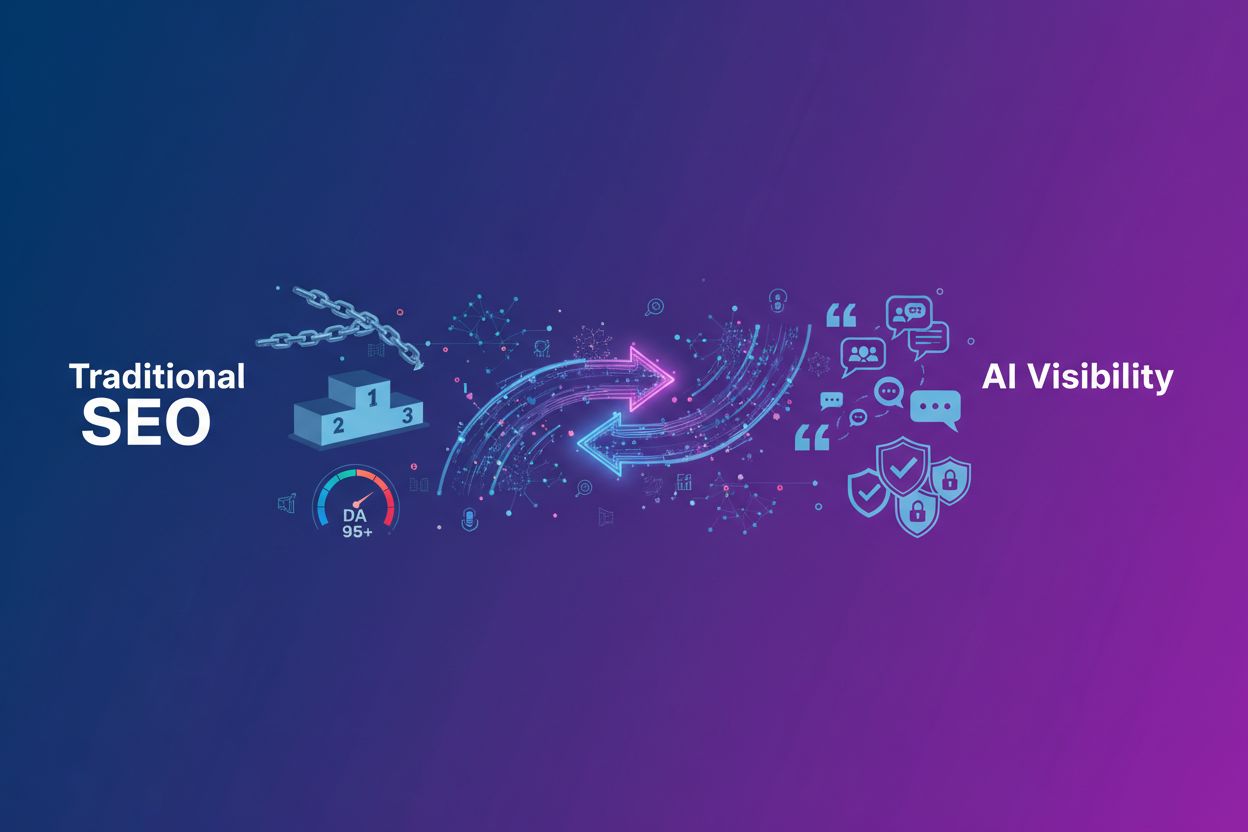
DA measures domain-level backlink authority. AI measures page-level content expertise. These are fundamentally different things.
Why my DA 45 client beats the DA 90 competitor:
New framework:
| Signal | Traditional SEO | AI Search |
|---|---|---|
| Primary metric | Domain Authority | Topical Authority |
| Level evaluated | Domain | Page/Author |
| Time sensitivity | Low | High |
| Expertise signal | Backlinks | Content depth |
| Size advantage | Big brands win | Best answer wins |
What I’m changing:
The liberating realization:
Smaller brands can absolutely compete with giants in AI search. It’s not about accumulated backlinks - it’s about having the best answer to specific questions.
Time to update our reporting dashboards and client strategy decks.
Get personalized help from our team. We'll respond within 24 hours.
Monitor where your content gets cited in AI answers regardless of domain authority. See how you compare to competitors across ChatGPT, Perplexity, and Google AI Overviews.
Learn how domain authority affects AI search visibility. Discover why ChatGPT, Perplexity, and Claude prioritize expertise over DA scores and what metrics actua...
Community discussion on how page authority differs for AI search compared to traditional SEO. Users share experiences on what actually drives AI citations.
Discover how Domain Authority impacts AI citations and visibility. Learn why DA still matters in the AI search era and strategies to improve your brand's AI pre...
Cookie Consent
We use cookies to enhance your browsing experience and analyze our traffic. See our privacy policy.