


Checkout Funnel
A checkout funnel is the sequence of steps a customer moves through from adding a product to their cart to completing a purchase, typically including cart, shipping information, payment, and order confirmation. E-commerce brands analyze it to find where customers drop off and lose revenue before completing a sale.
Definition of Checkout Funnel
A checkout funnel is the specific sequence of steps a customer passes through between adding an item to their cart and completing a purchase. It typically includes viewing the cart, entering shipping information, entering payment details, reviewing the order, and reaching a confirmation page. Unlike the broader customer journey — which covers awareness, consideration, and post-purchase stages — the checkout funnel is narrowly focused on the mechanics of completing a transaction the customer has already decided to make. Because every step in the funnel is an opportunity for a customer to abandon the purchase, the checkout funnel is one of the highest-leverage places in e-commerce to find and fix lost revenue, since the customer at this stage is already close to converting.
How a Checkout Funnel Works
A typical checkout funnel breaks into a handful of measurable stages, and merchants track the percentage of sessions that progress from one stage to the next:
- Cart view — customer has added at least one item and views the cart.
- Checkout initiated — customer clicks through to begin checkout.
- Shipping information entered — customer provides delivery details.
- Payment information entered — customer provides payment details.
- Order confirmed — the transaction completes.
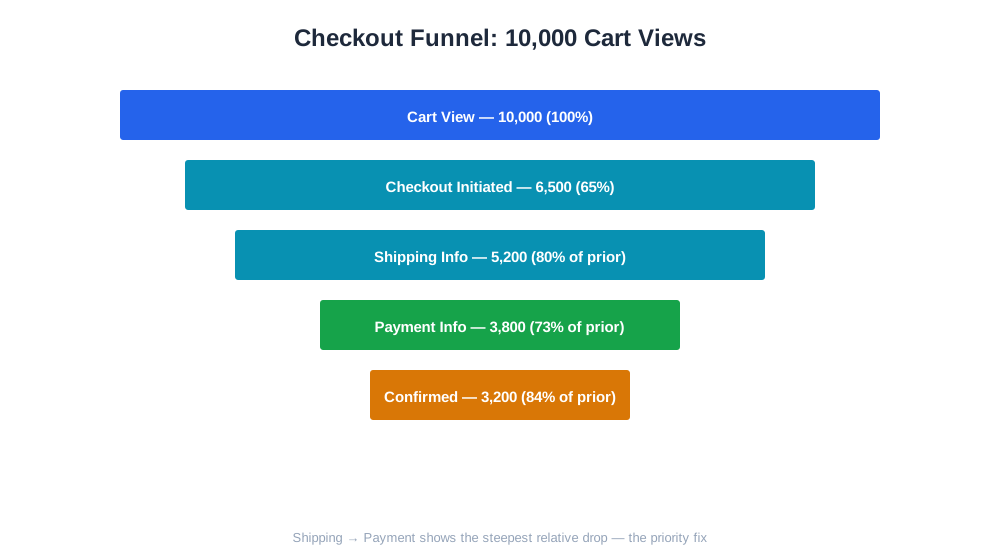
A worked example: a home goods store tracks 10,000 sessions that reach the cart view stage in a month. Of those, 6,500 initiate checkout, 5,200 complete shipping information, 3,800 reach payment information, and 3,200 confirm an order.
Calculating the drop-off at each stage: cart-to-checkout retains 65%, checkout-to-shipping retains 80% of those, shipping-to-payment retains about 73%, and payment-to-confirmation retains about 84%. The steepest relative drop is at the shipping-to-payment stage, which flags that as the priority area to investigate — perhaps the shipping cost reveal at that step is causing sticker shock, or the payment form itself has friction.

Ready to Monitor Your AI Visibility?
Track how AI chatbots mention your brand across ChatGPT, Perplexity, and other platforms.
Why Checkout Funnel Analysis Matters for E-commerce Brands
Every customer who abandons partway through checkout has already done the hard work of deciding to buy — they added a product, they started the process — which makes checkout abandonment some of the most recoverable lost revenue in e-commerce. Unlike a visitor who leaves a product page having never engaged, a checkout abandoner has demonstrated real purchase intent, so fixing the specific friction point that caused the drop-off often produces an outsized return relative to the effort involved.
Checkout funnel analysis also reveals problems that wouldn’t show up in a single blended conversion rate. A store might have a perfectly reasonable overall conversion rate while still leaking a large share of near-completed purchases at one specific step — information that only becomes visible once the funnel is broken into stages rather than measured as a single pass/fail outcome.
Checkout Funnel Stages and Common Friction Points
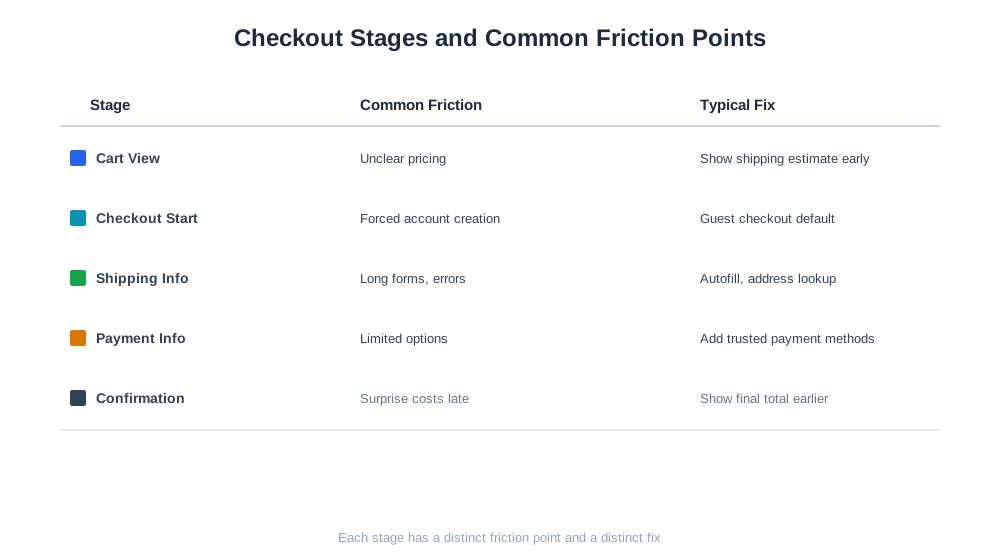
| Stage | Common Friction | Typical Fix |
|---|---|---|
| Cart view | Unclear pricing, no visible shipping estimate | Show estimated shipping and total cost early |
| Checkout initiated | Forced account creation | Offer guest checkout as the default path |
| Shipping information | Long forms, address validation errors | Autofill, address lookup, minimal required fields |
| Payment information | Limited payment options, security concerns | Add trusted payment methods, display security badges |
| Order review/confirmation | Surprise costs revealed late | Show final total, including tax, before the last step |
Stay Updated on AI Visibility Trends
Get the latest insights on AI mentions, brand monitoring, and optimization strategies.
Checkout Funnel and AI-Driven Commerce
As AI shopping assistants and agentic checkout experiences become more common, some purchases will increasingly be completed on a customer’s behalf through an AI interface rather than a traditional browser checkout flow, which changes what “the checkout funnel” even means for a growing share of orders. Merchants who support streamlined, low-friction checkout options — saved payment methods, minimal required fields, clear shipping costs upfront — are better positioned for both traditional shoppers and AI-mediated purchase flows, since both benefit from the same underlying reduction in friction.
AmICited’s eshop_get_order_mix tool breaks down order composition for connected stores by payment method, order type, and other dimensions, helping merchants spot patterns in where and how checkout friction concentrates — for example, whether a particular payment method or order type correlates with a higher abandonment or lower completion pattern.
Best Practices for Optimizing the Checkout Funnel
- Break checkout funnel measurement into discrete steps rather than tracking a single overall conversion number, so the specific point of highest drop-off is visible.
- Reveal shipping costs and taxes as early as possible in the funnel — surprise costs late in checkout are one of the most commonly cited reasons for abandonment.
- Offer guest checkout by default rather than requiring account creation before a purchase can be completed.
- Minimize required form fields and use autofill or address lookup tools to reduce the effort needed to complete shipping and payment steps.
- Test checkout funnel changes on mobile separately from desktop, since mobile friction points — small tap targets, slow-loading forms — often differ from desktop issues.
Common Checkout Funnel Mistakes
Measuring checkout performance with a single conversion number. A blended cart-to-purchase conversion rate hides exactly where in the funnel customers are dropping off. Breaking the funnel into stages is necessary to find the specific step worth fixing first.
Revealing shipping costs only at the final step. Customers who reach the last screen of checkout and see an unexpectedly high shipping cost are far more likely to abandon than customers who saw that cost earlier and already factored it into their decision to proceed.
Requiring account creation before checkout. Forcing a new account adds a real barrier for first-time customers who haven’t yet decided the brand is worth a long-term relationship. Guest checkout, with an option to create an account after the purchase completes, generally performs better.
Ignoring mobile-specific checkout friction. A checkout flow that works well on desktop can have poorly sized tap targets, slow-loading payment forms, or autofill issues on mobile that desktop testing alone won’t catch, even though mobile often represents the majority of e-commerce traffic.
Optimizing checkout funnel steps in isolation from the rest of the business. A shorter checkout that removes a legitimate step, like an order review screen, might reduce abandonment slightly while increasing return rate or customer service complaints from customers who didn’t realize what they were ordering. Checkout changes should be evaluated against downstream metrics, not just funnel completion alone.