


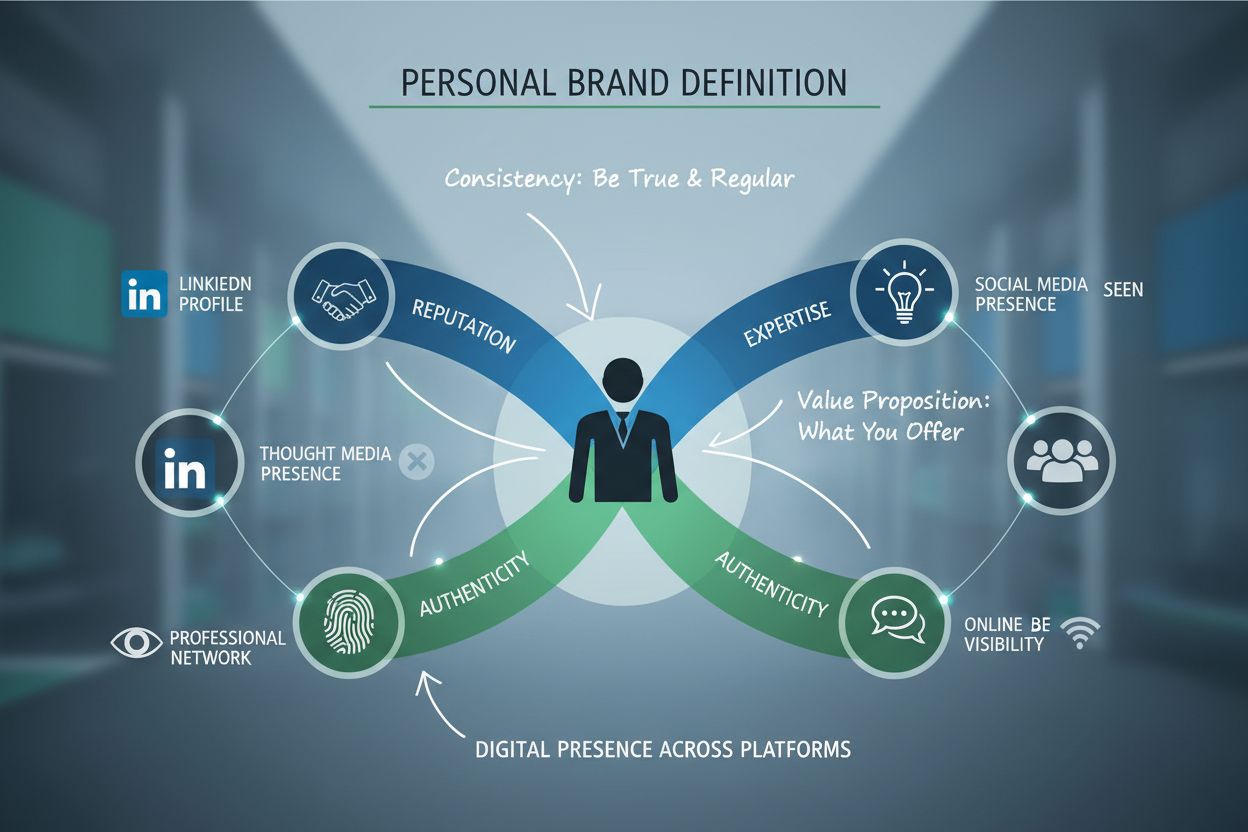
Personal Brand
Learn what a personal brand is and why it matters for professional reputation. Explore how individuals build authentic personal brands through consistency, visi...
11 min read
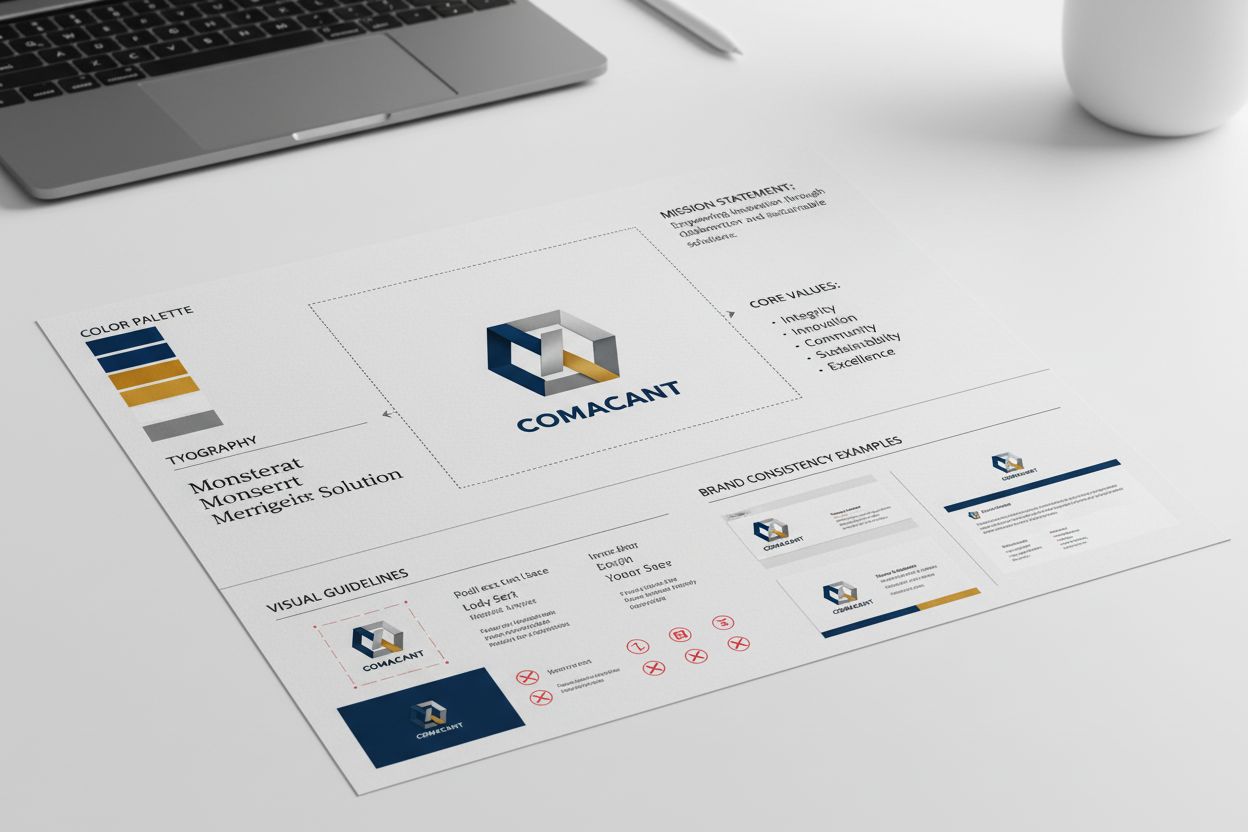
A corporate brand is the overall identity and reputation of a company as a unified entity, encompassing its name, values, mission, visual elements, and how it is perceived by all stakeholders including customers, employees, investors, and the public. It represents the parent company’s promise and differentiates the entire organization from competitors across all business operations and product lines.
A corporate brand is the overall identity and reputation of a company as a unified entity, encompassing its name, values, mission, visual elements, and how it is perceived by all stakeholders including customers, employees, investors, and the public. It represents the parent company's promise and differentiates the entire organization from competitors across all business operations and product lines.
A corporate brand is the comprehensive identity, reputation, and promise of an entire company as a unified entity, encompassing its name, logo, values, mission, visual elements, and the way it is perceived by all stakeholders. Unlike product brands that focus on individual offerings, a corporate brand represents the parent company itself and communicates to customers, employees, investors, media, regulators, and the general public. It serves as an umbrella identity that influences how the organization is perceived across all business operations, product lines, and market segments. The corporate brand is fundamentally about what the company stands for, why it exists, and what makes it distinctive in a competitive marketplace. It extends beyond visual identity to encompass organizational culture, employee behavior, corporate values, and the company’s long-term strategic vision. A strong corporate brand creates emotional connections with stakeholders, builds trust, and differentiates the entire organization from competitors in ways that are difficult to replicate.
The concept of corporate branding emerged prominently in the 1970s when major organizations began shifting their strategic focus from individual product branding to building unified company identities. Prior to this shift, most companies operated with fragmented brand portfolios where each product had its own distinct identity with minimal connection to the parent company. The evolution reflected a growing recognition that stakeholders—particularly in B2B markets—needed to understand and trust the parent organization, not just individual products. This transformation was revolutionary because it acknowledged that corporate reputation, stability, and values were as important as product features in influencing purchasing decisions and building long-term relationships. Today, corporate branding has become essential for organizations operating across multiple markets, product categories, and geographies. According to Deloitte’s CMO Survey, 51% of companies maintain a single corporate brand strategy, demonstrating the widespread adoption of this approach. The rise of digital communication, social media, and now AI search engines has further amplified the importance of corporate branding, as companies must maintain consistent identity and messaging across unprecedented numbers of touchpoints and stakeholder interactions.

Track how AI chatbots mention your brand across ChatGPT, Perplexity, and other platforms.
Understanding the differences between corporate and product brands is critical for developing appropriate branding strategies. The following comparison table illustrates the fundamental distinctions:
| Aspect | Corporate Brand | Product Brand |
|---|---|---|
| Primary Target Audience | Multiple stakeholders: customers, employees, investors, media, regulators, public | End customers and specific market segments |
| Strategic Scope | Represents entire parent company and all operations | Focuses on individual products or service lines |
| Decision-Making Authority | CEO and senior executive leadership across multiple departments | Product managers, marketing teams, or CMO |
| Brand Definition Approach | Inside-out: based on company legacy, culture, values, and strategic vision | Outside-in: based on customer insights and market needs |
| Primary Role | Build organizational trust, communicate purpose, attract talent, influence investors | Drive product preference, differentiate offerings, increase sales |
| Stakeholder Experience | Through workplace culture, investor relations, media coverage, corporate communications | Through product experience, advertising, packaging, sales interactions |
| Brand Impact Metrics | Employee retention, investor confidence, media sentiment, organizational valuation | Sales revenue, market share, customer loyalty, product adoption |
| Durability | Long-term, typically lasting decades or longer | Variable, often tied to product lifecycle |
| Competitive Advantage | Difficult to replicate; based on authentic culture and values | Easier to copy; often based on product features |
| Cost Structure | Lower management costs; single unified brand to maintain | Higher costs; multiple brands requiring separate management |
A comprehensive corporate brand comprises multiple interconnected elements that work together to create a unified organizational identity. The visual identity system includes the company name, logo, color palette, typography, imagery style, and graphic elements that appear consistently across all communications. The verbal identity encompasses the company’s mission statement, core values, brand voice, tone of communication, and key messaging pillars that define how the organization speaks to different audiences. The behavioral identity reflects how employees act, how the company treats customers, how it responds to crises, and how it demonstrates its stated values through concrete actions. The strategic identity includes the company’s unique value proposition, competitive positioning, and the specific benefits it promises to different stakeholder groups. Each of these components must be carefully defined, documented in comprehensive brand guidelines, and consistently applied across all organizational touchpoints. Brand guidelines serve as the operational manual for maintaining consistency, providing employees, partners, and external agencies with clear specifications for logo usage, color applications, typography standards, imagery requirements, tone guidelines, and messaging frameworks. Without these documented standards, corporate brand identity becomes fragmented and loses its power to create recognition and trust.
Get the latest insights on AI mentions, brand monitoring, and optimization strategies.
The financial and operational impact of a strong corporate brand is substantial and measurable across multiple business dimensions. Research demonstrates that companies with strong corporate brands experience significantly higher customer loyalty, with top-performing loyalty programs boosting revenue from engaged customers by 15-25% annually. Beyond customer metrics, corporate brand strength directly influences employee engagement and retention, with organizations featuring trusted corporate brands experiencing 5x greater revenue per employee compared to companies without strong brand identities. The impact extends to investor relations and market valuation, as a clear, authentic corporate brand narrative helps investors understand the company’s direction, stability, and long-term value creation potential. Strong corporate brands also reduce marketing costs by creating a unified identity that requires less fragmented spending across multiple product brands. Additionally, corporate brands provide resilience during crises, as stakeholder trust built through consistent brand delivery creates goodwill that protects the organization when challenges arise. The strategic advantage of corporate branding is particularly pronounced in B2B markets, where complex buying processes involving multiple decision-makers require high levels of organizational trust before purchases are made. A well-established corporate brand can shorten sales cycles, improve win rates, and command premium pricing by positioning the company as a trusted, stable, and values-aligned partner.
Organizations employ different corporate branding strategies depending on their business structure, market positioning, and strategic objectives. The masterbrand strategy (also called “Branded House”) uses the company name as the primary brand for all products and services, creating an umbrella identity that infers meaning across the entire portfolio. Virgin exemplifies this approach, with the Virgin name applied to airlines, hotels, financial services, and numerous other ventures, all communicating the company’s core values of innovation, customer service, and adventure. IBM similarly maintains a masterbrand strategy, leveraging its corporate identity across diverse technology offerings. The hybrid brand strategy combines corporate and product branding, where the company name endorses individual product brands, providing credibility while allowing product-specific positioning. Marriott’s Courtyard and Westin brands operate under this model, benefiting from Marriott’s reputation while maintaining distinct identities. The product brand strategy (or “House of Brands”) keeps the parent company name separate from product brands, allowing maximum flexibility in positioning different offerings to different markets. Procter & Gamble uses this approach, maintaining distinct brands like Tide, Gillette, and Pampers that operate independently while the parent company remains largely invisible to consumers. B2B organizations predominantly adopt masterbrand strategies because stakeholder trust in the parent organization is critical to complex purchasing decisions, whereas B2C companies more frequently use product or hybrid strategies to appeal to diverse consumer segments without brand conflicts.
The emergence of AI search engines and large language models has created a new dimension for corporate brand visibility and monitoring. AI systems like ChatGPT, Perplexity, Google AI Overviews, and Claude now generate answers to user queries by synthesizing information from multiple sources, and the corporate brands cited in these AI-generated responses gain significant credibility and influence. When a corporate brand appears in an AI answer, it signals authority and trustworthiness to users during their research and decision-making phases. Brand visibility in AI search has become a critical metric for understanding where companies are gaining or losing influence in buyer journeys. Research shows that pages updated within the past 12 months are twice as likely to retain citations in AI responses, and 60% of commercial queries cite content refreshed within the last six months. Additionally, structured content with schema markup boosts citation odds by 13%, making technical SEO and content organization increasingly important for corporate brand visibility. Companies must now monitor their corporate brand mentions across multiple AI platforms, track sentiment and context of citations, benchmark share of voice against competitors, and connect brand visibility metrics to business outcomes like pipeline generation and revenue. This represents a fundamental shift in how corporate brands are perceived and measured, as AI visibility has become as important as traditional search rankings in influencing buyer perception and decision-making.
Developing and maintaining a strong corporate brand requires systematic attention to multiple elements and consistent execution across the organization:
As corporate brands increasingly appear in AI-generated content, organizations must develop systematic approaches to monitor and optimize their brand presence across AI platforms. Brand visibility scoring provides a quantifiable metric by calculating the percentage of AI answers that mention a company’s brand relative to total answers for relevant queries. For example, if a company appears in 22 out of 100 AI responses for high-intent queries in their category, their brand visibility score would be 22%. This metric helps organizations understand their share of voice against competitors and track how visibility changes over time. Citation rate tracking reveals how frequently the corporate brand is mentioned in AI responses, while sentiment analysis determines whether mentions are positive, neutral, or negative. Organizations should monitor their corporate brand across multiple AI platforms including ChatGPT, Perplexity, Google AI Overviews, and Claude, as each platform may cite different sources and present information differently. Content freshness and structure significantly impact AI citation rates, making it essential to regularly update pages with new data, reorganize content with clear headings and lists, and implement schema markup to improve discoverability by AI systems. By connecting corporate brand visibility metrics to business outcomes like demo requests, sales pipeline, and closed deals, organizations can demonstrate the tangible business impact of their brand presence in AI search and justify continued investment in brand development and optimization.
Consider a mid-sized B2B software company that built its reputation under a single product name, then acquired two smaller companies with their own established customer bases and product identities. The leadership team faces the exact decision outlined in the masterbrand-versus-hybrid-versus-portfolio framework: fold everything under the parent company name, keep the acquired brands separate, or blend the two. Because the company operates in B2B markets where buying committees need to trust the organization behind the product—not just the product itself—they rule out a pure portfolio approach like Procter & Gamble’s, where the parent company stays invisible to the end customer. They also reject an immediate full masterbrand rename, since abruptly replacing the acquired companies’ names would risk losing the brand equity and customer trust those companies built independently, right when customer retention through the transition mattered most. They land on the hybrid model: “Acquired Company X, part of [Parent Company],” mirroring the Marriott-Courtyard pattern, giving customers continuity while signaling the backing and stability of the larger organization. Eighteen months later, once customers have absorbed the association, they revisit the decision and migrate fully to the masterbrand for the products that benefited most from the parent company’s broader reputation, while keeping the hybrid naming for a product line whose original brand still carried more recognition in its niche than the parent name did.
Start tracking how AI chatbots mention your brand across ChatGPT, Perplexity, and other platforms. Get actionable insights to improve your AI presence.
Learn what a personal brand is and why it matters for professional reputation. Explore how individuals build authentic personal brands through consistency, visi...

Build a company profile with verified identity facts, authoritative sources, governed sameAs links, Organization schema, and reliable update controls.

Learn what a brand entity is and how to define, structure, and maintain one so AI systems can recognize it. Covers entity components, relationship building, cro...
Cookie Consent
We use cookies to enhance your browsing experience and analyze our traffic. See our privacy policy.