


Cross-sell
Cross-selling is the practice of recommending complementary or related products alongside an item a customer is already buying, aiming to increase order value by encouraging additional purchases. It differs from upselling, which encourages a customer to buy a more expensive version of the same item rather than an additional, related one.
Definition of Cross-sell
Cross-selling is a sales technique that recommends a complementary or related product to a customer who is already purchasing or considering another item, with the goal of increasing the total value of the order. A classic example is a customer buying a camera being shown a memory card, a camera bag, or a spare battery, items that add genuine utility to the primary purchase rather than replacing it. Cross-selling is distinct from upselling, which nudges a customer toward a pricier version of the same item they’re already considering. Both tactics aim to increase order value, but cross-selling does so by widening the basket, while upselling does so by raising the price point of a single item within it.
How Cross-selling Works
Effective cross-selling depends on identifying genuinely complementary products and surfacing them at the moment a customer is most receptive: while browsing a product page, while reviewing their cart before checkout, or immediately after completing a purchase. The recommendation itself can be manually curated by a merchandiser based on category logic, or generated algorithmically from actual purchase history, most commonly using association techniques that identify which products are frequently bought together across many past orders.
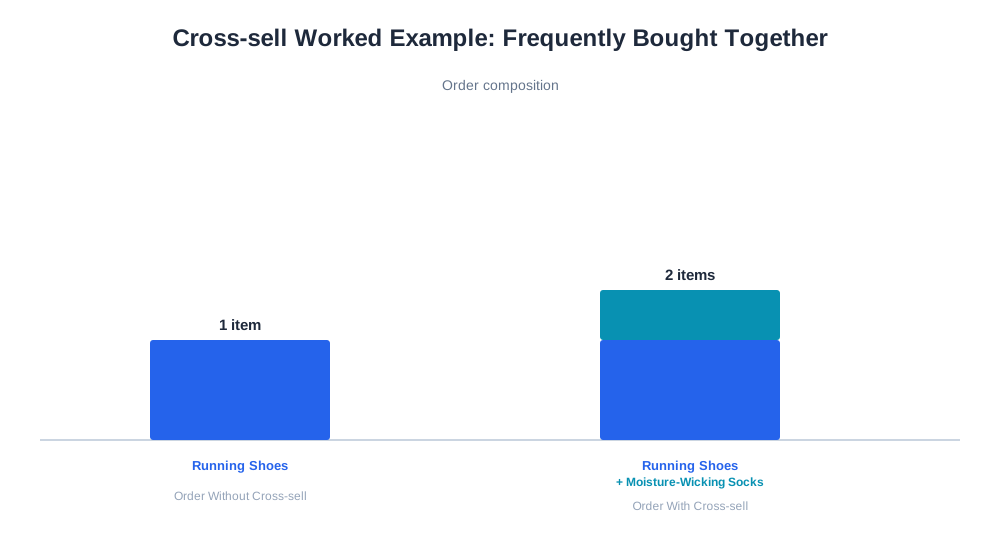
A worked example: a store selling running shoes notices, through its order history, that customers who buy a particular shoe model also buy moisture-wicking socks in a meaningful share of the same orders, far more often than would be expected by chance. Placing that sock as a “frequently bought together” recommendation on the shoe’s product page and in the cart captures purchases that would otherwise have been separate transactions, or missed entirely, increasing the average order value for that shoe without requiring any additional traffic or advertising spend.

Ready to Monitor Your AI Visibility?
Track how AI chatbots mention your brand across ChatGPT, Perplexity, and other platforms.
Why Cross-selling Matters for E-commerce Brands
Cross-selling is one of the more efficient levers for increasing revenue per customer, because it works on traffic and demand that already exists rather than requiring additional marketing spend to acquire it. A customer already in a buying mindset, actively completing a purchase, is generally more receptive to a relevant additional suggestion than a cold visitor who has not yet decided to buy anything. Done well, cross-selling also improves the customer experience by surfacing genuinely useful items the customer might not have thought to look for, such as reminding a phone buyer that they’ll need a case and screen protector before the phone arrives.
The risk lies in relevance and restraint. Cross-sell recommendations that feel like generic upselling, are unrelated to the item being purchased, or appear too aggressively at checkout can annoy customers and increase abandonment rather than order value. The most effective cross-sell programs are grounded in real purchase data rather than assumed category logic, since actual buying patterns often reveal pairings a merchandiser would not have guessed, while ruling out pairings that seem logical on paper but rarely occur together in practice.
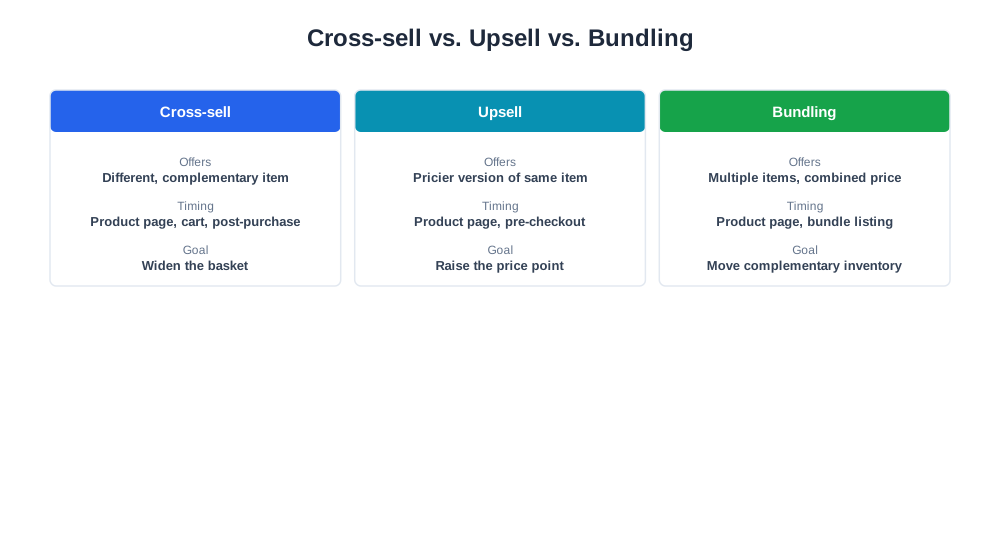
Comparison Table: Cross-sell vs. Upsell vs. Bundling
| Tactic | What It Offers | Timing | Goal |
|---|---|---|---|
| Cross-sell | A different, complementary product | Product page, cart, post-purchase | Widen the basket |
| Upsell | A pricier version of the same product | Product page, pre-checkout | Raise the item’s price point |
| Bundling | Multiple products packaged at a combined price | Product page, dedicated bundle listing | Increase order value and move complementary inventory together |
Stay Updated on AI Visibility Trends
Get the latest insights on AI mentions, brand monitoring, and optimization strategies.
Cross-selling and AI-Driven Commerce
As AI shopping assistants like ChatGPT Shopping, Perplexity Shopping, and Amazon Rufus increasingly help shoppers compare and choose products, cross-sell logic is starting to shift from a store’s own product page into the AI assistant’s response itself, where an assistant recommending a camera might also surface accessories a shopper would need alongside it. Brands whose product data clearly documents genuine complementary relationships, whether through structured product feeds or explicit “frequently bought together” signals, are better positioned to have those relationships reflected accurately when an AI assistant is compiling a recommendation, rather than the assistant guessing at generic accessory categories.
Identifying which products actually belong in a cross-sell relationship is best done from real order data rather than assumption. AmICited’s eshop_get_product_bundles report analyzes purchase history to surface cross-sell pairings along with lift and confidence scoring, quantifying not just that two products are bought together but how much more often they’re bought together than random chance would predict, giving merchandisers a defensible basis for which pairings are worth prioritizing in cart and product-page recommendations.
Best Practices for Cross-selling
- Base cross-sell recommendations on actual co-purchase data rather than category assumptions alone, since real buying patterns often diverge from what seems logical
- Place cross-sell suggestions at natural decision points: the product page, the cart, and post-purchase confirmation, rather than interrupting the checkout flow itself
- Limit the number of recommendations shown at once; a small number of highly relevant suggestions outperforms a long list of loosely related ones
- Reassess cross-sell pairings periodically, since purchase patterns shift with new product launches, seasonality, and changing customer preferences
- Track incremental order value lift from cross-sell placements specifically, rather than assuming a recommendation widget is working just because it’s present
Common Cross-sell Mistakes
A frequent mistake is cross-selling based purely on category adjacency, for instance always recommending “other items in this category” regardless of whether those specific items are ever actually bought together, which produces recommendations that feel generic and are easy for customers to ignore. Another common issue is showing too many cross-sell suggestions at once, overwhelming the customer with options at a decision point where simplicity and relevance convert better than volume. Some stores also place cross-sell prompts at the wrong moment, interrupting the checkout flow with new suggestions right as a customer is trying to complete payment, which adds friction rather than value and can increase abandonment. A further pitfall is never revisiting cross-sell pairings once set, letting recommendations grow stale as new products launch and customer buying patterns shift, so that pairings that made sense a year ago no longer reflect current demand. Finally, some merchants confuse cross-selling with upselling in their recommendation logic, showing a more expensive version of the same product where a genuinely complementary item would have converted better, missing the distinct psychological trigger each tactic depends on.