


Ecommerce Conversion Rate
Ecommerce conversion rate is the percentage of store visitors who complete a purchase, calculated by dividing total orders by total sessions or visitors over a given period. It is one of the core efficiency metrics for an online store, reflecting how well traffic is being turned into revenue.
Definition of Ecommerce Conversion Rate
Ecommerce conversion rate is the percentage of visitors to an online store who complete a purchase, calculated as the number of completed orders divided by the number of sessions (or unique visitors) over a given period. It is one of the most closely watched metrics in online retail because it captures, in a single number, how effectively a store turns traffic into revenue — a store can drive a large volume of visitors through advertising or organic search, but if conversion rate is weak, that traffic doesn’t translate into proportional sales. Conversion rate is typically tracked at the overall store level, but it’s most actionable when broken down further: by device, by traffic source, by landing page, and by customer type (new versus returning), since a single blended number can hide very different underlying performance across those segments.
How Ecommerce Conversion Rate Is Calculated
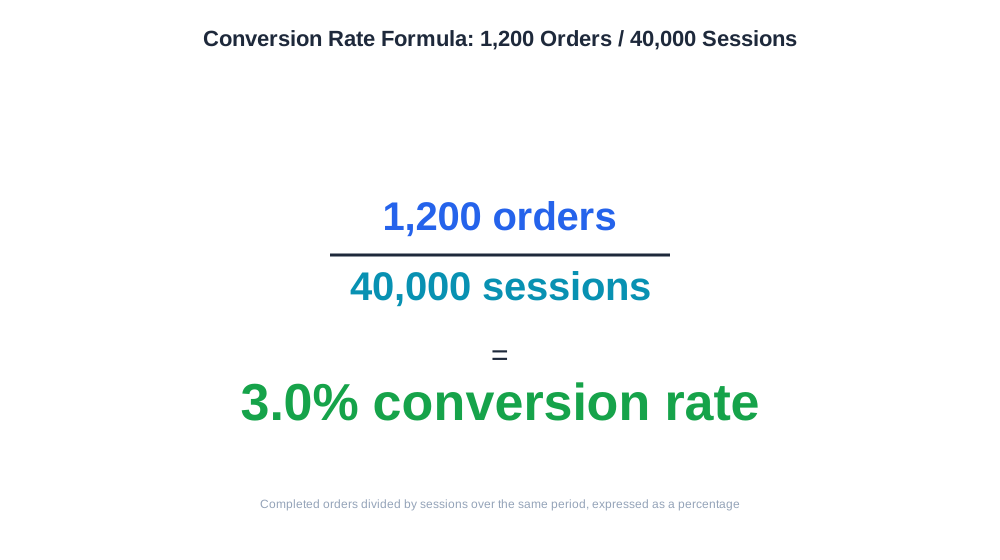
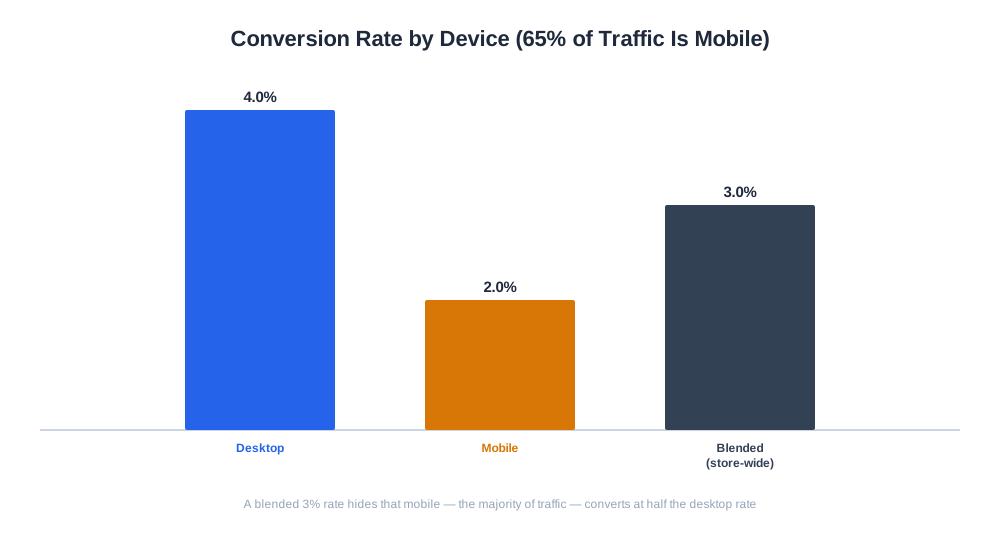
The core formula is simple: conversion rate equals completed orders divided by sessions, expressed as a percentage. A worked example: a store records 40,000 sessions and 1,200 completed orders in a month. That’s 1,200 divided by 40,000, or a 3% conversion rate. Breaking this down further often reveals more useful detail — if desktop sessions convert at 4% while mobile sessions convert at 2%, and mobile represents 65% of total traffic, the store’s overall rate is being pulled down by an underperforming mobile experience that a blended number alone wouldn’t surface clearly.
It’s also worth distinguishing conversion rate from related but narrower metrics. Checkout conversion rate measures only the share of customers who start checkout and complete it, isolating friction in that specific step from broader issues like weak product pages or unclear value proposition earlier in the funnel. A store might have a healthy checkout conversion rate but a low overall ecommerce conversion rate if the problem is earlier — poor product discovery, unclear pricing, or a landing page that doesn’t match visitor intent.

Ready to Monitor Your AI Visibility?
Track how AI chatbots mention your brand across ChatGPT, Perplexity, and other platforms.
Why Ecommerce Conversion Rate Matters for E-commerce Brands
Conversion rate matters because it’s often cheaper to improve than to acquire more traffic. Doubling a store’s traffic through advertising typically requires a proportional increase in ad spend, while improving conversion rate from, say, 2% to 2.5% can produce a comparable revenue lift without any additional spend — it simply captures more value from traffic the store is already paying for or already earning organically. This is why conversion rate optimization (CRO) is treated as a distinct discipline from traffic acquisition in most mature e-commerce operations, often with a dedicated testing program running product page, checkout, and pricing experiments continuously.
Conversion rate also serves as an early warning signal. A sudden drop in conversion rate, isolated to a specific device, browser, or traffic source, often points to a technical problem — a broken checkout step, a slow-loading page, or a tracking error — that would otherwise go unnoticed until revenue itself visibly declines.
Ecommerce Conversion Rate by Segment
| Segment | Typical Pattern | Why It Differs |
|---|---|---|
| Desktop vs. mobile | Desktop often converts higher | Larger screen, easier checkout entry, less distracted context |
| New vs. returning visitors | Returning visitors often convert higher | Established trust, saved payment/shipping details, prior positive experience |
| Paid search vs. organic vs. social | Paid search often converts higher due to intent match | Traffic source reflects different stages of purchase intent |
| First-time vs. repeat product category | Familiar, low-consideration categories often convert higher | Higher-consideration purchases require more research before converting |
Stay Updated on AI Visibility Trends
Get the latest insights on AI mentions, brand monitoring, and optimization strategies.
Ecommerce Conversion Rate and AI-Driven Commerce
AI shopping assistants are changing what “traffic” and “conversion” even mean for a store. When a customer researches and compares products through ChatGPT Shopping or Perplexity Shopping before ever visiting a merchant’s site, much of the consideration phase that traditionally happened on-site (and that conversion rate implicitly measured) now happens off-site, inside the AI interface. A visitor who arrives at a store’s site after already comparing options through an AI assistant may convert at a meaningfully different rate than a visitor arriving cold from a generic search result, since they’ve effectively pre-qualified themselves before landing. Stores should expect conversion rate benchmarks to shift as AI-mediated discovery grows, and should track conversion rate by referral source carefully enough to separate AI-referred traffic from other channels as that data becomes available.
Measuring conversion rate accurately also depends on connecting it to the metrics that determine whether a conversion was actually profitable. AmICited’s eshop_get_kpis and eshop_get_cross_source reports track conversion rate alongside average order value, repeat purchase rate, and margin, giving merchants a fuller picture than conversion rate alone — since a rising conversion rate driven by heavy discounting can coincide with falling margin, a pattern that a conversion-rate-only dashboard wouldn’t reveal.
Best Practices for Improving Ecommerce Conversion Rate
- Break conversion rate down by device, traffic source, and new-versus-returning visitor before drawing conclusions from the blended overall number.
- Reduce checkout friction directly — guest checkout options, transparent shipping costs shown early, and fewer required form fields all tend to lift conversion.
- Run structured A/B tests on high-traffic pages rather than making design changes based on intuition alone.
- Monitor conversion rate for sudden drops isolated to a specific segment, which often signal a technical bug rather than a genuine demand shift.
- Pair conversion rate with average order value and margin when evaluating whether a change actually improved the business, not just the raw percentage.
- Set realistic, store-specific benchmarks based on your own historical performance rather than chasing generic industry averages that may not reflect your traffic mix or price point.
Common Ecommerce Conversion Rate Mistakes
A common mistake is comparing a store’s conversion rate directly against a generic industry benchmark without accounting for differences in price point, traffic quality, or product category — a store selling a considered, higher-priced product will naturally convert lower than one selling an impulse-purchase item, and treating both against the same benchmark leads to the wrong conclusions. Another frequent issue is optimizing conversion rate in isolation from margin, where aggressive discounting or overly generous return policies can lift the conversion number while quietly eroding profitability per order. Stores also sometimes calculate conversion rate on inconsistent traffic definitions — mixing bot traffic, excluding certain session types inconsistently across periods — which makes month-over-month comparisons unreliable. Finally, a subtler mistake is reacting to conversion rate changes without first checking for a tracking or technical issue; a sudden apparent drop is sometimes a broken analytics tag or a checkout bug rather than a real change in customer behavior, and treating it as a marketing problem when it’s actually a technical one wastes effort solving the wrong issue.