


- A Google penalty is a loss of rankings or removal from results for breaking Google’s rules. Google calls the human kind a manual action; automated systems can also demote spammy or unhelpful pages.
- Only manual actions appear in Search Console, in the Manual actions report with the issue type and sample URLs. Algorithmic demotions have to be inferred from the timing of a drop.
- To recover from a manual action, fix every instance (not only the sample URLs), document the work and file a reconsideration request.
- Most traffic drops are not penalties. Check for migrations, noindex or robots.txt errors, tracking problems, seasonality and core updates first.
Where AmICited fits
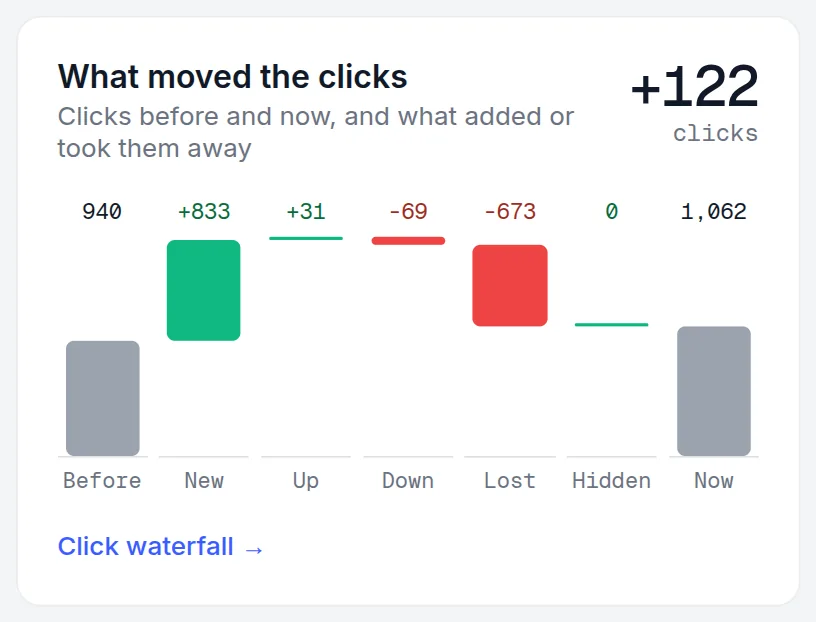
AmICited reads your Google Search Console and Bing Webmaster Tools data, marks Google updates and holidays on your search trend and splits click changes into new, rising, falling and lost queries, so you can date a drop and see whether it lines up with an update.
See the click waterfall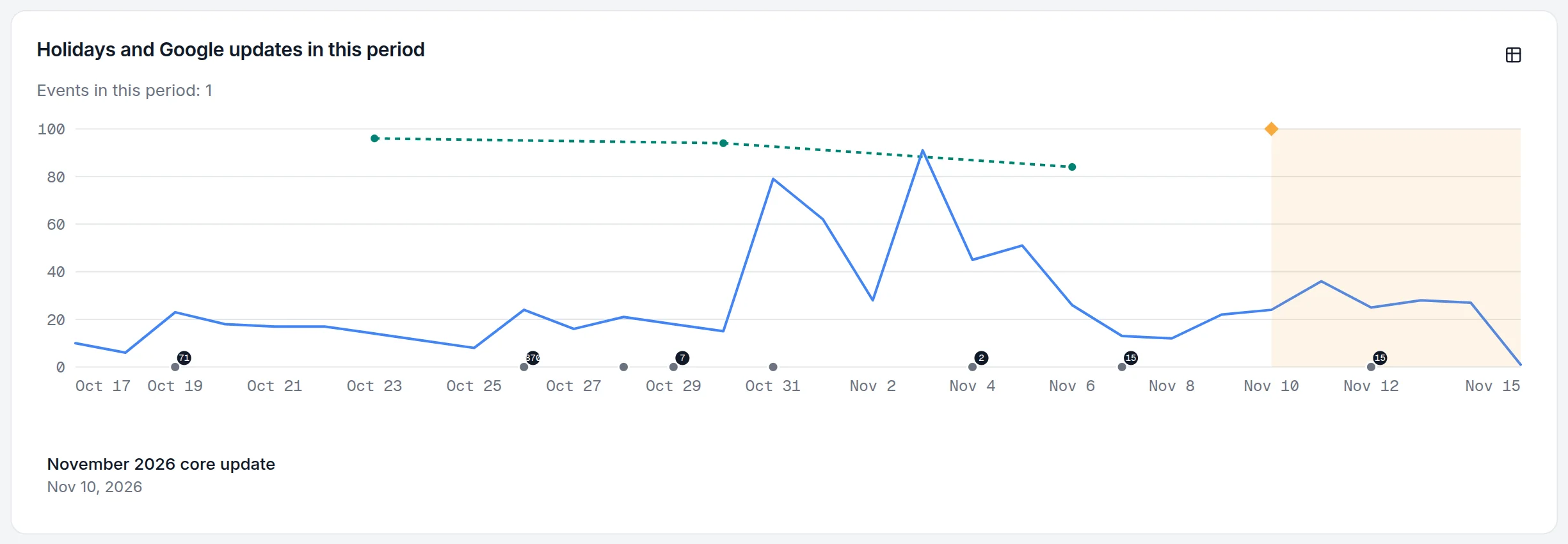
What Is a Google Penalty?
A Google penalty is a drop in rankings, or full removal from Google’s results, as a consequence of breaking Google’s rules or falling short of its quality systems. Google itself rarely uses the word “penalty”. It talks about manual actions, applied by human reviewers for spam policy violations, and about its ranking systems demoting content that is spammy or unhelpful.
Site owners usually discover a penalty through a sudden traffic drop in Google Analytics or Google Search Console. The first job is working out which kind it is, because the fix and the recovery process are completely different.
How Google Penalties Work
Manual actions happen when a Google reviewer confirms that pages violate the spam policies. They can affect specific pages (“partial match”) or the whole site (“site-wide match”). They’re listed in Search Console’s Manual actions report.
Algorithmic demotions come from automated systems. SpamBrain detects spam patterns, link spam systems discount manipulative links, and core ranking systems reassess quality during Google algorithm updates. Historic systems like Panda (content quality, 2011) and Penguin (link spam, 2012) have since been folded into Google’s core systems. Nothing is reported. You infer it from timing.
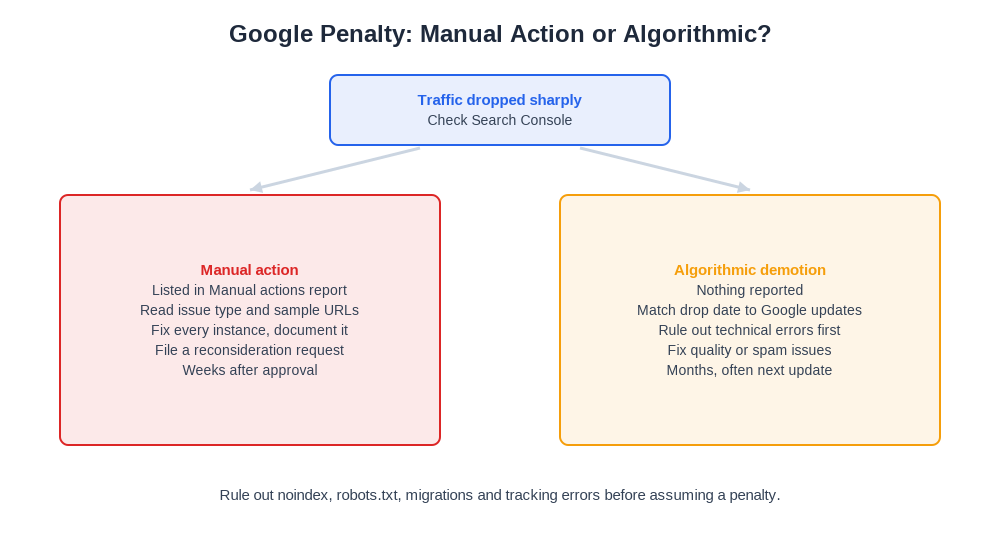
Recovery from a manual action follows a set process:
- Read the notice. It names the issue type and gives sample URLs.
- Fix all of it. Remove or nofollow paid links, delete or improve thin pages, clean hacked content, remove cloaking.
- Document. Record what you removed, who you contacted for link removal and what you disavowed.
- Request review. Submit a reconsideration request from the Manual actions report.
- Wait and respond. Google approves or rejects. If rejected, fix what’s left and resubmit.
Here’s a sense of scale. Say a site gets 40,000 organic clicks a month and receives a site-wide manual action for unnatural links. If the cleanup takes six weeks and the review two more, that’s around two months at a fraction of normal traffic: tens of thousands of lost clicks. Rankings also don’t always return to their old level, because the links that were propping them up are now discounted.
Manual Action vs Algorithmic Demotion
| Manual action | Algorithmic demotion | Core update drop | |
|---|---|---|---|
| Who decides | A Google reviewer | Automated spam systems | Core ranking systems |
| Reported in Search Console? | Yes, Manual actions report | No | No |
| Cause | Spam policy violation | Spam patterns detected | Pages judged less helpful than others |
| Is it a “penalty”? | Yes | Effectively | Not really, it’s a reassessment |
| How to recover | Fix, then reconsideration request | Fix, then wait for reassessment | Improve content and site quality, wait for later updates |
| Typical timeline | Weeks after a successful request | Months | Months, often until the next core update |
Common Types of Manual Actions
Google’s Manual actions report lists issue types such as:
- Unnatural links to your site, and unnatural links from your site
- Thin content with little or no added value, including doorway pages
- Cloaking and sneaky redirects
- Hidden text and keyword stuffing
- User-generated spam, such as spam comments or forum profiles
- Structured data issues, such as markup that doesn’t match the visible content
- Site reputation abuse, where third-party pages exploit a host site’s ranking signals
- Spammy free hosts, and pure spam sites
Security problems such as hacked content or malware appear separately in the Security issues report.

Stay Updated on AI Visibility Trends
Get the latest insights on AI mentions, brand monitoring, and optimization strategies.
Google Penalties and AI Search
Google AI Overviews and Google AI Mode use Google’s index and ranking systems, so pages that are demoted or removed lose visibility there too. Other AI engines run their own retrieval, but many draw on search indexes, so a penalty can still reduce how often a site gets cited.
The bigger risk is to brand trust. If an AI engine reads that your site was involved in link schemes, or cites competitor pages instead of yours for months, recovery takes longer than the penalty itself. Tracking AI citations next to rankings, for example with AmICited’s AI visibility reports, shows whether a recovery in Google has carried over to AI answers.
Best Practices for Avoiding a Google Penalty
- Check the Manual actions and Security issues reports in Search Console regularly and whenever traffic falls.
- Monitor rankings and clicks per query so you can date a drop precisely and match it to updates.
- Audit backlinks when you take over a site or end an agency relationship.
- Mark paid and affiliate links with
rel="sponsored". - Moderate user-generated content and block spam sign-ups.
- Don’t publish pages at scale unless each one gives users something useful.
- Keep structured data truthful and matched to visible content.
Common Google Penalty Mistakes
The most common mistake is assuming every traffic drop is a penalty. Many are caused by a site migration, a noindex or robots.txt error, tracking problems, seasonality or a core update. Check the technical basics and the Manual actions report before rewriting your link profile.
Other mistakes come during recovery: filing a reconsideration request after fixing only the sample URLs, disavowing whole swaths of good links in panic, deleting large parts of a site that only needed improvement, or moving to a new domain and redirecting the penalized one, which can carry the problem over.