


- LSI keywords is an SEO label for related terms. It borrows the name of latent semantic indexing, a retrieval method from around 1990 built for small, fixed document sets.
- Google does not use LSI. In 2019 Google’s John Mueller said there is no such thing as LSI keywords.
- The useful part is real: pages that explain the subtopics and questions readers expect do better than pages stuffed with a word list.
Where AmICited fits
AI engines split a prompt into fan-out sub-queries and match passages by meaning. AmICited’s Semantic Map plots your prompts, their fan-out queries and the cited pages by meaning, so you can see which related questions your pages leave open.
See the semantic map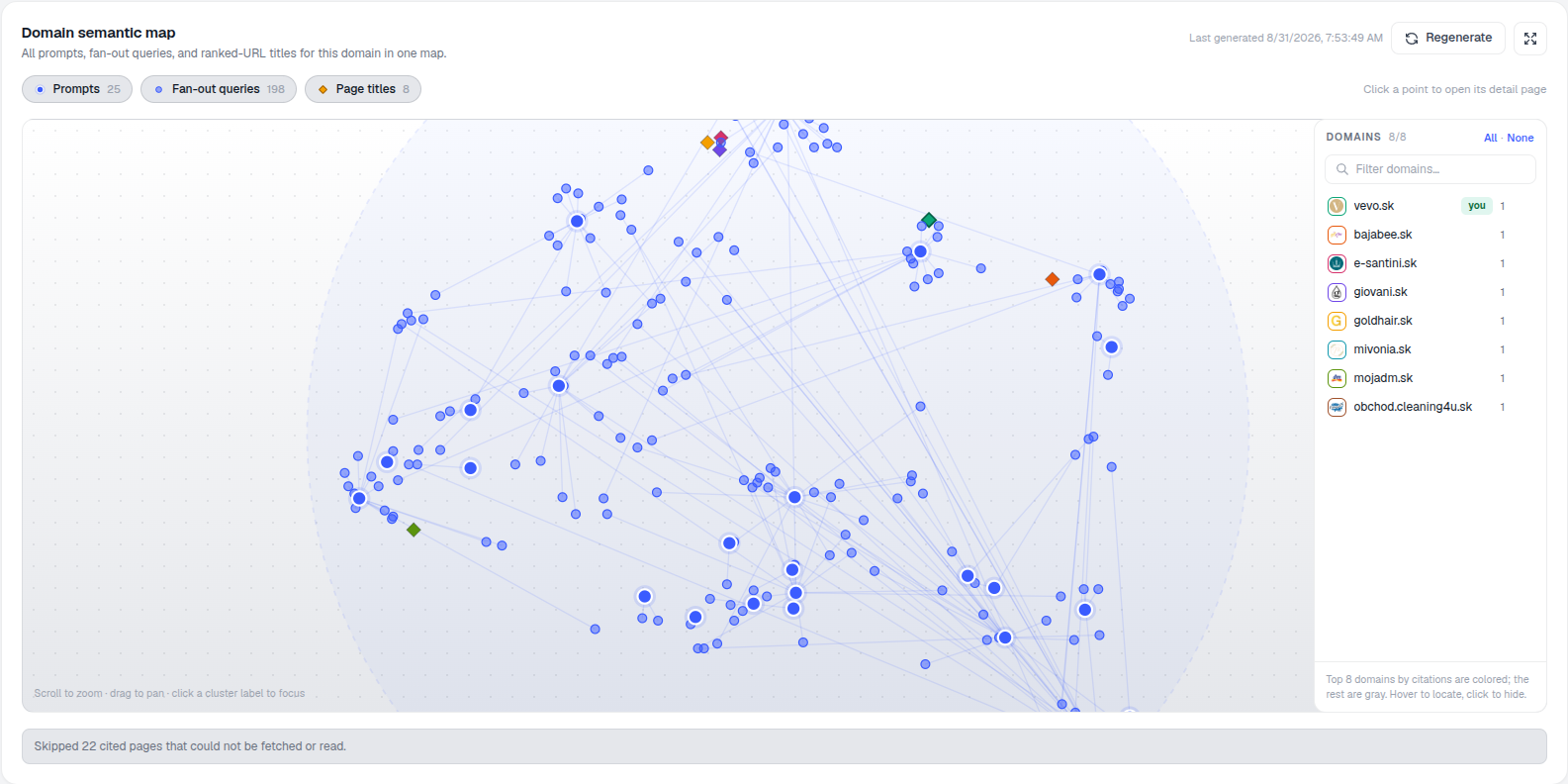
What Are LSI Keywords?
LSI keywords are terms that SEO tools and blogs describe as “semantically related” to your main keyword. The name comes from latent semantic indexing, an information retrieval method from the late 1980s. The claim behind the term is that Google uses LSI to understand topics, so adding LSI keywords to a page helps it rank.
That claim is wrong. Google has said it does not use latent semantic indexing, and its John Mueller put it bluntly in 2019: there’s no such thing as LSI keywords. Still, the phrase is searched thousands of times a month, appears in many SEO plugins and courses, and points at something real: pages that cover the related concepts of a topic usually serve readers better. This page explains what LSI actually is and what to do instead.
How Latent Semantic Indexing Actually Works
LSI was developed by researchers at Bellcore and described in a 1990 paper by Deerwester, Dumais and colleagues. It works on a fixed collection of documents:
- Build a matrix. Rows are terms, columns are documents, and each cell counts how often a term appears in a document.
- Reduce it. A method called singular value decomposition compresses the matrix into a small number of “latent” dimensions.
- Compare in that space. Terms that often appear in the same documents end up close together, so a query for “car” can match a document about “automobiles”.
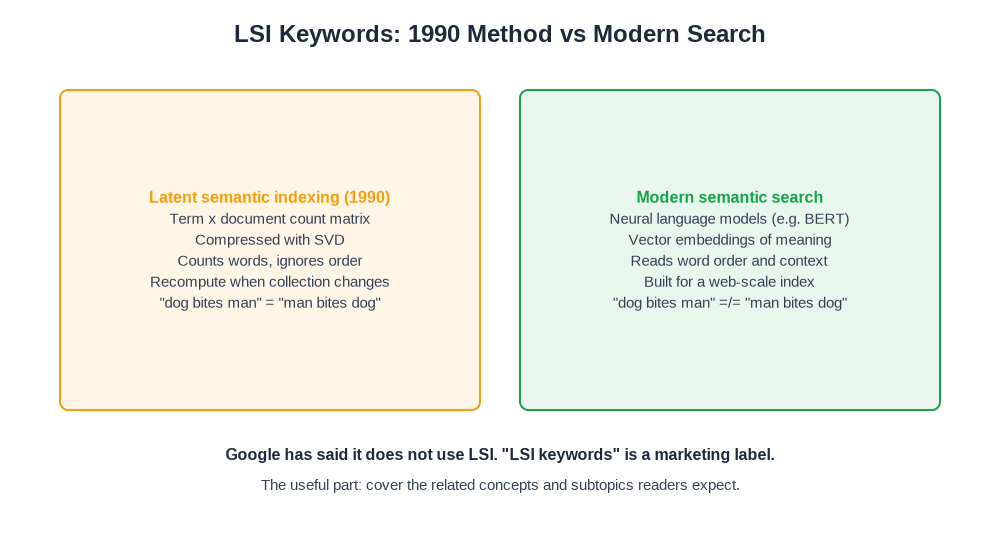
That was a real step forward in 1990. But LSI must recompute the whole decomposition when the collection changes, and it struggles with scale. A web index with hundreds of billions of pages changing every second is a poor fit. Modern search uses neural language models such as BERT and vector embeddings that understand word order and context, which LSI ignores.
A quick example of the gap: LSI treats “dog bites man” and “man bites dog” as identical, because it only counts words. A transformer model reads them as opposite events.
LSI Keywords vs Semantic Keywords vs Synonyms
| Term | What it means | Real or myth | What to do with it |
|---|---|---|---|
| LSI keywords | Marketing label for “related terms”, tied to LSI | The label is a myth; related terms are useful | Ignore the label, keep the useful part |
| Synonyms | Different words with the same meaning (“cheap”, “affordable”) | Real, handled by search engines automatically | Use naturally for readability |
| Related concepts | Entities and subtopics of a topic (“grind size” for cold brew) | Real and valuable | Cover the ones readers expect |
| Co-occurring terms | Words that often appear together in top pages | Real pattern, not a ranking factor | Use as a research prompt, not a checklist |
| Semantic SEO | Optimizing for topics, entities and intent | Real practice | Build pages around it |
How to Use Related Keywords Instead
Drop the idea of inserting a keyword list and do this:
- Map the questions. Pull People also ask, related searches and the H2s of the top five results. Group them into the subquestions your page should answer.
- Check your own data. In Google Search Console, look at the queries a page already gets impressions for but doesn’t answer well.
- Cluster them. Use keyword clustering to decide which related terms belong on this page and which deserve their own.
- Write explanations, not mentions. A related term earns its place when you explain it. “Use a coarse grind (like breadcrumbs) so the coffee doesn’t over-extract” helps. “Coarse grind” dropped into a sentence doesn’t.

Stay Updated on AI Visibility Trends
Get the latest insights on AI mentions, brand monitoring, and optimization strategies.
Why the LSI Keywords Myth Persists
The idea stuck because it explains something real. Pages that rank well do tend to use many related terms, so the correlation looks like proof. In fact those pages use related terms because they cover the topic well, and covering the topic well is what ranks. Adding the terms without the coverage reverses cause and effect.
Tools also kept the label alive. “LSI keyword generator” is an easy product to sell, and the lists they produce look scientific. Most of them simply scrape autocomplete, related searches or co-occurring words from top pages. That’s useful raw material for research, but it has nothing to do with latent semantic indexing.
LSI Keywords and AI Search
AI search makes the LSI myth even less relevant. ChatGPT, Perplexity, Gemini and Google AI Overviews split a prompt into several sub-queries and retrieve passages by meaning using embeddings. Your page doesn’t need a word list; it needs passages that answer those sub-queries clearly.
To see which related questions AI engines actually generate for your topic, AmICited’s Semantic Map shows prompts, fan-out queries and cited pages grouped by meaning.
Best Practices for Related Keywords
- Research subtopics from real search data, not from an “LSI keyword generator”.
- Answer each important subquestion in its own short section with a direct first sentence.
- Use synonyms where they make the text read better, not to hit a count.
- Keep separate intents on separate pages, and link them with descriptive anchors.
- Revisit pages when new related questions appear in search results or AI answers.
Common LSI Keyword Mistakes
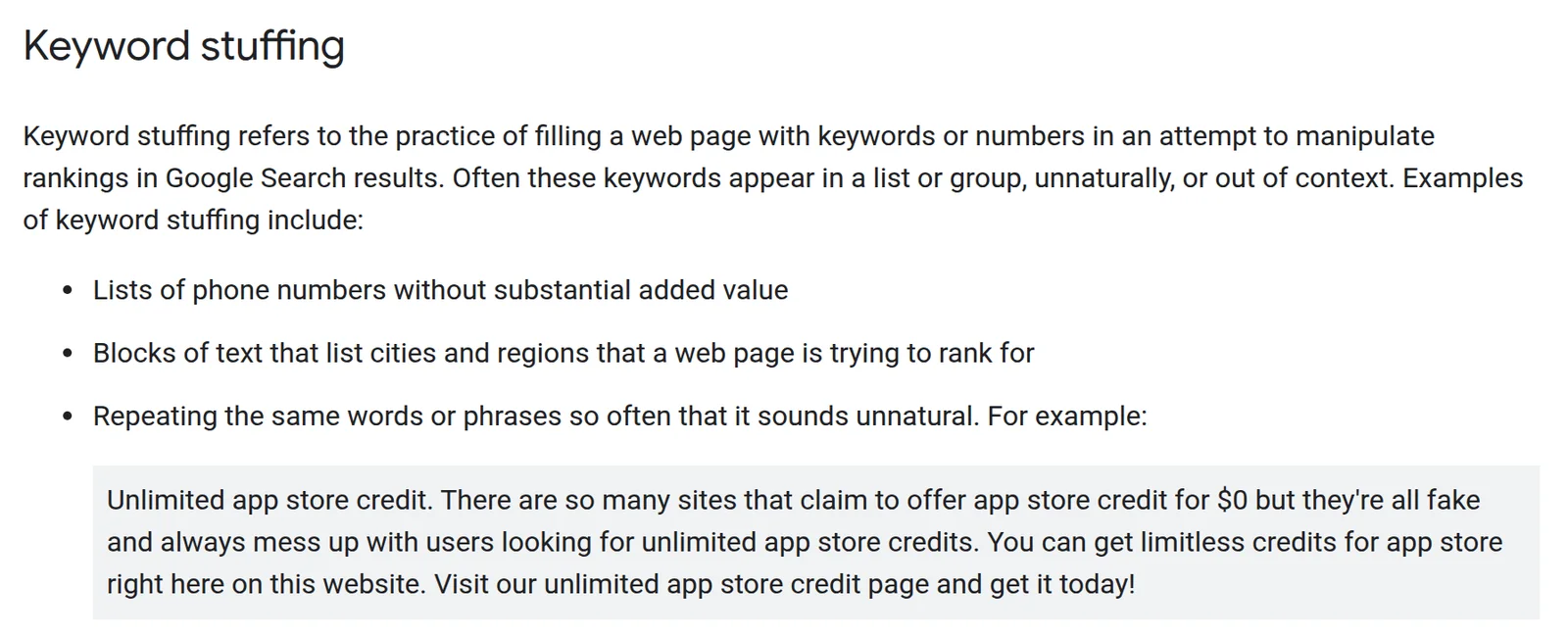
The main mistake is believing the myth and paying for tools or services that promise “LSI optimization”. The output is usually a list of co-occurring words, and pasting them into a page produces awkward text without any ranking benefit. A related mistake is keyword stuffing by another name: repeating a dozen variants of the main keyword under the impression that they are distinct LSI terms.
The subtler mistake is throwing out the useful part along with the myth. Pages that cover related concepts thoroughly do perform better, because they answer more of what searchers want. Keep that, and stop calling it LSI.