


- Semantic SEO means optimizing a page for a topic and its meaning (the entities involved and the questions that come next) instead of one exact keyword.
- Google has read queries by meaning since Hummingbird, RankBrain and BERT, so one page can rank for hundreds of queries it never repeats word for word.
- Measure coverage: if the top results answer 8 subquestions and your page answers 3, you have a semantic gap, whatever your keyword count.
- AI engines split prompts into fan-out sub-queries, so a page that answers the follow-up questions has more passages that can be cited.
Where AmICited fits
AmICited’s Semantic Map plots your tracked prompts, their fan-out queries and the titles of cited pages by meaning, so you can see which subtopics you cover and which ones competitors answer and you don’t.
See the Semantic Map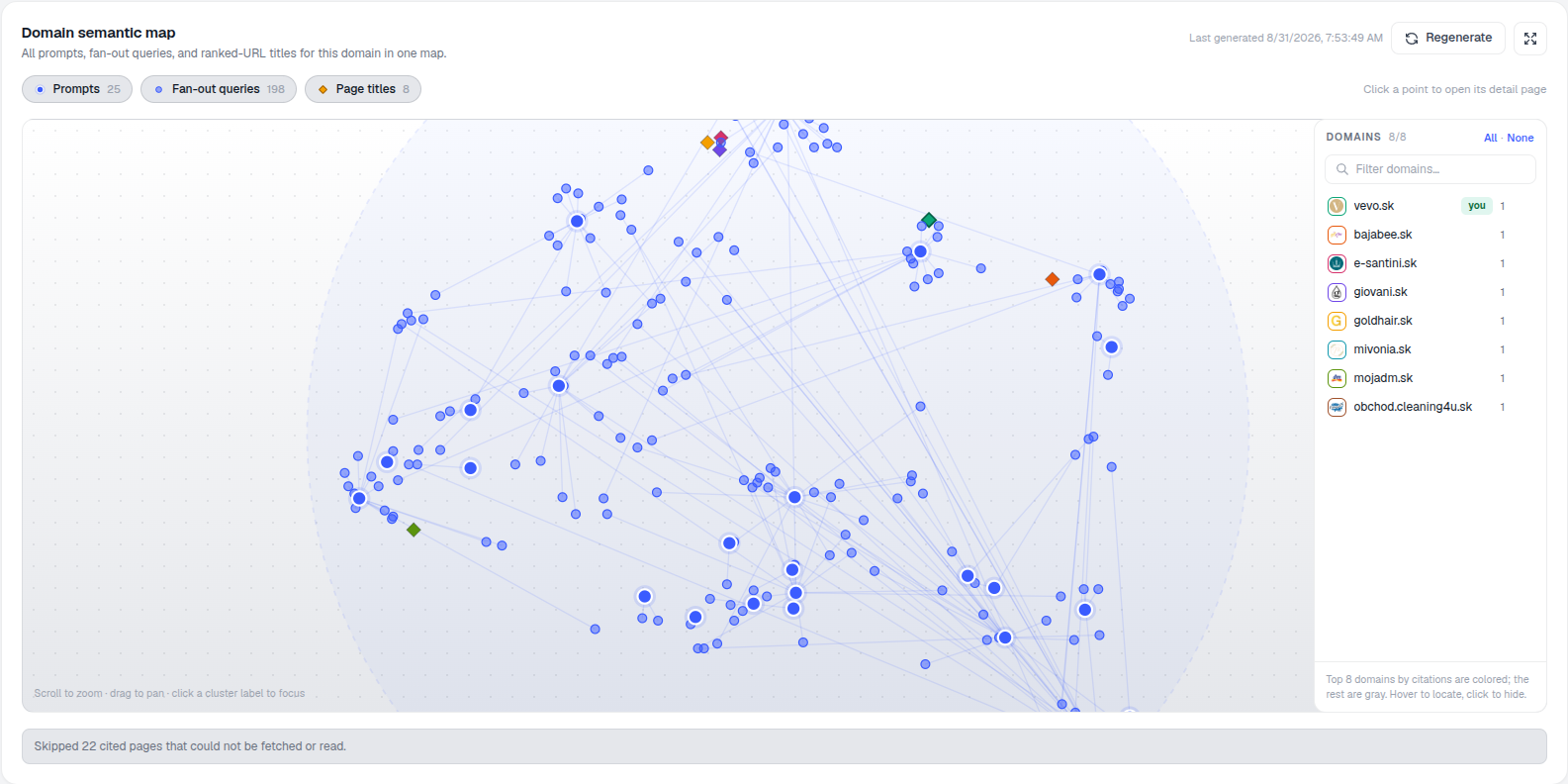
What Is Semantic SEO?
Semantic SEO is optimizing content for meaning: the topic a searcher cares about, the entities involved and the questions that naturally come next. Instead of building a page around one exact phrase, you build it around a subject and cover it well enough that a search engine can tell the page fully answers the query and its close relatives.
The shift came from Google itself. The Knowledge Graph (2012) introduced entities, Hummingbird (2013) moved Google toward understanding whole queries, RankBrain (2015) and BERT (2019) added machine learning that reads words in context. Today Google can rank a page for hundreds of queries that never appear on it word for word. Semantic SEO is how content teams write for that reality.
How Semantic SEO Works
Search engines turn queries and passages into representations of meaning, then match them. Semantic SEO works with that process in four steps.
- Pick the core topic and intent. “Cold brew coffee” with informational search intent means the reader wants to make it.
- List the entities. Coffee beans, grind size, water, ratio, steep time, refrigerator, iced coffee, acidity.
- List the subquestions. What ratio? How long to steep? How long does it keep? Is it stronger than hot coffee? How is it different from iced coffee?
- Structure the page. One H2 per subquestion, a direct answer under each, a table where comparison helps, and structured data that names the main entity.
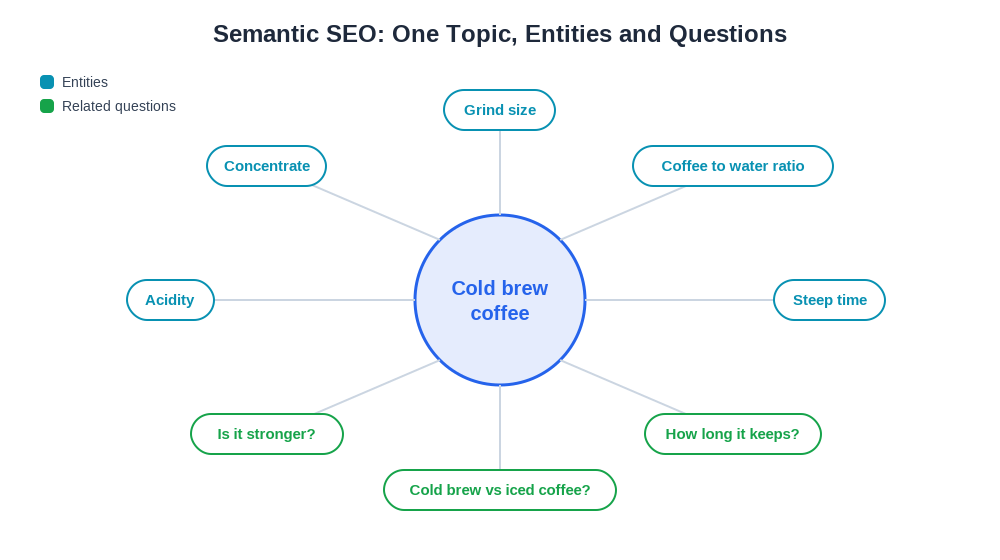
A useful check is coverage: count the subquestions your page answers out of the ones that show up in “People also ask”, related searches and competitor H2s. If the top results cover 8 subquestions and you cover 3, you have a semantic gap, regardless of how many times your main keyword appears.
Semantic SEO vs Traditional Keyword SEO
| Keyword-focused SEO | Semantic SEO | |
|---|---|---|
| Unit of optimization | One keyword per page | One topic per page, many queries |
| Main signal | Exact phrase in title, H1, body | Entities, subtopics and intent covered |
| Typical tactic | Repeat the keyword at a target density | Answer related questions, define entities |
| Handling variants | Separate pages for “best X” and “top X” | One page, variants treated as the same intent |
| Risk | Keyword stuffing, thin pages | Overlong pages if every tangent is included |
| Fits with | Older lexical matching | Semantic search, embeddings, AI answers |
Keywords still matter. The query has to be addressed in plain words, ideally in the title and first paragraph. Semantic SEO just stops treating the keyword as the whole job.
Semantic SEO Techniques
- Topic clusters. A pillar page covers the broad subject and links to focused pages for each subtopic. See the topic cluster model.
- Keyword clustering. Group keywords that share search results into one page target with keyword clustering, so you don’t split one intent across several URLs.
- Entity clarity. Name things precisely (“Apple the company” vs “apple the fruit”) and use schema such as Organization, Product or Article to remove ambiguity.
- Internal links with descriptive anchors. Anchor text tells search engines how two pages relate.
- Answer-first sections. Put a one or two sentence answer right under each question heading.

Stay Updated on AI Visibility Trends
Get the latest insights on AI mentions, brand monitoring, and optimization strategies.
How to Audit a Page for Semantic Gaps
Pick one important page and check it against the search results it competes in:
- Search its main query and note the H2s of the top five results.
- Add the People also ask questions and related searches.
- Merge duplicates into a list of subquestions.
- Mark each subquestion as answered well, answered weakly or missing on your page.
- Fill the missing ones that match the page’s intent, and move the rest to other pages.
Repeat this every few months for pages that matter. Search results change, and new subtopics show up in them before they show up in keyword tools.
Semantic SEO and AI Search
Semantic SEO matters even more in AI search. ChatGPT, Perplexity, Gemini and Google AI Overviews break a prompt into several sub-queries (often called fan-out queries), retrieve passages that match each one by meaning, and then write an answer that cites a few sources. A page that answers the main question and the obvious follow-ups has more passages that can match those sub-queries.
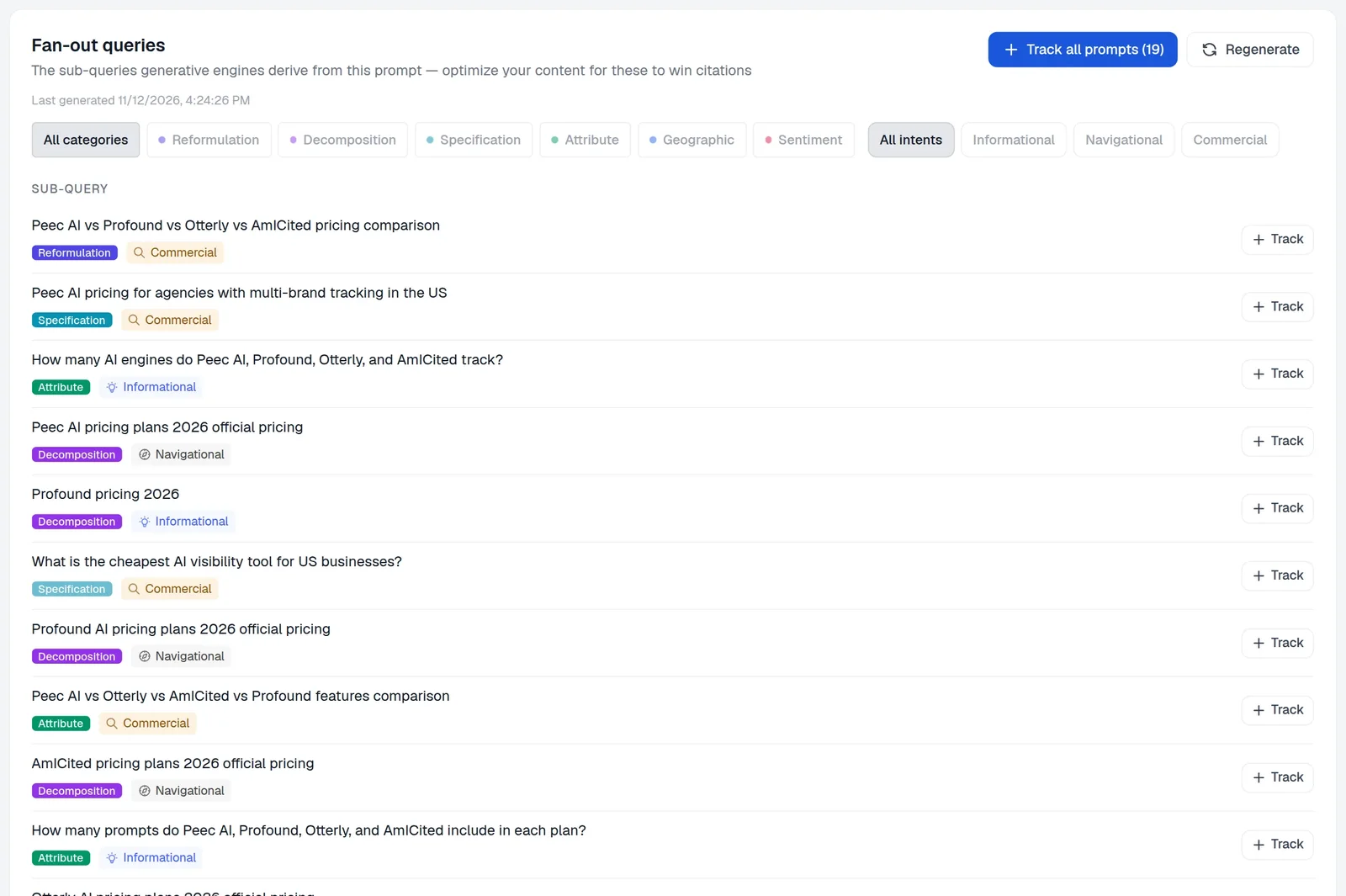
AmICited’s Semantic Map plots your tracked prompts, their fan-out queries and the pages AI engines cite by meaning, which shows you the subtopics competitors cover and you don’t.
Best Practices for Semantic SEO
- Start from intent: write down what the searcher wants to do after reading, then plan sections around that.
- Build a subquestion list from People also ask, related searches, forums and competitor headings before writing.
- Cover each subquestion with a direct answer first, then detail. Short answers are easy to extract.
- Use one page per intent. If two keywords return mostly the same top results, target them on the same page.
- Mark up the main entity with schema and link to related pages on your site with descriptive anchor text.
- Refresh pages when new subtopics appear in the SERP or in AI answers.
Common Semantic SEO Mistakes
The first mistake is treating semantic SEO as a list of synonyms to sprinkle in. Swapping “cheap” for “affordable” in three places does not add meaning. Covering what the reader needs to know does. The second is chasing LSI keywords from a tool and pasting them into a draft without explaining anything new.
The opposite mistake also happens: pages that try to cover every related entity become long, unfocused guides that answer nothing quickly. Semantic completeness means covering the questions that matter for this intent, not every tangent. Finally, many sites build topic clusters but forget to link the pages together, so search engines never see the relationship.