


Payment Reconciliation
Payment reconciliation is the process of matching records of orders placed in a store against the actual payments received from processors, banks, or analytics platforms, to confirm that what was recorded as sold matches what was actually paid and collected. It surfaces discrepancies caused by refunds, chargebacks, currency conversion, fees, and failed transactions.
Definition of Payment Reconciliation
Payment reconciliation is the process of comparing a store’s recorded order data against the actual money that moved — what a payment processor settled, what a bank deposited, and often what an analytics platform like GA4 logged as a purchase event. The goal is to confirm that every order the store believes it sold corresponds to a real, collected payment, and to explain any gap when it doesn’t. In e-commerce, these gaps are common and usually explainable: processing fees deducted before deposit, currency conversion on cross-border sales, refunds and chargebacks processed after the fact, failed or declined payments that never actually settled, and timing differences between when an order is placed and when funds actually clear. Reconciliation turns “our numbers don’t match” into a specific, categorized explanation of exactly where and why they diverge.
How Payment Reconciliation Works
The reconciliation process typically starts by pulling three data sets covering the same period: order records from the store platform (Shopify, WooCommerce, or similar), settlement records from the payment processor (Stripe, PayPal, or a card acquirer), and, often, purchase event data from an analytics platform like GA4. Each order is matched across these sources using an identifier — an order ID, transaction ID, or a combination of amount, timestamp, and customer identifier when a shared ID isn’t available.
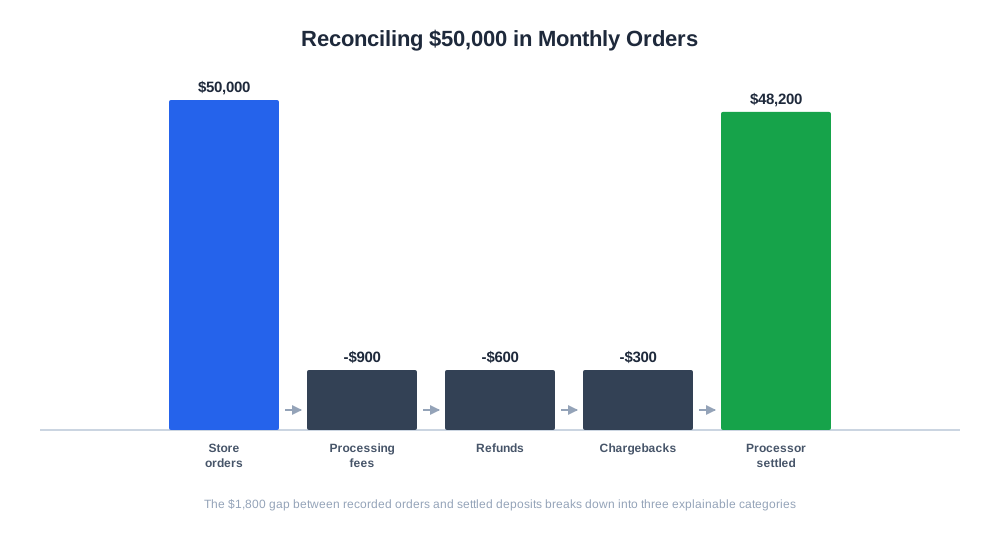
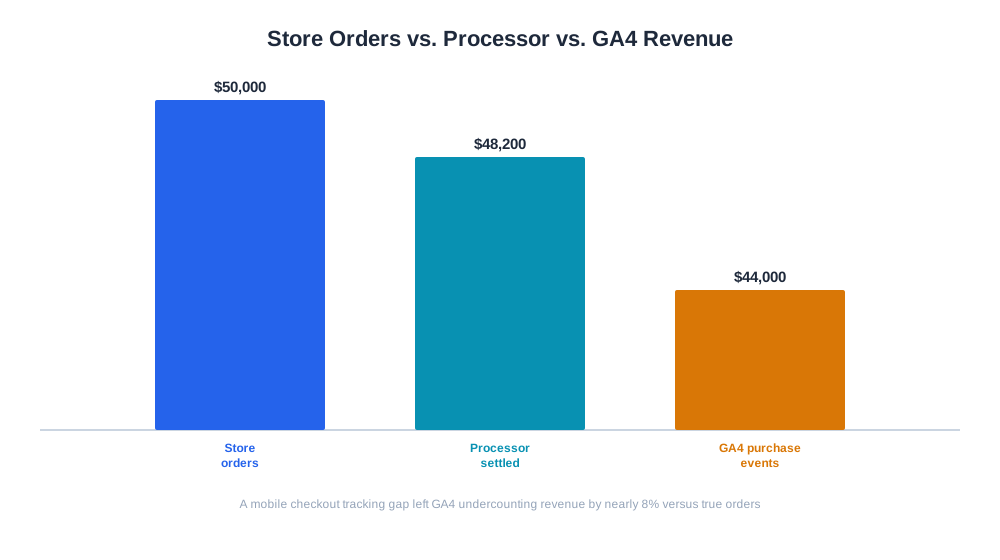
A worked example: a store’s order system shows $50,000 in sales for the month. The payment processor’s settlement report shows $48,200 deposited. Reconciliation traces the $1,800 gap: $900 in processing fees, $600 in refunds processed mid-month, and $300 in chargebacks. Separately, GA4 shows only $44,000 in purchase-event revenue for the same orders — a further $4,200 gap explained by a checkout redirect that occasionally failed to fire the GA4 purchase tag on mobile browsers. Without reconciliation, a merchant relying on GA4 alone would underestimate true revenue by nearly 8%, potentially misjudging channel performance and marketing ROI as a result.

Ready to Monitor Your AI Visibility?
Track how AI chatbots mention your brand across ChatGPT, Perplexity, and other platforms.
Why Payment Reconciliation Matters for E-commerce Brands
Reconciliation matters because every downstream financial and marketing decision depends on trusting the revenue number underneath it. A merchant calculating true ROAS, gross margin, or contribution margin off unreconciled analytics data risks making budget decisions on numbers that are systematically off by a consistent margin — often understating revenue from channels where tracking is weakest, like paid social on mobile, and overstating channels where tracking happens to be more complete.
Beyond marketing decisions, reconciliation is foundational to accurate bookkeeping and tax reporting. A store that books gross order value as revenue without accounting for refunds, chargebacks, and processing fees will overstate both revenue and profit, creating problems at tax time and giving founders a falsely rosy picture of cash flow.
Payment Reconciliation vs. Related Processes
| Process | What It Compares | Primary Purpose | Typical Frequency |
|---|---|---|---|
| Payment reconciliation | Store orders vs. processor settlement vs. analytics events | Confirm order-level revenue accuracy | Weekly to monthly |
| Bank reconciliation | Accounting ledger vs. bank statement | Confirm overall cash balance accuracy | Monthly |
| Inventory reconciliation | Recorded stock levels vs. physical counts | Confirm inventory accuracy | Monthly to quarterly |
| Conversion tracking audit | Analytics events vs. actual site behavior | Confirm marketing attribution accuracy | Ongoing / as needed |
Stay Updated on AI Visibility Trends
Get the latest insights on AI mentions, brand monitoring, and optimization strategies.
Payment Reconciliation and AI-Driven Commerce
As checkout increasingly happens through AI-mediated flows — a customer completing a purchase via ChatGPT Instant Checkout, Perplexity Shopping, or an agentic commerce integration rather than directly on a merchant’s site — reconciliation gets more complex, not less. Orders originating from these channels may pass through additional intermediary payment rails, settle on different schedules, or report back to the merchant’s own order system with delays or formatting quirks that a manual reconciliation process can easily miss. Merchants adding these channels should treat each new AI shopping integration as a new reconciliation source to validate, the same way they would validate a new payment processor.
This is precisely the gap AmICited’s eshop_get_reconciliation tool is built to close on the analytics side: it matches a store’s actual order data against GA4 purchase events automatically, surfacing exactly which orders are missing from analytics, which purchase events have no matching order, and how large the resulting revenue discrepancy is — turning what is often a manual, error-prone spreadsheet exercise into an automated, ongoing check.
Best Practices for Payment Reconciliation
- Reconcile on a fixed schedule (weekly or monthly) rather than only when a discrepancy becomes obviously large.
- Match records using a unique, shared identifier wherever possible rather than relying solely on amount and date, which can produce false matches.
- Reconcile against more than one source — processor settlement and analytics purchase events separately — since each captures different failure modes.
- Categorize every discrepancy (fee, refund, chargeback, currency conversion, tracking failure) rather than lumping all gaps into a single unexplained variance.
- Automate the matching process as order volume grows; manual reconciliation error rates increase sharply past a few hundred orders per period.
- Review reconciliation results before making marketing budget or margin decisions, especially when comparing performance across channels with different tracking reliability.
Common Payment Reconciliation Mistakes
A frequent mistake is reconciling only against the payment processor and skipping analytics data entirely, which hides a very real problem: GA4 and similar platforms routinely undercount purchases due to ad blockers, consent declines, and tracking implementation gaps, and a merchant who trusts GA4 revenue for channel-level ROAS calculations without reconciling it against actual orders will consistently misjudge which channels are actually performing. Another common issue is reconciling at too coarse a level — comparing monthly totals rather than order-level records — which can mask a small number of large discrepancies behind an average that looks acceptable. Merchants selling internationally often miss currency conversion as a reconciliation category, mistaking FX-driven gaps for tracking errors and spending time investigating the wrong root cause. Finally, some stores treat reconciliation as a one-time cleanup project rather than an ongoing process, which means each new integration, checkout change, or new sales channel introduces fresh discrepancies that go unnoticed until the next crisis-driven cleanup.