


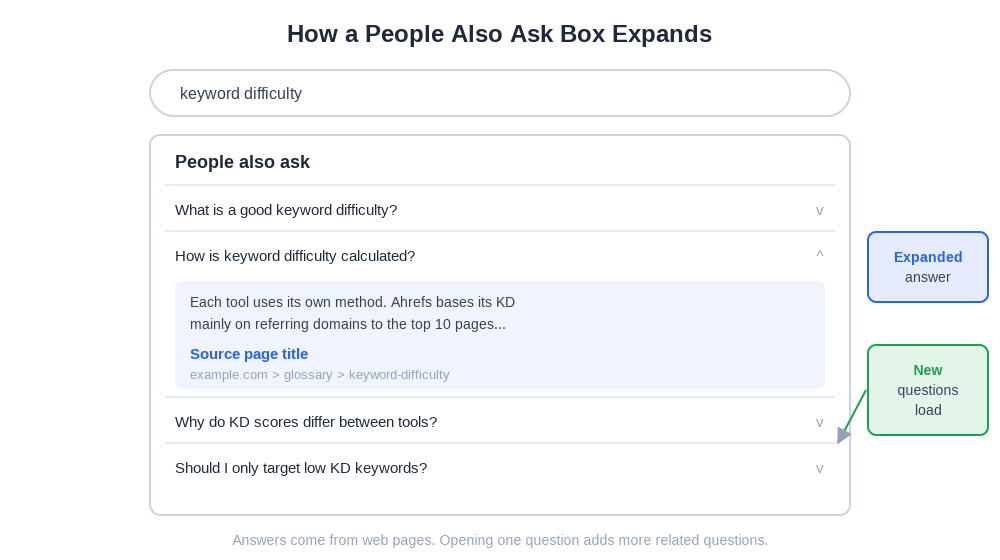
- People Also Ask (PAA) is a Google box of related questions. Each one expands to a short answer taken from a web page, with a link to the source.
- Opening a question loads more questions. The source page only needs to answer that question clearly; it does not have to rank in the top three for the main search.
- A question heading with a direct answer right below it is the usual way in. FAQ schema is not.
- PAA questions read like the follow-ups people type into ChatGPT, Perplexity and AI Mode, so they double as a guide to AI prompts.
Where AmICited fits
In AmICited’s prompt detail, the Google Search tab lists the results collected for a tracked prompt, with People Also Ask questions labelled, next to the answers from AI engines that AmICited runs the same prompt in on a schedule.
See prompt tracking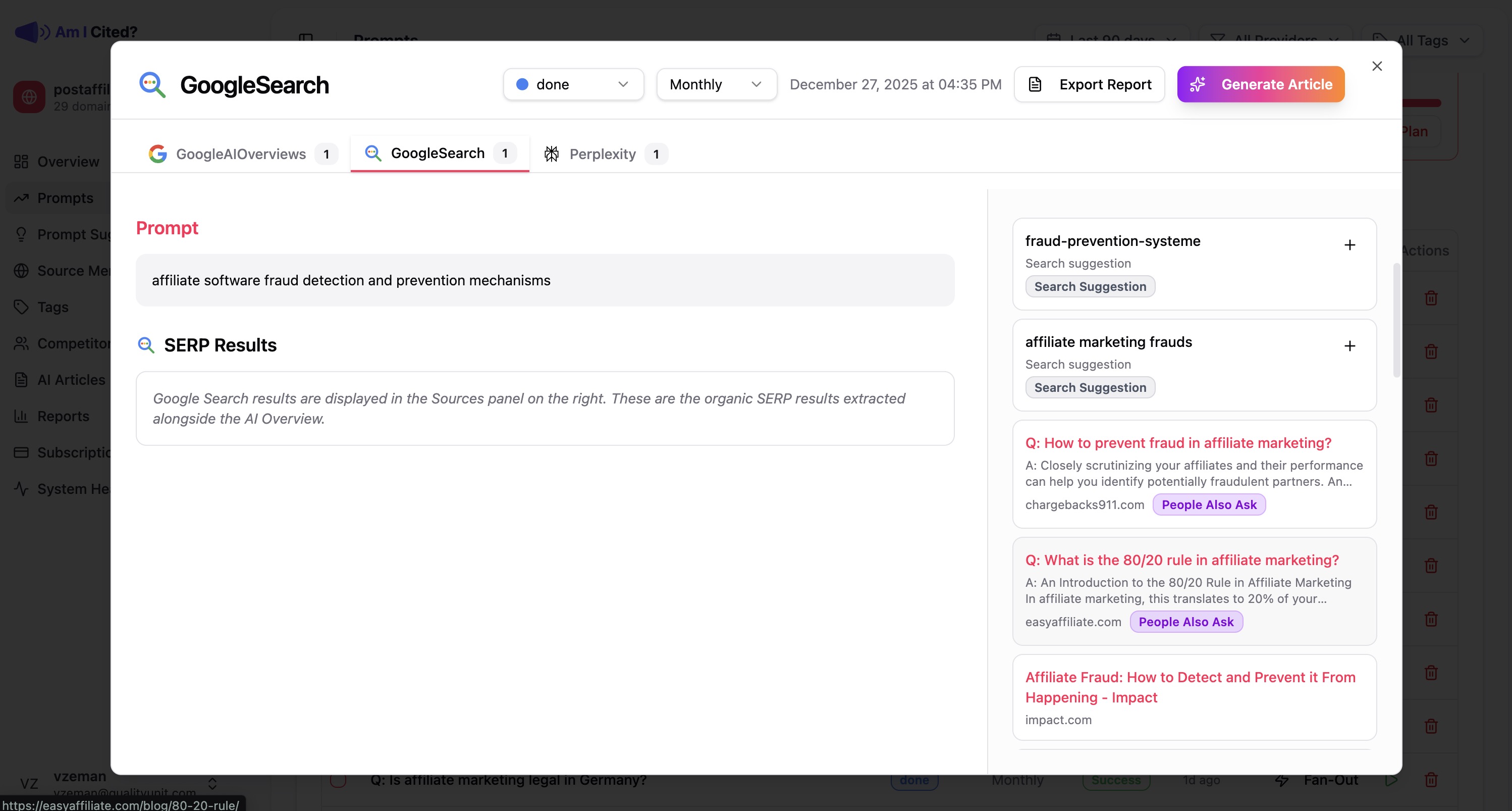
What Is People Also Ask?
People Also Ask (PAA) is a box in Google search results that lists questions related to your search. Each question is collapsed at first. When you click one, it expands to show a short answer pulled from a web page, with the page title and link underneath. Opening a question usually adds a few more questions to the bottom of the box, so the list can keep growing as you click.
PAA boxes appear on a large share of informational searches and on many commercial ones too, often near the top of page one. SEO teams treat them as a SERP feature to win and as a free source of keyword research. You will see them tracked in rank tracking tools and in tools like AlsoAsked, which map the question trees they create.
How People Also Ask Works
Google does not document the system in detail, but its behavior is easy to observe:
- Google chooses related questions. They come from what people search around the topic, so a search for “keyword difficulty” might show “What is a good keyword difficulty?” and “How is keyword difficulty calculated?”.
- Each question gets an answer from a web page. Google pulls a passage, list or table that answers that question, much like a featured snippet. The source page is often, but not always, one that ranks for that question on its own.
- Clicking expands the box. Opening a question shows the answer and adds more questions related to the one you clicked.
- Answers link out. Each answer shows the source page title and URL, and a link to search that question on its own.
The source does not need to rank in the top three for your original query. It only needs to give a clear answer to the specific question shown. This is why a well-structured page from a smaller site can appear in PAA next to much larger competitors.
People Also Ask vs Other Search Features
PAA sits beside several other features that answer questions on the results page. They work differently and need different approaches.
| Feature | What it shows | Where the content comes from | How to target it |
|---|---|---|---|
| People Also Ask | Expandable related questions with short answers | Passages from web pages | Question headings with a direct answer underneath |
| Featured snippet | One answer box for the exact query | One web page | Concise answer high on a page that ranks on page one |
| Related searches | Links to other queries, usually at the bottom | Search behavior | Not targetable; use for keyword ideas |
| AI Overview | Generated summary with cited links | Several pages, combined by Google’s model | Clear, quotable facts and strong rankings |
| Knowledge panel | Entity facts in a side panel | Knowledge Graph sources | Consistent entity data across the web |
The practical difference is clicks. A featured snippet answers the query itself. A PAA answer is hidden until a user expands it, so it gets fewer views, but each question is a separate chance to appear.
How to Find People Also Ask Questions for a Topic
Start with a manual search for your main keyword in an incognito window, then click three or four questions to load more. Repeat for two or three close variants. Copy the questions into a list, group the ones that share an intent, and note which pages Google uses as the source for each answer. Those source pages show you the format, length and depth that currently win. Rank trackers and question research tools can collect the same data across many keywords at once.
People Also Ask and AI Search
People Also Ask is a good preview of how people phrase questions to AI assistants. The questions in PAA boxes look a lot like the follow-up questions users type into ChatGPT, Perplexity and Google AI Mode. Pages that answer those questions in a direct sentence under a matching heading are easier to quote for both PAA and AI answers.
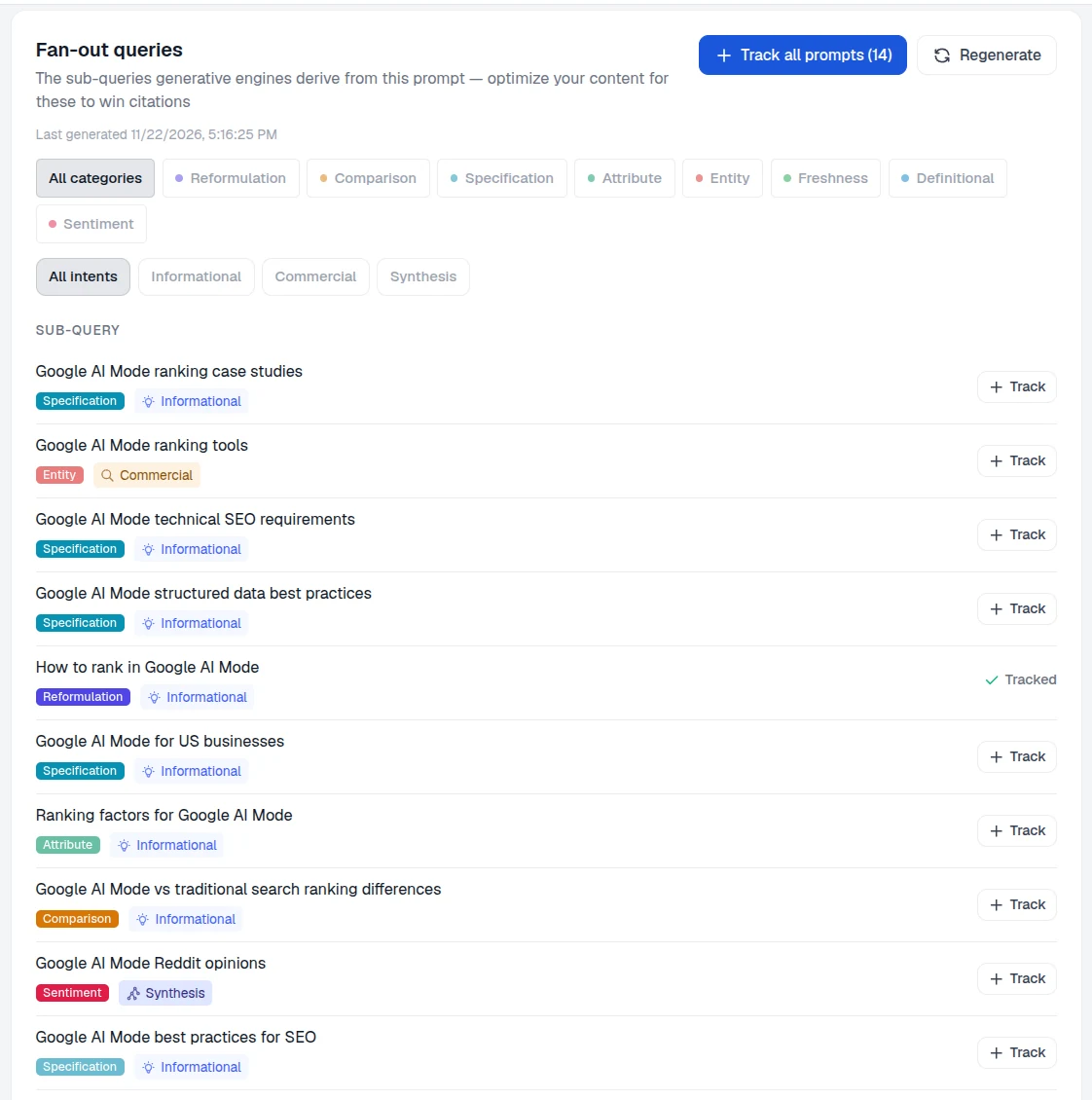
The difference is that you can see PAA in a browser, while AI answers vary by engine and by run. Prompt tracking runs set questions in AI engines on a schedule so you can see which brands they mention and cite over time.

Stay Updated on AI Visibility Trends
Get the latest insights on AI mentions, brand monitoring, and optimization strategies.
Best Practices for People Also Ask
- Collect PAA questions for your main keywords and group them by topic before writing.
- Use the question, or close to it, as an H2 or H3, and answer it in the first 40–60 words below.
- Pick the right format for each answer: a sentence for “what is”, steps for “how to”, a table for comparisons.
- Cover a cluster of related questions on one page when they share the same intent, rather than one thin page per question.
- Recheck PAA boxes every few months. The questions shift as search behavior changes.
- Treat question-based search phrasing as a guide for headings, not as a list of keywords to stuff in.
Common People Also Ask Mistakes
A common mistake is relying on FAQ schema to get into PAA. The two are separate. FAQ rich results are limited to a small set of authoritative sites, and PAA answers come from page content. Another mistake is answering every question vaguely in a long intro before getting to the point. The answer Google pulls is usually a short passage right after the heading.
Some sites also create dozens of tiny pages, one per PAA question, with a two-sentence answer each. Those pages compete with each other and rarely earn rankings on their own. Finally, teams sometimes track PAA appearances without checking clicks. Use Search Console to see whether those impressions actually bring visitors.