


Product Bundling
Product bundling is the practice of selling two or more items together as a single package, typically at a combined price lower than the sum of buying each item separately. It is used to increase average order value, move slower-selling inventory alongside popular items, and simplify decisions for shoppers who would otherwise have to assemble a set on their own.
Definition of Product Bundling
Product bundling is the practice of packaging two or more products together and selling them as a single unit, typically at a price lower than the combined cost of purchasing each item separately. Bundles can be fixed, where the same items are grouped every time (a shampoo-and-conditioner set), or dynamic, where the customer builds their own bundle from a defined set of eligible products (build-your-own gift box). Bundling serves several purposes at once: it increases the average value of a transaction, gives merchants a way to move slower-selling inventory by pairing it with popular items, and reduces decision friction for customers who would otherwise need to research and select several items individually.
How Product Bundling Works
The mechanics of a bundle are straightforward — combine a set of SKUs, apply a single price or discount, and present it as one purchasable unit — but the decision of which products to bundle is where most of the value or risk lies. A well-constructed bundle reflects real co-purchase behavior: products that customers already tend to buy together in the same order, not products a merchandiser assumes should go together based on category alone.
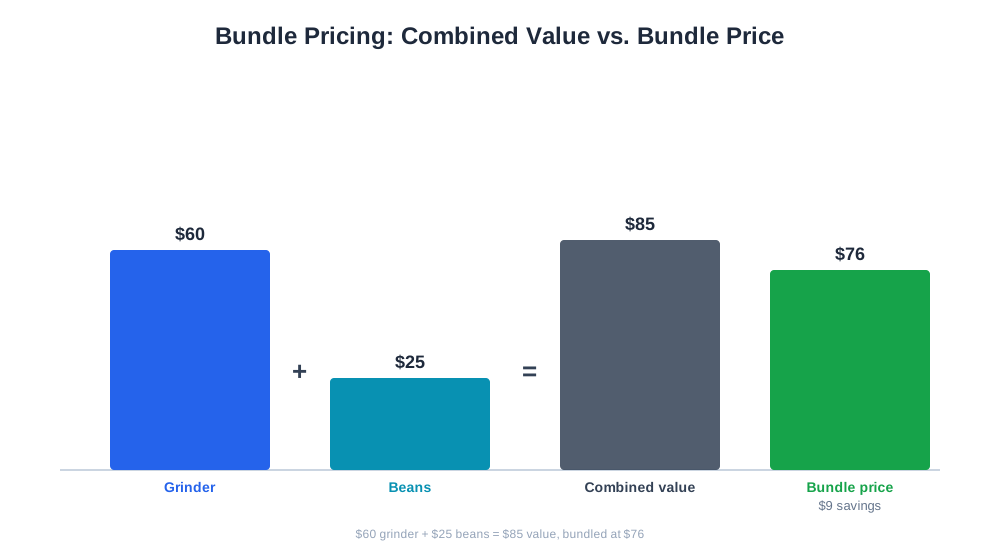
A useful worked example: a store selling a $60 coffee grinder and a $25 bag of specialty beans might notice, from order history, that a meaningful share of grinder buyers also add the same bean bag in the same transaction. Bundling the two at $76 (a $9 discount off the $85 combined price) gives the merchant a lift in average order value from customers who were highly likely to buy both anyway, while also making the decision easier for a new customer who wasn’t sure which beans to pair with the grinder. The key statistical concepts behind this kind of decision are support (how often the pairing appears across all orders), confidence (how often buying one item leads to buying the other), and lift (whether the pairing happens more often than random chance would predict) — a pairing with high lift and confidence is a genuine pattern worth bundling, while one with low lift may just be two popular items that happen to co-occur without any real relationship.

Ready to Monitor Your AI Visibility?
Track how AI chatbots mention your brand across ChatGPT, Perplexity, and other platforms.
Why Product Bundling Matters for E-commerce Brands
Bundling directly affects average order value and margin, but its impact goes further. It can smooth demand across a product catalog by pairing overstocked or slow-moving items with fast sellers, reducing the need for steep clearance discounts later. It also simplifies the shopping decision for less-informed customers — a new buyer looking at a complex product category (skincare, electronics accessories, home office setups) often values a curated bundle precisely because it removes the burden of researching what pairs well. Poorly constructed bundles, on the other hand, can actively hurt conversion: a bundle padded with an irrelevant or unwanted item is often perceived as a way to force extra spend, and can suppress purchases from shoppers who would have bought the core item alone.
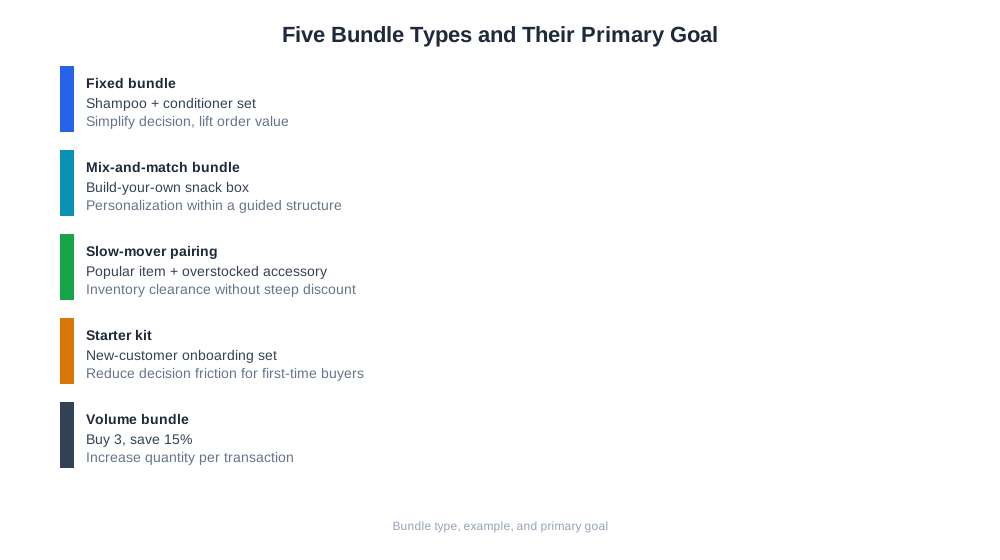
| Bundle Type | Example | Primary Goal |
|---|---|---|
| Fixed bundle | Shampoo + conditioner set | Simplify decision, lift order value |
| Mix-and-match bundle | Build-your-own snack box | Personalization within a guided structure |
| Slow-mover pairing | Popular item + overstocked accessory | Inventory clearance without steep discount |
| Starter kit | New-customer onboarding set | Reduce decision friction for first-time buyers |
| Volume bundle | Buy 3, save 15% | Increase quantity per transaction |
Product Bundling and AI-Driven Commerce
AI shopping assistants such as ChatGPT Shopping and Perplexity Shopping increasingly answer questions like “what do I need to go with this” by inferring commonly paired products, which means a brand’s own verified bundle offers can double as a signal of what genuinely goes together — a well-supported bundle is more likely to be echoed by an AI assistant’s recommendation than a bundle assembled without evidence. AmICited’s eshop_get_product_bundles tool directly supports this by scanning a store’s order history to identify which products customers actually buy together, reporting the underlying support, lift, and confidence scores rather than a simple co-occurrence count, so a merchant can distinguish a durable purchase pattern from statistical noise before committing shelf space or marketing budget to a bundle.
Stay Updated on AI Visibility Trends
Get the latest insights on AI mentions, brand monitoring, and optimization strategies.
Best Practices for Product Bundling
- Base bundles on verified co-purchase data rather than category assumptions or gut instinct
- Check lift and confidence, not just raw frequency, before treating a pairing as a genuine pattern
- Price bundles to reflect a real, visible discount so the value proposition is obvious to the shopper
- Use bundling to support slow-moving inventory only when there is a genuine affinity with the paired item
- Offer mix-and-match or build-your-own bundles for categories where personal preference varies widely
- Revisit bundle performance regularly, since purchase patterns shift with seasonality and catalog changes
Common Product Bundling Mistakes
A common mistake is bundling based on category logic rather than actual purchase behavior — pairing two items that seem like they should go together (two accessories in the same product line, for instance) without checking whether customers actually buy them in the same order. This often produces bundles that sit unsold because the assumed affinity doesn’t exist. Another frequent issue is discounting a bundle so shallowly that the perceived value isn’t worth the extra spend, leaving the bundle underperforming both the individual items; testing a slightly deeper discount on a genuinely high-confidence pairing usually resolves this. Some merchants also bundle a popular item with a much less desirable one purely to clear inventory, which can suppress sales of the popular item as shoppers avoid the bundle altogether and seek the standalone SKU instead — if the standalone option remains available and cheaper for the core item alone, the bundle will simply be bypassed. Finally, bundles are sometimes left static for years without revalidation; as a catalog changes and new products are introduced, previously strong pairings can weaken, so re-running the underlying basket analysis periodically keeps bundle offers aligned with current buying behavior.