


Basket Analysis
Basket analysis is the practice of examining which products customers tend to purchase together within the same transaction, in order to uncover meaningful purchase patterns. It underpins decisions about product bundling, cross-selling, store layout, and merchandising by revealing real, data-backed relationships between products rather than assumed ones.
Definition of Basket Analysis
Basket analysis is the technique of examining transaction data to identify which products customers tend to buy together in the same order. The name comes from the physical shopping basket: rather than analyzing products in isolation, basket analysis looks at the full contents of each completed purchase to find recurring co-purchase patterns. It’s a foundational technique behind product bundling, “frequently bought together” recommendations, and merchandising decisions, because it replaces guesswork about which products go well together with evidence drawn directly from actual customer behavior.
How Basket Analysis Works
Basket analysis relies on three core statistical measures to evaluate whether a pairing between two products is meaningful. Support measures how often a specific pairing appears across all transactions — if 50 out of 1,000 total orders contain both Product A and Product B, the support for that pairing is 5%. Confidence measures how often buying Product A leads to also buying Product B, calculated as the number of transactions containing both divided by the number of transactions containing Product A alone — if 200 orders contain Product A, and 50 of those also contain Product B, the confidence is 25%. Lift measures whether that co-purchase happens more often than would be expected by chance alone, calculated by comparing the actual confidence against what Product B’s overall popularity would predict — a lift above 1 suggests a genuine positive relationship, while a lift near or below 1 suggests the pairing is coincidental or even negatively associated.
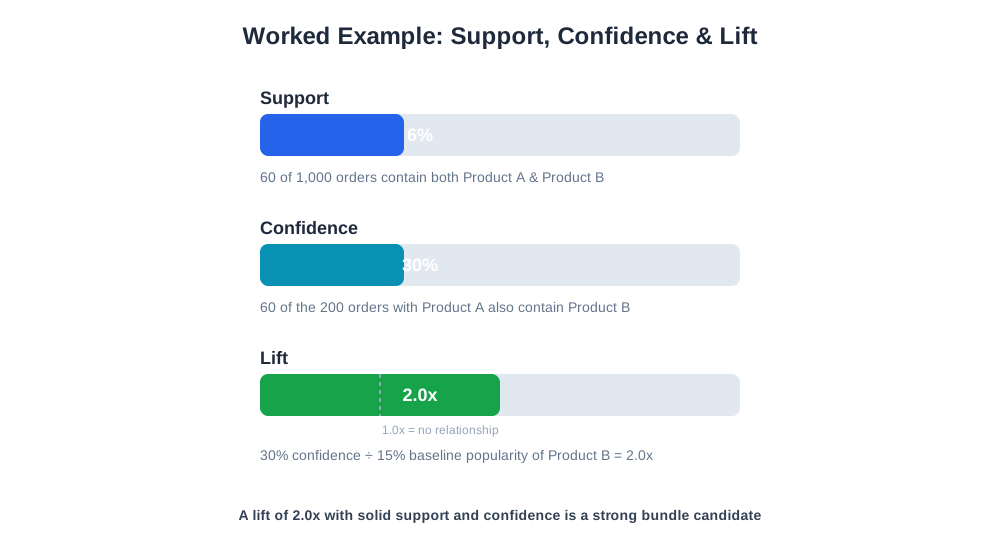
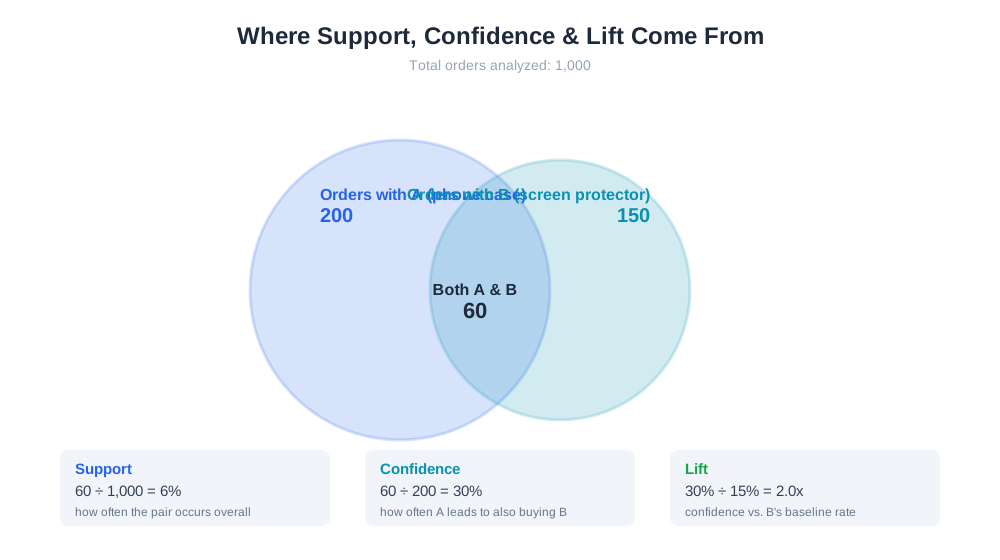
A worked example makes this concrete. Suppose a store has 1,000 total orders. Product A (a phone case) appears in 200 of them. Product B (a screen protector) appears in 150 of them. Of the 200 orders containing Product A, 60 also contain Product B. Support for the pairing is 60 ÷ 1,000 = 6%. Confidence is 60 ÷ 200 = 30%. To calculate lift, compare that 30% confidence against Product B’s baseline popularity of 150 ÷ 1,000 = 15%: lift is 30% ÷ 15% = 2.0, meaning customers who buy Product A are twice as likely to also buy Product B as a random customer would be. A lift of 2.0 with reasonable support and confidence is a strong candidate for a bundle or cross-sell recommendation, since the relationship is both statistically meaningful and common enough to act on.

Ready to Monitor Your AI Visibility?
Track how AI chatbots mention your brand across ChatGPT, Perplexity, and other platforms.
Why Basket Analysis Matters for E-commerce Brands
Basket analysis matters because merchandising decisions made without it tend to rely on assumptions — category adjacency, gut instinct, or what “seems like” it should pair well — that frequently don’t match actual customer behavior. A store might assume two products in the same category naturally sell together, only to find through basket analysis that customers actually pair one of those products with something from an entirely different category instead. Acting on verified basket analysis results, rather than assumed relationships, tends to produce bundles and cross-sell recommendations that convert better, because they reflect demand patterns that are already happening rather than patterns a merchandiser hopes will happen.
| Metric | What It Measures | Example Interpretation |
|---|---|---|
| Support | Frequency of the pairing across all orders | Low support may mean too little data to trust the result |
| Confidence | Likelihood B is bought given A is bought | High confidence suggests a strong directional relationship |
| Lift | Whether the pairing beats random chance | Lift near 1 means no real relationship exists |
Basket Analysis and AI-Driven Commerce
AI shopping assistants such as ChatGPT Shopping and Perplexity Shopping increasingly answer implicit “what goes with this” questions when helping a shopper compare or complete a purchase, which means a brand’s own verified basket analysis results can double as input for building accurate bundle and recommendation offers that these assistants are more likely to reflect back to shoppers. AmICited’s eshop_get_product_bundles tool runs this analysis directly against a store’s real order history, surfacing pairings scored by support, lift, and confidence so a merchant can act on genuinely strong relationships rather than assumptions, whether the goal is building a bundle, improving on-site cross-sell placements, or simply understanding the catalog’s actual purchase structure better.
Stay Updated on AI Visibility Trends
Get the latest insights on AI mentions, brand monitoring, and optimization strategies.
Best Practices for Basket Analysis
- Require a minimum level of support before treating a pairing as reliable, since low-volume pairings are prone to noise
- Prioritize lift alongside confidence, since a high-confidence pairing can still be uninformative if lift is close to 1
- Re-run basket analysis periodically, since purchase patterns shift with seasonality, promotions, and catalog changes
- Segment basket analysis by customer type or channel where relevant, since new and repeat customers may pair products differently
- Use results to inform bundles, cross-sell placements, and even category page structure, not just promotional offers
Common Basket Analysis Mistakes
A frequent mistake is acting on support alone without checking lift, which can surface pairings between two simply popular products that don’t actually have any real relationship — two bestsellers will co-occur in a meaningful number of orders purely by chance, so lift is essential to filter out these false positives. Another common issue is running basket analysis on too small a dataset, such as a newly launched product with only a handful of orders, and treating the resulting pairing as reliable when it’s really just an artifact of low sample size; setting a minimum order threshold before trusting a result avoids this. Some businesses also let basket analysis results go stale, building a bundle or recommendation years ago based on a pattern that no longer holds as the catalog and customer base have evolved — a periodic re-run against current data catches this drift. Treating every high-lift pairing as equally actionable is another mistake, since a strong statistical relationship between two low-margin, rarely-searched products may not be worth building merchandising around, even if the numbers look clean; basket analysis results should be weighed against business value, not statistical significance alone.