


Otterly.ai Review 2026: Pricing, Features & Fit
Review Otterly.ai’s 2026 pricing, engine coverage, GEO audit, agency features, limitations, and who should buy it.
16 min read
Compare 11 Otterly.ai alternatives in 2026 by pricing, engine coverage, and strengths, from focused monitors to enterprise platforms.
Otterly.ai earned its place in the AI visibility conversation for good reason. It automated what most marketing teams were doing manually: running prompts in ChatGPT, screenshotting responses, and pasting results into spreadsheets. The interface is clean, setup is fast, and at $29/month, it’s the lowest advertised entry price in the category. Gartner recognized it as a Cool Vendor in 2025. It serves over 15,000 marketing professionals.
But Otterly.ai is a monitoring tool, not an optimization platform. It tells you where your brand appears in AI-generated answers, and where it doesn’t. It doesn’t tell you what to do about it. For teams that have moved past the “Is AI search real?” stage and into the “How do we actually win here?” stage, that implementation gap is the difference between useful data and actionable intelligence.
This guide compares the 11 best Otterly.ai alternatives in 2026, evaluated on engine coverage, pricing at scale, analytics depth, actionability, and real-world fit. Every tool on this list was cross-referenced against multiple sources, including Reddit communities, independent reviews, and vendor documentation, to give you an honest, balanced comparison.
Otterly.ai is an AI search monitoring platform that tracks brand mentions, website citations, and competitor visibility across AI-powered search engines. It covers four base platforms: ChatGPT, Perplexity, Google AI Overviews, and Microsoft Copilot, with Gemini and Google AI Mode available as paid add-ons. Its GEO Audit feature provides a structured SWOT analysis with tactical recommendations.
The platform works well for teams that need a lightweight, affordable way to establish a baseline. But as AI search has matured, three structural limitations have become difficult to ignore:
1. The pricing cliff arrives fast. The $29/month Lite plan includes 15 prompts across 4 engines, enough to prove the concept, not enough to monitor a real brand across a real category. The jump to Standard is $189/month, a 6.5x increase. Add Gemini ($9–$149/month depending on tier) and Google AI Mode, and the real cost of comprehensive monitoring can exceed $300/month.
2. Monitoring without action. Otterly shows you your visibility score. It does not generate content briefs, provide citation gap analysis, or connect visibility data to a content workflow. As one Reddit user described it: “It tracks the source, but gives zero actionable strategy on how to restructure content to get cited.”
3. Coverage gaps on lower plans. Gemini, Google AI Mode and Claude are paid add-ons, and Grok, DeepSeek and Meta AI aren’t part of the base engine set. For teams that need clean multi-engine coverage from day one, this is a structural limitation, not a roadmap item.
4. No revenue attribution. There are no GA4 integrations, no Google Search Console connections, and no way to connect AI visibility to actual traffic or revenue. You can see that your brand appeared in 40% of relevant AI responses, but you cannot prove that those mentions drove any business outcome.
None of this means Otterly is a bad product. For small brands that need affordable monitoring and have the internal capacity to act on the data independently, it remains a solid entry point. The alternatives below are for teams that have hit one of these walls and need a platform that goes further.

Track how AI chatbots mention your brand across ChatGPT, Perplexity, and other platforms.
Before comparing specific tools, it’s worth defining what separates a monitoring dashboard from a genuine AI visibility platform. The best tools in this category share five characteristics:
Multi-engine coverage. AI search is fragmented across ChatGPT, Claude, Gemini, Perplexity, Google AI Overviews, Copilot, Grok, DeepSeek, and Meta AI. Profound’s citation overlap research found that nearly 89% of AI citations come from completely different sources depending on which model users query. You could be visible in ChatGPT and invisible in Claude. A platform that only tracks three or four engines is giving you a partial picture.
Actionability. Visibility data is only worth paying for if it tells you what to change. The strongest platforms connect monitoring to an action loop: identify the gap, generate a content recommendation, and measure whether the change increased citations.
Pricing transparency at scale. A low entry price means nothing if the real cost of comprehensive monitoring is 3–5x higher. The best tools are upfront about what’s included and what’s an add-on. Prompt-based pricing is standard in the category, but the per-prompt cost should scale reasonably as your needs grow.
Attribution. The ability to connect AI visibility to actual traffic, leads, or revenue is what separates a reporting tool from a strategic platform. GA4 integration, Google Search Console connection, and CRM attribution are increasingly table stakes.
Enterprise readiness. For larger teams, SOC 2 compliance, crawler log analysis, role-based access controls, and dedicated account management are not optional. The enterprise tier of any tool should make procurement and security teams comfortable.
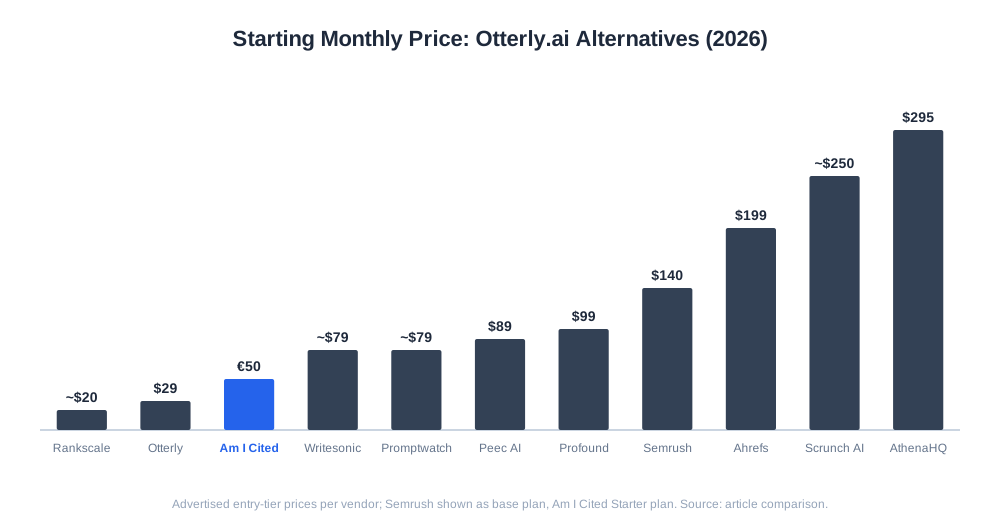
| Tool | Best For | Starting Price | AI Engines | Content Tools | Attribution |
|---|---|---|---|---|---|
| Am I Cited | Best overall alternative | €50/mo (no per-engine add-ons) | By tier: ChatGPT and Perplexity (Starter), Copilot (Pro), Claude, Grok, DeepSeek (Premium) | Optimization recommendations | No |
| Profound | Enterprise | Free 7-day trial, custom Enterprise | Up to 9 | Content generation | GA4, crawler logs |
| Peec AI | Mid-market analytics | $89/mo | 3–7 (Claude Enterprise-only) | No | Limited |
| Promptwatch | Full-stack GEO | From $95/mo | 4 per plan | Gap analysis, content gen | Yes |
| AIclicks | Action-oriented teams | ~$99/mo | 10+ (Real-UI) | Ranked action plans | No |
| Semrush AI Toolkit | Existing Semrush users | Add-on to $139.95/mo base | Multiple | Content toolkit | Via Semrush |
| Scrunch AI | Brand safety & governance | ~$250/mo | Multiple | Content generation | Yes |
| AthenaHQ | Deep analytics | $295/mo | Multiple | No | Shopify, GA4 |
| Writesonic GEO | Content + tracking | ~$79/mo | Multiple | Built-in AI writer | No |
| Ahrefs Brand Radar | Ahrefs users | $199/mo (with Ahrefs) | 6 | No | No |
| Rankscale AI | Budget monitoring | ~$20/mo | Multiple | No | No |
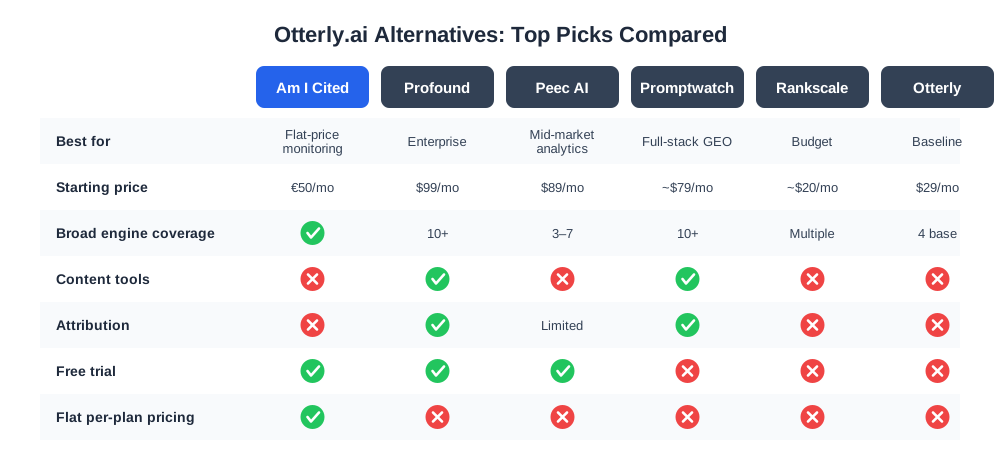
Am I Cited is built as a focused, dedicated AI visibility monitor: no per-engine add-on fees, no prompt-tier pricing cliffs, just per-plan pricing covering the AI surfaces that carry the most traffic.
What it does well: Am I Cited’s engine access widens by plan tier rather than through add-ons: Starter tracks ChatGPT and Perplexity, Copilot unlocks from Pro, and Claude, Grok and DeepSeek from Premium. Unlike Otterly and most of the tools below, it pairs monitoring with optimization recommendations, so you get a path from “here’s your gap” to “here’s what to publish,” not just a dashboard. Flat per-plan pricing makes cost predictable as you scale prompts and competitors.
Where it falls short: Starter covers only ChatGPT and Perplexity, so Claude, Grok and DeepSeek require Premium (€500/mo); if you need Meta AI tracked, or Profound’s broader engine breadth, you’ll want a wider-coverage tool.
Pricing: From €50/month, per plan.
Verdict: For teams that have outgrown Otterly’s pricing cliff and want predictable costs plus optimization guidance rather than a bigger dashboard, Am I Cited is the strongest all-around next step.
Profound is the category leader in enterprise AI visibility. With $155 million raised and a $1 billion valuation, it has the deepest dataset, the broadest engine coverage, and the most sophisticated analytics in the market. It was built from the ground up for AI search monitoring, not bolted onto an existing SEO tool.
What it does well: Profound’s Enterprise plan covers up to 9 AI engines including ChatGPT, Claude, Gemini, Perplexity, and Google AI Overviews. Its crawler log intelligence shows you exactly how AI crawlers interact with your site, a feature no other platform on this list offers at the same depth. The Conversation Explorer tracks unlinked citations, and Agent Analytics provides CDN-level intelligence into how AI systems interpret your content. It is SOC 2 compliant and built for enterprise procurement.
Where it falls short: Profound no longer lists self-serve tiers: its pricing page now shows a free 7-day trial and custom-priced Enterprise, which independent reviews say can run into the thousands monthly. For small teams or solo marketers, the price is hard to justify. The platform is also data-heavy: it rewards teams that have the analytical capacity to interpret what it surfaces.
Pricing:
Verdict: If you’re a Fortune 500 company, a well-funded scale-up, or an enterprise where AI search is a board-level priority, Profound is the strongest option on the market. If you’re a small team testing the GEO waters, start elsewhere.
Peec AI has grown faster than any other challenger in the space, reaching $4M+ ARR in its first ten months and raising $29 million. It positions itself as the mid-market analytics platform: more sophisticated than Otterly, more accessible than Profound.
What it does well: Peec AI covers ChatGPT, Perplexity, Gemini, Google AI Overviews, and Google AI Mode. Its visual reporting is cleaner and more client-ready than Otterly’s. It includes sentiment tracking, competitor benchmarking, and source/citation analysis, showing you which third-party sources AI platforms are drawing on. Unlimited seats on every plan is a genuine differentiator for agencies.
Where it falls short: Peec limits how many engines you can track per plan (per third-party reviews as of Oct 2026, Peec doesn’t publish this openly). There is no content generation and no crawler log analysis, and attribution is limited. Peec does offer an MCP server and API for automation. Peec tells you where you stand with more polish than Otterly, but it still stops at the insight: it doesn’t help you act on it.
Pricing:
Verdict: Peec AI is the natural upgrade from Otterly for teams that need better reporting, more professional dashboards, and unlimited seats, but aren’t ready for Profound’s price tag. Agencies managing multiple clients will find the per-seat economics compelling.
Promptwatch has been rated as a Leader across all GEO categories in 2026, and it’s the only platform on this list that combines monitoring, content gap analysis, content generation, and traffic attribution in a single workflow.
What it does well: Promptwatch’s pricing page lists 4 AI models per plan. Its full action loop, from gap analysis to content generation to traffic attribution, is what separates it from monitoring-only tools. It includes crawler log monitoring on higher plans and visitor analytics. For content teams that need to move from “we’re invisible here” to “here’s what we published to fix it,” Promptwatch connects the dots.
Where it falls short: Promptwatch is a newer platform than Profound or Otterly, and its brand recognition is still building. Citation depth and content gap analysis, while present, are less mature than Otterly’s dedicated GEO Audit. The platform is evolving quickly, which means feature availability can shift between plans.
Pricing: $95/month Essential (50 prompts, 1 site), $245/month Professional (150 prompts, 2 sites, 5 articles), $579/month Business (350 prompts, 5 sites, 10 articles).
Verdict: If your primary frustration with Otterly is the “now what?” gap (you can see the problem but can’t fix it), Promptwatch is the most direct answer. It’s the best full-stack alternative for content and SEO teams that want visibility tracking and optimization in one place.
AIclicks takes a fundamentally different approach to AI visibility data. Instead of just reporting your visibility score, it tells you exactly why a competitor was recommended instead of you and provides a ranked action plan to steal that citation.
What it does well: AIclicks tracks 10+ AI engines using Real-UI querying, meaning it scrapes the actual interface a human sees, avoiding discrepancies between API responses and consumer results. This matters because API responses can differ significantly from what real users experience. Its “Competitors” tab is the most actionable competitive intelligence feature in the category. The platform is built for agencies and teams that want a clear action plan, not just a dashboard.
Where it falls short: AIclicks is less established than Profound or Otterly. It doesn’t offer GA4 attribution or crawler log analysis. The focus on action plans means it’s less suited for teams that just want passive monitoring.
Pricing: Approximately $99/month for self-serve plans.
Verdict: If you’re tired of dashboards that report problems without helping you fix them, AIclicks is your tool. It’s particularly strong for agencies managing multiple clients who need to show progress, not just data.
Semrush is the largest all-in-one SEO platform, and its AI Visibility Toolkit is a natural extension for teams already standardized on the Semrush ecosystem.
What it does well: The AI Visibility add-on connects GEO data with your existing keyword, content, and competitive intelligence workflows. You can track traditional SERP keywords and AI engine visibility (ChatGPT, Perplexity, Google AI Overviews) side by side in a unified dashboard. The integration value is real: no need to manage a separate login, billing relationship, or data export workflow.
Where it falls short: The AI visibility features are shallower than dedicated platforms. Semrush tracks fixed prompts rather than custom queries, and its engine coverage is limited. It’s not a best-in-class GEO tool; it’s a best-in-class SEO tool with GEO bolted on. If AI visibility is your primary focus, a dedicated platform will serve you better.
Pricing: Available as an add-on to Semrush subscriptions, which start at $139.95/month. The AI Toolkit add-on is included in higher-tier plans or available separately.
Verdict: If you’re already paying for Semrush and want to add AI visibility tracking without adding another vendor, the AI Toolkit is the most natural upgrade path. If you’re choosing a GEO platform from scratch, start with a dedicated tool.
Scrunch AI focuses on enterprise AI search with an emphasis on competitive intelligence, brand safety, and hallucination detection, features that matter most to regulated industries and large brands.
What it does well: Scrunch covers multiple AI engines with deep competitive intelligence. Its AXP delivery system and content generation capabilities go beyond monitoring. The brand safety and hallucination detection features are unique in the category and critical for enterprises in finance, healthcare, and legal sectors. Crawler log analysis and visitor analytics are included.
Where it falls short: Scrunch is enterprise-focused, with pricing around $250/month and up. It’s overkill for small teams. The platform requires a more formal onboarding process than self-serve alternatives.
Pricing: Approximately $250/month starting, with custom enterprise pricing.
Verdict: If your brand operates in a regulated industry where AI hallucination poses a real reputational risk, Scrunch AI is worth the premium. For most mid-market teams, the price and complexity are hard to justify.
Founded by former Google Search and DeepMind engineers, AthenaHQ is built for teams that treat AI visibility as a serious competitive function rather than a reporting metric.
What it does well: AthenaHQ provides prompt-level analytics and competitor share-of-voice tracking that goes deeper than any other self-serve platform. Its Action Center connects AI visibility directly to Shopify and GA4 revenue attribution, so you can see exactly how a mention in ChatGPT or Perplexity translates into dollars. The technical SEO focus makes it uniquely strong for teams that need to understand the infrastructure behind AI visibility.
Where it falls short: At $295/month for the self-serve plan, AthenaHQ is more than twice the price of Otterly’s Standard tier. It requires a formal onboarding process. There is no content generation; it’s purely an analytics and attribution platform.
Pricing: $295/month for self-serve; custom for enterprise.
Verdict: For e-commerce brands and data-driven marketing teams that need to prove ROI on AI visibility spend, AthenaHQ’s attribution capabilities are the strongest in the category. If you don’t need revenue attribution, the price is hard to justify.
Where Otterly stops at monitoring, Writesonic continues into content creation. It identifies AI visibility gaps, targets prompts where competitors are beating you, and then uses its built-in AI writer to generate or refresh content to capture those citation signals.
What it does well: The integration of tracking and creation in a single workflow is Writesonic’s core advantage. It pulls live data before generating content, which matters for AI engines that prioritize current information. For content-heavy marketing teams that are stretched for production capacity, having tracking and creation in one platform eliminates the tool-switching friction.
Where it falls short: Writesonic’s GEO tracking is less mature than dedicated platforms. It’s a content platform with GEO features, not a GEO platform with content features. The AI writing quality, while improving, may not match what specialized content teams produce.
Pricing: Approximately $79/month for entry-level plans with GEO features.
Verdict: If your team produces high volumes of content and the bottleneck is production capacity, not strategy, Writesonic is a pragmatic choice. If you need deep analytics and attribution, pair it with a dedicated monitoring tool.
Ahrefs Brand Radar is an AI citation and brand mention tracking add-on that sits inside the Ahrefs ecosystem. It’s the equivalent of Semrush’s AI Toolkit: a natural extension for existing users, not a standalone GEO platform.
What it does well: Brand Radar tracks AI citations and brand mentions alongside traditional SEO data. For teams already using Ahrefs for keyword research, backlink analysis, and rank tracking, it adds AI visibility without adding a new tool. The six-engine coverage is solid for a bolt-on product.
Where it falls short: Prompts are fixed, not customizable. There is no content generation, no crawler log analysis, and no AI-specific attribution. It’s a brand monitoring add-on, not a GEO platform. The $199/month starting price (which includes the Ahrefs subscription) makes it more expensive than dedicated AI visibility tools if you’re not already using Ahrefs.
Pricing: Included with Ahrefs subscriptions starting at $199/month.
Verdict: If you’re already deep in the Ahrefs ecosystem, Brand Radar is a useful add-on. If you’re choosing a GEO platform from scratch, look elsewhere.
Rankscale offers daily monitoring with multi-engine coverage at a price point that undercuts even Otterly’s entry tier. It’s the most affordable way to get a basic AI visibility baseline.
What it does well: Rankscale provides daily and hourly tracking across multiple AI engines at the lowest price in the category. For teams that need data before they can justify a larger investment, it gets the job done. The engine coverage is broader than Otterly’s base offering.
Where it falls short: Reporting depth and GEO audit capability are more limited than Otterly’s. There is no content generation, no attribution, and no advanced analytics. It’s a monitoring tool for teams that are earlier in the AI visibility journey.
Pricing: From ~$20/month for entry-level plans.
Verdict: If you need to prove that AI visibility matters before your organization will invest in a serious platform, Rankscale is the lowest-risk way to build that case. Just don’t expect it to do more than monitor.
Get the latest insights on AI mentions, brand monitoring, and optimization strategies.
The right tool depends on three things: your use case, your budget, and your team’s capacity to act on the data.
You want the best all-around alternative for comprehensive AI visibility. Am I Cited is the strongest overall pick for most teams: per-plan pricing with no per-engine add-on fees, engine access that widens by tier (ChatGPT and Perplexity on Starter, Copilot from Pro, Claude, Grok and DeepSeek from Premium), and, unlike most monitoring-only tools on this list, built-in optimization recommendations that tell you what content to publish to close visibility gaps, not just where the gaps are.
You’re a freelancer or solo marketer. Stay with Otterly’s Lite plan ($29/month) or try Rankscale if you need broader engine coverage. You don’t need enterprise analytics yet. What you need is a baseline and proof that AI visibility matters.
You’re an agency managing multiple clients. Peec AI is the strongest fit. Unlimited seats on every plan, polished client-ready reporting, and competitive benchmarking make it the most agency-friendly platform. If you also manage traditional SEO, Nightwatch or SE Ranking with AI visibility add-ons are worth evaluating.
You’re a mid-market brand that needs to move from monitoring to optimization. Promptwatch or AIclicks. Both connect visibility data to action: Promptwatch through content generation, AIclicks through ranked action plans. If you need revenue attribution, AthenaHQ is the stronger (but pricier) choice.
You’re an enterprise with compliance requirements. Profound is the category leader. SOC 2 compliance, crawler log intelligence, and the deepest dataset in the market make it the default enterprise choice. If brand safety and hallucination detection are critical, also evaluate Scrunch AI.
You’re already using Semrush or Ahrefs. Add the AI visibility module to your existing subscription. The integration value is real, and you’ll avoid adding another vendor. Just know that the AI features are shallower than dedicated platforms.
| Budget | Best Option | What You Get |
|---|---|---|
| Under $30/month | Rankscale AI or Otterly Lite | Basic monitoring, limited prompts |
| ~€50/month | Am I Cited | Flat pricing, no add-ons, optimization recommendations |
| $80–$100/month | Promptwatch, Peec AI Starter, or Writesonic | Monitoring + some actionability |
| $200–$300/month | Peec AI Pro, AIclicks, AthenaHQ | Deeper analytics, action plans, or attribution |
| $400+/month | Profound Growth, Scrunch AI | Enterprise analytics, crawler logs, compliance |
| Custom | Profound Enterprise, Scrunch Enterprise | Full platform, dedicated support, SLAs |
1–3 people: Otterly, Rankscale, or Promptwatch. Keep it simple. You don’t have the capacity to act on deep analytics, so prioritize tools that give you clear, actionable signals.
5–20 people: Peec AI, AIclicks, or Writesonic. You need better reporting, collaboration features, and a path from data to action. Unlimited seats matter.
20+ people (or dedicated GEO team): Profound, AthenaHQ, or Scrunch AI. You have the analytical capacity to interpret deep data, the content team to act on it, and the budget to invest in enterprise-grade tools.
Enterprise: Profound or Scrunch AI. Compliance, security, dedicated support, and SLAs are non-negotiable.
The most common reasons teams look for Otterly.ai alternatives are:
When you should stay with Otterly: If you’re a small brand that needs affordable monitoring, has the internal capacity to act on the data independently, and doesn’t need Grok or DeepSeek coverage (or can pay for Claude as an add-on), Otterly remains a solid, well-supported product. The G2 reviews are consistently strong. The GEO Audit is genuinely useful. If your needs haven’t outgrown it, there’s no reason to switch.
None of Otterly’s own tiers connect to a store, so an ecommerce brand evaluating alternatives should weigh that gap specifically. Am I Cited is the strongest fit here: connect Shopify or WooCommerce and Cross-source Revenue Attribution ties AI-assisted sessions to real orders, while AI Content Generation drafts product pages and buying guides scored against the shopping prompts you’re currently losing, on top of the same multi-engine monitoring Otterly offers. Ranketta is the other ecommerce-specific option on the market, narrower in scope but purpose-built for SKU-level shopping-answer tracking and automated product feed enrichment, worth a look if that single capability is your only priority. Otterly itself, like Peec AI and Profound, has no ecommerce-specific features or store integration at any tier.
Switching from a different tool? See our guides to the best Semrush alternatives for AI search visibility , the best Ahrefs Brand Radar alternatives , the best Peec AI alternatives , and the best Profound alternatives , or map the whole category in our best AI visibility tools for 2026 .
Arshia is an AI Workflow Engineer at FlowHunt. With a background in computer science and a passion for AI, he specializes in creating efficient workflows that integrate AI tools into everyday tasks, enhancing productivity and creativity.

Am I Cited tracks how ChatGPT, Perplexity, Copilot, Claude, Grok, DeepSeek and more cite your brand, with per-plan pricing and no prompt-based add-on math; engine access widens by tier. See how it compares on a free trial.
Review Otterly.ai’s 2026 pricing, engine coverage, GEO audit, agency features, limitations, and who should buy it.
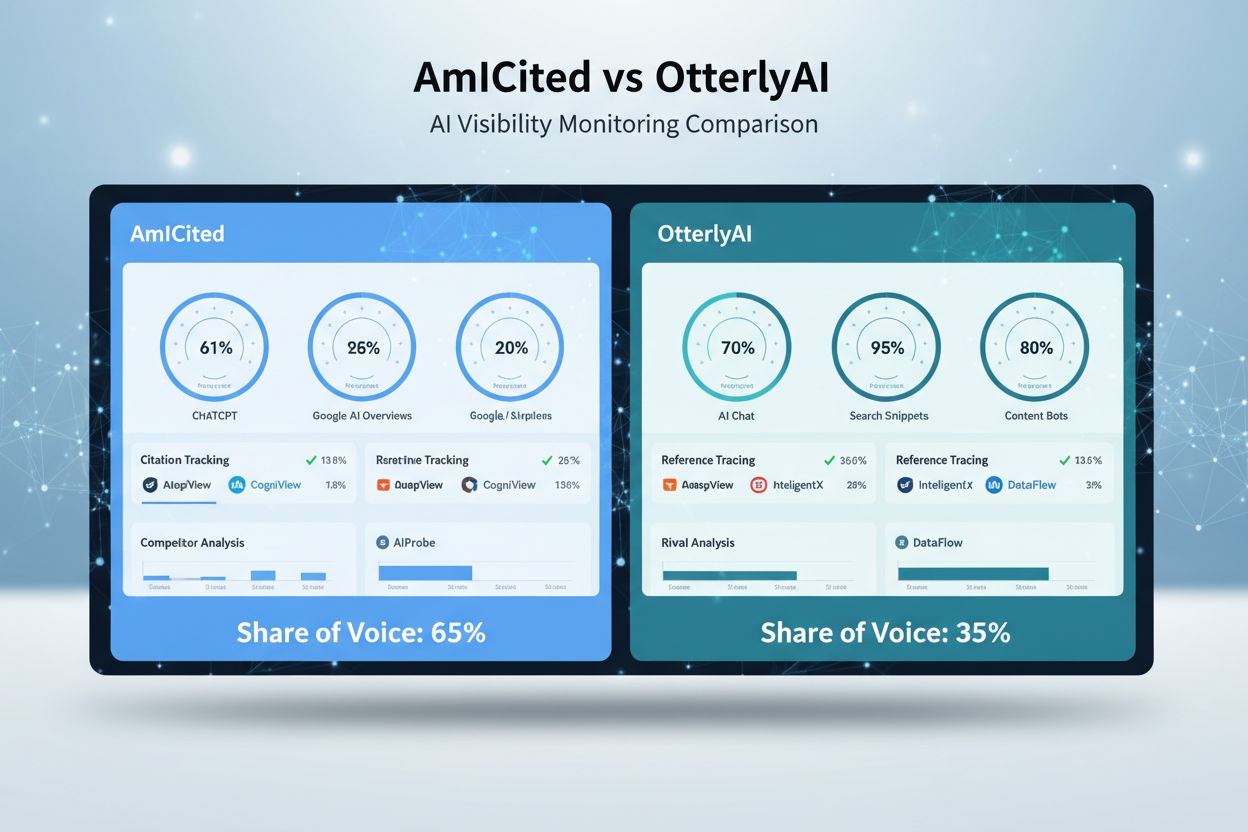
Compare Am I Cited and OtterlyAI for AI visibility tracking, including brand mentions, supported platforms, features, and pricing.
Compare 15 AI search visibility platforms by pricing, engine coverage, free plans, and ideal use case. See verified 2026 figures in this buyer’s matrix.
Cookie Consent
We use cookies to enhance your browsing experience and analyze our traffic. See our privacy policy.