


Semrush AI Visibility Toolkit Review
Review Semrush’s AI Visibility Toolkit, including features, pricing, pros and cons, and comparisons with Am I Cited and Profound.
13 min read
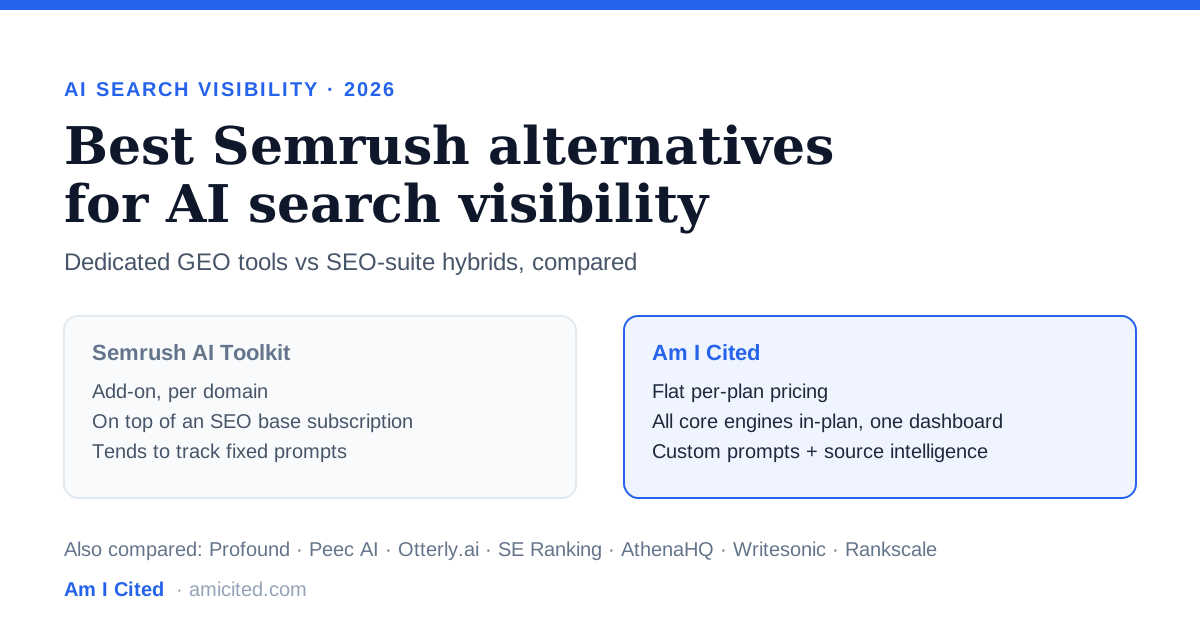
Best Semrush alternatives for AI search visibility tracking in 2026, compared: dedicated GEO tools vs SEO hybrids, with Am I Cited as a flat-priced pick.
The best Semrush alternatives for AI search visibility tracking are dedicated GEO platforms (Am I Cited, Profound, Peec AI, and Otterly.ai) plus leaner SEO hybrids like Ahrefs Brand Radar and SE Ranking. If you only need AI visibility, a dedicated tool is usually cheaper and deeper than Semrush’s per-domain add-on model.
Semrush’s AI Visibility Toolkit is a capable product, but it sits on top of a full SEO suite you may not need. You pay the base Semrush subscription first, then bolt the AI Toolkit on per domain. For teams whose priority is now AI search, you pay for a whole platform to reach one feature. This guide compares nine alternatives so you can find a better-fit option by budget, team size, and use case.
Semrush built its reputation on traditional SEO: keyword research, rank tracking, backlinks, and site audits. The AI Visibility Toolkit extends that suite into AI search, tracking how ChatGPT, Perplexity, and Google AI Overviews reference brands. It’s genuinely useful if you already live in Semrush every day.
But three structural issues push many teams to look elsewhere.
The cost stacks up. As of 2026 (verify current pricing), a Semrush base plan runs around $139.95/mo, the AI Toolkit adds roughly $99/mo per domain, and the bundled Semrush One tier sits near $199/mo. If AI visibility is the only job you need done, you’re paying for an entire SEO platform to unlock one module.
Prompts tend to be fixed, not custom. The Toolkit leans toward a predefined prompt set rather than the fully custom, scheduled prompt tracking that dedicated GEO tools build their whole product around. That matters when the exact buyer questions you care about are specific to your niche.
It’s a bolt-on, not a purpose-built tool. AI visibility inside Semrush is a feature of an SEO suite. Dedicated platforms treat AI answers as the core product, which shows up in things like source and citation intelligence, sentiment analysis, and share-of-voice depth that a bolt-on rarely matches.
None of this makes Semrush a bad tool. It makes it the wrong shape for teams whose center of gravity has shifted from ten blue links to AI answers. If that’s you, a dedicated GEO platform or a leaner SEO hybrid will fit better. For a fuller landscape, our 25-tool AI visibility pillar maps the whole category, and our head-to-head on Am I Cited vs Semrush AI visibility breaks down the direct comparison.
The nine tools below split into dedicated GEO platforms and SEO-suite hybrids, led by Am I Cited, with the Semrush AI Toolkit as a baseline so you can see the thing you’re replacing inside the same grid.
| Tool | Best for | Starting price (verify current) | Engines | Dedicated GEO? |
|---|---|---|---|---|
| Am I Cited | Flat-priced dedicated tracking with source intelligence | ~€50/mo | ChatGPT, Perplexity, Gemini, Google AI Mode, Copilot, Grok, DeepSeek | Yes |
| Ahrefs Brand Radar | Teams already inside Ahrefs | Add-on (~$129+ base) | ~6 | Hybrid |
| AthenaHQ | Prompt-level analytics + revenue attribution | ~$295/mo | Multi-engine | Yes |
| Otterly.ai | Cheapest clean entry-level monitor | $29/mo (Standard $189) | 4 base (Gemini/Claude add-ons) | Yes |
| Peec AI | Agencies wanting client-ready reporting | ~€89/mo | ~3 of 7 on base (Claude enterprise-only) | Yes |
| Profound | Enterprise depth and agent analytics | ~$99/mo (Growth ~$399) | 10+ | Yes |
| Rankscale AI | Lowest-cost daily multi-engine checks | ~$20/mo | Multi-engine, daily | Yes |
| Semrush AI Toolkit (baseline) | The suite you’re replacing | ~$139.95 base + ~$99/domain | ChatGPT, Perplexity, Google AI Overviews | Hybrid (add-on) |
| SE Ranking (SE Visible) | Hybrid SEO + GEO on a budget suite | ~$89/mo add-on | ChatGPT, Google AI Overviews/Mode, Gemini, Perplexity | Hybrid |
| Writesonic GEO | Content-first teams wanting tracking + writing | ~$79–399/mo | Multi-engine | Hybrid |
Best for: Teams that want purpose-built AI visibility tracking without add-on math or per-engine creep.
What it does well: Am I Cited is a dedicated AI search visibility platform, a spinoff from FlowHunt.io, now used by 500+ brands and agencies. It tracks mentions, citations, sentiment, and share of voice across ChatGPT, Perplexity, Gemini, Google AI Mode, Copilot, Grok, and DeepSeek from a single dashboard. Two things separate it from a Semrush add-on. First, pricing is flat per plan, starting around €50/mo, with all core engines included, no paying extra per engine or per prompt. That’s a direct contrast to stacking a Semrush base subscription plus a per-domain AI Toolkit fee. Second, it’s actionable rather than monitoring-only: its Source and Domain Intelligence shows which sources feed AI answers about you and your competitors, Reddit threads, YouTube videos, review sites, so you can see what to influence, not just a score. Beyond that, it offers scheduled prompt tracking, a Brand Visibility Score, competitor share-of-voice analysis, automatic Prompt Discovery from Google Search data, Shopping data, an Entity Tracker, visibility calendars, and an MCP server plus API to automate reporting. It supports EN/DE/ES/FR/IT/SK, which helps agencies serving multi-market clients.
Where it falls short: Am I Cited is newer than incumbents like Semrush and Ahrefs, so it doesn’t carry the same brand recognition or a decade of traditional-SEO tooling. If you need keyword research, backlink graphs, and site audits in the same product, this isn’t that. It’s a focused GEO tool, not an all-in-one SEO suite.
Pricing: Entry around €50/mo (verify current), all core engines in-plan, free trial, no per-engine or per-prompt surcharges. See current plans on the pricing page .
Verdict: For teams whose priority is AI search visibility, Am I Cited is the strongest dedicated replacement for the Semrush Toolkit: all core engines in-plan, predictable pricing, and source intelligence that tells you where AI answers actually come from. Explore the AI rank tracker for scheduled prompt checks and AI visibility monitoring for the brand-tracking side.
Best for: Large brands and enterprise agencies that need maximum depth and compliance.
What it does well: Profound is the enterprise leader in this category, well-funded (reportedly ~$155M raised at a ~$1B valuation) and built for scale. It tracks 10+ engines, offers crawler-log-based Agent Analytics, a Conversation Explorer for understanding how AI discusses your category, and SOC 2 compliance for procurement-heavy buyers.
Where it falls short: It’s monitoring-first and carries a steep learning curve. The price and complexity are hard to justify unless you’re operating at enterprise scale.
Pricing: Brands around $99/mo, Growth around $399/mo, Enterprise custom (four figures per month is possible). Verify current pricing.
Verdict: If you’re leaving Semrush because you’ve outgrown it upward, Profound is the natural enterprise landing spot, powerful, but priced and paced for larger teams.
Best for: Agencies that manage many brands and need clean, client-ready reports.
What it does well: Berlin-based Peec AI (~€29M raised, 1,300+ brands) targets mid-market analytics with unlimited seats, which agencies love because seat costs don’t scale with headcount. Reporting is polished and client-ready, and it supports 115+ languages.
Where it falls short: Base plans cap coverage at roughly three of seven engines, with Claude reserved for enterprise tiers. There’s no content generation, no crawler logs, and no GA4 attribution, so it’s analytics, not an end-to-end optimization stack.
Pricing: Starter around €89/mo. Verify current pricing.
Verdict: A solid agency pick if unlimited seats and multilingual reporting matter more than maximum engine breadth.
Best for: Small teams testing AI visibility on a tight budget.
What it does well: Otterly.ai (Gartner Cool Vendor 2025, 15,000+ users) has the lowest advertised entry price and a clean interface. Its GEO Audit, covering crawlability, content, and query fan-out, is a useful diagnostic.
Where it falls short: The pricing cliff is steep: Lite ($29/mo, 15 prompts, four base engines) jumps 6.5x to Standard ($189/mo). Gemini, Google AI Mode, and Claude are paid add-ons ($9–$149, Claude up to $439), so comprehensive coverage climbs fast. It’s monitoring-only, has no native white-label, and updates weekly rather than in real time.
Pricing: Lite $29/mo, Standard $189/mo, Premium $489/mo, plus engine add-ons. Verify current pricing.
Verdict: Best for proving the concept cheaply. As you scale prompts and engines, the add-on math starts to resemble the cost creep you left Semrush to avoid. See our Otterly.ai review for a deeper look.
Best for: Teams that already pay for Ahrefs and want AI visibility alongside it.
What it does well: Brand Radar is backed by Ahrefs’ large search dataset, giving it real prompt-data scale across roughly six engines. If you already use Ahrefs, it’s a low-friction add.
Where it falls short: Like Semrush’s Toolkit, it’s an add-on inside an SEO suite. Prompts are fixed rather than custom, and there’s no content generation and no AI-specific attribution.
Pricing: Add-on to Ahrefs (base ~$129+/mo; effective ~$199/mo once the add-on is included; it was free in beta). Verify current pricing.
Verdict: A reasonable choice if you’re staying in Ahrefs, but if you’re leaving Semrush to escape the add-on model, swapping one SEO-suite add-on for another may not solve the core problem. Compare directly in Am I Cited vs Ahrefs Brand Radar .
Best for: Teams wanting a cheaper SEO suite with an AI layer attached.
What it does well: SE Ranking’s SE Visible add-on covers ChatGPT, Google AI Overviews and AI Mode, Gemini, and Perplexity, bundled with a full, affordable SEO toolset. Good hybrid value if you want both jobs in one budget-friendly suite.
Where it falls short: As an add-on to an SEO platform, its GEO depth trails dedicated tools, and it makes most sense only if you’re already on (or moving to) SE Ranking.
Pricing: Add-on around $89/mo on top of the SE Ranking suite. Verify current pricing.
Verdict: A sensible Semrush replacement if you want a cheaper all-in-one SEO suite plus decent AI tracking, rather than best-in-class GEO.
Best for: Teams that want to connect AI visibility to revenue.
What it does well: Founded by ex-Google Search and DeepMind engineers, AthenaHQ offers deep prompt-level analytics, an Action Center, and GA4/Shopify revenue attribution, closing the gap between “we appear in AI answers” and “it drove sales.”
Where it falls short: No content generation, and it comes with formal onboarding rather than instant self-serve setup. Entry price is higher than lightweight monitors.
Pricing: Around $295/mo self-serve. Verify current pricing.
Verdict: A capable pick if attribution is your priority and you can absorb the onboarding.
Best for: Content teams that want visibility tracking and an AI writer together.
What it does well: Writesonic bundles GEO tracking with a built-in AI writer, so you can spot gaps and produce content in one place, appealing if content production is your bottleneck.
Where it falls short: The GEO tracking layer is less mature than dedicated tools. You’re buying a content platform with tracking attached, not a specialist visibility monitor.
Pricing: Around $79–399/mo depending on tier. Verify current pricing.
Verdict: Good for content-led teams, weaker if you need the deepest visibility analytics.
Best for: Budget-conscious solo operators and small teams.
What it does well: Rankscale delivers multi-engine, daily monitoring from around $20/mo, the lowest sustained price on this list, making it an easy way to keep a pulse on AI visibility.
Where it falls short: Reporting is shallow compared with dedicated analytics platforms. It’s a lightweight checker, not a full workbench.
Pricing: From ~$20/mo. Verify current pricing.
Verdict: The budget floor. Great for a daily signal, limited if you need depth or actionability.
The decision hinges on how much you still rely on Semrush’s traditional SEO features.
Keep Semrush, add a dedicated AI tool. If your team runs keyword research, rank tracking, and backlink analysis in Semrush every day, don’t rip it out. Keep the SEO suite for what it’s great at, but skip the AI Visibility Toolkit add-on and run a dedicated GEO tool like Am I Cited instead. You’ll get deeper AI-answer tracking and source intelligence for a predictable flat fee, without stacking a per-domain add-on onto your base subscription.
Replace Semrush entirely. If AI search is now your priority and your traditional SEO needs are modest, you can often drop Semrush for a lighter, cheaper SEO tool (or SE Ranking’s hybrid suite) plus a dedicated AI-visibility platform, and spend less overall than a full Semrush One plan with the Toolkit attached.
The mistake to avoid is paying for a full SEO suite purely to access one AI module. If the AI module is the only part you use, a dedicated tool almost always wins on both depth and cost.
By budget. Under $30/mo, Rankscale (~$20) and Otterly Lite ($29) are the realistic entry points, though both trade depth or engine coverage for price. Around €50/mo, Am I Cited gives you all core engines in-plan with no add-on math, often the best value once you account for Semrush’s stacked costs. At $250/mo and up, AthenaHQ and Profound bring attribution and enterprise depth.
By team size. Solo operators and small teams do well with Am I Cited or Rankscale. Agencies should weigh Peec AI (unlimited seats) and Am I Cited (flat pricing, multi-language, MCP/API automation). Enterprises with compliance and scale needs land on Profound.
By use case. For pure, actionable AI-visibility tracking with source intelligence, choose Am I Cited. For revenue attribution, AthenaHQ. For content production plus tracking, Writesonic GEO. For a cheap SEO-plus-GEO hybrid, SE Ranking. For staying inside an existing SEO suite, Ahrefs Brand Radar.
The through-line: match the tool to the job that’s actually your priority. Most teams leaving the Semrush Toolkit want a leaner, dedicated GEO layer, and that’s exactly where flat-priced, all-engines-in-plan tools like Am I Cited earn their place.
If you’re ready to see which AI answers cite your brand, and which sources feed them, start a free trial of Am I Cited or get in touch to talk through the right fit for your team.
Yasha is a talented software developer specializing in Python, Java, and machine learning. Yasha writes technical articles on AI, prompt engineering, and chatbot development.

Am I Cited tracks your citations, mentions, and share of voice across ChatGPT, Perplexity, Gemini, Google AI Mode, Copilot, Grok, and DeepSeek from one dashboard, at flat per-plan pricing.
Review Semrush’s AI Visibility Toolkit, including features, pricing, pros and cons, and comparisons with Am I Cited and Profound.
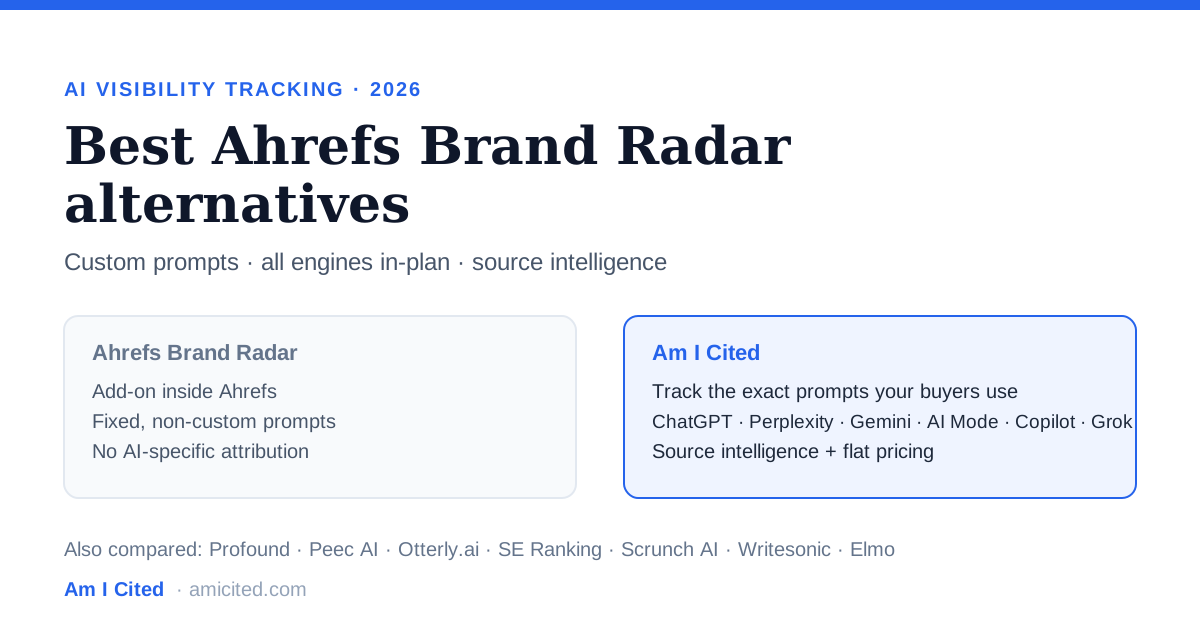
Compare the best Ahrefs Brand Radar alternatives for tracking AI visibility in 2026 on price, engines, and custom prompts, with Am I Cited as a top pick.
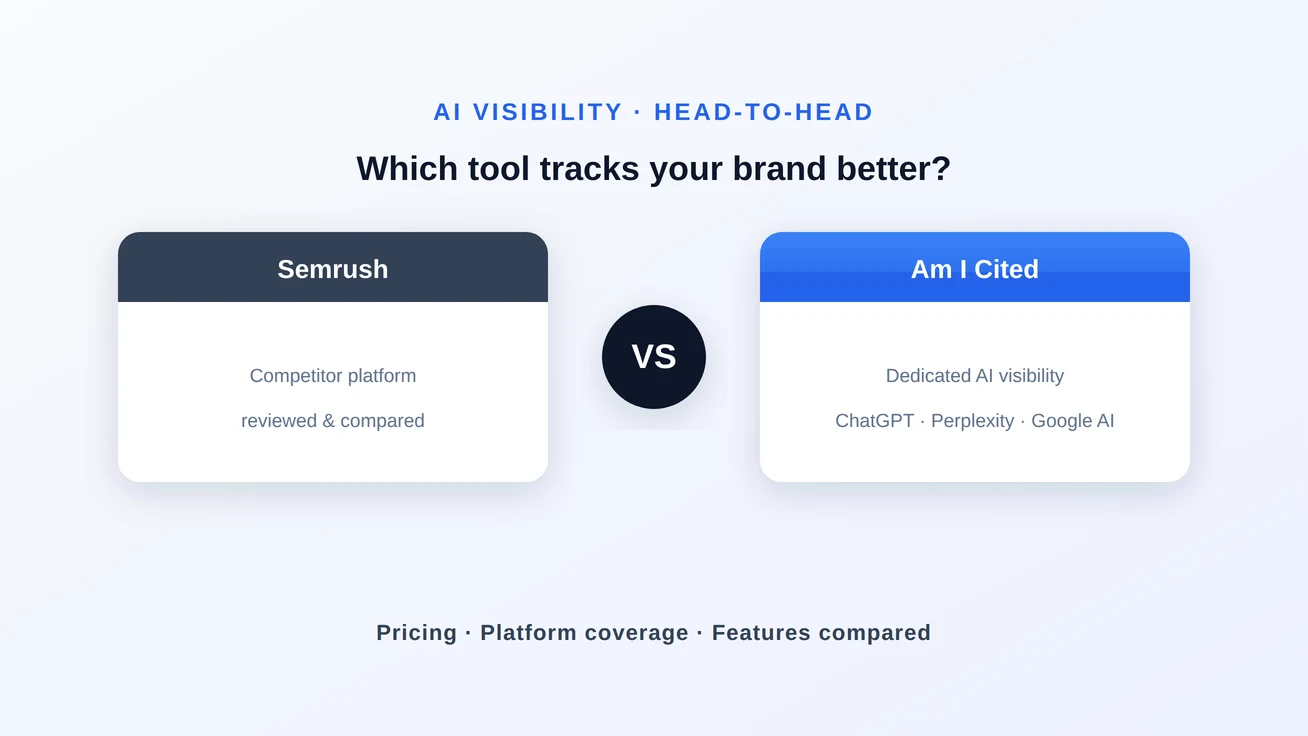
Compare Am I Cited with Semrush’s AI Visibility Toolkit by 2026 pricing, engine coverage, features, and platform fit.
Cookie Consent
We use cookies to enhance your browsing experience and analyze our traffic. See our privacy policy.