


Semrush AI Visibility Toolkit Review
Review Semrush’s AI Visibility Toolkit, including features, pricing, pros and cons, and comparisons with Am I Cited and Profound.
13 min read
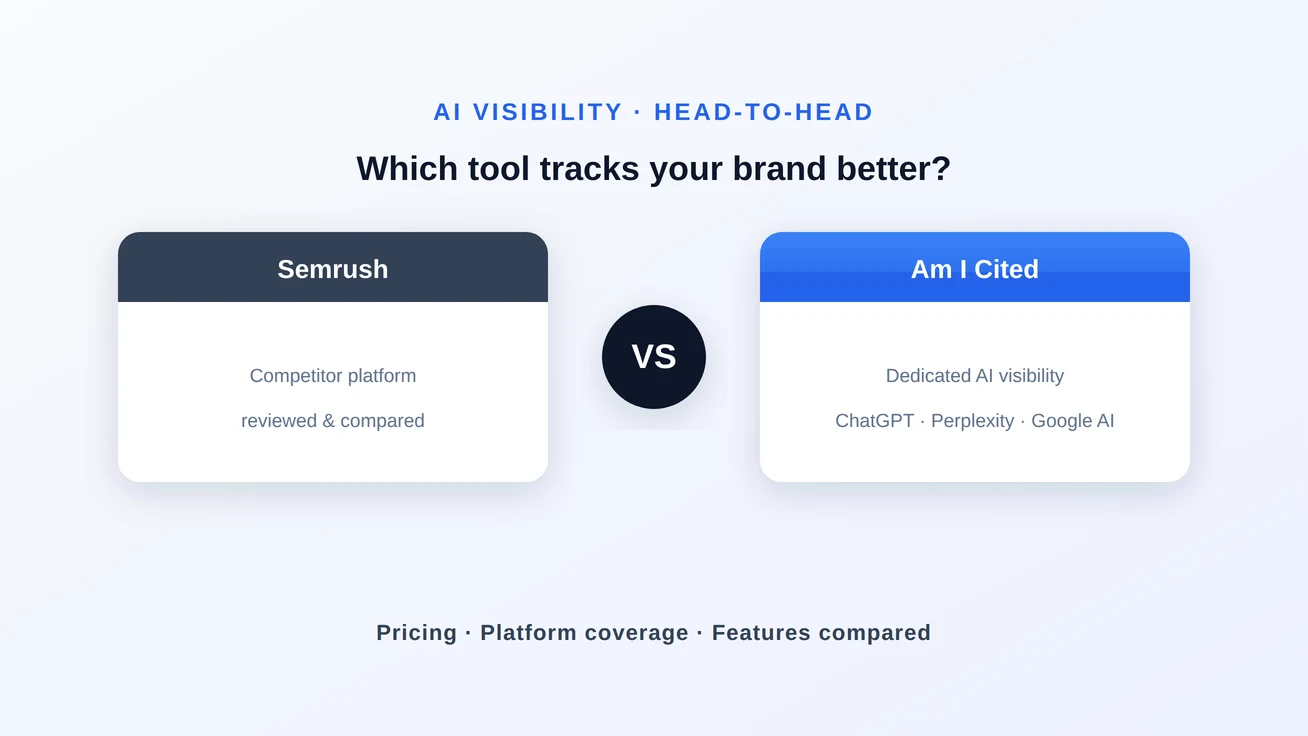
Compare Am I Cited with Semrush’s AI Visibility Toolkit by 2026 pricing, engine coverage, features, and platform fit.
| AmICited | Semrush AI Visibility Toolkit | |
|---|---|---|
| Best for | Teams wanting a dedicated, purpose-built GEO platform | Teams already invested in Semrush for SEO |
| Starting price | €50/month (no base platform required) | ~$99/month add-on, plus a base Semrush plan |
| Standout feature | Prompt-level citation tracking, daily updates, 8 engines | Unified dashboard with existing SEO data |
| Verdict | Best overall pick for serious, dedicated AI visibility monitoring | Reasonable convenience option only if you already pay for Semrush |
Search is splitting in two. While traditional SEO still drives traffic through Google’s blue links, a parallel universe of AI-powered answer engines (ChatGPT, Google AI Overviews, Perplexity, Gemini, and Claude) is reshaping how users discover information. When these AI systems generate answers, they cite far fewer sources than the traditional 10 organic results. If your brand isn’t mentioned inside an AI-generated response, you’re invisible to a growing segment of search traffic.
This shift has created a new discipline: Generative Engine Optimization (GEO), the practice of earning citations and mentions within AI-powered answer engines. And it’s created a new buying decision: Should you use a dedicated AI visibility platform, or layer AI monitoring onto your existing SEO suite?
This comparison cuts through the marketing noise. We’ll examine AmICited (a purpose-built GEO platform) and Semrush AI Visibility Toolkit (a bolt-on feature within Semrush’s SEO ecosystem) across 11 critical dimensions. By the end, you’ll understand not just the features each offers, but the architectural trade-offs that determine which fits your team’s goals, budget, and execution model.

Track how AI chatbots mention your brand across ChatGPT, Perplexity, and other platforms.
AmICited is a dedicated, standalone platform built entirely around AI brand monitoring and citation analysis. It was purpose-built from the ground up to solve a single problem: How is my brand being mentioned and cited across AI systems, and how can I improve that visibility?
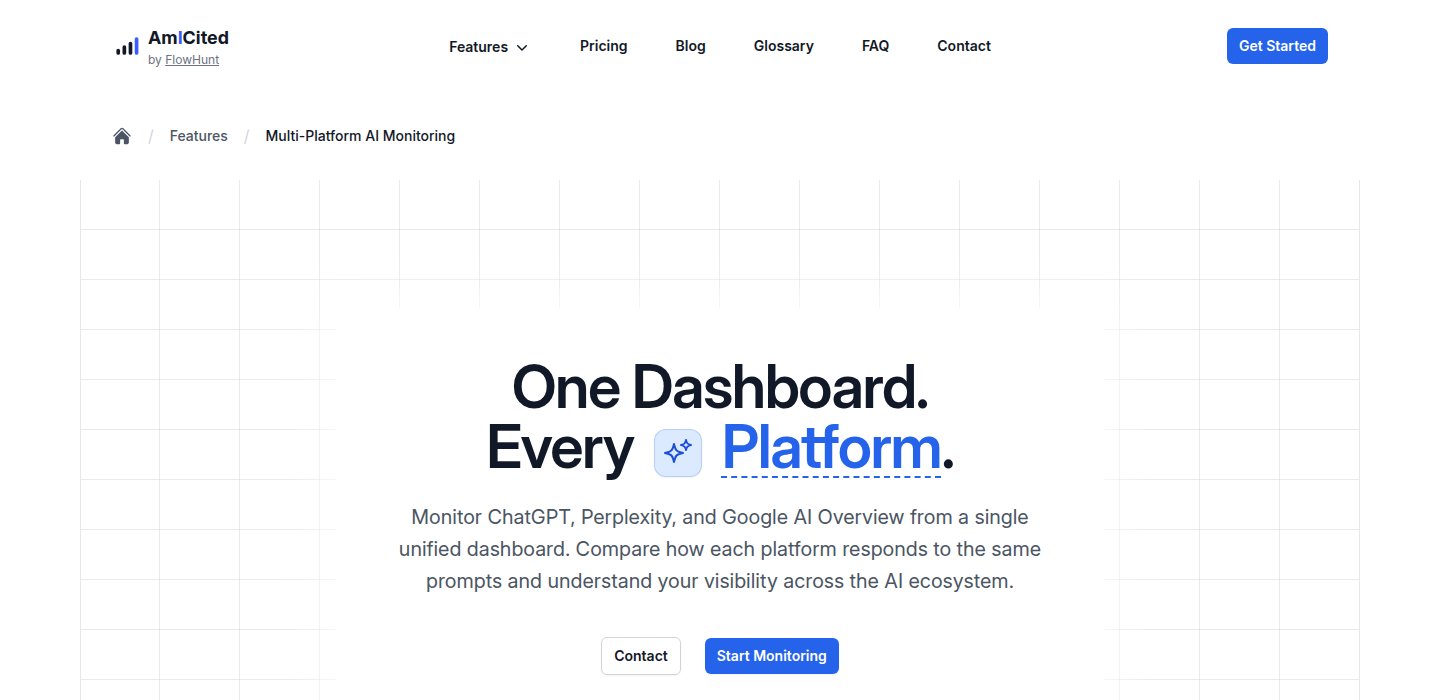
AmICited centers on four pillars:
AmICited is not an SEO tool. It doesn’t track keyword rankings on Google, backlinks, or traditional search metrics. Its entire data model is built around AI citation volatility: the fact that 40–60% of cited domains change monthly across major AI platforms.
Semrush AI Visibility Toolkit is a paid add-on feature within Semrush’s broader SEO platform. Semrush, founded in 2008 as an SEO tool, added AI visibility monitoring in September 2025 as an extension of its existing keyword and site-health workflows.
The toolkit is designed to integrate AI visibility reporting into your existing Semrush dashboard, allowing you to:
Get the latest insights on AI mentions, brand monitoring, and optimization strategies.
This is the foundational difference between the two tools, and it shapes everything else.
AmICited was designed from the ground up with one constraint in mind: AI search results are inherently volatile. Research shows 40–60% of cited domains change monthly across major platforms:
This volatility is fundamentally different from traditional search, where a ranking change of 10–15% monthly is considered normal. AmICited’s data infrastructure (from citation tracking to sentiment analysis to prompt-level granularity) was built to handle this unpredictability.
Implication: AmICited’s architecture is optimized for detecting subtle shifts in how AI systems cite your brand, making it more sensitive to the real changes that matter in GEO.
Semrush’s AI Visibility Toolkit is built on top of Semrush’s traditional SEO platform. The architecture was designed for keyword rankings, backlinks, and organic traffic, metrics that change more slowly and predictably than AI citations.
When you use Semrush for AI visibility, you’re layering AI monitoring onto a system built for traditional search. This has benefits (unified dashboard, familiar workflows) and limitations (less granular AI-specific insights, keyword-focused rather than prompt-focused analysis).
Implication: Semrush’s approach prioritizes integration and convenience over specialized AI analysis. You get directional AI awareness, but not the depth needed for serious GEO execution.
One of the most critical decisions in choosing an AI visibility tool is coverage breadth. If a platform doesn’t monitor the AI engines your audience uses, you’re missing visibility into a crucial part of the picture.
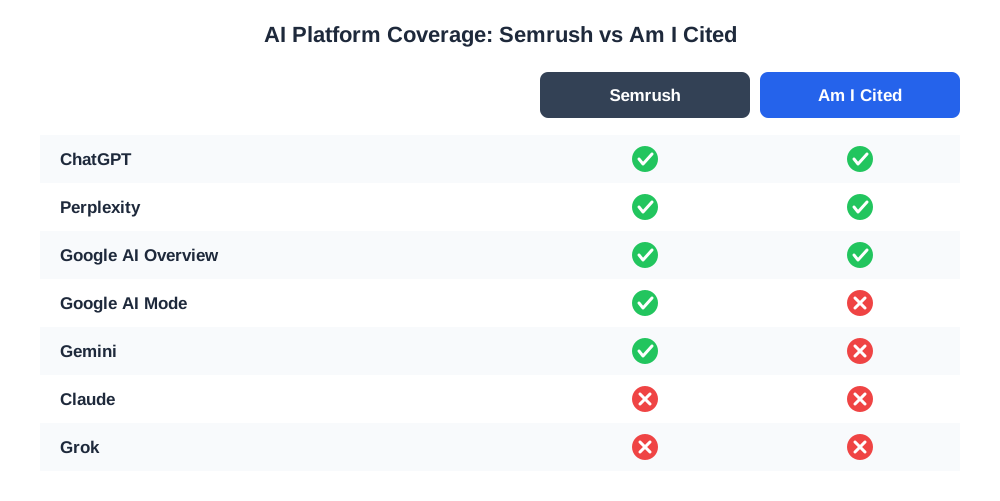
AmICited monitors:
Coverage: 8 major platforms, with ongoing expansion planned.
Semrush currently monitors:
Coverage: 3 major platforms confirmed, with limited breadth.
Semrush’s limitation is significant. If your audience uses Perplexity, Claude, or Grok, which are rapidly gaining adoption, especially among technical and professional users, Semrush leaves you blind to those channels. You’d be monitoring only 30–40% of the AI visibility landscape that matters to your audience.
AmICited’s broader coverage means you get a more complete picture of where your brand is (or isn’t) being cited across the AI ecosystem.
Verdict: AmICited wins on coverage breadth. For brands serious about GEO, monitoring 8 engines vs. 3 is a material difference.
Both platforms track citations, but they do so fundamentally differently.
AmICited tracks citations at the prompt level, meaning it monitors exactly which sources the AI system cites in response to specific queries. For example:
Data collection method: Real user conversations and API queries across major LLMs.
Update frequency: Daily updates for tracked prompts; weekly for broader visibility scores.
Sampling methodology: Multi-session sampling (multiple runs of the same prompt to account for LLM variation).
Semrush tracks citations at the keyword level, aligning with its traditional SEO architecture. For the same query, Semrush would show:
Data collection method: Periodic API queries and monitoring.
Update frequency: Weekly or less frequent updates.
Sampling methodology: Single or limited sampling (one run per monitoring cycle).
Prompt-level analysis (AmICited) is more granular and actionable. If you see that your brand is cited in 30% of ChatGPT responses for “project management tool,” you can drill down to see:
Keyword-level analysis (Semrush) is simpler but less diagnostic. You know you’re visible for the keyword, but you don’t know why or how to improve it.
For serious GEO work, prompt-level analysis is significantly more useful.
| Dimension | AmICited | Semrush |
|---|---|---|
| Tracking Granularity | Prompt-level | Keyword-level |
| Citation Depth | Source attribution | Basic mention count |
| Update Frequency | Daily | Weekly |
| Sampling Methodology | Multi-session | Single/limited |
| Sentiment Tracking | Yes, detailed | Basic |
| Actionability | High | Medium |
It’s not enough to know you’re cited: you need to know how you’re described. This is where sentiment analysis becomes critical.
AmICited provides detailed sentiment tracking that goes beyond simple positive/negative/neutral classification:
This data is granular enough to inform content strategy. If the AI system consistently describes you as “expensive” but you’re positioning as “affordable,” that’s actionable intelligence.
Semrush offers basic sentiment tracking as part of the Brand Performance report:
It’s useful for high-level monitoring but lacks the attribute-level detail that AmICited provides.
Verdict: AmICited’s sentiment analysis is deeper and more actionable. If brand perception in AI systems is a priority, AmICited gives you the insights you need to improve it.
Both platforms allow you to monitor specific prompts (queries), but their approaches differ.
AmICited’s prompt tracking is prompt-centric:
This is particularly useful for campaigns. If you’re launching a new product feature, you can set up prompts around that feature and monitor real-time how AI systems discuss it.
Semrush’s approach is keyword-focused:
The workflow feels familiar if you’re already using Semrush for traditional SEO, but it’s less specialized for GEO work.
AmICited: Provides topic clustering and related prompts, helping you discover new queries where your brand should be visible.
Semrush: Offers keyword-focused topic research, extending its traditional SEO research tools.
Verdict: For pure GEO execution, AmICited’s prompt-centric approach is more aligned with how AI systems actually work. Semrush’s keyword-centric approach is more aligned with traditional SEO thinking.
You could have perfect data, but if the interface is confusing, you won’t act on it.
Strengths:
Weaknesses:
Strengths:
Weaknesses:
Verdict: If you’re already deep in Semrush, the integrated dashboard is convenient. If you’re starting fresh or want a specialized GEO interface, AmICited’s modular design is cleaner.
This is where the “dedicated vs. bolt-on” distinction becomes financially real.
AmICited uses a monthly subscription model:
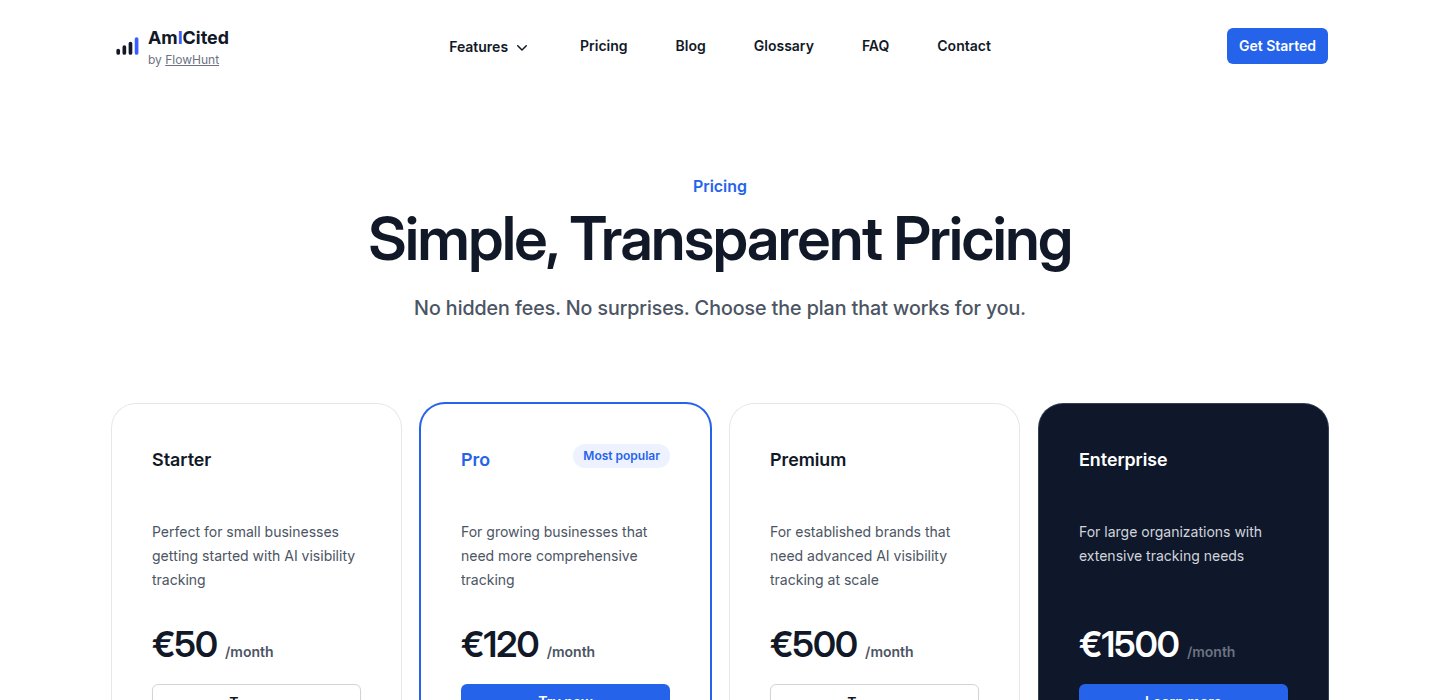
Cost structure: Volume-based pricing. Plans are defined by prompt and AI-response volume (and the number of competitors you track), not by domain count, so the price doesn’t automatically multiply as you add brands.
What’s included:
Hidden costs: None significant. The pricing is transparent and scales with prompt and AI-response volume rather than with domain count.
Semrush pricing is layered:
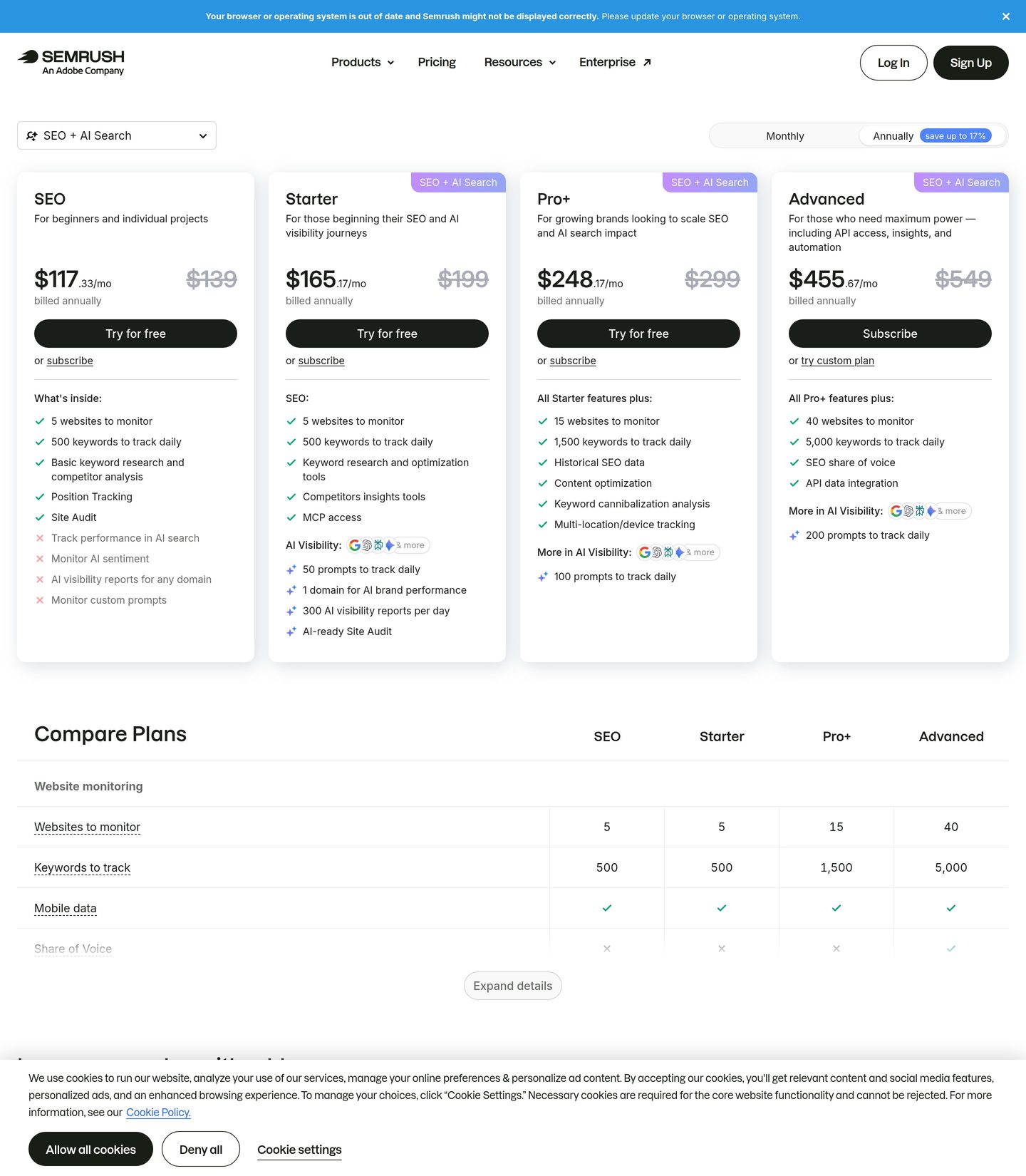
Cost structure: You must have a Semrush subscription first, then add AI Visibility as a paid module.
What’s included:
True cost example:
| Scenario | AmICited | Semrush |
|---|---|---|
| 1 domain, GEO only | €50–€1,500 (plan by prompt volume, no per-domain fee) | $218 |
| 5 domains, GEO only | €50–€1,500 (same plan covers multiple brands; scales by prompt volume) | $614 |
| 10 domains, GEO only | €50–€1,500 (same plan covers multiple brands; scales by prompt volume) | $1,109 |
| 1 domain, GEO + SEO | €50–€1,500 (GEO only; no SEO suite) | $218 |
| 5 domains, GEO + SEO | €50–€1,500 (GEO only; no SEO suite) | $614 + SEO tools |
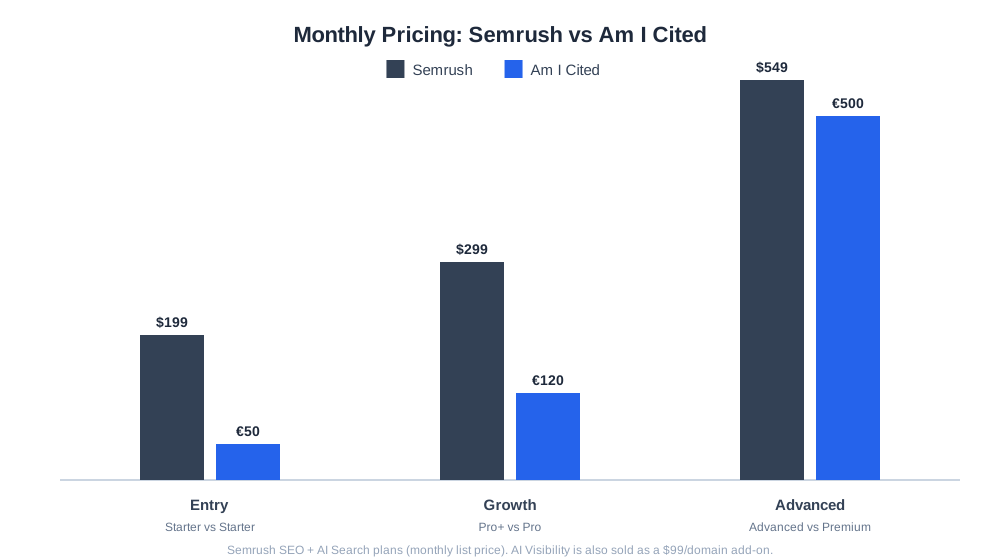
Verdict: For GEO-only use cases, AmICited is more cost-effective. For teams already paying for Semrush’s SEO tools, the AI Visibility add-on is an affordable incremental cost.
Neither tool exists in isolation. Both need to connect to your data sources and workflow tools.
AmICited integrates with:
Workflow: AmICited is designed as a source of truth for GEO data. You pull insights from AmICited and push them into your other tools.
Semrush integrates with:
Workflow: Semrush is designed as a hub. You access all your SEO, content, and (now) AI visibility data from one dashboard.
If you’re already using Semrush as your primary SEO platform, the integrated approach is seamless. You don’t need to jump between tools.
If you’re using multiple point solutions (e.g., Ahrefs for SEO, HubSpot for CRM, Slack for alerts), AmICited’s flexible integrations may fit better.
Verdict: Depends on your existing stack. Semrush wins if you’re already in the ecosystem; AmICited wins if you want to layer GEO onto a diverse toolset.
GEO is new, and many teams are learning as they go. Support quality matters.
Support channels:
Onboarding: AmICited includes onboarding calls for new customers, helping you set up initial prompts and understand the platform.
Training: Regular webinars and documentation on GEO best practices.
Response quality: Generally strong; support team understands GEO deeply.
Support channels:
Onboarding: Standard onboarding; not specialized for AI Visibility module.
Training: Semrush Academy covers SEO extensively; AI Visibility training is limited.
Response quality: Good for general platform issues; less specialized for GEO questions.
Known limitation: Users have reported difficulty getting AI Visibility-specific support; the module sometimes feels like an afterthought.
Verdict: AmICited’s support is more specialized for GEO. If you’re new to AI visibility work, AmICited’s onboarding and training will be more helpful.
How quickly can you get insights from each platform?
Initial setup: 30–60 minutes
Learning curve: Moderate. The concepts are new (GEO is unfamiliar to most), but the interface is intuitive for those who understand the discipline.
Day-1 value: You’ll see your current AI visibility across tracked engines, but actionable insights take 7–14 days as historical data accumulates.
Ongoing learning: Plan for 2–3 weeks to fully understand how to interpret and act on the data.
Initial setup: 15–30 minutes
Learning curve: Low. If you know traditional SEO, the keyword-focused approach is immediately familiar.
Day-1 value: High. You’ll see immediate visibility data for your keywords.
Ongoing learning: Minimal if you’re already an SEO user; moderate if you’re new to Semrush.
Verdict: Semrush has a faster time to value and lower learning curve. AmICited requires more GEO education but provides deeper insights once you understand it.
In fast-moving AI search, data freshness is critical.
AmICited prioritizes accuracy over speed, using multi-session sampling to account for LLM variation.
Semrush’s traditional SEO architecture means less frequent updates. AI Visibility data is refreshed on a weekly cycle, not daily.
For most use cases, weekly data is sufficient. But if you’re running a time-sensitive campaign or need to respond quickly to competitive moves, daily updates matter.
Verdict: AmICited wins on data freshness. Daily updates are more useful for GEO work, where AI systems can shift citations rapidly.
For most teams doing serious GEO work, AmICited is the stronger overall choice: it’s a purpose-built platform with broader engine coverage, deeper prompt-level and sentiment data, and pricing that isn’t tied to a base SEO subscription. Semrush’s toolkit remains a reasonable convenience if you’re already paying for the full Semrush suite. The right choice still depends on your goals, team structure, and existing tools.
✅ You’re serious about GEO: You’re building a dedicated AI visibility strategy and need specialized tools.
✅ You need broad engine coverage: You want to monitor Perplexity, Gemini, Claude, Grok, and DeepSeek, plus Google AI Mode, not just ChatGPT and Google AI Overviews.
✅ You want prompt-level insights: You need to understand exactly which prompts drive citations and how to optimize for them.
✅ You’re managing multiple brands: You need white-label options or multi-domain management.
✅ You want specialized support: You need a team that understands GEO deeply, not traditional SEO.
✅ You have a diverse tool stack: You use Ahrefs for SEO, HubSpot for CRM, and want to layer GEO on top.
✅ Budget is volume-based: You prefer transparent pricing tied to prompt and AI-response volume rather than a per-domain fee, and without a base platform cost.
✅ You’re already in Semrush: You use Semrush for SEO and want to add AI visibility without switching tools.
✅ You want integrated SEO + AI tracking: You need to see traditional search and AI visibility in one dashboard.
✅ You need affordability for a single domain: The $99/month add-on is cheaper than AmICited if you only monitor one domain.
✅ You’re new to GEO: You want a low-risk way to explore AI visibility without committing to a dedicated platform.
✅ You prefer keyword-focused analysis: Your team thinks in keywords, not prompts, and that’s your workflow.
✅ You want SEO + AI in one contract: You prefer consolidating vendors.
Some teams use both tools strategically:
This approach is expensive ($200–$300/month combined for a single domain) but useful for enterprises where GEO is a core strategy.
| Size | Primary Tool | Rationale |
|---|---|---|
| Freelancer / Solo | Semrush (if already subscribed) or AmICited Starter | Low cost, minimal setup |
| Small Team (5–10 people) | AmICited Pro | Specialized GEO focus, better support |
| Mid-Market (10–50 people) | AmICited + Semrush (hybrid) | Depth + SEO integration |
| Enterprise (50+ people) | AmICited Enterprise + Semrush | White-label, dedicated support, full coverage |
Arshia is an AI Workflow Engineer at FlowHunt. With a background in computer science and a passion for AI, he specializes in creating efficient workflows that integrate AI tools into everyday tasks, enhancing productivity and creativity.

Track how ChatGPT, Perplexity, Gemini, Claude, Grok, DeepSeek, Google AI Overview, and Google AI Mode mention and cite your brand with a platform built exclusively for AI visibility. Get started in minutes, no SEO suite required.
Review Semrush’s AI Visibility Toolkit, including features, pricing, pros and cons, and comparisons with Am I Cited and Profound.
Compare Am I Cited with SE Ranking’s AI Visibility tracker by pricing, engine coverage, and dedicated versus SEO-suite features.
Compare Am I Cited with Ahrefs Brand Radar for AI visibility, including 2026 pricing, engine coverage, and dedicated versus add-on features.
Cookie Consent
We use cookies to enhance your browsing experience and analyze our traffic. See our privacy policy.