


Am I Cited vs Rankscale: AI Visibility Compared
Compare Am I Cited and Rankscale for AI search visibility, including 2026 pricing, engine coverage, and Rankscale’s credit-based model.
16 min read
Compare Am I Cited with Ahrefs Brand Radar for AI visibility, including 2026 pricing, engine coverage, and dedicated versus add-on features.
The question every brand is now asking: when a customer turns to ChatGPT, Perplexity, or Google AI Overviews for a recommendation, does your brand get mentioned, or does your competitor?
That question has spawned an entirely new category of software: AI visibility monitoring tools. Two of the most discussed names in this space are Amicited and Ahrefs Brand Radar. Both promise to answer the same core question, but they approach it from fundamentally different directions.
This article breaks down the architectural, strategic, and practical differences between Amicited and Ahrefs Brand Radar, so you can decide which approach (or combination) matches your AI visibility goals.
| Amicited | Ahrefs Brand Radar | |
|---|---|---|
| Approach | Precision monitoring of your own prompts | Broad discovery across the AI landscape |
| Engines tracked | 8: ChatGPT, Perplexity, Gemini, Claude, Grok, DeepSeek, Google AI Overview, Google AI Mode | 6 engines (adds Copilot, drops Claude/Grok/DeepSeek), plus YouTube/TikTok/Reddit |
| Starting cost | Standalone, low entry point | Ahrefs base plan ($129+) plus $199-$699 AI add-on |
| Optimization guidance | Yes | No |
| Best for | Teams who want dedicated, actionable AI monitoring | Existing Ahrefs users wanting a broader discovery layer |
Verdict: if you want a focused, affordable platform built specifically to track and improve AI citations, Amicited is the stronger overall pick; Ahrefs Brand Radar is worth it mainly as an add-on for teams already committed to the full Ahrefs suite.
Amicited is a dedicated AI visibility monitoring platform built from the ground up to track how AI systems reference your brand. Rather than bolting AI tracking onto an existing SEO suite, Amicited was designed specifically for the zero-click era, where users get answers directly from AI without ever visiting a website.
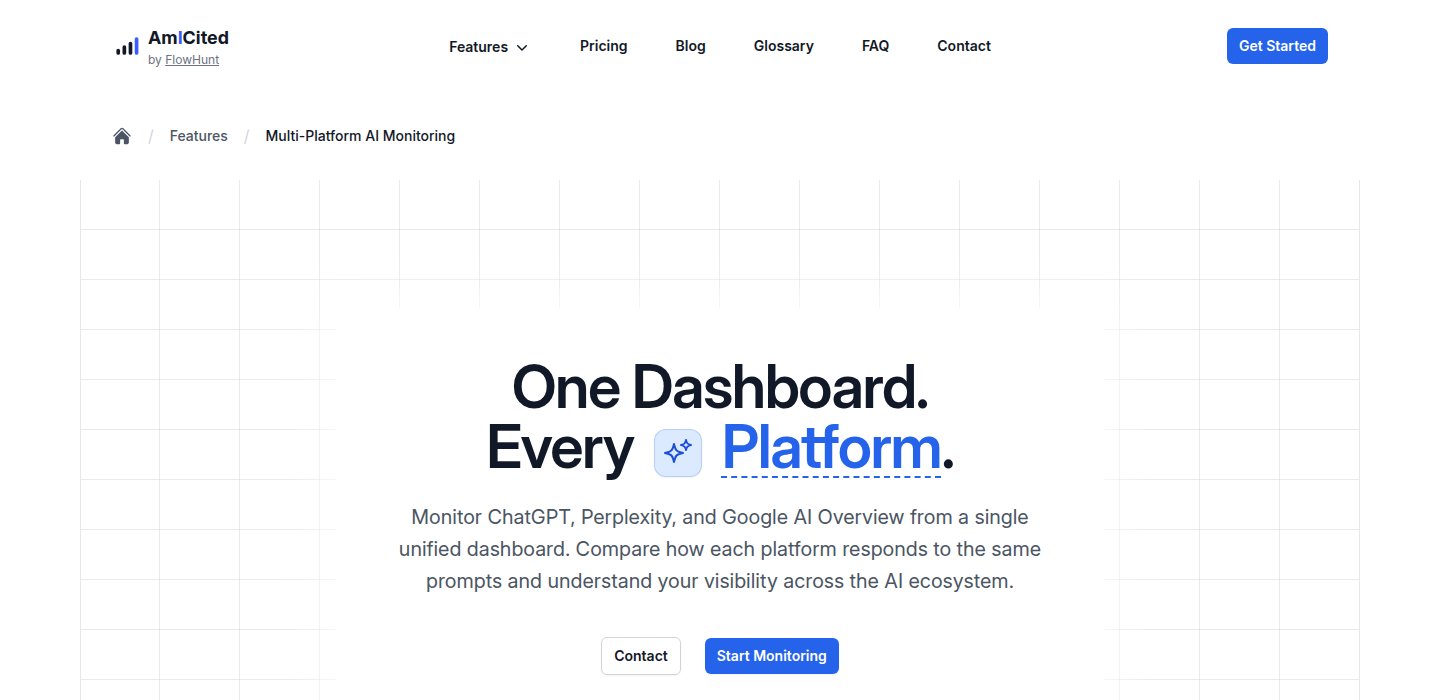
The platform’s core workflow is straightforward:
Amicited tracks proprietary metrics including Citation Frequency Rate (CFR), how often your brand appears across a set of monitored prompts, and Response Position Index (RPI), where within an AI response your brand is mentioned. These are designed to measure not just whether you appear, but how prominently you appear.
The platform is closer to a rank tracker for AI answers than a broad market intelligence tool: precise, focused, and built for teams actively managing their generative engine optimization (GEO) strategy.
Ahrefs Brand Radar is an AI visibility module integrated into the broader Ahrefs SEO ecosystem. It leverages Ahrefs’ existing data advantage (a keyword database of over 100 billion terms) to build a massive prompt universe for AI monitoring.
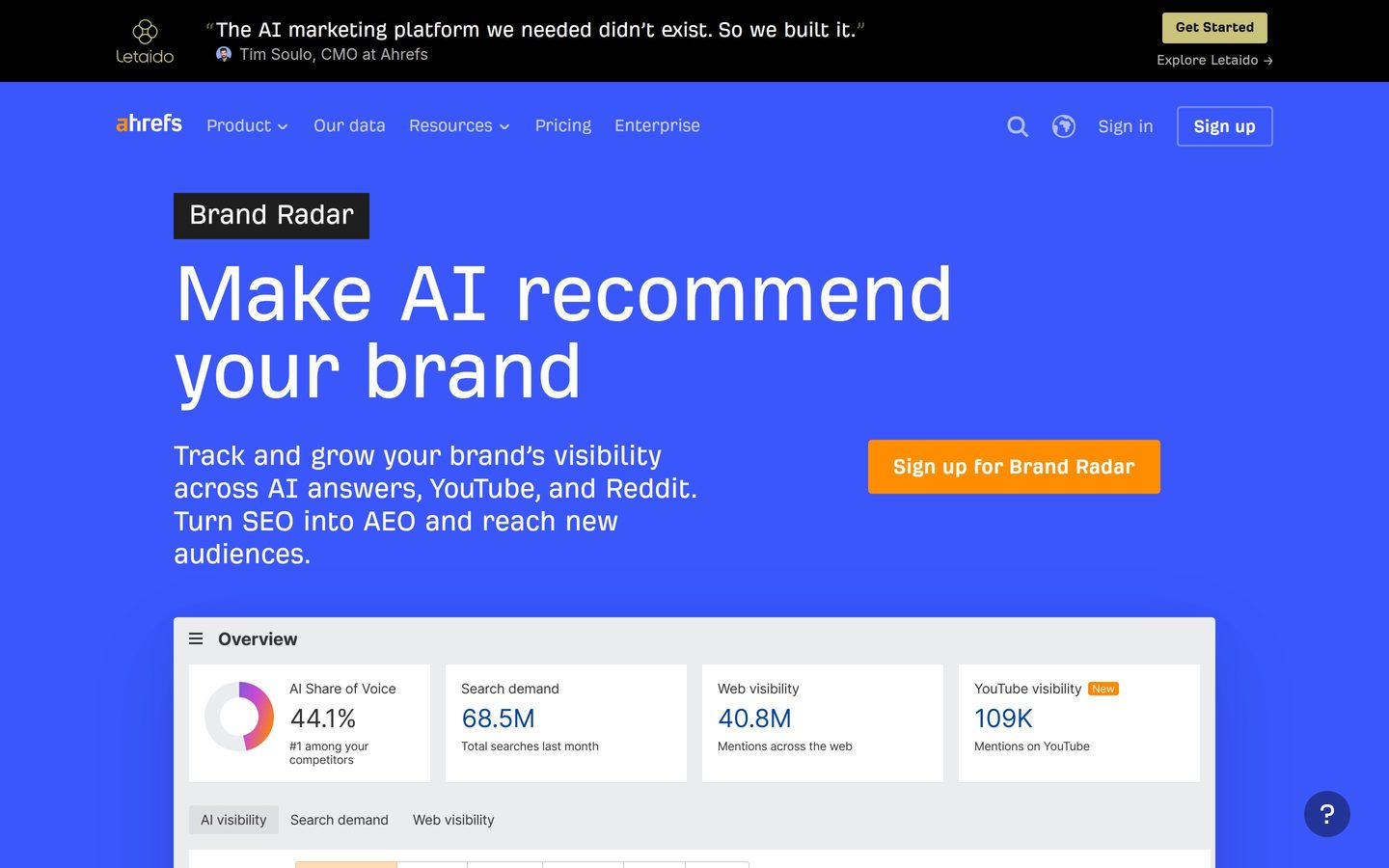
Rather than asking you to define which prompts matter, Brand Radar works in reverse:
Brand Radar’s metrics include Mentions (a brand appearing in an AI response), Citations (specific sources linked), Estimated Impressions (modeled visibility based on search volume), and AI Share of Voice (competitive positioning across topics).
This is closer to Ahrefs Rank Tracker, but for AI answers: a discovery and benchmarking layer built on top of search behavior data, designed for market-level intelligence rather than surgical monitoring of specific customer journeys.
The single most important difference between these two tools is their philosophical orientation:
| Amicited | Ahrefs Brand Radar | |
|---|---|---|
| Core question | “For the questions that matter to us, what does AI say right now?” | “Across millions of AI-driven searches, where does our brand appear and how do we compare?” |
| Orientation | Bottom-up: precision monitoring of known high-value queries | Top-down: macro-level discovery across the AI search landscape |
| Analogy | Rank tracking for AI | Market intelligence for AI |
Amicited starts with your customer journey. You know the questions prospects ask before buying. You track those questions. You see exactly when and how your brand appears, or doesn’t.
Ahrefs Brand Radar starts with the market. It surfaces brand visibility in conversations you may not have even known were happening. It reveals category-adjacent opportunities and competitive blind spots.
Neither approach is inherently better. They serve different operational needs.
Amicited’s data model is user-defined and prompt-driven. You decide which questions to track, and the platform repeatedly queries AI systems with those exact prompts, recording the responses over time.
This approach has a clear trade-off:
Brand Radar’s data model is search-backed and database-driven. It draws from Ahrefs’ keyword research database, expands queries using Google’s People Also Ask and semantic fanout, and runs the resulting prompt universe against AI platforms at scale.
The data model difference is fundamental: Amicited gives you depth on known questions; Brand Radar gives you breadth across unknown ones.
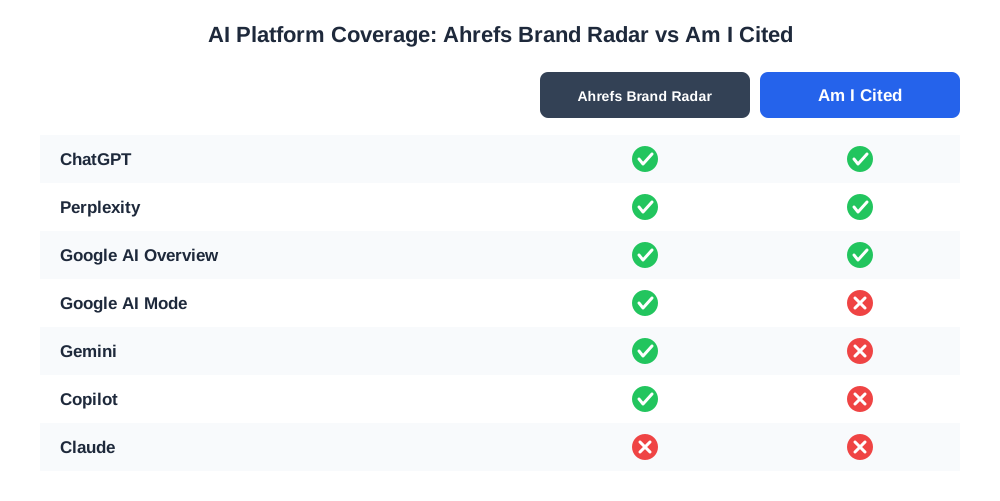
Amicited now tracks eight AI engines: ChatGPT, Perplexity, Gemini, Claude, Grok, DeepSeek, Google AI Overview, and Google AI Mode. That’s broader engine coverage than Brand Radar, including Claude, Grok, and DeepSeek, which Brand Radar doesn’t track.
Ahrefs Brand Radar covers six platforms: Google AI Overviews, Google AI Mode, ChatGPT, Perplexity, Gemini, and Microsoft Copilot. Amicited doesn’t track Copilot. Brand Radar also tracks brand mentions on YouTube, TikTok, and Reddit, recognizing that these platforms increasingly influence what AI systems cite. That non-AI-engine breadth remains Brand Radar’s main coverage advantage.
Claude, Grok, and DeepSeek are covered by Amicited but not by Brand Radar; Copilot is covered by Brand Radar but not by Amicited.
Amicited tracks visibility at the prompt level with metrics designed to show not just whether you appear, but how you appear:
Brand Radar tracks visibility at the topic and brand level with metrics designed for market comparison:
The key difference: Amicited tells you whether your brand appears for your specific questions and how that changes week to week. Brand Radar tells you how your brand’s AI visibility compares to competitors across broad topic categories.
Pricing is one of the most significant differentiators between the two tools.
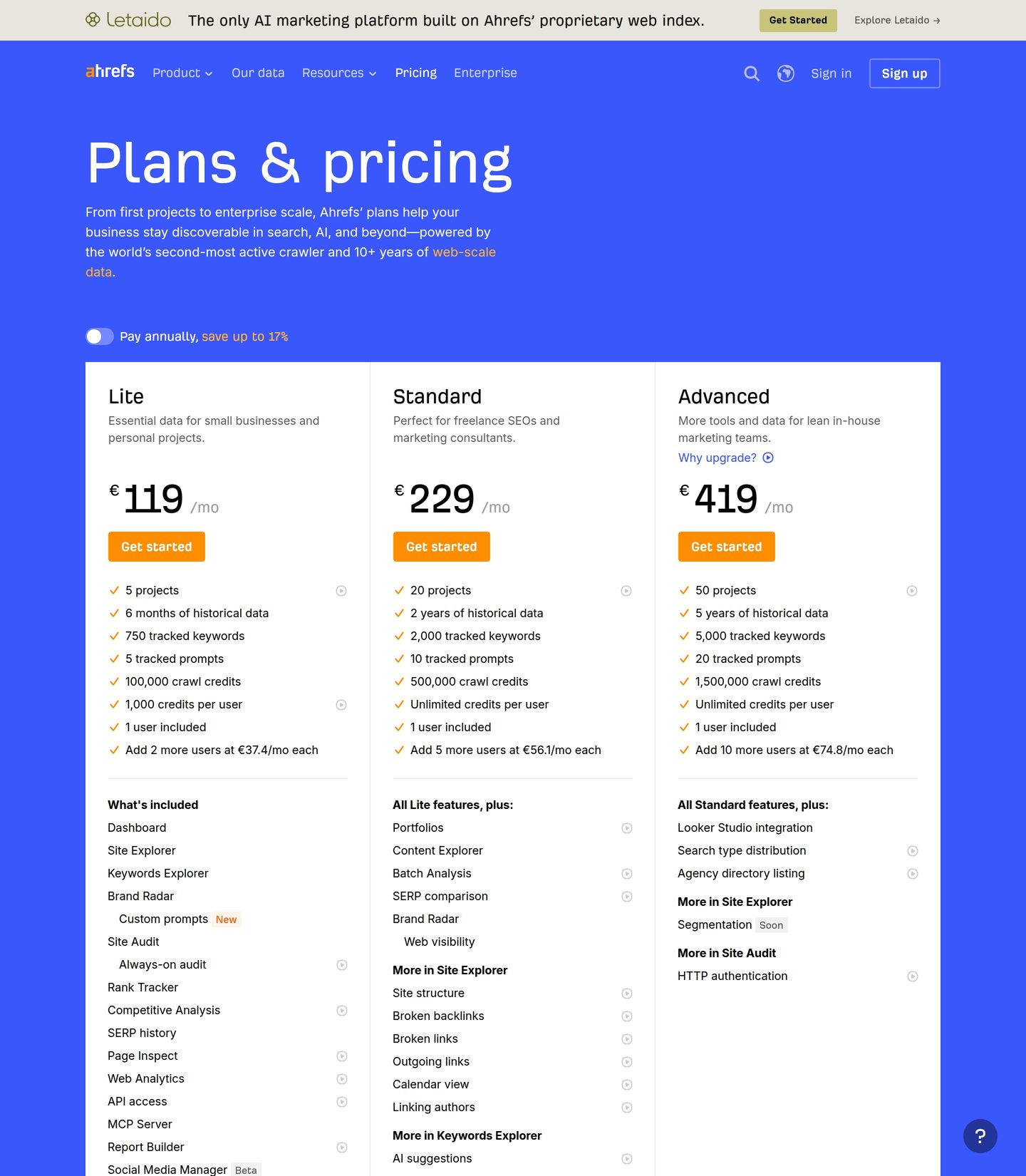
| Amicited | Ahrefs Brand Radar | |
|---|---|---|
| Model | Standalone subscription | Add-on to Ahrefs base plan |
| Base cost | Accessible, linear pricing | Ahrefs base plan: from $129/mo |
| AI visibility add-on | Included | $199/mo per AI index, or $699/mo for all 6 |
| Typical total | Lower entry point, built for AI-only teams | ~$828–$1,148+/mo for full AI coverage |
| Free trial | Available | Not available for Brand Radar |
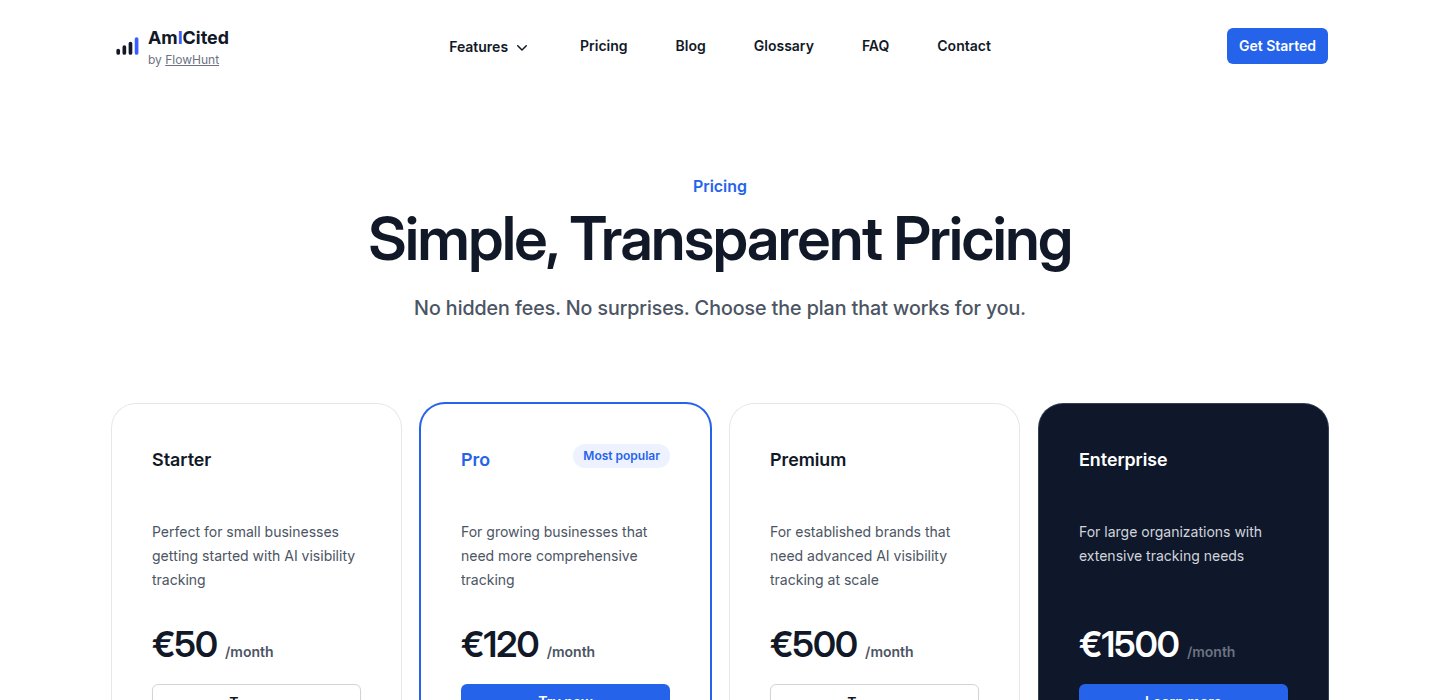
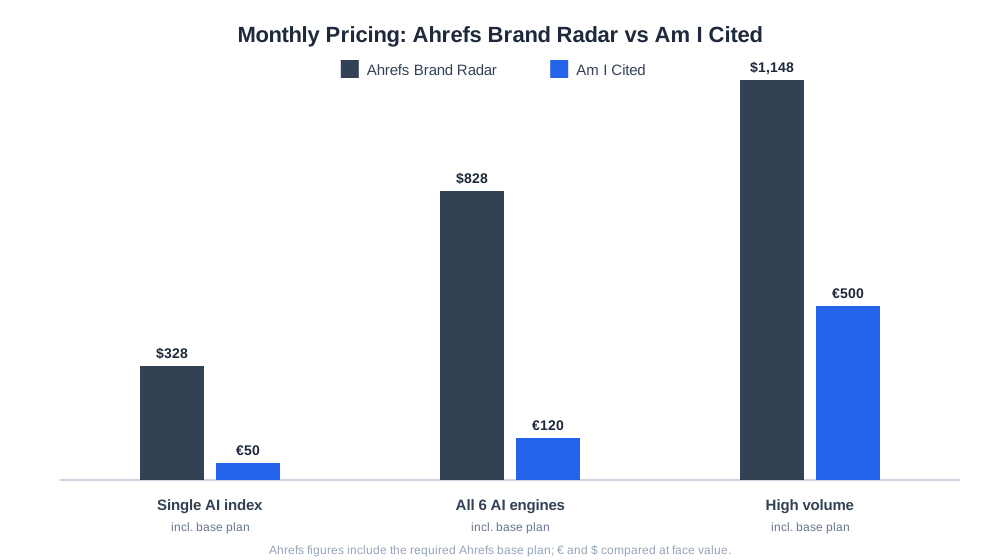
Brand Radar’s pricing reflects its positioning as an enterprise-grade module within a premium SEO suite. For teams already paying for Ahrefs and using it daily, the add-on cost may be justifiable. But for organizations that only need AI visibility tracking, without the legacy SEO tooling, the total cost can be prohibitive.
Amicited’s pricing is purpose-built for teams whose primary focus is AI visibility. You’re not paying for a backlink database or rank tracker you may not need.
One of the most commonly cited limitations of Ahrefs Brand Radar, across multiple independent reviews, is the lack of sentiment analysis and actionable optimization guidance.
Brand Radar tells you that your brand was mentioned. It does not tell you how it was mentioned (positively, negatively, neutrally) or what to do to improve. It is a monitoring and discovery tool, not an optimization platform.
Amicited, by contrast, includes:
If your goal is to measure AI visibility, both tools work. If your goal is to improve AI visibility, Amicited’s built-in optimization layer provides a more complete workflow.
Both tools offer competitive benchmarking, but at different resolutions:
For competitive intelligence teams, Brand Radar’s market-level view is powerful. For GEO practitioners running specific campaigns, Amicited’s prompt-level precision is more actionable.
AI responses are inherently unstable: they vary by prompt phrasing, model version, time of day, and even user session context. This makes refresh frequency critical.
Independent testing has also documented accuracy gaps in Brand Radar’s snapshot-based methodology. For example, one review found that Brand Radar reported 3 ChatGPT mentions for a brand when independent testing revealed 123 actual mentions, a discrepancy driven by the tool’s sampling approach rather than continuous monitoring.
| Dimension | Amicited | Ahrefs Brand Radar |
|---|---|---|
| Core philosophy | Precision monitoring of known high-value queries | Market-level discovery across the AI landscape |
| Data model | User-defined prompts | 413M+ search-backed prompts |
| AI platforms | 8 (ChatGPT, Perplexity, Gemini, Claude, Grok, DeepSeek, AI Overviews, AI Mode) | 6 (ChatGPT, Perplexity, AI Overviews, AI Mode, Gemini, Copilot) |
| Non-AI coverage | None | YouTube, TikTok, Reddit |
| Custom prompts | Core feature: unlimited user-defined prompts | Available as add-on (from $50/mo) |
| Key metrics | CFR, RPI, visibility scores, trends | Mentions, Citations, Impressions, AI Share of Voice |
| Sentiment analysis | ✅ Yes | ❌ No |
| Optimization guidance | ✅ Yes: content and source recommendations | ❌ No, data only |
| Competitor benchmarking | Prompt-level | Topic and market-level |
| Refresh frequency | Real-time / on-demand | Monthly (90-day window) |
| Setup | Requires defining prompts | Zero setup, instant search |
| Pricing | Standalone, AI-focused (lower entry point) | $199/mo per index or $699/mo bundle + Ahrefs base plan ($129+) |
| Best for | GEO practitioners, agencies, SaaS teams actively managing AI reputation | Enterprise SEO teams, competitive intelligence, market analysis |
The answer depends on what job you need the tool to do.
Many mature teams may eventually use both:
This is not unlike how teams use broad SEO crawlers for site-wide audits and dedicated rank trackers for high-value keyword monitoring. AI visibility is following a similar pattern: discovery tools for the landscape, precision tools for the money pages.
For most brands that don’t already have a large Ahrefs subscription to lean on, Amicited is simply the better overall pick: it is purpose-built for AI visibility, comes with optimization guidance Brand Radar lacks, refreshes in real time rather than monthly, and costs a fraction of the realistic Ahrefs-plus-Brand-Radar bill.
Arshia is an AI Workflow Engineer at FlowHunt. With a background in computer science and a passion for AI, he specializes in creating efficient workflows that integrate AI tools into everyday tasks, enhancing productivity and creativity.

Track how ChatGPT, Perplexity, Gemini, Claude, Grok, DeepSeek, Google AI Overviews, and Google AI Mode mention and cite your brand with a platform built exclusively for AI visibility, without an enterprise SEO subscription.
Compare Am I Cited and Rankscale for AI search visibility, including 2026 pricing, engine coverage, and Rankscale’s credit-based model.
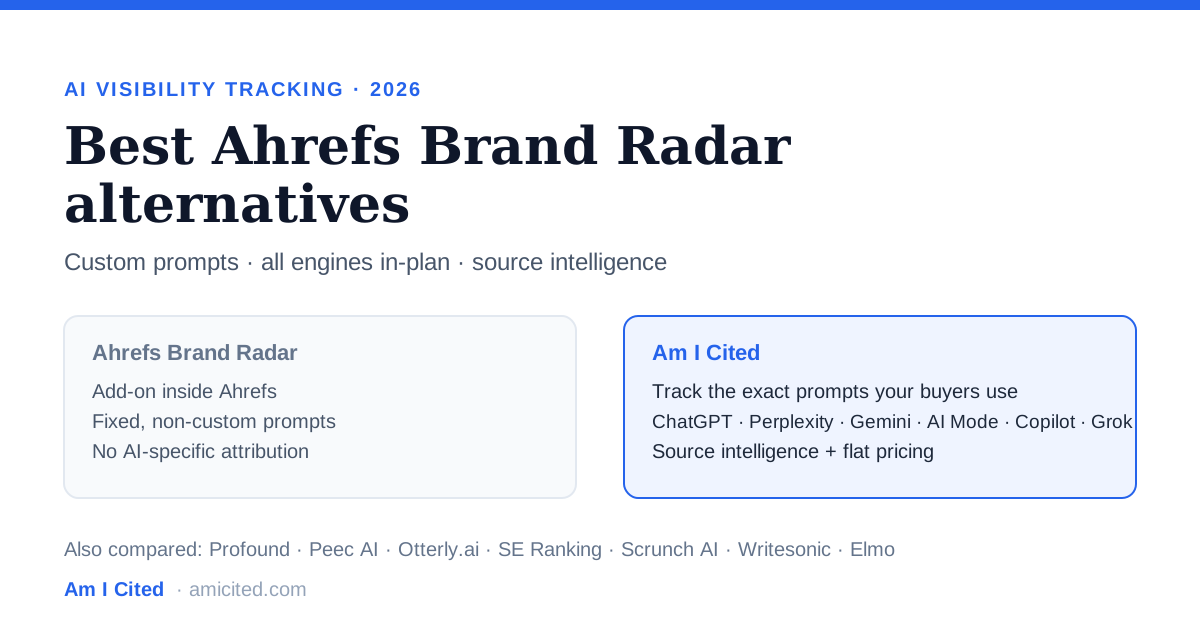
Compare the best Ahrefs Brand Radar alternatives for tracking AI visibility in 2026 on price, engines, and custom prompts, with Am I Cited as a top pick.
Compare Am I Cited with SE Ranking’s AI Visibility tracker by pricing, engine coverage, and dedicated versus SEO-suite features.
Cookie Consent
We use cookies to enhance your browsing experience and analyze our traffic. See our privacy policy.