


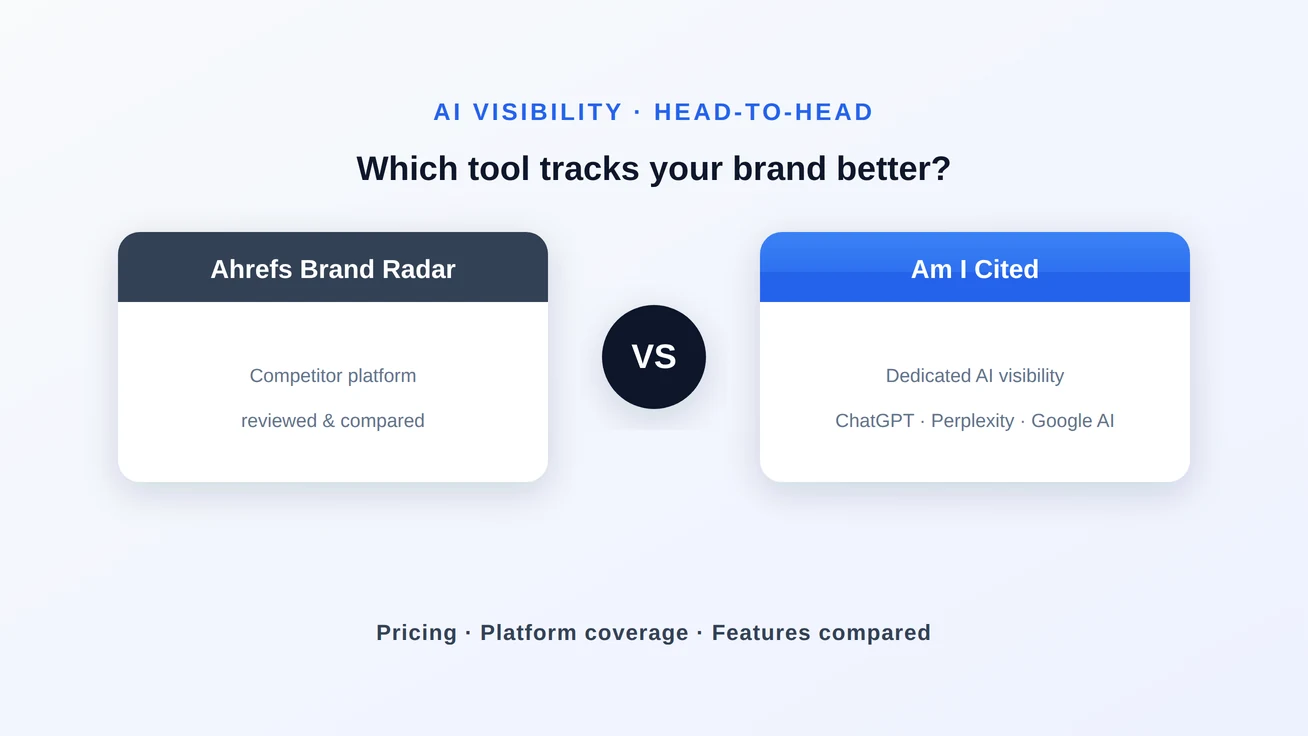
Am I Cited vs Ahrefs Brand Radar: AI Visibility
Compare Am I Cited with Ahrefs Brand Radar for AI visibility, including 2026 pricing, engine coverage, and dedicated versus add-on features.
11 min read
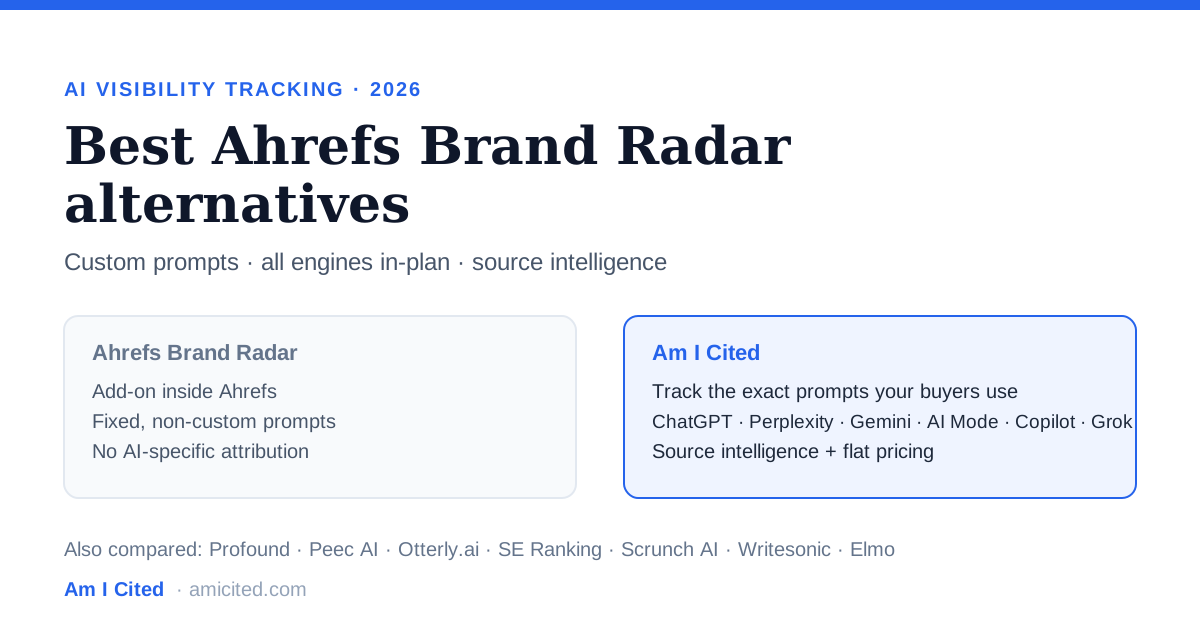
Compare the best Ahrefs Brand Radar alternatives for tracking AI visibility in 2026 on price, engines, and custom prompts, with Am I Cited as a top pick.
The best Ahrefs Brand Radar alternatives for tracking AI visibility in 2026 are dedicated GEO tools that give you custom prompt tracking, actionable source intelligence, and all core engines in one plan, led by Am I Cited, with Profound, Peec AI, and Otterly.ai as strong picks by budget and scale.
Ahrefs Brand Radar is a useful feature. It sits inside Ahrefs and taps a huge, search-backed prompt dataset, so it can show how often your brand surfaces across roughly six AI engines at real data scale. If you already live in Ahrefs for backlinks and rank tracking, seeing AI visibility in the same tab is convenient.
But convenient is not the same as complete. Three limits push teams to look elsewhere.
First, the prompts are fixed. Brand Radar tracks visibility against Ahrefs’ own prompt dataset rather than the exact questions your buyers type. That is fine for broad trend-spotting, but it rarely mirrors your specific funnel, the “best tool for X under $50” and “alternative to Y” queries where deals are won.
Second, it is a bolt-on, not a dedicated platform. Brand Radar is an add-on inside Ahrefs, with a base around $129+/month and roughly $199/month once the AI features are included, as of 2026. There is no content generation and no AI-specific attribution, so it tells you where you appear but not what to do next.
Third, it is monitoring-first. You see the number move; you do not get a clear next action, source-level intelligence, or the ability to test whether a change lifted your citations.
If any of those matter, a dedicated tool built for generative engine optimization is a better fit. Here is how the main alternatives compare.
| Tool | Best for | Starting price | Engines | Custom prompts? |
|---|---|---|---|---|
| Am I Cited | Dedicated AI visibility with source intelligence | ~EUR 50/mo | ChatGPT, Perplexity, Gemini, Google AI Mode, Copilot, Grok, DeepSeek | Yes |
| Profound | Enterprise depth and crawler analytics | ~$99/mo | 10+ | Not specified |
| Peec AI | Agencies and mid-market analytics | ~EUR 89/mo | ~3 of 7 on base | Not specified |
| Otterly.ai | Cheapest entry and GEO audit | ~$29/mo | 4 base (add-ons for more) | Yes |
| Semrush AI Toolkit | Teams already on Semrush | ~$99/mo add-on | ChatGPT, Perplexity, Google AI Overviews | Tends to track fixed prompts |
| SE Ranking (SE Visible) | Hybrid SEO + GEO on a budget | ~$89/mo add-on | ChatGPT, Google AI Overviews/Mode, Gemini, Perplexity | Not specified |
| Scrunch AI | Brand safety and governance | ~$250/mo | Not specified | Not specified |
| Writesonic GEO | Content-first tracking + writer | ~$79/mo | Not specified | Not specified |
| Rankscale | Budget daily monitoring | ~$20/mo | Multiple | Not specified |
| Elmo | Open-source, self-hosted control | Free (self-host) | Not specified | Not specified |
Prices are as of 2026, verify current pricing before you buy, since AI-tool plans change often.

Track how AI chatbots mention your brand across ChatGPT, Perplexity, and other platforms.
Best for: teams that want a dedicated AI visibility platform with custom prompts, all core engines in-plan, and source-level intelligence.
What it does well: Am I Cited is built from the ground up for AI search visibility, not bolted onto an SEO suite. You track the exact prompts your buyers use, and it discovers more automatically from Google Search data like People Also Ask and related queries, so you cover questions you would have missed. It monitors mentions, citations, sentiment, and share of voice across ChatGPT, Perplexity, Gemini, Google AI Mode, Copilot, Grok, and DeepSeek in one dashboard.
It goes further with source and domain intelligence: it shows which domains (Reddit, YouTube, review sites, forums) feed AI answers about you and your competitors. That closes the gap Brand Radar leaves open. You see not just whether you appear, but why, and you can test whether a campaign changed your results. It also includes a Brand Visibility Score, competitor analysis, an Entity Tracker, Shopping data, and visibility calendars. An MCP server and API handle automation. The platform is multi-language (EN/DE/ES/FR/IT/SK).
Where it falls short: Am I Cited is newer than incumbents like Ahrefs, so it does not carry the decade-long brand recognition of a legacy SEO suite. If your only requirement is bundling AI metrics next to your existing backlink reports, an add-on may feel more familiar.
Pricing: flat, predictable plans starting around EUR 50/month with a free trial. Because pricing is per-plan rather than per-engine, you avoid the add-on math that inflates other tools.
Verdict: the strongest dedicated pick for teams that want custom tracking, source intelligence, and one flat bill instead of an SEO-suite surcharge. See the head-to-head in our Am I Cited vs Ahrefs Brand Radar comparison and the full landscape in our best AI visibility tools guide .
Best for: enterprises that need the deepest analytics and are ready to pay for them.
What it does well: Profound is the enterprise heavyweight, covering 10+ engines with crawler-log and Agent Analytics, a Conversation Explorer to see how AI systems discuss topics, and SOC 2 compliance. If you want to understand agent behavior at scale and have a team to operate it, few tools go deeper.
Where it falls short: it leans to monitoring over action, carries a steep learning curve, and gets pricey fast. Enterprise plans can run into four figures per month.
Pricing: Brands around $99/month, Growth around $399/month, Enterprise custom.
Verdict: the right call for large organizations that need depth and governance; overkill and overpriced for most SMBs.
Get the latest insights on AI mentions, brand monitoring, and optimization strategies.
Best for: agencies and mid-market teams that report to many stakeholders.
What it does well: the Berlin-based platform offers clean, client-ready reporting, unlimited seats (a real perk for agencies), and coverage in 115+ languages. It is a solid mid-market analytics layer with a tidy interface.
Where it falls short: base plans cap at roughly three of seven engines, with Claude reserved for Enterprise. There is no content generation, no crawler logs, and no GA4 attribution.
Pricing: Starter around EUR 89/month.
Verdict: an excellent agency reporting tool if its engine coverage matches your priority list; check the tiers before committing to Claude-heavy tracking.
Best for: the cheapest entry point and a strong GEO audit.
What it does well: Otterly.ai is a Gartner Cool Vendor with 15,000+ users, a clean UI, and a useful GEO Audit that checks crawlability, content, and query fan-out. Its Lite plan is the easiest low-cost way to start monitoring.
Where it falls short: the pricing cliff from Lite to Standard is steep, roughly 6.5x. Gemini, Google AI Mode, and Claude are paid add-ons, updates are weekly rather than real-time, and it is monitoring-only with no native white-label.
Pricing: Lite $29/mo, Standard $189/mo, Premium $489/mo, plus add-ons.
Verdict: great for a cheap first look; the per-engine add-ons and pricing jump can erode the savings. Compare options in our best Otterly.ai alternatives roundup and the full Otterly.ai review .
Best for: teams already standardized on Semrush.
What it does well: the AI Visibility Toolkit plugs into Semrush’s integrated SEO suite and tracks ChatGPT, Perplexity, and Google AI Overviews alongside your existing keyword and backlink data. If Semrush is your source of truth, the continuity is real.
Where it falls short: it is an add-on to an SEO tool, not a dedicated GEO platform, and it tends to track fixed prompts rather than fully custom ones. You are also paying on top of a Semrush base subscription.
Pricing: AI Toolkit around $99/month per domain on top of a base around $139.95/month; Semrush One around $199/month.
Verdict: sensible if you live in Semrush; less compelling as a standalone AI visibility purchase.
Best for: budget-minded teams wanting hybrid SEO plus GEO.
What it does well: SE Visible adds AI visibility tracking to SE Ranking’s SEO suite, covering ChatGPT, Google AI Overviews and AI Mode, Gemini, and Perplexity. It is a cost-effective way to blend traditional and generative tracking if you already use SE Ranking.
Where it falls short: it rides inside a broader SEO product rather than a standalone GEO platform, so depth is more modest than specialist tools.
Pricing: add-on around $89/month.
Verdict: good value for existing SE Ranking users; a lighter option if you want deep source or attribution analytics.
Best for: enterprises focused on brand safety and governance.
What it does well: Scrunch AI leans into brand-safety monitoring, hallucination detection, and crawler logs, useful when the priority is catching what AI gets wrong about your brand, not just measuring share of voice.
Where it falls short: it is a governance-first, enterprise-priced tool, so it is more than most marketing teams need for day-to-day visibility tracking.
Pricing: around $250/month and up.
Verdict: a specialist pick for risk and compliance teams rather than a general Brand Radar swap.
Best for: content teams that want tracking and writing in one place.
What it does well: Writesonic pairs GEO tracking with a built-in AI writer, so you can spot gaps and draft content to fill them without switching tools. That content-first workflow is handy for lean teams.
Where it falls short: its GEO tracking is less mature than dedicated visibility tools, so the analytics depth trails specialists.
Pricing: roughly $79–$399/month.
Verdict: a fit if content production is your bottleneck; look elsewhere if measurement precision is the priority.
Best for: the lowest-cost daily monitoring.
What it does well: Rankscale offers multi-engine, daily monitoring from a very low starting price, which makes it an easy budget entry for keeping a pulse on visibility.
Where it falls short: reporting is shallow, so it is better for a quick daily check than for the deep analysis a strategy needs.
Pricing: from around $20/month.
Verdict: fine as a cheap tracker; plan to graduate to a fuller platform as your program matures.
Best for: teams that want full control and no license fees.
What it does well: Elmo is open-source and self-hostable, so you own your data and control your setup, appealing for privacy-conscious or engineering-led teams.
Where it falls short: you provide the infrastructure, setup, and ongoing maintenance, and you trade polished dashboards and support for control.
Pricing: free to self-host.
Verdict: the right choice if control and zero license cost outweigh convenience; not for teams that want turnkey reporting.
If Ahrefs is central to your SEO work and you only need occasional, trend-level AI visibility, keeping Brand Radar is reasonable. You are already paying for the base, the data scale is real, and one fewer tool is one fewer login to manage.
Replace or supplement it when any of these become true:
A common pattern: keep Ahrefs for links and rankings, and run a dedicated tool like Am I Cited for the AI layer. You lose nothing on the SEO side and gain custom tracking, source intelligence, and brand visibility monitoring built specifically for AI answers.
Match the tool to your constraints, not the other way around.
By budget. Under tight limits, start with Otterly.ai’s Lite tier or Rankscale, or self-host Elmo for free. Around EUR 50/month, Am I Cited gives you flat pricing with all core engines in-plan, which usually beats add-on math once per-engine fees stack up. Enterprise budgets unlock Profound and Scrunch AI.
By use case. For dedicated AI visibility with actionable source intelligence, choose Am I Cited. For enterprise crawler analytics and governance, Profound or Scrunch AI. For content production plus tracking, Writesonic. For hybrid SEO plus GEO inside a suite you already own, Semrush AI Toolkit or SE Ranking.
By team size. Solo operators and small teams should favor low entry cost and a clean UI (Otterly.ai or Rankscale. Agencies need seats, share of voice, and client-ready reporting, which points to Peec AI or Am I Cited with its API and MCP automation. Enterprises need depth, compliance, and scale) Profound.
Whatever you pick, prioritize custom prompt tracking and source-level insight. Those are the two things Brand Radar’s fixed-prompt, monitoring-first design leaves on the table, and they are where most AI visibility decisions get made. You can track scheduled prompt checks across engines with our AI rank tracker , then act on what you learn.
If you want a dedicated tool that shows you the exact prompts and sources shaping your AI visibility, with flat pricing and no per-engine surcharges, start a free trial of Am I Cited or contact the team to see it against your own prompts.
Yasha is a talented software developer specializing in Python, Java, and machine learning. Yasha writes technical articles on AI, prompt engineering, and chatbot development.

Am I Cited tracks your citations, mentions, sentiment, and share of voice across ChatGPT, Perplexity, Gemini, Google AI Mode, Copilot, Grok, and DeepSeek, with custom prompts and source intelligence in one flat-priced dashboard.
Compare Am I Cited with Ahrefs Brand Radar for AI visibility, including 2026 pricing, engine coverage, and dedicated versus add-on features.
Review Ahrefs Brand Radar for AI visibility: features, pricing, strengths, limitations, and how it compares with Writesonic and Profound.
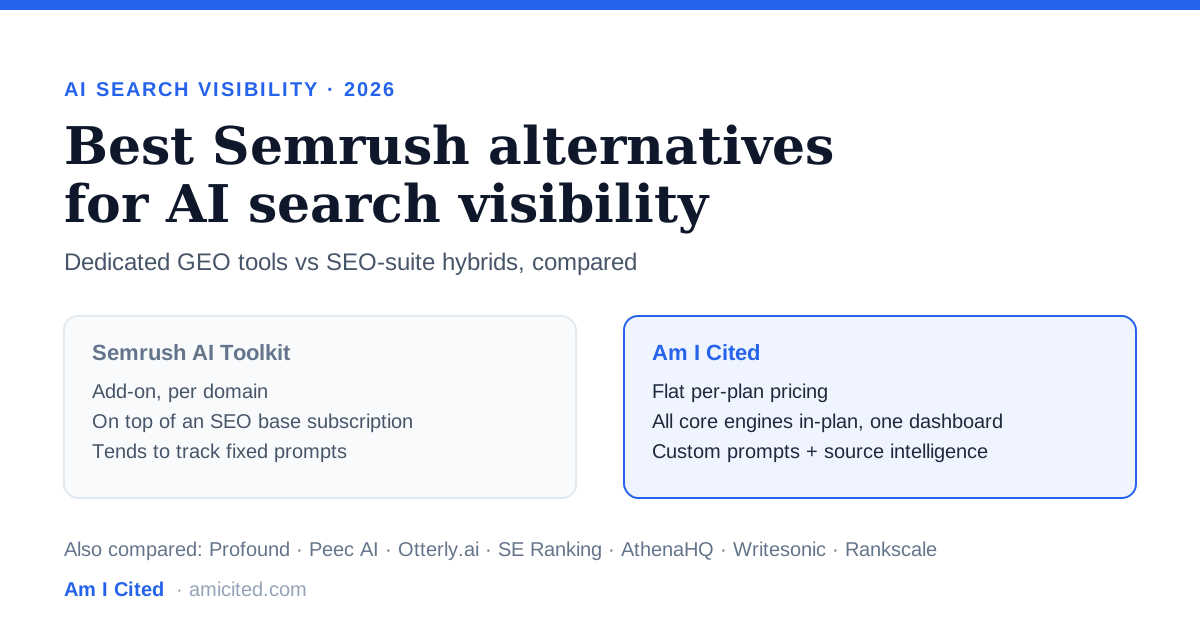
Best Semrush alternatives for AI search visibility tracking in 2026, compared: dedicated GEO tools vs SEO hybrids, with Am I Cited as a flat-priced pick.
Cookie Consent
We use cookies to enhance your browsing experience and analyze our traffic. See our privacy policy.