



Amazon Rufus
Learn about Amazon Rufus, the AI shopping assistant that answers product questions, compares items, and provides personalized recommendations. Discover how it w...
5 min read
What Amazon Rufus is, how its RAG-based architecture works, and how it differs from Amazon’s A9 search. A mechanics-first explainer for sellers.
Amazon Rufus is an AI shopping assistant that lets customers ask natural-language questions about products and get conversational answers instead of a ranked results page. Since launch, over 250 million customers have used Rufus, and it now powers approximately 13.7% of Amazon searches, with monthly active users up 149% and interactions surging 210% year-over-year. Customers who use Rufus are 60% more likely to make a purchase than those relying on the standard search box alone. This guide is a mechanics-first explainer: what Rufus actually is, how it’s built, and how it differs from the keyword-based search Amazon has run for two decades. If you’re a seller looking for the step-by-step to-do list instead, what to actually change in a listing and in what order, skip ahead to the tactical section below.
Rufus runs on Retrieval-Augmented Generation (RAG): rather than answering purely from what a language model memorized during training, it retrieves current, specific product information — listings, reviews, Q&A, A+ content — and feeds that into a model to generate its response. This retrieval step is what lets Rufus answer questions about products and attributes that didn’t exist when its underlying model was last trained. Amazon built Rufus on Amazon Bedrock, combining Claude Sonnet, Amazon Nova, and proprietary Amazon models, run through a continuous batching and streaming architecture that keeps response times low even during peak shopping traffic. The AI assistant also incorporates a real-time feedback loop, so its outputs shift as it observes which recommendations customers actually engage with. None of this changes what a seller submits to Amazon — the listing fields are the same ones that have always existed — but it changes how that information gets used: instead of being indexed and ranked, it’s retrieved and synthesized into a conversational answer.

Track how AI chatbots mention your brand across ChatGPT, Perplexity, and other platforms.
| Aspect | A9 (Traditional Search) | Rufus AI Assistant |
|---|---|---|
| Query Type | Keyword-based | Conversational, natural language |
| Data Sources | Titles, bullet points, backend keywords | Descriptions, reviews, Q&A, A+ content, purchase history |
| Response Format | Ranked list of product listings | Conversational answer with reasoning |
| Personalization | Limited to browsing history | Shopping memory across purchases, browsing, reviews |
| Context Understanding | Literal keyword matching | Semantic understanding of intent |
| Learning | Static ranking algorithm | Continuous real-time feedback |
A9 and Rufus are not competing systems — they’re complementary layers Amazon runs side by side. A9 still handles the bulk of search traffic: it decides what shows up when a customer types keywords into the search box, weighing signals like keyword relevance, conversion rate, and price. Rufus handles the conversational layer on top of that: questions, comparisons, and recommendations that don’t map neatly onto a single keyword query. Currently fewer than 3 out of 100 Amazon purchases involve Rufus, so A9 remains the dominant discovery mechanism for now — but the two systems draw on the same underlying product data, which is why improving listing quality tends to help both simultaneously rather than forcing a trade-off between them.
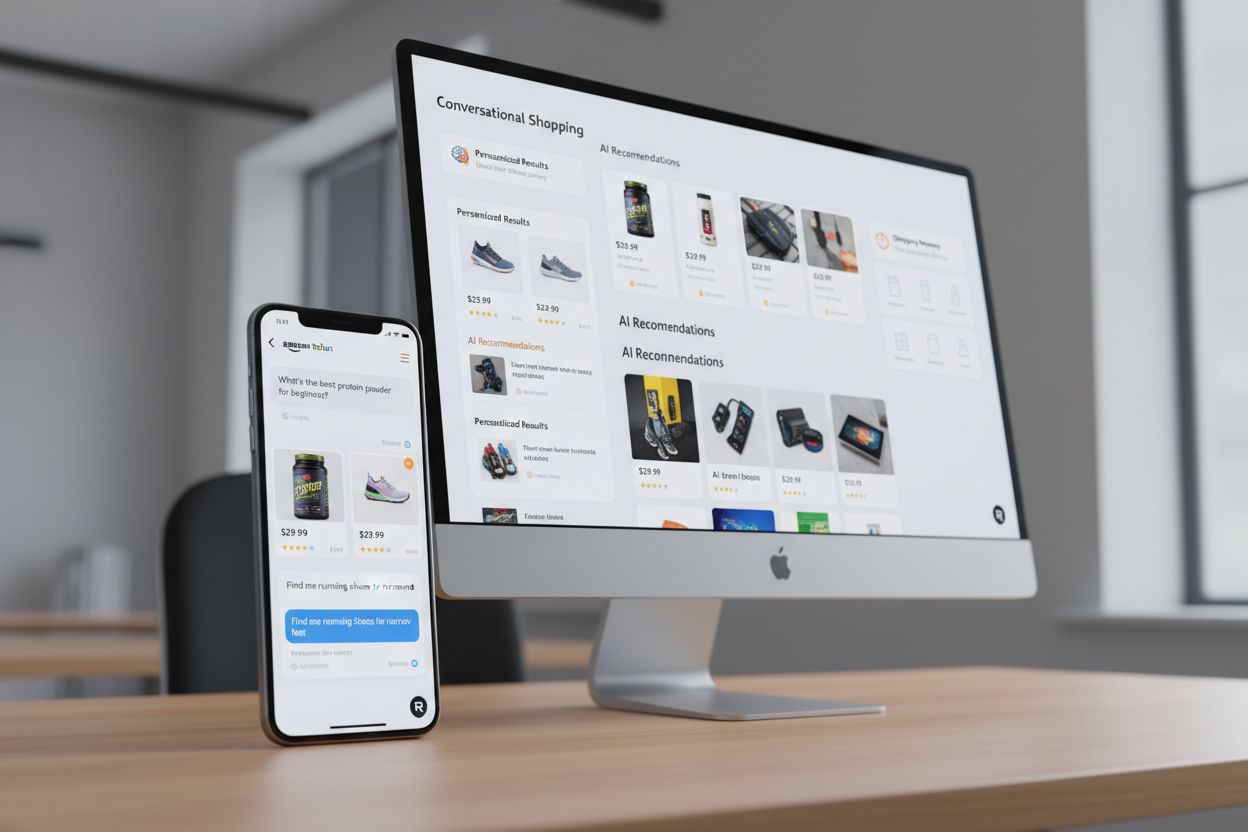
The clearest evidence of this shift is in query behavior itself. Where a customer once searched “protein powder,” they now ask Rufus something like “what’s the best protein powder for beginners on a budget who want to avoid artificial sweeteners?” That’s not a keyword with modifiers — it’s a compound question with an implicit budget constraint, an experience level, and an ingredient exclusion, all in one sentence. A9’s ranking model was built to match keywords, not parse compound intent, which is exactly the gap Rufus is designed to fill. Because Rufus reasons over natural language rather than tokenizing a search string, it can surface a product that never literally contains the phrase “protein powder for beginners” anywhere in its listing, as long as the underlying attributes match what the customer described. This is the structural reason product content depth now matters more than keyword placement alone, a distinction the tactical section below turns into concrete listing changes.
Get the latest insights on AI mentions, brand monitoring, and optimization strategies.
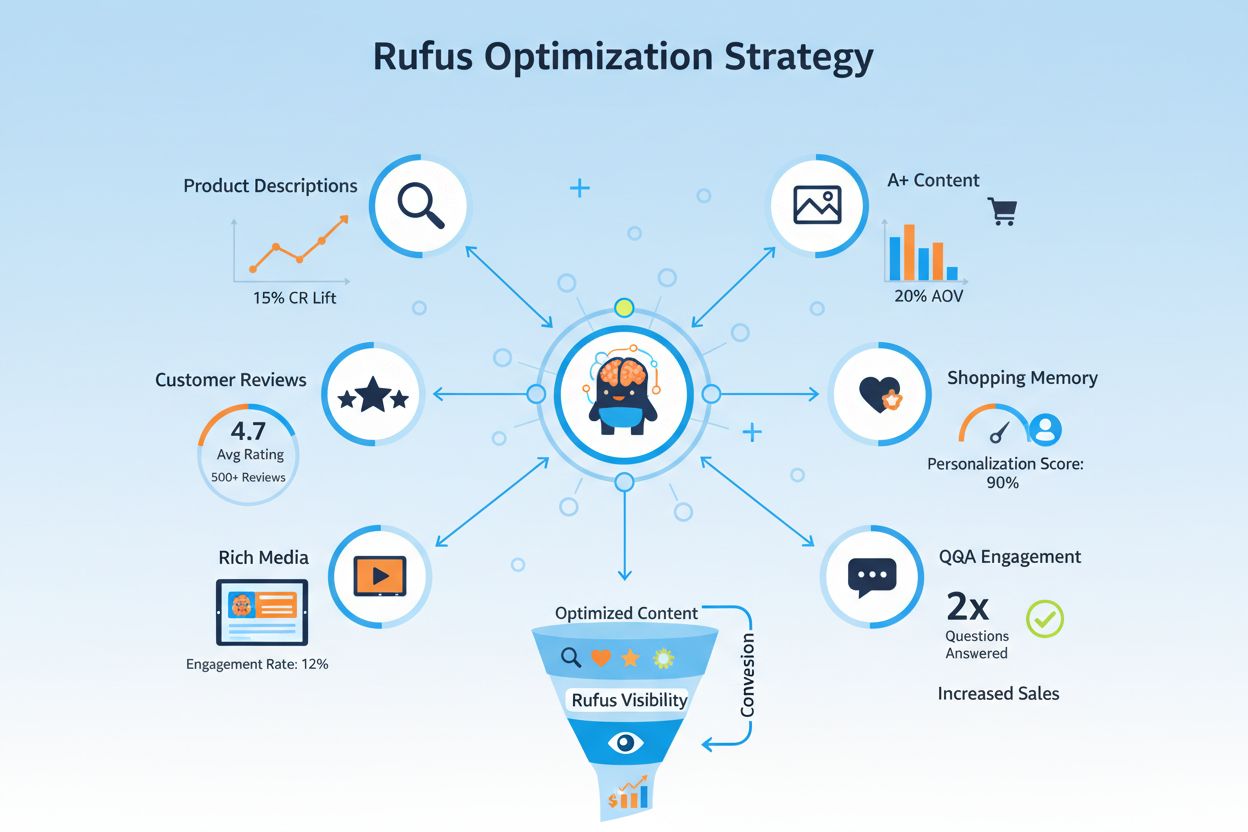
Rufus’s retrieval layer draws from five categories of listing data: the product description and bullet points, A+ content, customer reviews, the Q&A section, and product images. Each contributes differently. Product descriptions and bullet points supply baseline facts. A+ content supplies narrative and lifestyle context that plain specs can’t. Reviews and Q&A supply the parts no seller writes — real customer language about durability, fit, and edge cases — which is exactly the kind of information the AI assistant is best at retrieving, because it wasn’t written to be search-optimized in the first place. Product images are processed for both composition and embedded text, so a chart, size guide, or callout baked into an image is legible to Rufus the same way it’s legible to a shopper. None of these sources works in isolation: Rufus’s confidence in a recommendation tends to track how consistently these five sources agree with each other, which is why contradictions between your bullet points and your reviews are more costly under Rufus than they ever were under A9’s keyword matching.
The introduction of shopping memory represents a paradigm shift in how Rufus personalizes recommendations, moving beyond session-based personalization to a persistent understanding of each customer’s shopping profile. Rufus now remembers purchase history, browsing patterns, reviews customers have left, search history, and abandoned cart items, creating a rich contextual foundation for every recommendation. This means a customer who has previously purchased premium fitness equipment and left detailed reviews about durability will receive different product recommendations than a budget-conscious customer browsing the same category. A product that closely matches a customer’s previous purchases and stated preferences will receive preferential visibility in Rufus recommendations, even if a competing product has a higher overall rating. This personalization layer extends across Amazon services — Rufus can draw on data from Prime Video viewing history, Alexa interactions, and other Amazon ecosystem touchpoints to inform recommendations. Practically, this means product data can’t target an individual customer’s memory profile directly; the only lever a seller has is making the underlying listing detailed and consistent enough that Rufus can make confident matches across a wide range of customer profiles.
Because Rufus doesn’t expose a dedicated traffic source in Seller Central, there’s no dashboard that isolates “Rufus-driven sales” the way there is for sponsored ads. What’s observable is indirect: how your products come up when you query Rufus directly, and how metrics like conversion rate and long-tail keyword ranking move after you change your listing content, the concrete checklist for tracking that is covered below. Strategically, it’s worth keeping Rufus in proportion: at under 3% of Amazon purchases today, it’s additive to a seller’s visibility, not a replacement for A9 optimization, sponsored placements, or traffic driven from outside Amazon. The sellers best positioned as Rufus grows are the ones who treat it as one more consumer of the same high-quality product data they already need to maintain everywhere else.
Rufus isn’t a new algorithm to reverse-engineer, it’s a new consumer of the same listing content sellers already control: images, descriptions, Q&A, reviews, and keywords. These are the five concrete changes that move the needle, roughly in the order they’re worth tackling.
1. Optimize product images with strategic text overlays. Rufus’s visual processing extracts text, identifies key features, and assesses quality from image composition, not just what the product looks like. Make sure the primary image is clear, well-lit, and shows the product from its most representative angle, since this is often the image Rufus weighs most heavily. Text overlays calling out specs, dimensions, or certifications (a kitchen appliance labeled “Energy Star Certified,” for instance) give Rufus concrete facts to cite when it recommends the product, and lifestyle images showing the product in use help it understand real-world applications.
2. Craft context-rich product descriptions. Because Rufus uses natural language understanding rather than keyword matching, a description that tells a real story about what the product does, who it’s for, and why it’s worth choosing works better than a feature list. Use specific details about materials, dimensions, and performance instead of vague claims like “durable construction,” structure the text with subheadings so Rufus can parse it, and cover use cases that aren’t immediately obvious.
3. Leverage the FAQ and Q&A sections. Rufus actively mines these sections to answer customer questions, so proactively writing comprehensive FAQs around compatibility, usage, maintenance, and troubleshooting, and responding promptly to real customer questions, directly shapes what Rufus says about your product. Natural, conversational phrasing in your answers helps Rufus recognize relevance to similar future queries.
4. Encourage photo-rich customer reviews. Rufus weighs review content, ratings, and especially review images when assessing quality and satisfaction. A post-purchase follow-up asking customers to share photos of the product in use, combined with prompt, professional responses to reviews, builds the kind of visual and textual evidence Rufus treats as a strong trust signal.
5. Refine your keyword strategy around intent, not exact match. Rufus’s semantic understanding recognizes synonyms and related phrasing, so research the questions customers actually ask about your category (“best headphones for running” alongside “wireless headphones”) and work that language naturally into your title, bullet points, and description.
Sequence matters if you’re working through a catalog with limited time. Start with images and descriptions, since these are the inputs Rufus reads on nearly every query and errors here (a blurry primary image, a thin description) limit everything else from working. Tackle the Q&A section next, because existing gaps are actively costing visibility every time a customer asks Rufus a question your listing doesn’t answer. Reviews come third, since photo-rich reviews take longer to accumulate and the sooner you start encouraging them, the sooner that data compounds. Keyword refinement is a reasonable last step, since it works best once the content it’s layered onto is already strong. What this sequence deliberately leaves out is trying to reverse-engineer Rufus’s shopping memory and personalization system directly: that’s a real part of how Rufus ranks products for individual customers, but no single listing update can target it, the more complete and internally consistent your product data is across the five changes above, the more scenarios the personalization layer can match your product to.
Amazon doesn’t expose a dedicated “Rufus traffic” metric, so measuring impact means watching indirect indicators: unusual traffic patterns, conversion rate changes, customer feedback that mentions Rufus or an AI recommendation by name, and movement in your search ranking for long-tail, conversational keywords. Set baseline metrics (current conversion rate, average order value, traffic sources) before making changes, then track them closely afterward. UTM parameters on any promotional links you run can help separate Rufus-adjacent gains from other traffic, and A/B testing different descriptions, images, or FAQ content can clarify which specific changes are driving results.
Common mistakes worth avoiding: keyword stuffing that reads as unnatural (Rufus’s semantic understanding tends to penalize this), vague or incomplete product information, a neglected Q&A section, reviews with no photos or detail, and contradictory information across your title, bullet points, and description, since inconsistency reduces Rufus’s confidence in recommending a listing at all.
Beyond answering product questions, Rufus has shipped a set of consumer-facing features that extend what shopping memory and retrieval can do for the person on the other end of the conversation.
Price tracking, alerts, and auto-buy. Rufus shows 30- and 90-day price history on a product so shoppers can tell whether a current price is actually a deal, and lets them set a price alert for a target price point. For Prime members, auto-buy goes a step further and automatically completes the purchase once an item reaches the target price, using the shopper’s default payment method and shipping address, with a 24-hour window to cancel. Amazon reports that customers using auto-buy save an average of 20% per purchase, and auto-buy requests stay active for six months or until cancelled.
Visual search and handwritten lists. Shoppers can upload a photo and ask Rufus to find similar products or solve a problem from it, for example a photo of a stained rug paired with “how do I remove this coffee stain?” prompts Rufus to analyze the fabric and recommend relevant cleaning products. On iOS, Rufus can also read a handwritten shopping or holiday list from a photo and add the items directly to the shopping cart, with Android support following.
From collaborative filtering to generative AI. These features sit on top of a genuine shift in how Amazon’s recommendation technology works. For roughly two decades, Amazon’s core recommendation engine was item-to-item collaborative filtering: it analyzed purchase correlations between products rather than similarities between customers, recommending items that other shoppers with a similar purchase history had bought together. That approach scaled well but struggled with new products, new customers, and the sheer computational cost of comparing millions of customer relationships. Rufus represents a move away from that retrieval-based logic toward a generative approach: instead of “find products similar to what you bought,” it works from “understand what you’re trying to accomplish and recommend the best solution,” which is what lets it handle multi-part questions, explain its reasoning, and make reasonable recommendations even for products with few or no reviews yet.
Amazon has shipped more than 50 technical upgrades and new features to Rufus since launch, and the trajectory points toward the assistant taking on more of the comparison and decision-support work customers currently do themselves, price comparisons, sustainability information, and multi-product comparisons among them. Agentic capabilities are also expanding: Rufus is increasingly able to take autonomous actions like adding items to a cart or setting up recurring purchases, not just suggesting them. Amazon isn’t alone in this direction either; Walmart, Google, Perplexity, and other retailers are building their own conversational shopping assistants, which suggests this is an industry-wide shift rather than an Amazon-specific feature. Real-time feedback integration means Rufus’s judgment about which products to surface will keep shifting as it observes more customer interactions, which is also why staying visible in Rufus isn’t a one-time project: a listing that satisfies Rufus today may need new content in six months as the model’s expectations evolve. The practical implication for sellers isn’t to chase every update, it’s to keep the underlying product data deep and internally consistent, since that’s the raw material Rufus will keep pulling from no matter how its retrieval and ranking logic changes underneath it.
Yasha is a talented software developer specializing in Python, Java, and machine learning. Yasha writes technical articles on AI, prompt engineering, and chatbot development.

Understanding how Rufus works is the first step. Track how your products are actually cited and recommended by Amazon Rufus and other AI shopping assistants with AmICited.
Learn about Amazon Rufus, the AI shopping assistant that answers product questions, compares items, and provides personalized recommendations. Discover how it w...
Cookie Consent
We use cookies to enhance your browsing experience and analyze our traffic. See our privacy policy.