



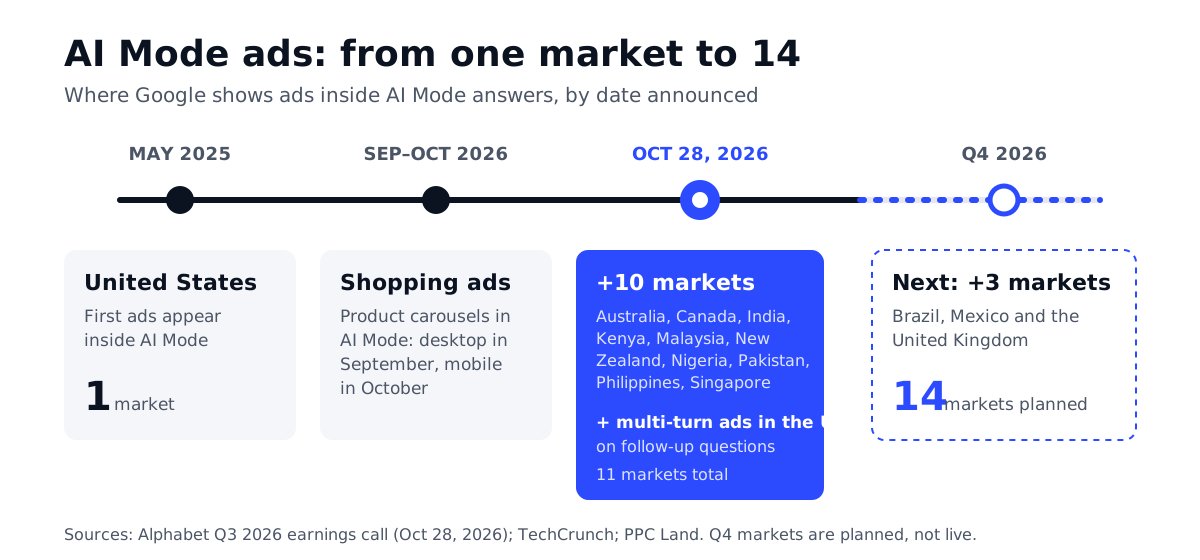
On October 28, 2026, Google used Alphabet’s Q3 earnings call to announce that ads in AI Mode are going international. Ten new markets get them now, three more follow before the end of the year, and US users start seeing sponsored placements in follow-up questions too.
For brands, the timing matters. AI Mode is already the default way most English-speaking users search, and the answer box is now a place where you can both earn a mention and buy one. Knowing which is which is the new baseline.
Key Takeaways
- Google is bringing AI Mode ads to Australia, Canada, India, Kenya, Malaysia, New Zealand, Nigeria, Pakistan, the Philippines and Singapore. Brazil, Mexico and the UK follow in Q4 2026.
- In the US, new multi-turn ads can appear in follow-up answers, not just the first response.
- Google’s Search revenue growth fell from 19% in Q1 to 12% in Q3. Google tied part of the slowdown to lower monetization in AI Mode.
- Google says sponsored and organic product listings in AI Mode get similar click-through rates. It hasn’t published the numbers.
- Paid spots don’t replace earned ones. The answer text, citations and official-site links are still won with content, and you need to track them separately from ad performance.
What Google announced
Chief business officer Philipp Schindler called the move “taking our monetization footprint global for the first time,” and said Google is “scaling high-quality ads within AI overviews in AI mode to more users and queries,” according to TechCrunch.
Ads first appeared in AI Mode in the US in May 2025. PPC Land reports that Shopping ads carousels arrived in AI Mode on desktop in September 2026 and on mobile in October. The new multi-turn ads are labeled “Sponsored” and show up on follow-up responses.

Ready to Monitor Your AI Visibility?
Track how AI chatbots mention your brand across ChatGPT, Perplexity, and other platforms.
Why Google needs these ads
The numbers explain the urgency. Google’s Search and other revenue grew 19% year over year in Q1 2026, 17% in Q2 and 12% in Q3, reaching $63.4 billion. Alphabet’s shares fell after the report.
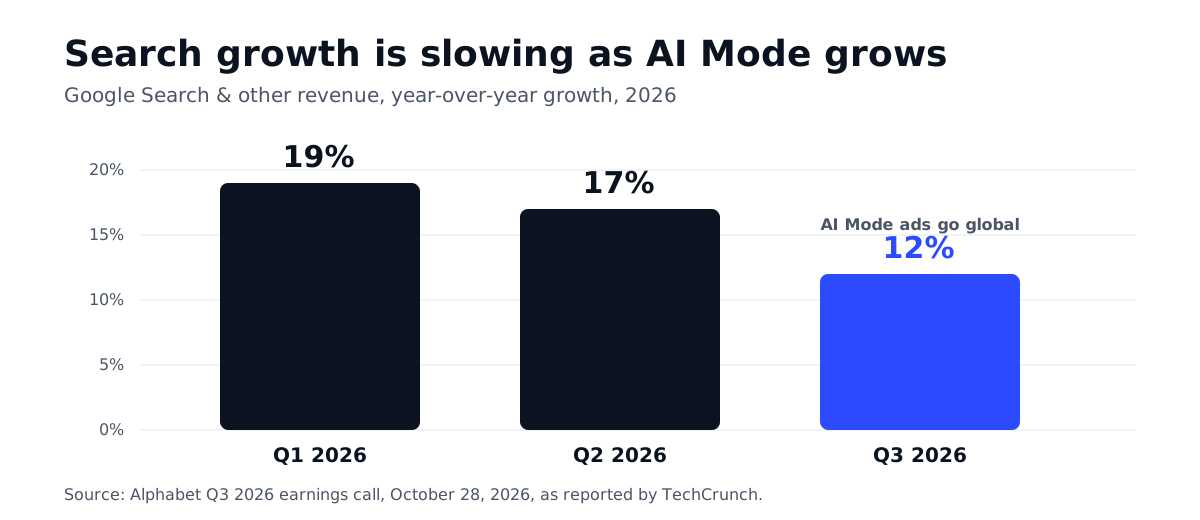
Schindler was direct about the cause: “The strong growth in AI Mode queries had an impact because of the lower monetization we were seeing in AI Mode.” In other words, people are moving their searches into AI Mode faster than Google can sell ads there. Sundar Pichai said query growth is the highest in five years. The queries are just landing in a format that earns less per search.
The same pressure is visible at OpenAI, which took ChatGPT ads to new markets in October. Both of the largest AI answer engines are now selling space inside the answer.
Paid and earned in one answer
An AI Mode answer now has two kinds of real estate. Some is bought: sponsored product listings and, in the US, ads on follow-up turns. The rest is earned: the brands the answer names, the inline citation links, and the links further down.
Google has been making the earned part more visible. On October 15, 2026, it said inline links will appear higher in AI Mode and AI Overviews more often, began testing a section at the top of some answers that highlights one or two official websites, and gave some “Dive deeper” links image thumbnails and publisher names, as reported by TokenPost. That came alongside a push on Preferred Sources, whose use Google says has grown more than seven times since the start of 2026.
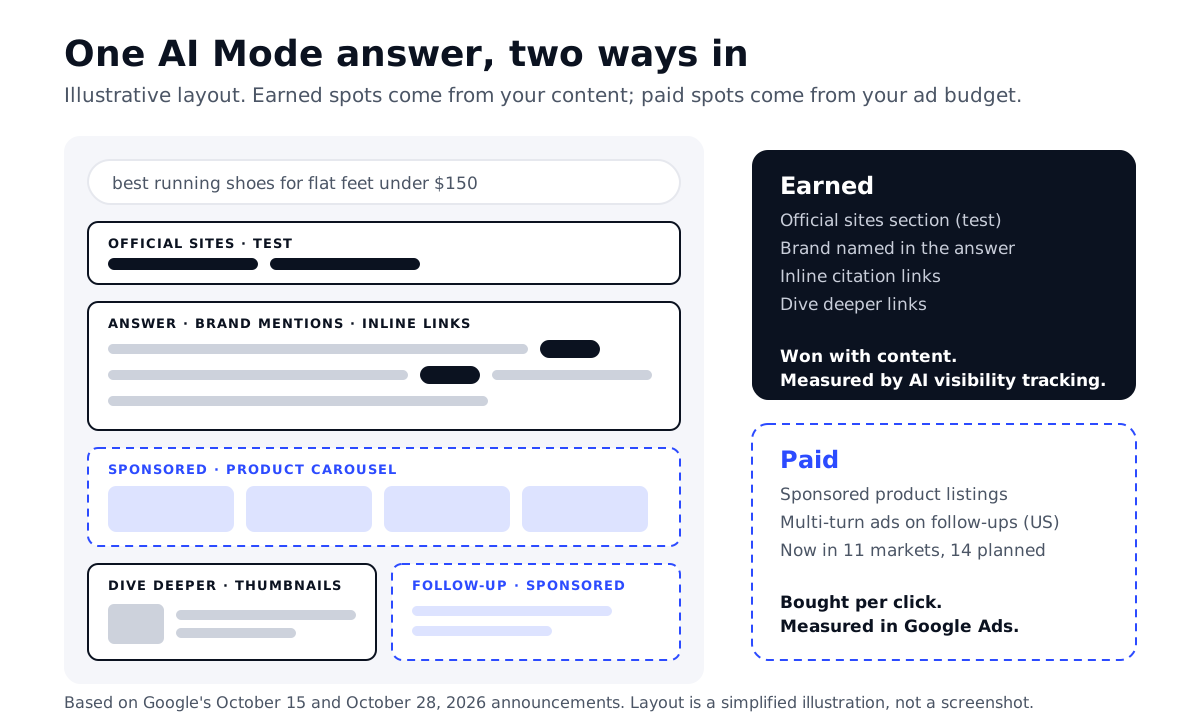
So the answer is becoming a split screen. A competitor can buy the carousel under an answer that recommends you, or you can buy the carousel under an answer that recommends them.
Stay Updated on AI Visibility Trends
Get the latest insights on AI mentions, brand monitoring, and optimization strategies.
The CTR claim, with caveats
Google’s headline claim is that “click-through rates are already similar between sponsored and organic product list items within AI Mode.” That’s a big claim, and three caveats apply:
- No numbers. Google didn’t publish the rates, the sample or the period.
- Product listings only. The comparison covers product list items, not text answers. PPC Land notes that Barry Schwartz questioned whether the same holds for text links.
- Clicks are scarce anyway. Inside AI Mode, most searches end without a click. We covered the scale of that in Google AI Mode Is Now Default and the wider pattern in AI Overviews and organic CTR. Similar CTRs on a small pool of clicks still leave the answer text as the main place where buyers form a shortlist.
What it means for AI visibility
Being named matters more, not less. An ad gets you into the carousel. It doesn’t get your brand into the sentence that says which option is best for a given need. That sentence is earned, and it’s what most readers act on in a zero-click answer.
Your competitors’ budgets become a visibility signal. In the 10 new markets, a rival that wasn’t named organically can now appear in sponsored listings next to the answer. You’ll want to know when that starts for your category, and in which countries.
Multi-turn ads target the end of the conversation. Follow-up questions are where buyers narrow down (“which one is cheapest”, “is it available in Canada”). Ads there sit closest to a decision. If your brand drops out of the answer between the first question and the third, a sponsor can fill the gap.
Country matters again. AI Mode answers already differ by market. With ads rolling out country by country, your visibility in Canada or India may change before it changes in the US.
How to respond this quarter
- Track AI Mode by country. Set up a fixed prompt set in Prompt Tracking for each market where you sell, starting with the 10 new ad markets and the UK, and record a baseline before ads reach your category.
- Track follow-up prompts, not just first questions. Add the second- and third-turn questions buyers actually ask, such as price, availability and comparisons. That’s where multi-turn ads appear.
- Watch who appears next to you. Use Competitor Analysis to see which brands are named alongside yours in AI Mode, and whether a new name shows up in the same weeks ads launch in a market.
- Separate earned from paid in reporting. Report organic mentions and citations as their own metric, alongside AI share of voice. Sponsored placements belong in your Google Ads reports. Mixing them hides what your content is earning.
- Make your official pages easy to pick. Google’s official-sites test favors the pages that answer the task directly. Keep product, pricing, availability and comparison pages crawlable, current and specific, so they qualify for the top section and inline links.
The takeaway
Google is selling space inside AI answers in 11 markets now and plans 14 by year end, because AI Mode is growing faster than it monetizes. That doesn’t make organic AI visibility less valuable. It makes it the part of the answer you can’t simply buy. Get a per-country baseline of who AI Mode names and cites today, so that when sponsored placements reach your category, you’ll know exactly what changed.
 LinkedIn