Key Takeaways
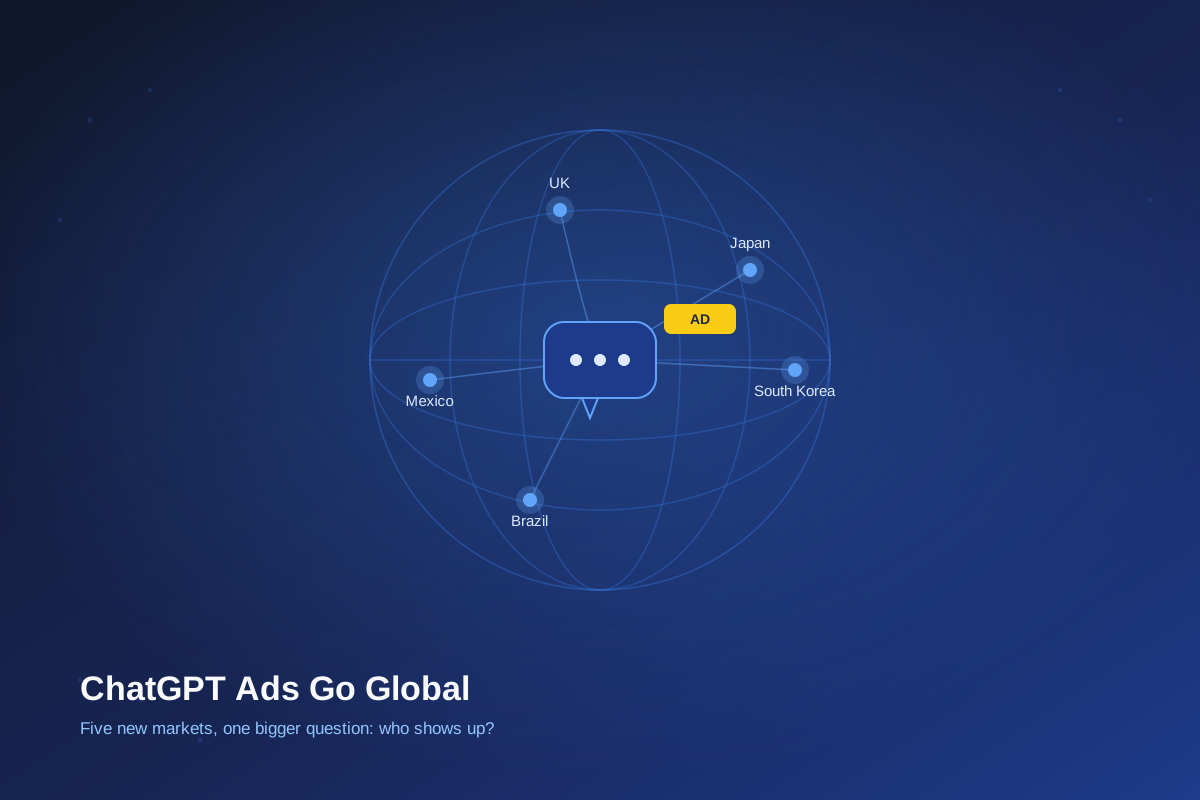
- OpenAI expanded ChatGPT Ads on August 11, 2026 from four markets (US, Canada, Australia, New Zealand) to nine, adding the UK, Mexico, Brazil, Japan, and South Korea in a single announcement.
- Ads are shown only to logged-in Free and Go tier users, capped at one per response, and clearly labeled as sponsored and separate from the answer itself.
- Product feed ads, live in beta since June 2026, let retailers turn an existing product catalog into ChatGPT shopping ads automatically, and the same catalog data also powers free, unpaid shopping cards.
- Independent research already found that a majority of shopping-related ChatGPT questions surface an ad, while free shopping cards, built from clean product data rather than ad spend, appear far less often, and the two aren’t won the same way.
- Bottom line: as paid placements spread to nine markets, brands need to track organic AI share of voice separately from paid ad presence, or they’ll misread who’s actually earning attention in ChatGPT.
ChatGPT Ads Expand to Five New Markets
OpenAI confirmed on August 11, 2026 that ChatGPT Ads is now live in the United Kingdom, Mexico, Brazil, Japan, and South Korea, on top of the US, Canada, Australia, and New Zealand where the test was already running. The pilot started in the US in February 2026 and grew market by market since; this expansion more than doubles the ad-eligible footprint in a single move.
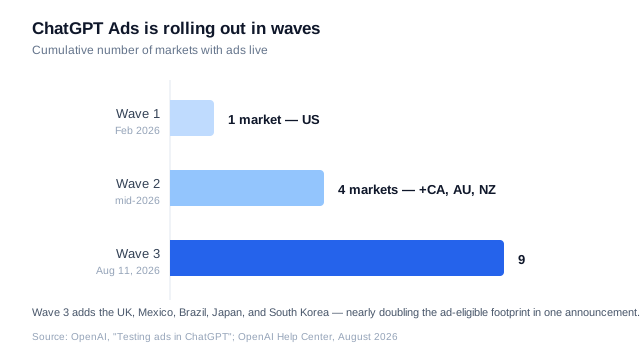
The eligibility rules haven’t changed with the expansion. Ads only appear for logged-in adult users on the Free and Go tiers; Plus, Pro, Business, Enterprise, and Education subscribers see none. Each response can carry at most one ad, always labeled sponsored and kept visually distinct from ChatGPT’s own answer. OpenAI has said this is a test, not a finished product, and that more markets are planned before the end of the year.

Ready to Monitor Your AI Visibility?
Track how AI chatbots mention your brand across ChatGPT, Perplexity, and other platforms.
Why This Expansion, Why Now
Distribution logic explains the pace. OpenAI is scaling ads into markets where ChatGPT already has a large free-tier user base, the same audience the ad slot is designed to monetize, rather than markets where usage is still thin. It’s a similar playbook to the one behind Gemini’s own billion-user growth: meet users where they already are, then layer the new feature or product on top.
For brands, the practical effect is that “does ChatGPT run ads where my customers are” just became a question worth checking market by market instead of assuming a single global answer.
Product Feed Ads Make Buying In Easier
The bigger structural change isn’t the country list, it’s how ads get built. Product feed ads, launched in beta in June 2026, let a retailer connect its existing product catalog once and have ChatGPT auto-generate sponsored placements from that data, filtering which products are eligible rather than building each ad by hand. Many retailers can reuse the same feed they already maintain for Google Shopping, which removes most of the setup cost that would otherwise slow adoption.
That same catalog data does double duty. It’s also what feeds ChatGPT’s free, unpaid shopping cards, the small product tiles with a photo, price, and rating that our analysis of ChatGPT shopping recommendations covered in detail. A brand with clean, well-structured product data is now positioned for both the paid and the organic placement; a brand without it is positioned for neither, no matter how big its ad budget is.
Stay Updated on AI Visibility Trends
Get the latest insights on AI mentions, brand monitoring, and optimization strategies.
Paid Ads and Earned Mentions Are Not the Same Game
It’s worth being precise about what ads change and what they don’t. OpenAI states that ads don’t influence the content of ChatGPT’s answer, only what appears in the separate, labeled slot beneath it. That distinction matters because prior research we cited in our piece on how to show up in ChatGPT without paying for ads found that a majority of shopping-related questions already surface a sponsored ad, while free shopping cards show up far less often and go to whoever has the cleanest product data, not the biggest budget.
Expanding ads to five more markets doesn’t close that gap, it just extends it to more places at once. The brands winning the organic game, named directly in ChatGPT’s written answers through content and credibility rather than spend, are playing a different game from the ones winning the ad slot or the shopping card. A single visibility metric that blends all three together will hide which one you’re actually losing.
What Changes for AI Visibility Tracking
Every time a paid channel opens up inside an AI assistant, it adds a variable that a pure generative engine optimization strategy doesn’t control. That’s not a reason to abandon GEO, earned mentions still show up for logged-in Plus and Pro users who never see an ad at all, but it is a reason to stop treating “AI visibility” as one number.
The share of voice calculation that works for a single-channel platform like Perplexity, where results are still overwhelmingly organic, needs an extra dimension in ChatGPT now: mentioned in the answer, present in the shopping card, or bought the ad slot. Conflating those three into one score means you can’t tell whether a competitor’s presence is something to out-content or something to outbid, and those require completely different budgets.
This isn’t unique to ChatGPT. Commerce-native surfaces are moving the same direction across the board, from Perplexity’s own shopping features to the broader shift toward agentic commerce protocols like WebMCP that let AI agents transact directly. Paid and organic visibility are going to keep overlapping across more assistants, not fewer.
What to Do About It Now
A few concrete steps make sense given how quickly this expanded:
- Check whether ads are live in your market. If you sell into the UK, Mexico, Brazil, Japan, or South Korea, this is now relevant to you; it wasn’t a week ago.
- Clean up your product feed regardless of whether you plan to advertise. The same data structure that qualifies you for a paid product feed ad is what earns you a free shopping card, so the work pays off either way.
- Separate paid presence from earned mentions in your tracking. If a competitor shows up in a ChatGPT answer, find out whether that’s an ad, a shopping card, or an organic citation before deciding how to respond, since the fix for each is different.
- Re-check regularly, not once. OpenAI has expanded this program in waves roughly every few months since February 2026; a market that has no ads today may have them by year-end.
- Keep GEO fundamentals in place. Ads don’t touch the written answer itself, so the content and structured-data work that earns a direct mention still matters exactly as much as it did before this announcement.
ChatGPT Ads reaching nine markets in one step is a distribution story, much like Gemini’s user growth was. The part that actually requires a strategy change is subtler: brand visibility inside ChatGPT is no longer one thing to measure, it’s at least three, and the gap between them just got wider in five more countries.
Sources: OpenAI, “Testing ads in ChatGPT” and Help Center (“Ads in ChatGPT”); OpenAI Ads Manager beta documentation, June 2026; reporting on the August 11, 2026 international expansion.
 LinkedIn