



Do Backlinks Still Matter for AI Search? Complete Guide for 2025
Discover how backlinks impact AI search visibility across ChatGPT, Perplexity, and Google AI Overviews. Learn why quality matters more than quantity in the AI e...
13 min read
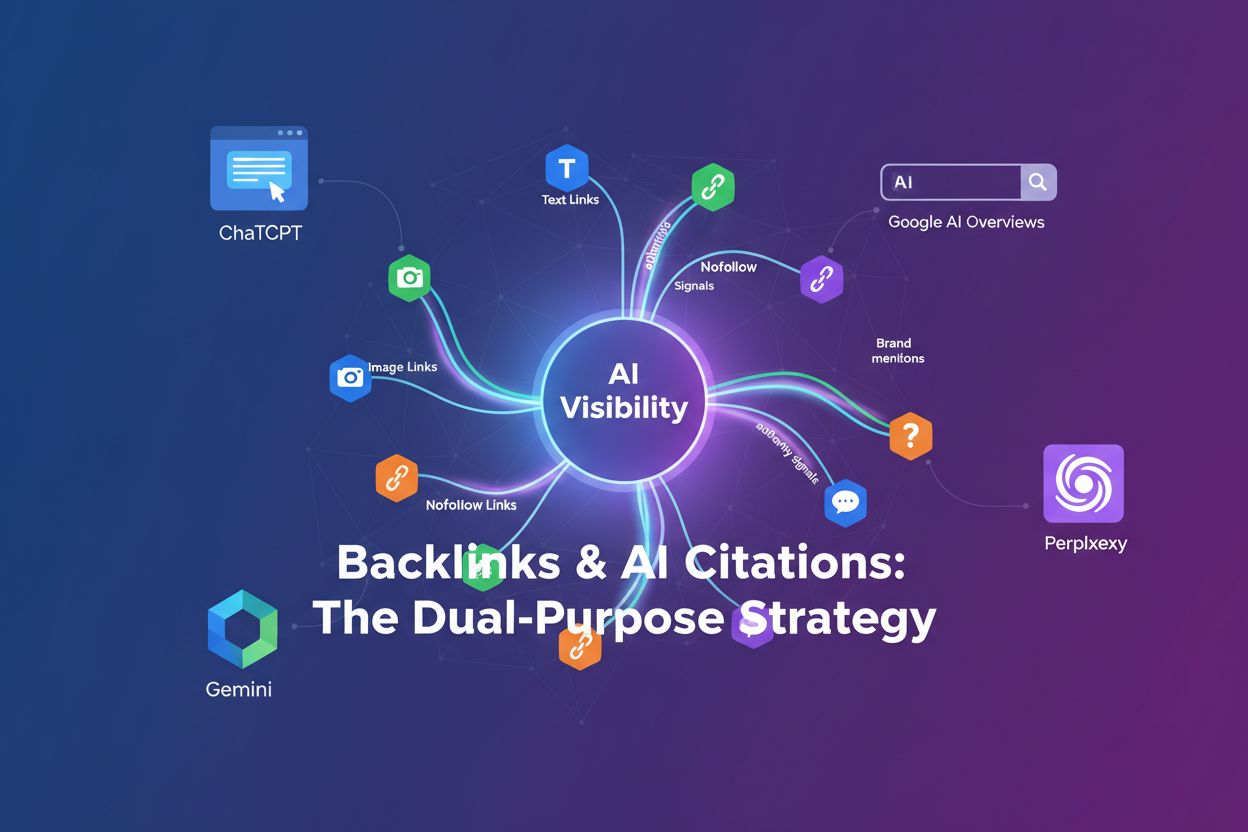
Learn how backlinks drive both traditional rankings and AI citations. Discover dual-purpose link strategies that boost visibility in ChatGPT, Gemini, and Google AI Overviews.
Backlinks have long been the cornerstone of SEO strategy, but their role has fundamentally expanded in the age of AI-powered search. Today’s dual-purpose links serve two critical functions simultaneously: they boost traditional search rankings while also increasing your visibility in AI-generated answers and citations. A dual-purpose backlink is one that comes from an authoritative source relevant to your topic, signals genuine expertise, and appears in content that AI systems actively reference when generating responses. The shift from keyword-focused anchor text to authority-focused link building represents a fundamental change in how we should approach link acquisition. According to recent research, 73% of SEO professionals believe backlinks directly affect AI visibility, reflecting the growing recognition that these two channels are increasingly intertwined. Rather than treating traditional SEO and AI citations as separate objectives, forward-thinking marketers now recognize that a single high-quality backlink can drive value across both channels. This convergence means that your link-building strategy must now account for both algorithmic ranking factors and the citation patterns of major AI systems.
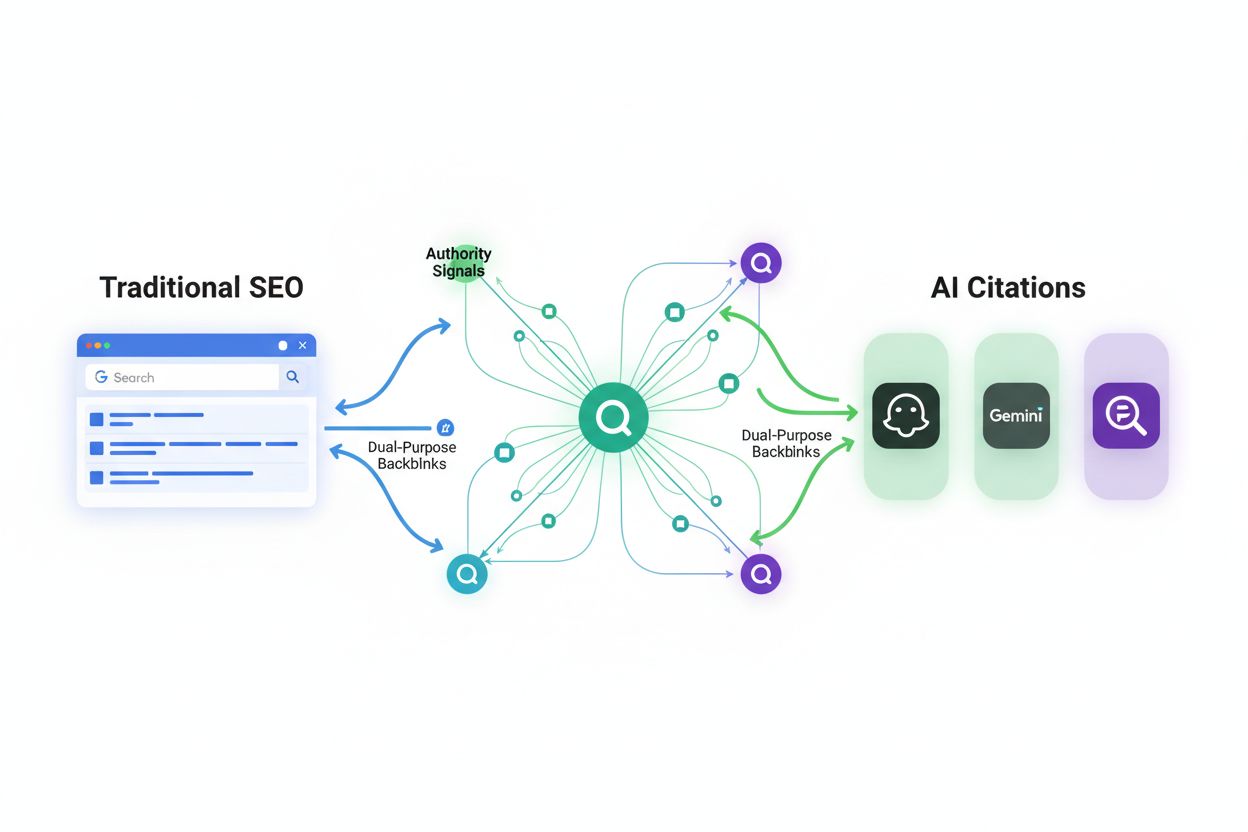

Track how AI chatbots mention your brand across ChatGPT, Perplexity, and other platforms.
Different AI platforms evaluate and weight backlinks in distinct ways, creating a complex landscape that requires nuanced understanding. While all major AI systems recognize backlinks as authority signals, the specific mechanisms and emphasis vary significantly across platforms. Here’s how leading AI systems incorporate backlink data into their citation decisions:
| AI Platform | How Backlinks Influence Citations | Key Ranking Factors |
|---|---|---|
| ChatGPT | Uses backlink authority as credibility filter; prioritizes sources with strong domain reputation | Domain authority, topical relevance, recency |
| Gemini | Integrates backlink data with E-E-A-T signals; emphasizes editorial quality | Author expertise, publisher authority, content depth |
| Perplexity | Weights backlinks alongside citation frequency; favors sources cited by other authoritative sites | Cross-domain citations, topical authority, freshness |
| Google AI Overviews | Leverages existing Search ranking signals including backlinks; prioritizes featured snippets | Backlink profile, featured snippet eligibility, relevance |
| Claude | Evaluates source credibility through training data patterns; less transparent backlink weighting | Content quality, factual accuracy, source reputation |
Research shows that Authority Score demonstrates a 0.65 Pearson correlation with AI mentions, indicating a strong relationship between backlink-derived authority and AI citation frequency. This correlation is notably higher than many other individual ranking factors, suggesting that building a robust backlink profile should be a primary focus for AI visibility. Understanding these platform-specific differences allows you to optimize your content and link strategy for maximum impact across the AI ecosystem.
The age-old SEO principle that quality trumps quantity becomes even more critical when considering AI citations. Authority thresholds exist across all major AI platforms, a domain must reach a certain credibility level before its citations carry meaningful weight in AI-generated responses. Domains with higher Authority Scores appear far more frequently in AI-generated answers, and this relationship is not linear; the improvement accelerates as you climb the authority ladder. A single backlink from a domain with an Authority Score of 70+ often delivers more AI visibility value than dozens of links from lower-authority sources. This threshold effect means that your link-building strategy should prioritize securing backlinks from established, authoritative publishers in your industry rather than pursuing volume-based approaches. The incremental improvements in AI citations become more pronounced as you move from mid-tier to top-tier authority domains, making strategic targeting of premium link sources essential. Rather than celebrating 100 mediocre backlinks, focus your efforts on earning 10 links from genuinely authoritative sources that will meaningfully impact both your traditional rankings and AI visibility.
Get the latest insights on AI mentions, brand monitoring, and optimization strategies.
One of the most counterintuitive findings in recent AI citation research is that nofollow links carry nearly equivalent weight to follow links when it comes to AI visibility. Historically, SEO professionals dismissed nofollow links as valueless for ranking purposes, but AI systems evaluate them through a different lens, one focused on authority and credibility rather than PageRank flow. Nofollow links show a 0.340 Pearson correlation with AI mentions compared to 0.334 for follow links, a difference so minimal that it’s statistically negligible. This near-parity exists because AI systems care primarily about whether a reputable source mentions or links to your content, regardless of the rel attribute. However, platform variations do exist: Gemini and Google AI Overviews show slightly stronger weighting for follow links, while ChatGPT and Perplexity treat nofollow and follow links more equally. This discovery has profound implications for your link-building strategy, as it means you should actively pursue mentions and links from high-authority platforms like LinkedIn, Medium, and industry forums, even when those links carry nofollow attributes. The practical takeaway is clear: don’t dismiss nofollow opportunities from authoritative sources, as they contribute meaningfully to your AI citation profile.
Visual content represents a significant but often overlooked opportunity for earning backlinks that drive AI citations. Image links show a 0.415 Pearson correlation with AI mentions, substantially outperforming text-based links at 0.334, a 24% improvement that shouldn’t be ignored. This advantage likely stems from the fact that image-based content (infographics, charts, product visuals, and data visualizations) tends to be more shareable, more frequently cited, and more likely to be referenced by AI systems seeking authoritative visual evidence. When you create compelling infographics that explain complex concepts, original charts that visualize industry data, or product photography that showcases your offerings, you’re creating natural link magnets that appeal to both human audiences and AI systems. Distribution strategies for image-based backlinks should include submitting to design galleries, infographic directories, and visual content platforms where publishers actively source imagery for their articles. Consider developing a visual content strategy that produces 2-3 high-quality, data-driven infographics monthly, each one has the potential to earn dozens of backlinks while simultaneously boosting your AI citation frequency. The combination of superior link-earning potential and stronger AI citation correlation makes image-based content a strategic priority for forward-thinking content teams.
While backlinks remain important, an even more powerful signal for AI visibility emerges from brand mentions without accompanying links. An Ahrefs study revealed a striking finding: brand mentions show a 0.664 correlation with AI visibility compared to just 0.218 for backlinks alone: a threefold difference that fundamentally challenges traditional link-building orthodoxy. AI systems recognize that mentions of your brand across the web signal relevance, authority, and trustworthiness, even when those mentions don’t include hyperlinks. Platforms like Reddit, industry forums, review sites, and social media generate countless brand mentions that AI systems actively monitor and incorporate into their citation decisions. These unlinked citations often carry more weight because they represent organic, unpaid endorsements that are harder to manipulate than traditional link-building campaigns. To capitalize on this opportunity, implement a brand mention monitoring strategy using tools like Ahrefs Brand Radar, Brand24, or Semrush to track where your brand is discussed across the web. Actively engage in communities where your audience congregates, answer questions on Reddit, participate in industry forums, and encourage customer reviews on relevant platforms. The strategic insight here is that your AI citation strategy should extend far beyond link acquisition to encompass a comprehensive brand mention and reputation management program.
Creating a link-building strategy that simultaneously drives traditional SEO and AI citations requires a deliberate, multi-faceted approach. Rather than treating these channels separately, successful marketers now develop integrated strategies that recognize the overlapping value of quality backlinks and brand authority. Here are the core components of an effective dual-purpose link strategy:
Tracking the impact of your backlinks on both traditional SEO and AI visibility requires a sophisticated measurement framework that goes beyond traditional link metrics. Traditional backlink metrics like Domain Authority and referring domains tell only part of the story: you must also measure how those links translate into actual AI citations and visibility. Tools like Semrush AI Visibility Toolkit and AmICited provide direct measurement of how often your content appears in AI-generated answers, allowing you to correlate specific backlinks with AI citation increases. Implement Share of Voice tracking to understand your competitive position in both traditional search results and AI-generated responses, revealing which link-building efforts deliver the most competitive advantage. Use Google Search Console to monitor click-through rates from traditional search results, while simultaneously tracking AI mention frequency through dedicated monitoring platforms. GA4 segmentation allows you to create custom audiences based on traffic source, enabling you to analyze the behavior and value of visitors arriving from AI-cited content versus traditional search. Consider developing a monthly reporting dashboard that displays backlink acquisition, Domain Authority trends, AI mention frequency, and revenue attribution across both channels, this holistic view reveals which link-building tactics deliver the strongest ROI.
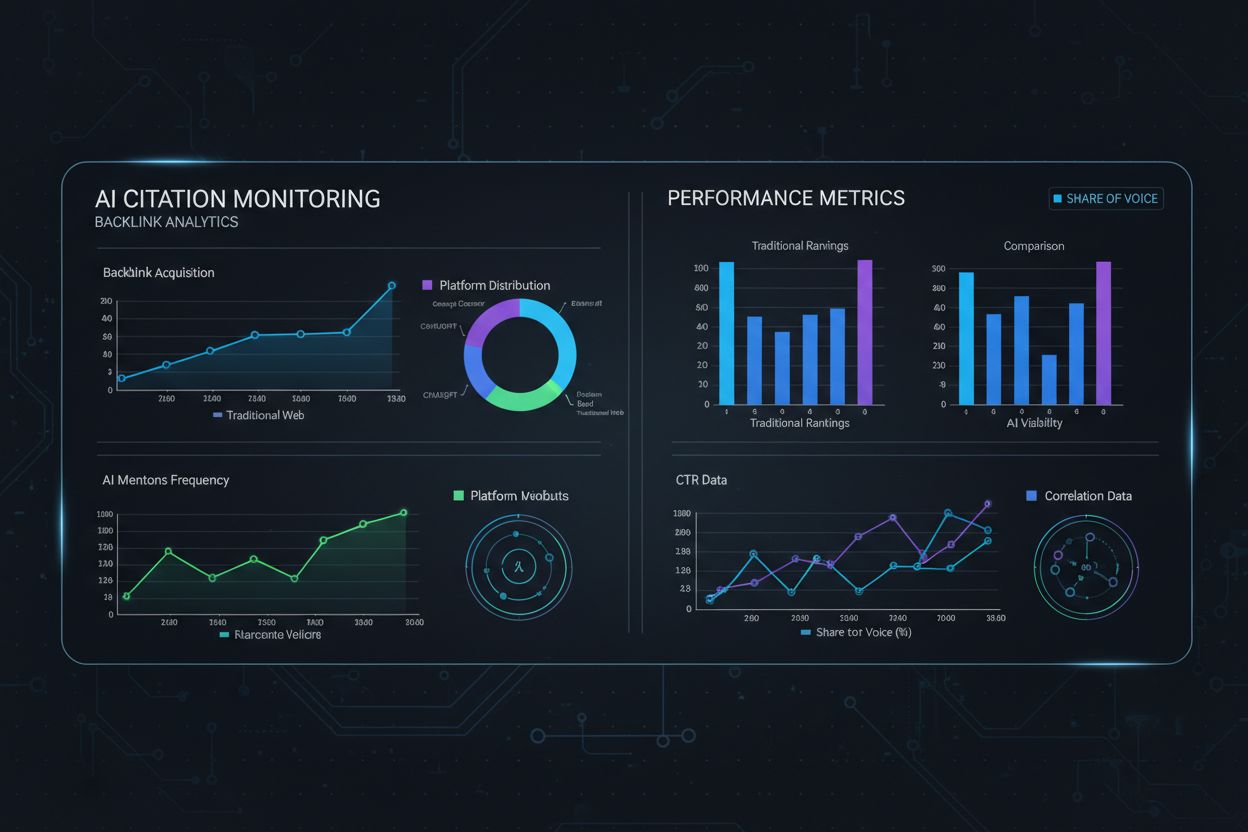
The link-building landscape is undergoing a fundamental transformation as AI systems become increasingly central to how information is discovered and consumed. Digital PR is experiencing explosive growth as marketers recognize that earning media mentions and editorial coverage drives value across both traditional and AI channels simultaneously. The emerging consensus among SEO professionals is that entity profile building: establishing your brand as a recognized, authoritative entity across the web, matters more than ever before. As we’ve explored throughout this analysis, nofollow links and brand mentions are gaining relative importance compared to traditional follow links, forcing marketers to expand their definition of valuable link-building outcomes. Early adopters who shift their strategies to account for AI citation patterns are gaining significant competitive advantages, as they’re optimizing for a channel that most competitors still ignore. The brands that will dominate search results in 2025 and beyond will be those that recognize backlinks as dual-purpose assets and build comprehensive strategies that maximize value across both traditional rankings and AI visibility. Your link-building strategy should evolve immediately to incorporate AI citation tracking, brand mention monitoring, and authority-focused acquisition tactics, waiting for AI search to become mainstream means ceding competitive advantage to more forward-thinking competitors.
Viktor Zeman is a co-owner of QualityUnit. Even after 20 years of leading the company, he remains primarily a software engineer, specializing in AI, programmatic SEO, and backend development. He has contributed to numerous projects, including LiveAgent, PostAffiliatePro, FlowHunt, UrlsLab, and many others.

Track how your backlinks drive citations in ChatGPT, Gemini, Perplexity, and Google AI Overviews with AmICited
Discover how backlinks impact AI search visibility across ChatGPT, Perplexity, and Google AI Overviews. Learn why quality matters more than quantity in the AI e...
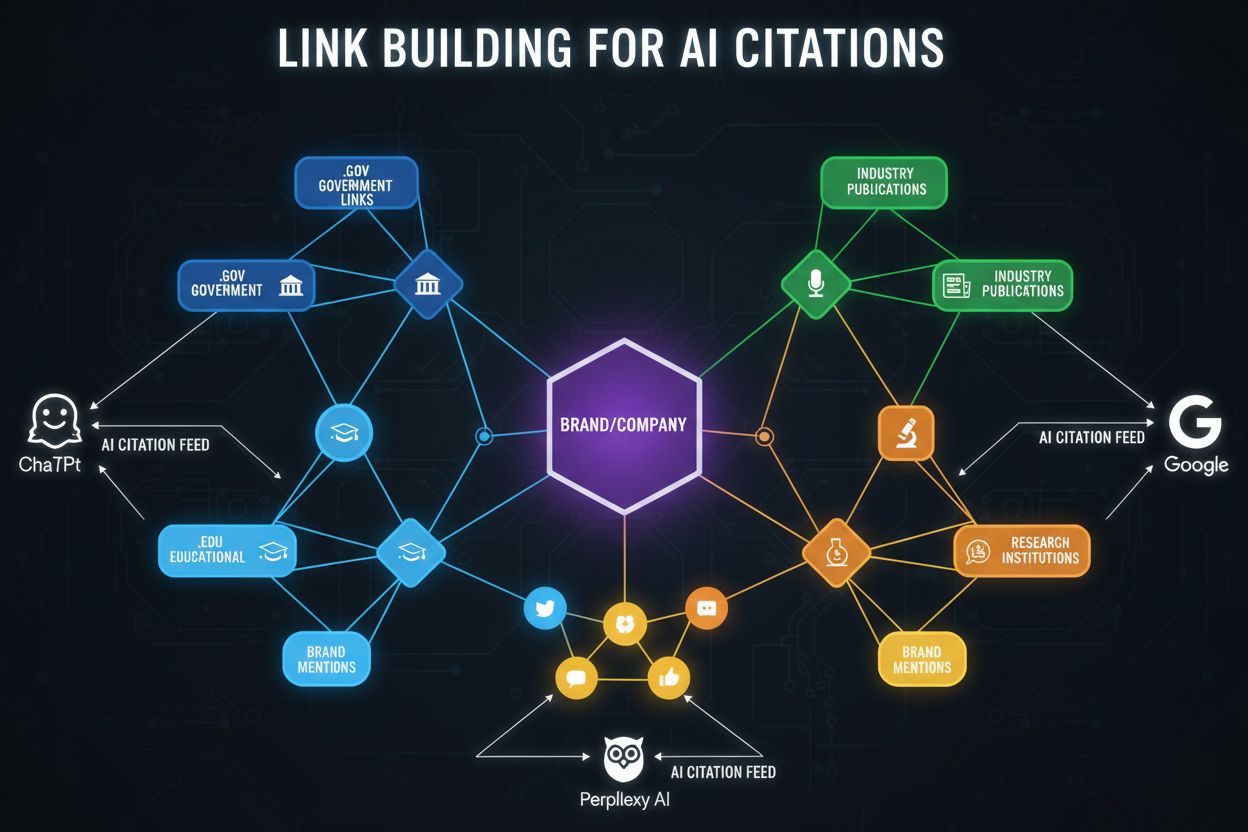
Learn how link building has evolved for AI search. Discover strategies to earn AI citations across ChatGPT, Perplexity, and Google AI Overviews. Master the new ...
Community discussion on whether backlinks still matter for AI search visibility. Real experiences from SEO professionals adapting link building strategies for C...
Cookie Consent
We use cookies to enhance your browsing experience and analyze our traffic. See our privacy policy.