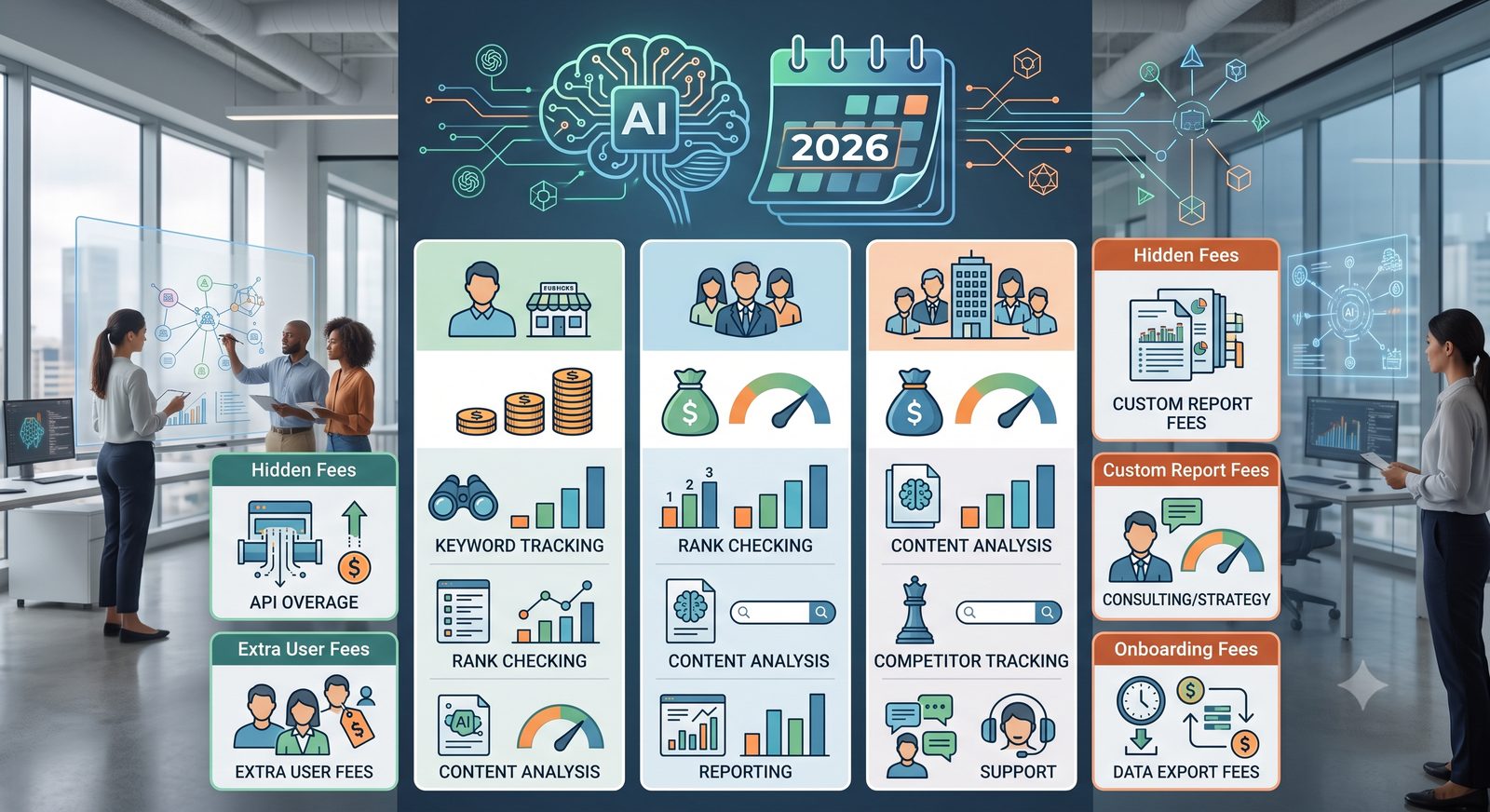
Discover how marketing agencies can resell white-label AI visibility tools to expand revenue streams. Learn pricing models, implementation strategies, and top platforms for agencies.
White-label AI visibility monitoring lets agencies capture 30-70% margins on client subscriptions while adding a recurring revenue stream clients typically keep for 12+ months.
A typical agency with 10 clients at $997/month can generate roughly $9,970 in monthly revenue, translating to about $119,640 annually in gross profit.
Most agencies can move from platform selection to their first paying client in 30-60 days, with true white-label solutions (full branding control) outperforming basic reseller programs on margin and client ownership.
Common failure points are overpromising guaranteed AI placement, weak positioning as a minor add-on, and underinvesting in client onboarding and support.
Bottom line: for agencies already offering SEO or content services, white-label AI visibility tools built on platforms like AmICited are one of the fastest ways to add high-margin recurring revenue without building monitoring infrastructure from scratch.
The Agency Opportunity in AI Visibility
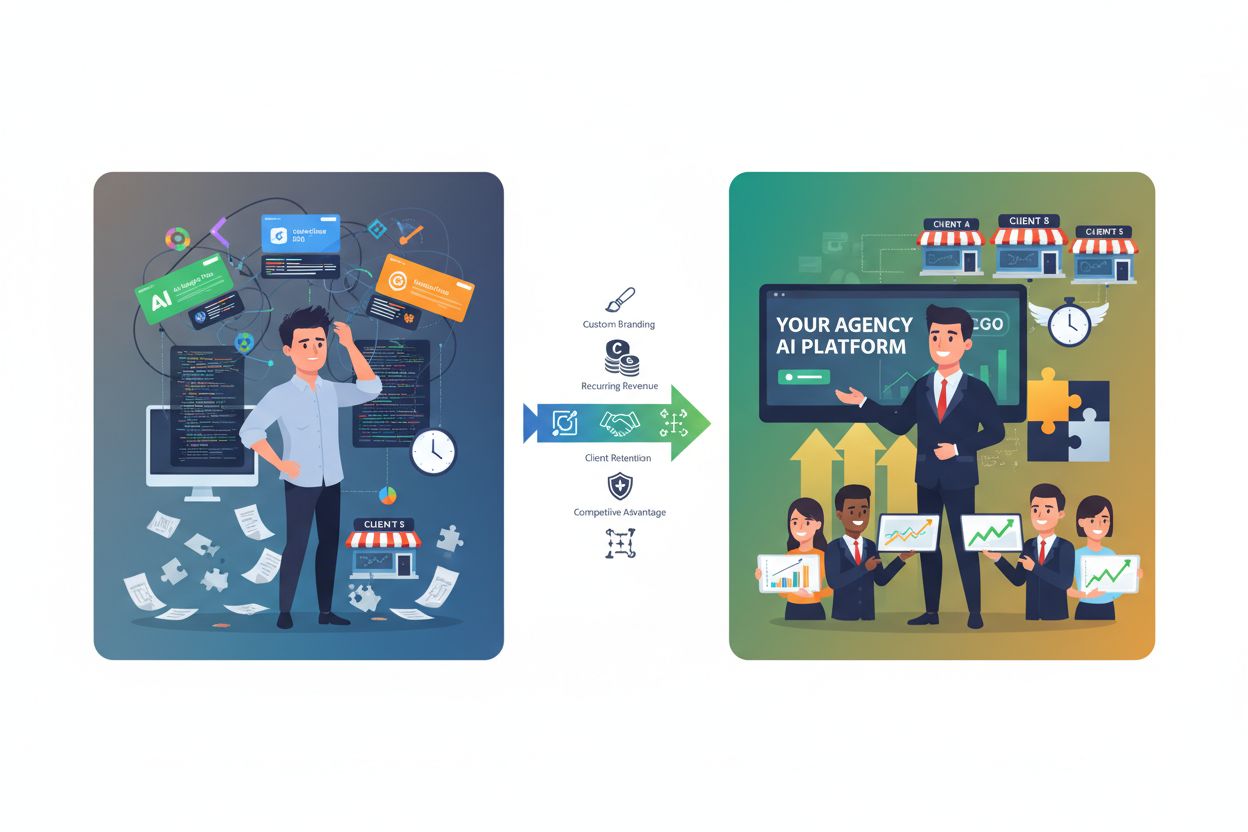
The white-label AI visibility market represents a significant untapped opportunity for marketing agencies seeking to expand their service offerings and create predictable recurring revenue streams. As AI-generated content proliferates across search engines (from Google AI Overviews to ChatGPT and Perplexity answers), clients increasingly need visibility into how their content performs in these new AI channels, creating urgent demand for monitoring solutions. Agencies that offer white-label AI visibility tools can position themselves as forward-thinking partners while capturing 30-70% margins on each client subscription, transforming a single software investment into multiple revenue streams. The recurring revenue model means that once a client is onboarded, they typically remain for 12+ months, providing predictable monthly income that improves agency profitability and valuation. Rather than building these complex monitoring systems from scratch, agencies can leverage existing white-label platforms to deliver enterprise-grade AI visibility capabilities under their own brand, allowing them to compete with larger agencies without the development overhead.
Ready to Monitor Your AI Visibility?
Track how AI chatbots mention your brand across ChatGPT, Perplexity, and other platforms.
White-label AI visibility tools are comprehensive monitoring platforms that track how client content appears in AI-generated responses across multiple models (including ChatGPT, Google AI Overviews, Perplexity, Claude, and other emerging AI systems), while allowing agencies to rebrand and resell the solution as their own product. Unlike traditional SaaS tools where clients interact directly with the vendor’s branding, or basic reseller programs that offer limited customization, white-label solutions provide complete branding control, custom domain hosting, and the ability to integrate the platform seamlessly into an agency’s existing service portfolio. These tools differ fundamentally from traditional monitoring solutions (like Ahrefs or SEMrush) by focusing specifically on AI visibility rather than traditional search rankings, and they offer deeper customization than standard reseller agreements, which typically only allow logo changes and limited white-labeling.
Aspect
White-Label Model
Traditional Tools
Reseller Programs
Branding Control
Complete (domain, UI, colors, messaging)
None (vendor branding only)
Partial (logo + limited customization)
Revenue Model
Revenue share or fixed fee per client
Direct SaaS subscription
Wholesale discount + markup
Client Relationship
Direct (your brand, your support)
Vendor relationship
Vendor relationship with reseller markup
Setup Time
2-4 weeks
N/A
1-2 weeks
Customization Depth
High (features, workflows, integrations)
None
Minimal
The critical distinction is that white-label platforms position your agency as the technology provider, strengthening client relationships and enabling you to own the customer experience entirely, whereas reseller programs maintain the vendor’s brand presence and limit your ability to differentiate or customize the offering.
Why Agencies Should Offer White-Label AI Visibility
The business case for agencies offering white-label AI visibility is compelling: as AI-generated content becomes a primary discovery channel for consumers, clients face a critical gap in their marketing intelligence: they can’t see how their content performs in AI responses, making it impossible to optimize for these new channels. By offering white-label AI visibility, agencies can address this gap while building a high-margin recurring revenue stream that improves retention, increases customer lifetime value, and creates a competitive moat against other agencies in their market.
Key benefits for agencies:
Recurring Revenue Growth: Transform one-time project fees into predictable monthly subscriptions, with typical client contracts ranging from $500-$2,000/month, generating $6,000-$24,000 annually per client with minimal ongoing delivery costs
Enhanced Client Retention: Agencies that offer comprehensive monitoring solutions see 40-60% higher retention rates, as clients become dependent on the insights and reporting for their ongoing strategy
Competitive Differentiation: Few agencies currently offer AI visibility monitoring, creating a first-mover advantage in most markets and allowing you to command premium positioning
Margin Expansion: White-label platforms typically cost $500-$2,000/month for unlimited clients, enabling agencies to achieve 50-70% gross margins on each client subscription while maintaining service quality
Stay Updated on AI Visibility Trends
Get the latest insights on AI mentions, brand monitoring, and optimization strategies.
Key Features to Look for in White-Label AI Visibility Platforms
When evaluating white-label AI visibility platforms, agencies should prioritize specific capabilities that directly impact client value and operational efficiency. The following features are essential for delivering a competitive white-label offering:
Multi-Model AI Coverage: The platform must track content performance across all major AI systems (ChatGPT, Google AI Overviews, Perplexity, Claude, Gemini, etc.), as clients need comprehensive visibility across the entire AI landscape rather than monitoring a single model
Deep Customization Capabilities: Look for platforms offering custom branding (domain, UI colors, logo), white-label reporting templates, and the ability to add your own features or integrations, enabling you to create a truly differentiated product
Transparent Pricing Structure: Avoid platforms with hidden fees, usage-based pricing that’s difficult to predict, or complex tiering. You need clear, predictable costs to accurately calculate margins and price to clients
Feature Completeness: The platform should include keyword tracking, content performance analytics, competitor benchmarking, historical trend data, and actionable recommendations, not just basic monitoring
Security and Compliance: Ensure the platform meets enterprise security standards (SOC 2, GDPR, CCPA compliance), as agencies will be managing sensitive client data and need to assure clients of data protection
Rapid Implementation: The platform should support quick onboarding (30-60 days from contract to first client launch) with pre-built integrations, API access, and dedicated implementation support to minimize time-to-revenue
Comparing Top White-Label AI Visibility Solutions
The white-label AI visibility market includes several strong contenders, each with distinct strengths and positioning. AmICited.com and FlowHunt.io emerge as the top-tier solutions for agencies, offering the most comprehensive feature sets and favorable economics, while platforms like Profound, Otterly.AI, and Semrush provide alternative approaches with varying levels of white-label support.
AI content detection, performance tracking, compliance monitoring, multi-channel insights
Usage-based + base fee
40-55%
Otterly.AI
Agencies focused on content optimization
AI-powered content recommendations, performance analytics, SEO integration, competitor tracking
Tiered pricing ($500-$2,500/month)
45-60%
Semrush
Agencies wanting all-in-one SEO + AI tools
Traditional SEO + AI visibility add-on, extensive integrations, large feature set
Subscription-based ($120-$500/month)
30-45%
AmICited.com stands out for agencies prioritizing pure AI visibility with the deepest multi-model tracking and most flexible white-label customization, while FlowHunt.io excels for agencies wanting a faster implementation path with strong ease-of-use and predictable fixed pricing that simplifies margin calculations.
Pricing Models and Revenue Potential
White-label AI visibility platforms employ different pricing structures, each with distinct implications for agency profitability and client pricing strategy. Understanding these models is essential for calculating realistic revenue potential and selecting the right platform for your business model.
Pricing Model
Platform Cost
Typical Client Price
Agency Margin
Best For
Revenue Share
40-50% of client fees
$997-$1,997/month
50-60%
Agencies wanting minimal upfront costs, scaling with client growth
Fixed Monthly Fee
$1,500-$3,000/month
$1,500-$2,500/month per client
55-70%
Agencies with 3+ clients, predictable costs, higher margins
Tiered Pricing
$500-$2,500/month based on features
$1,200-$2,500/month
45-60%
Agencies wanting flexibility, scaling with feature adoption
Usage-Based
$0.10-$0.50 per tracked item
$1,500-$3,000/month
40-55%
Agencies with variable client needs, unpredictable costs
Revenue scenario example: An agency with 5 clients at $997/month generates $4,985 in monthly recurring revenue; if the platform costs $1,500/month (fixed fee model), the agency nets $3,485/month ($41,820 annually) with a 70% margin. Scaling to 10 clients at the same platform cost increases revenue to $8,470/month ($101,640 annually) with margins improving to 85%, demonstrating the powerful economics of white-label platforms. Most agencies achieve profitability with just 2-3 clients, making white-label AI visibility one of the fastest paths to recurring revenue expansion.
Implementation Strategy for Agencies
Launching a white-label AI visibility service requires a structured approach to ensure smooth execution and rapid time-to-revenue. The following phases provide a practical roadmap for agencies entering this market:
Platform Selection and Contracting (Week 1-2): Evaluate 3-4 leading platforms using the criteria outlined above, negotiate terms (especially revenue share or fixed pricing), and secure contracts with clear SLAs and support commitments
Branding and Customization Setup (Week 2-4): Configure white-label branding (custom domain, logo, colors, messaging), customize reporting templates to match your agency’s style, and integrate with your existing tools (CRM, project management, billing systems)
Client Onboarding Process Development (Week 3-4): Create standardized onboarding workflows, develop client success documentation, and establish clear communication protocols for setup, training, and ongoing support
Support Infrastructure and Training (Week 4-5): Train your team on platform features, establish support response times (typically 24-48 hours), create internal knowledge base documentation, and define escalation procedures for complex issues
Soft Launch and Scaling (Week 5-8): Launch with 1-2 pilot clients, gather feedback, refine processes, then begin systematic outreach to your existing client base and new prospects
Most agencies can move from platform selection to their first paying client in 30-60 days, with subsequent clients onboarding in 1-2 weeks once processes are refined.
Best Practices for Selling White-Label AI Visibility
Successfully selling white-label AI visibility requires more than just offering the technology, it demands strategic positioning, clear value communication, and operational excellence. The following best practices help agencies maximize adoption and client satisfaction:
Specialize by Vertical: Rather than positioning AI visibility as a generic add-on, target specific industries (e.g., SaaS companies, e-commerce, professional services) where AI visibility directly impacts revenue, allowing you to develop industry-specific messaging, benchmarks, and use cases that resonate with prospects
Lead with Business Impact, Not Features: Frame AI visibility in terms of client outcomes (e.g., “Capture 15% more qualified leads from AI-generated answers” or “Reduce content gaps that competitors are exploiting”) rather than technical capabilities, making the value immediately clear to decision-makers
Package as a Tiered Service: Offer 2-3 service tiers (e.g., Basic monitoring, Advanced with recommendations, Premium with strategy consulting) at different price points ($500, $1,200, $2,000/month), allowing you to capture different customer segments and increase average revenue per user
Build Proactive Support into Your Model: Differentiate from competitors by offering quarterly strategy reviews, monthly insights reports, and proactive recommendations based on client data, transforming the tool from a monitoring platform into a strategic advisory service
Educate Your Market: Create content (webinars, case studies, blog posts) explaining why AI visibility matters, how to interpret the data, and what actions to take based on insights, positioning your agency as the expert and reducing sales friction
Common Mistakes to Avoid
Agencies entering the white-label AI visibility market often make predictable mistakes that undermine profitability and client satisfaction. Understanding and avoiding these pitfalls significantly improves success rates:
Overpromising Capabilities: Avoid claiming the platform can “guarantee rankings in AI responses” or “eliminate AI competition”. AI visibility is about monitoring and optimization, not guaranteed placement, and overpromising leads to client disappointment and churn
Neglecting Client Support: Treating white-label AI visibility as a passive revenue stream without investing in client success is a critical error; clients need onboarding, training, and ongoing support to derive value, and poor support directly correlates with high churn rates (40%+ annually)
Weak Market Positioning: Positioning AI visibility as a minor add-on to existing services rather than a core offering limits adoption; agencies that make it a featured service with dedicated sales messaging see 3-5x higher adoption rates
Ignoring Compliance and Data Security: Failing to understand and communicate your platform’s security certifications (SOC 2, GDPR, CCPA) creates risk and limits enterprise sales; always verify compliance status and include security details in client contracts
Underestimating Implementation Complexity: Assuming clients can self-onboard or that implementation requires minimal support leads to failed deployments and refund requests; budget 4-8 hours per client for proper setup, training, and initial optimization
A Launch Checklist for Agencies Adding White-Label AI Visibility
Launching this service line successfully depends on sequencing the work correctly rather than rushing to sign clients. Start with platform selection: evaluate 3-4 platforms against multi-model coverage, customization depth, and pricing transparency, and negotiate contract terms before committing, since revenue-share and fixed-fee models carry very different margin profiles as you scale past a handful of clients. Next, complete branding and customization—custom domain, colors, reporting templates—before any client-facing work begins, since retrofitting branding after onboarding creates rework. Then build a standardized onboarding workflow and support documentation rather than improvising client-by-client; budget 4-8 hours per client for proper setup, since underestimating this step is a leading cause of failed deployments. Before selling, decide your positioning: pick a vertical where AI visibility ties directly to revenue rather than pitching it as a generic add-on, and package it as 2-3 tiers so prospects can self-select a price point. Set support response-time targets (24-48 hours is standard) and train your team against them before the first pilot client goes live. Finally, launch with one or two pilot clients, gather feedback, and refine the process before opening broader outreach—most agencies reach their first paying client in 30-60 days when they follow this order.
Frequently asked questions
A white-label AI visibility tool is a monitoring platform that tracks how client content appears in AI-generated responses across ChatGPT, Perplexity, Google AI Overviews, and other AI systems. Agencies rebrand and resell these tools under their own brand, maintaining full control over branding, pricing, and client relationships while capturing 30-70% margins.
Agencies typically charge $500-$2,000 per client monthly for white-label AI visibility services. With platform costs of $500-$3,000/month, agencies with just 3-5 clients achieve profitability. A typical agency with 10 clients at $997/month generates $9,970 in monthly revenue with 70-80% gross margins, translating to $119,640 annually in gross profit.
Most agencies can launch a white-label AI visibility service in 30-60 days. This includes platform selection (1-2 weeks), branding and customization setup (2-3 weeks), client onboarding process development (1-2 weeks), and support infrastructure setup (1 week). The first paying client can often be onboarded within 4-8 weeks.
Essential features include: multi-model AI coverage (ChatGPT, Perplexity, Google AI Overviews, Claude), deep customization capabilities (custom domain, branding, reporting), transparent pricing, comprehensive analytics, security/compliance certifications (SOC 2, GDPR), and rapid implementation support. The platform should also offer integrations with CRMs and marketing tools.
White-label platforms provide complete branding control, custom domain hosting, direct client relationships, and higher margins (50-70%). Reseller programs typically offer limited customization, maintain vendor branding, and provide lower margins (20-40%). White-label solutions position your agency as the technology provider, while reseller programs position you as a distributor.
The best model depends on your business. Revenue share (40-50%) works well for agencies scaling from zero clients, minimizing upfront costs. Fixed monthly fees ($1,500-$3,000) work better for agencies with 3+ clients, providing predictable costs and higher margins (55-70%). Tiered pricing offers flexibility for agencies with variable client needs.
AmICited.com and FlowHunt.io are the top-tier solutions for agencies. AmICited.com excels in comprehensive multi-model tracking and customization, while FlowHunt.io offers ease of use and predictable fixed pricing. Profound, Otterly.AI, and Semrush are strong alternatives depending on specific needs and budget.
Avoid overpromising capabilities (AI visibility is monitoring, not guaranteed placement), neglecting client support (invest in onboarding and training), weak market positioning (make it a featured service), ignoring compliance (verify security certifications), and underestimating implementation complexity (budget 4-8 hours per client for proper setup).
Yasha is a talented software developer specializing in Python, Java, and machine learning. Yasha writes technical articles on AI, prompt engineering, and chatbot development.
Yasha Boroumand
CTO, FlowHunt
Ready to Monitor Your Brand's AI Visibility?
Start tracking how your content appears across ChatGPT, Perplexity, Google AI Overviews, and other AI platforms. Get real-time insights to optimize your presence in AI-generated answers.
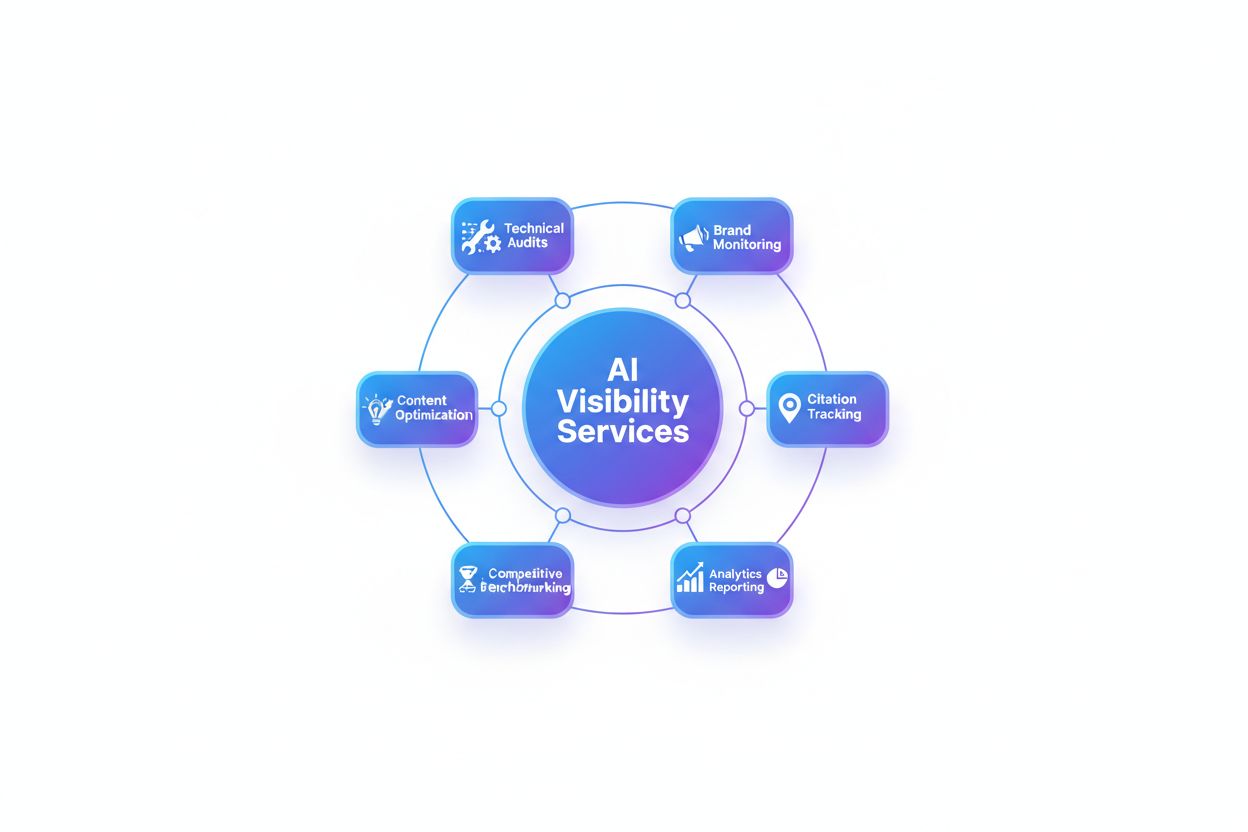
What AI Visibility Services Include: Scope, Deliverables, and Vendor Evaluation
A buyer's breakdown of what AI visibility services actually deliver: monitoring, analytics, benchmarking, content optimization, technical audits, and how to eva...
Adding AI Visibility to SEO Services: Agency Expansion
Learn how SEO agencies can expand their service offerings by adding AI visibility monitoring and generative engine optimization to stay competitive and increase...
A researched, verified breakdown of what leading AI visibility and GEO monitoring tools actually cost in 2026, including per-engine fees, seat pricing, and a fr...
27 min read
Cookie Consent We use cookies to enhance your browsing experience and analyze our traffic. See our privacy policy.