


How to Choose an AI Visibility Agency
Learn how to choose an AI visibility agency, compare GEO providers and evaluate their monitoring capabilities.
14 min read

How marketing agencies package, price, staff, and sell AI visibility as a new service line: positioning, retainer pricing, white-label options, and client onboarding.
The marketing landscape is undergoing a seismic shift as artificial intelligence fundamentally changes how consumers discover information. LLM traffic has surged 800% year-over-year, with platforms like ChatGPT, Perplexity, and Google’s AI Overviews now serving as primary information sources for millions of users—bypassing traditional search engines entirely. For marketing agencies, that shift is a business opportunity: clients are already asking about their visibility across these new platforms, whether they show up in AI-generated responses, and the agency that can answer confidently keeps the retainer. This guide is about the business side of that opportunity—how to package, staff, price, and sell AI visibility as a service. If you’re the one buying this service rather than building it, our companion piece on what AI visibility services actually include breaks down the deliverables and vendor evaluation criteria in depth.
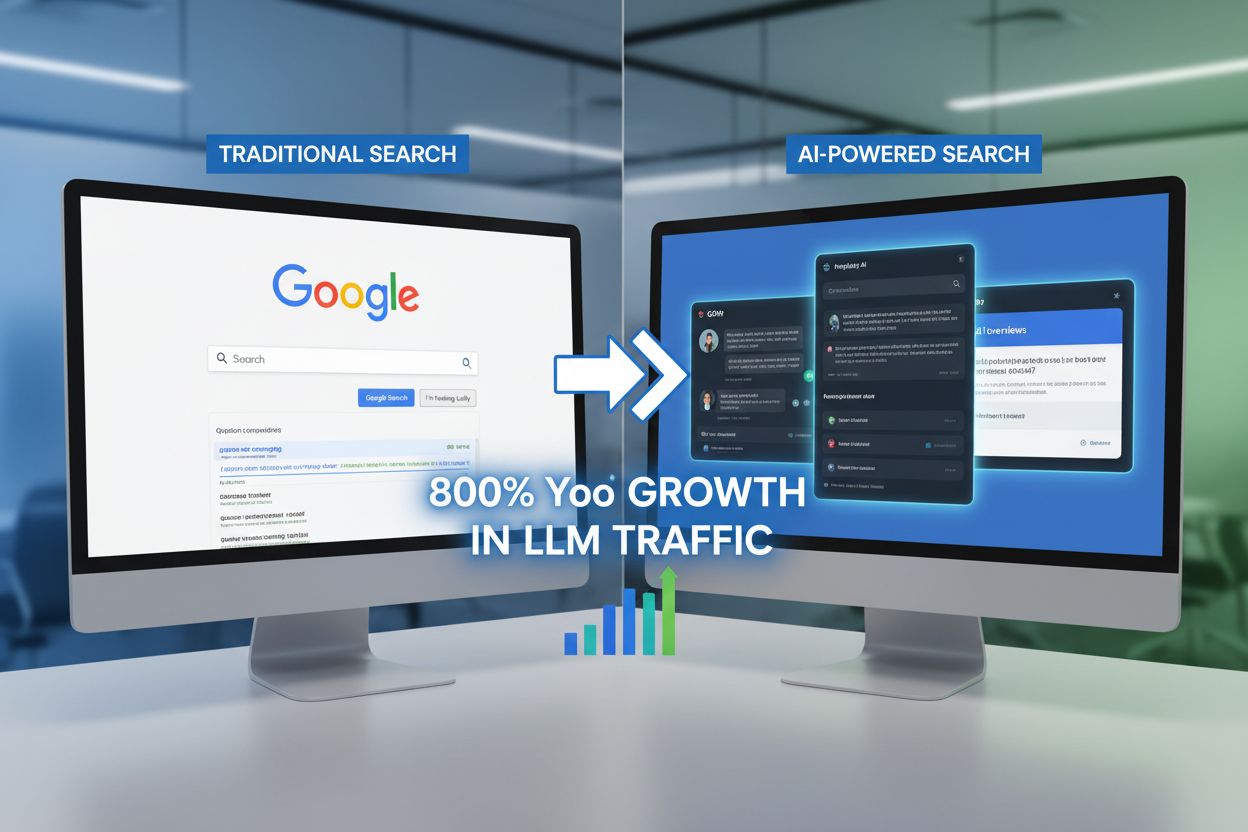
AI visibility isn’t a replacement for SEO—it’s an adjacent discipline that most agencies are best positioned to layer on top of work they already do. Unlike traditional SEO, which focuses on ranking for specific keywords in Google’s organic results, AI visibility tracks whether and how a brand appears when users ask AI chatbots and search engines natural-language questions across ChatGPT, Perplexity, Google AI Overviews, Google’s AI Mode, Gemini, and Microsoft Copilot. For a content or SEO agency, that means the content team you already have can extend its remit rather than being replaced by a new one. The platforms differ in who they reach, which matters when you’re deciding which clients to pitch first:
| AI Platform | User Base | Best For |
|---|---|---|
| ChatGPT | 200M+ monthly users | General brand awareness clients |
| Perplexity | Growing research-focused audience | Research- and comparison-driven categories |
| Google AI Overviews | Billions of Google users | Clients wanting mainstream visibility |
| Gemini | Google ecosystem users | Clients already invested in Google’s stack |
| Microsoft Copilot | Enterprise and consumer users | B2B and productivity-focused clients |
A client selling enterprise software cares far more about Copilot and Perplexity than one selling a consumer product, and leading with the platform mix that matches a prospect’s audience makes the pitch land better than a generic “we now do AI visibility” line.

Track how AI chatbots mention your brand across ChatGPT, Perplexity, and other platforms.
Once you know which platforms matter to a given client, the next decision is how to price the work. Most agencies choose between two models: bundling AI visibility as a paid add-on to an existing SEO or content retainer, or selling it as a standalone monthly service. Bundling is the easier sell to current clients—it reads as a natural extension of work you’re already trusted with, and it protects the retainer from being poached by a competitor offering the newer service. Selling standalone lets you price the service on its own merits and target clients who don’t currently retain you for anything else, which is useful for landing new logos. Either way, your retail price should sit above whatever the underlying monitoring platform costs you, since the client is paying for your strategy and reporting on top of the raw data; for the platform-side cost tiers you’d be marking up, see what’s included at each AI visibility service tier .
Delivering AI visibility well doesn’t usually require a new hire—it requires upskilling people you already have. You need someone comfortable reading a visibility dashboard and translating Visibility Score, Share of Voice, and Sentiment Analysis movement into client language, a content lead who understands Answer Engine Optimization and can write for entity-based, citation-friendly structure, and someone technical enough to run a basic crawler-access check. Many agencies start by handing this to an existing SEO strategist, since the research instincts transfer directly even though the tactics differ: content comprehensiveness, entity relationships, and citation building matter more than keyword density. Digital PR and earned media also carry new weight, since a mention in a reputable publication influences how AI systems characterize a brand, so your PR or content lead should understand that connection even if they never touch the monitoring dashboard directly.

Get the latest insights on AI mentions, brand monitoring, and optimization strategies.
The platform you build your offering on matters more for an agency than for a single brand, because you need to manage many client accounts without the overhead multiplying. Semrush extends its existing SEO infrastructure to AI visibility tracking, which is convenient if your agency already lives in that ecosystem. Profound offers competitive benchmarking that’s useful for demonstrating ROI across a client roster. Peec AI focuses on citation accuracy. OtterlyAI offers an accessible dashboard for teams newer to the category. AmICited.com is built around comprehensive citation tracking and gap identification—surfacing where a client should be mentioned but isn’t—with multi-client dashboards and reseller options that suit an agency workflow rather than a single-brand one.
| Tool | Best For Agencies | Key Strength | White-Label / Reseller |
|---|---|---|---|
| Semrush | Agencies already on Semrush | Integrated SEO + AI visibility | Limited |
| Profound | Client-facing ROI reporting | Multi-platform benchmarking | Available |
| Peec AI | Citation-accuracy-sensitive clients | Detailed citation analysis | Available |
| OtterlyAI | Teams new to AI visibility | User-friendly dashboard | Limited |
| AmICited | Multi-client account management | Citation intelligence & gap detection | Available |
Before committing, confirm whether the platform supports true multi-client dashboards and reseller pricing—many AI visibility tools were built for a single brand’s marketing team first, and agency features were added later.
The most effective pitch isn’t a market-growth statistic—it’s a live demonstration. Query a handful of AI platforms with the questions a client’s prospects would actually ask, and show them exactly how they appear, or don’t, right now. Seeing a direct competitor recommended by ChatGPT while they’re absent from the same answer does more to close a deal than any deck slide. Frame the service as protecting share of voice in a channel that’s growing while traditional organic click-through rates are flattening, and be upfront that this is a newer discipline than SEO—clients respect the honesty, and it sets up realistic expectations for the reporting cadence that follows.
Once a client signs on, a structured onboarding process mirrors traditional SEO onboarding but with AI-specific steps:
Retaining an AI visibility client comes down to whether your reporting connects the work to business outcomes they care about. Track improvements in Visibility Score and Share of Voice over time so clients can see their competitive position strengthening month over month. Add UTM parameters to monitor referral traffic from ChatGPT, Perplexity, and other AI platforms through Google Analytics, so the client sees direct traffic impact rather than an abstract score. Watch Citation Tracking quality, not just quantity—a citation that links back to the client’s site is worth more than a bare mention, and reporting the distinction builds trust in the metric. Set the expectation early that meaningful movement typically takes 2-3 months, since AI systems update training data and response patterns on their own schedules, and build a client-facing dashboard that translates the technical numbers into brand awareness, traffic, and lead generation language. That storytelling is what justifies renewal and, eventually, expanding the service to more of an agency’s roster.
Viktor Zeman is a co-owner of QualityUnit. Even after 20 years of leading the company, he remains primarily a software engineer, specializing in AI, programmatic SEO, and backend development. He has contributed to numerous projects, including LiveAgent, PostAffiliatePro, FlowHunt, UrlsLab, and many others.

AmICited helps marketing agencies track how their clients appear across ChatGPT, Perplexity, Google AI Overviews, and other AI platforms. Multi-client dashboards and competitive benchmarking make it easy to package AI visibility as a premium service line.
Learn how to choose an AI visibility agency, compare GEO providers and evaluate their monitoring capabilities.

Learn how SEO agencies can expand their service offerings by adding AI visibility monitoring and generative engine optimization to stay competitive and increase...
Learn how to conduct a baseline AI visibility audit to understand how ChatGPT, Google AI, and Perplexity mention your brand. Step-by-step assessment guide for b...
Cookie Consent
We use cookies to enhance your browsing experience and analyze our traffic. See our privacy policy.