Key Takeaways
- Advertised prices rarely reflect real cost: once you add per-engine fees, seat licensing, and API overages, expect to pay 2-3x the base price.
- Entry-level tools run $29-99/month, mid-market tools run $150-400/month, and enterprise plans run $1,000-4,500+/month, but tier alone doesn’t tell you what’s included.
- Per-engine fees and seat costs are the two biggest hidden expenses; ask vendors for a quote based on your actual engine count and team size before comparing tools.
- ROI on AI visibility tools typically breaks even after 4-6 months, assuming you have the internal resources to act on the insights.
- Free trials are the best way to validate fit before committing, since pricing pages alone won’t reveal the true cost of ownership.
Bottom line: Budget for the realistic cost, not the advertised one, and pick a tool like AmICited or a comparable platform that publishes transparent, all-in pricing so you’re not renegotiating every quarter.
Introduction
Most AI visibility tool pricing pages lie.
They show you a base price ($99/month, $199/month, “custom enterprise”) but they don’t show you the real cost. They don’t mention that tracking ChatGPT, Perplexity, and Gemini costs extra per engine. They don’t disclose that each additional team member needs a seat license. They don’t warn you that API overages can double your bill.
By the time you’ve negotiated with sales, added the engines your competitors use, and provisioned your team, you’re paying 2–3x the advertised price.
This is the definitive guide to what AI search visibility tools actually cost in 2026, with no hidden surprises.
The shift from traditional SEO to Generative Engine Optimization (GEO) is reshaping how brands get discovered. AI search now accounts for 30% of total search volume, with Perplexity surpassing 100 million monthly visits and Google AI Overviews appearing in roughly 47% of searches. When ChatGPT, Perplexity, or Gemini answers a user’s question, your brand either gets cited or it doesn’t. If it doesn’t, you’re invisible to that potential customer, no matter how high you rank on Google.
To compete in this new landscape, you need visibility into where your brand appears in AI-generated answers. That’s where AI visibility tools come in. But choosing the right tool isn’t just about features: it’s about understanding the true cost of ownership, including the hidden fees that most vendors bury in their fine print.
By the end of this guide, you’ll understand:
- The real pricing of 15+ leading AI visibility tools (not the advertised base price)
- Hidden costs that double your monthly spend (per-engine fees, seat licensing, API overages)
- Cost-benefit analysis by company size (startup, mid-market, enterprise)
- ROI frameworks to justify the investment to leadership
- How to choose the right tool for your budget without overpaying
Let’s start with why pricing matters so much in this category.
Ready to Monitor Your AI Visibility?
Track how AI chatbots mention your brand across ChatGPT, Perplexity, and other platforms.
The Shift from SEO to GEO
For decades, marketing success meant one thing: Google rankings. If you ranked in the top 3 for your target keywords, customers would find you.
That’s no longer true.
In 2026, your customers are asking questions directly to ChatGPT, Perplexity, and Claude. They’re not clicking through to Google and then to your website. The AI model is the destination. The citation is the conversion.
This shift is quantifiable. According to Conductor’s analysis of 21.9 million Google queries in Q1 2026, 25.11% of them triggered an AI Overview. Semrush reports that global traffic to AI search engines grew 527% year over year. Otterly’s 2026 AI Citations Report found that brand-owned domains account for only 52.5% of all citations, meaning 47.5% of citation value is being captured by media outlets, reference sites, and competitor content.
The implication is stark: ranking on Google no longer guarantees being cited by ChatGPT or Perplexity. These systems re-rank sources based on freshness, structure, extractability, and authority. A competitor’s 6-month-old blog post might get cited instead of your authoritative guide because it’s better formatted for AI consumption.
This is why AI visibility tools have become essential. They answer the questions your leadership is already asking:
- Is my brand being mentioned in AI-generated responses? Most brands don’t know.
- How do I compare to competitors? If you can’t measure it, you can’t improve it.
- Which content and messaging drive AI citations? Generic SEO optimization won’t work anymore.
- What’s my playbook for improvement? Data without direction is just noise.
AI visibility tools are fundamentally different from traditional SEO platforms, and their pricing reflects that complexity.
A traditional SEO tool like Ahrefs or Semrush charges a flat monthly fee for unlimited keyword tracking, backlink analysis, and rank monitoring. The cost is predictable and doesn’t change based on how many keywords you track or how many competitors you monitor.
AI visibility tools, by contrast, charge based on:
- Which AI engines you monitor (ChatGPT, Perplexity, Gemini, Claude, Google AI Overviews, each may cost extra)
- How many prompts/keywords you track (some tools charge per prompt; others per brand/keyword combination)
- How many team members need access (seat-based licensing)
- How frequently data is refreshed (daily vs. weekly vs. monthly)
- Which additional features you use (competitor benchmarking, historical tracking, API access, white-label reporting)
This complexity means that the advertised “starting price” is almost never the real price you’ll pay. A tool advertised at $99/month might actually cost $250–$400/month once you factor in per-engine fees, seat licensing, and add-ons.
The Hidden Cost Problem in the Industry
Most AI visibility tool vendors are deliberately vague about pricing. Here’s why:
- Rapid market evolution: The category is only 18–24 months old. Pricing models are still being figured out.
- Highly variable use cases: A startup tracking 50 keywords across 3 engines has very different needs (and budget) than an enterprise tracking 10,000 keywords across 6 engines.
- Sales-driven pricing: Many vendors don’t publish pricing because they want to negotiate with each customer individually, extracting maximum value from well-funded enterprises while offering discounts to price-sensitive startups.
The result is confusion. Teams spend weeks evaluating tools, only to discover during the sales call that the real cost is 2–3x higher than advertised.
This guide cuts through that confusion by mapping out the true cost of every major platform: base price, per-engine fees, seat costs, and realistic total cost of ownership.
Before we compare specific tools, you need to understand how AI visibility tool pricing actually works. Most vendors use a combination of these pricing levers:
Base Subscription Pricing (Entry, Mid, Enterprise Tiers)
Most AI visibility tools offer tiered pricing, similar to traditional SaaS:
- Starter/Lite tier: $29–$99/month: Tracks 1–3 AI engines, limited prompts/keywords, basic reporting
- Professional/Standard tier: $99–$299/month: Tracks 4–8 engines, 100–500 prompts, advanced analytics, competitor benchmarking
- Enterprise tier: $300–$3,000+/month: Unlimited engines, unlimited prompts, API access, white-label reporting, dedicated support
The base price is what vendors advertise. It’s also the least important number, because it rarely includes everything you need.
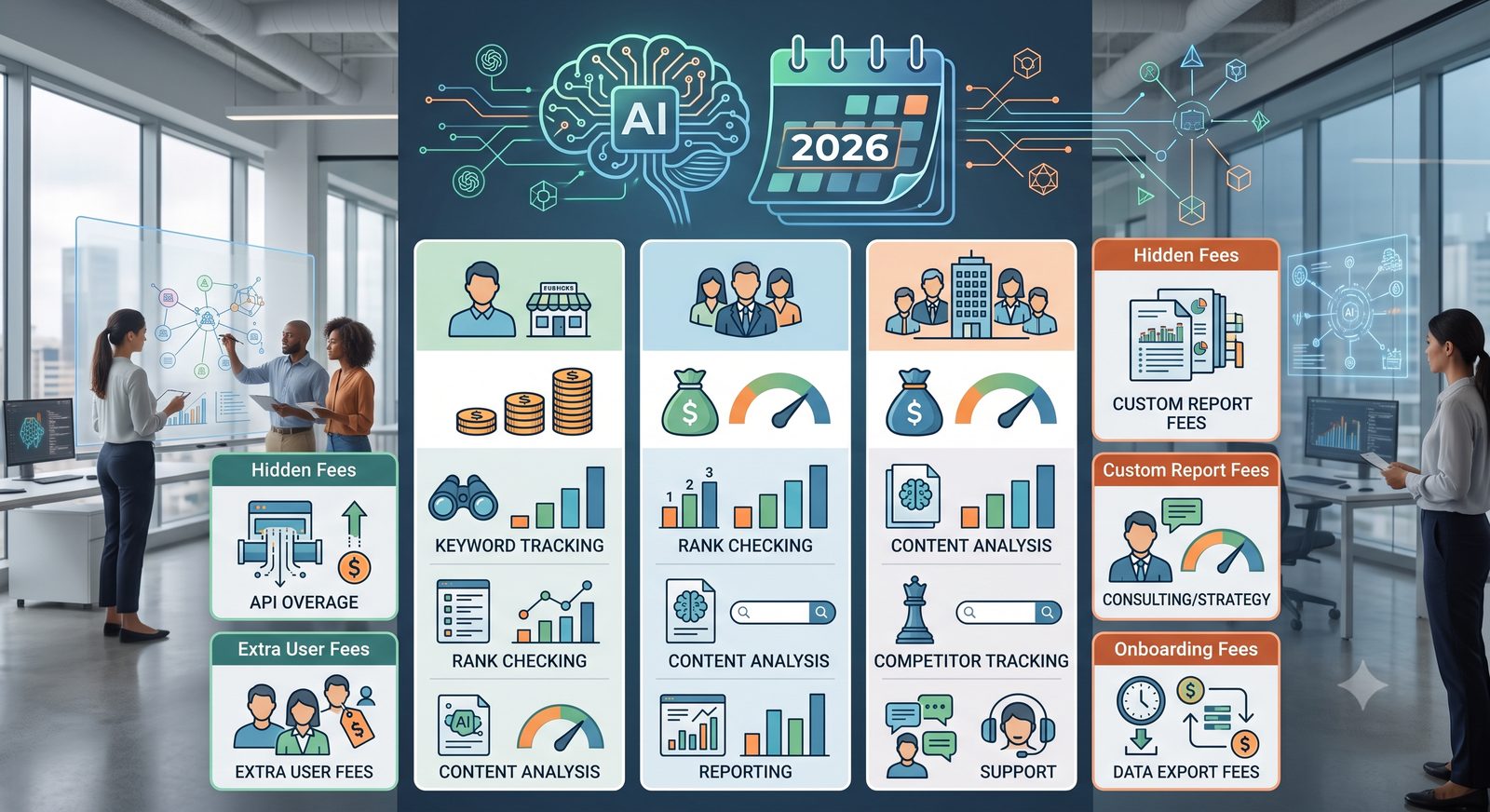
Hidden Costs: Per-Engine Fees
Here’s where pricing gets complicated.
Most AI visibility tools don’t charge for tracking one engine (usually ChatGPT). But tracking additional engines (Perplexity, Gemini, Claude, Google AI Overviews) often costs extra.
Example from Wrodium’s research:
“Base plans only include 3 AI engines. Each additional engine costs €20–30/month, so the advertised price is rarely the actual price.”
This means:
- Base price: $99/month for 3 engines (ChatGPT, Perplexity, Google AI Overviews)
- Add Gemini: +$25/month
- Add Claude: +$25/month
- Real monthly cost: $99 + $25 + $25 = $149/month (50% more than advertised)
If you’re tracking 6–8 engines (which enterprise teams often do), per-engine fees can add $100–$200/month to your bill.
Hidden Costs: Seat/User Licensing
Most AI visibility tools are team tools. Your marketing team needs access to dashboards, reports, and alerts. But how many team members can access the platform?
Some tools include unlimited seats at all price tiers. Others charge per seat:
- Included seats: 1–5 depending on tier
- Additional seat cost: $20–$50/month per user
- Enterprise: Often unlimited seats at the highest tier
Example:
- Base price: $99/month (includes 1 seat)
- Add 4 team members: 4 × $30/month = $120/month
- Real monthly cost: $99 + $120 = $219/month (2.2x advertised price)
For a mid-market team of 8–10 people who all need access, seat costs can exceed the base subscription price.
Hidden Costs: API and Data Export Limits
If you want to integrate AI visibility data into your own dashboards, CRM, or reporting system, you’ll need API access. Some tools include basic API access in their plans. Others charge separately:
- API calls per month: 10,000–100,000 depending on tier
- Overage costs: $0.01–$0.10 per API call beyond the limit
- Data export limits: Some tools limit how much historical data you can export
For teams running automated workflows or exporting data daily, API overages can add $50–$200/month.
Hidden Costs: Implementation and Onboarding
This is often overlooked but can be significant, especially for enterprise deals.
- Setup and configuration: $0–$5,000 (some vendors charge; others include it)
- Data migration from previous tool: $0–$10,000
- Training and documentation: $0–$5,000
- Dedicated onboarding support: Included in enterprise plans; not available in lower tiers
For a startup, these costs might be zero. For an enterprise switching from another platform, they can add $10,000–$20,000 to the first-year cost.
Complete Pricing Matrix: Real Cost of Ownership
Here’s a table showing the true cost of 15 major AI visibility tools, accounting for base price, per-engine fees, seat costs, and typical add-ons:
| Tool | Base Price | AI Engines Included | Per-Engine Fee | Seats Included | Cost per Extra Seat | Realistic Monthly Cost (5 seats, 6 engines) |
|---|
| Otterly AI | $29/mo | 3 | $0 | 1 | $10/mo | $29 |
| Indexly | $99/mo | 5+ | $0 | 1 | $15/mo | $109 |
| Peec AI | €85/mo | 8 | €0 | 1 | €20/mo | €169 |
| Nightwatch | €79/mo | 4 | €0 | 1 | $15/mo | $179 |
| Profound | $99/mo | 10 | $0 | 1 | $25/mo | $199 |
| KIME | €149/mo | 10 | €0 | 3 | €20/mo | €249 |
| Semrush AI Toolkit | $99/mo (add-on) | Multiple | $0 | 1 | $45/mo | $179 |
| Surfer SEO | €99/mo | 3 | $25/mo | 1 | $15/mo | $274 |
| Frase | $49/mo | Multiple | $0 | 1 | $30/mo | $229 |
| Writesonic | $99/mo | Multiple | $0 | 1 | $50/mo | $199 |
| SE Ranking | €109/mo | 3 | $15/mo | 1 | $16/mo | $155 |
| Ahrefs | $129/mo | Limited | $0 | 1 | $40/mo | $259 |
| Slate | $99/mo | Multiple | $0 | 1 | $30/mo | $199 |
| Omnia | €79/mo | Multiple | $0 | 1 | $25/mo | $199 |
| seoClarity ArcAI | Custom | Multiple | Included | Unlimited | Included | $2,500–$4,500+/mo |
Key insight: The realistic cost is typically 2–3x the base price once you account for per-engine fees, seat licensing, and add-ons.
Stay Updated on AI Visibility Trends
Get the latest insights on AI mentions, brand monitoring, and optimization strategies.
Now let’s break down the tools by price tier and help you understand what you’re actually getting at each level.
Budget Tier ($29–$99/month): Best for Startups and Small Teams
These tools are designed for lean teams with limited budgets. They track 3–5 AI engines and include 1–2 seats.
Otterly AI: $29/month (Lite tier)
- What’s included: Tracks ChatGPT, Perplexity, Google AI Overviews; 25 prompts; basic reporting
- Best for: Solopreneurs, small agencies, early-stage startups
- Realistic cost at scale: $29–$99/month (very few add-ons)
- Pros: Cheapest option; free trial available; simple interface
- Cons: Limited to 3 engines; minimal analytics; no competitor benchmarking; no API access in base tier
Indexly: $99/month
- What’s included: Tracks 5+ AI engines; unlimited keywords; basic competitor benchmarking
- Best for: Small businesses and agencies wanting multi-engine coverage
- Realistic cost at scale: $99–$199/month (with seats and add-ons)
- Pros: Affordable; multi-engine coverage; includes lead tracking
- Cons: Fewer features than mid-market tools; limited historical data
Peec AI: €85/month (Starter tier)
- What’s included: Tracks 8 AI engines; 25 prompts; basic analytics
- Best for: European teams; e-commerce brands; startups
- Realistic cost at scale: €169–€299/month (with seats and add-ons)
- Pros: Good engine coverage; free trial; simple setup
- Cons: Per-seat costs add up quickly; limited API access
Mid-Market Tier ($99–$299/month): Best for Growing Teams and Agencies
These tools are designed for teams of 5–20 people who need deeper analytics, competitor benchmarking, and multi-engine tracking.
Profound: $99/month
- What’s included: Tracks 10 AI engines; unlimited prompts; daily monitoring; competitor benchmarking; historical tracking
- Best for: Mid-market companies; agencies; teams needing enterprise-grade data
- Realistic cost at scale: $199–$399/month (with seats and API access)
- Pros: Highest engine coverage; raw data and APIs; near-real-time monitoring; trusted by analysts
- Cons: No built-in recommendations; requires analyst interpretation; steep learning curve
KIME: €149/month
- What’s included: Tracks 10 AI engines (3 in core package; 10 with Enterprise); multi-brand, multi-country support; Action Centre for optimization; 3 seats
- Best for: Multi-brand companies; international teams; end-to-end GEO optimization
- Realistic cost at scale: €249–€499/month (with additional seats and advanced features)
- Pros: Best multi-brand support; integrated optimization workflow; strong GEO education
- Cons: Higher base price; European-focused (though global coverage available)
Semrush AI Toolkit: $99/month (add-on to Semrush)
- What’s included: Tracks multiple AI engines; integrated with Semrush SEO tools; competitor analysis; content optimization recommendations
- Best for: Teams already using Semrush; companies needing SEO + AI visibility in one platform
- Realistic cost at scale: $179–$299/month (base Semrush plan + AI add-on + seats)
- Pros: Integrated with SEO data; built-in content optimization; familiar interface for Semrush users
- Cons: AI features feel bolted-on; requires Semrush subscription; expensive if you only need AI visibility
Nightwatch: €79/month (base) + $20–$50/month (AI add-on)
- What’s included: SEO rank tracking + AI visibility add-on; tracks 4 AI engines; 14-day free trial
- Best for: Teams wanting SEO + AI visibility without paying for a full suite
- Realistic cost at scale: $179–$299/month (with seats and add-ons)
- Pros: Affordable base; flexible add-ons; good for hybrid SEO/GEO teams
- Cons: AI features are less mature than dedicated tools; limited engine coverage
Frase: $49/month
- What’s included: Tracks multiple AI engines; daily monitoring; content optimization; publishing integration
- Best for: Content teams; companies wanting to monitor AND fix citation gaps in one workflow
- Realistic cost at scale: $229–$399/month (with seats and advanced features)
- Pros: Best-in-class content optimization; publishing integration; actionable recommendations
- Cons: Higher cost than pure monitoring tools; less suitable for analysis-only teams
Writesonic: $99/month
- What’s included: Tracks multiple AI engines; AI content generation; SEO optimization; brand monitoring
- Best for: Content-first teams; companies wanting to generate content optimized for AI
- Realistic cost at scale: $199–$349/month (with seats and add-ons)
- Pros: Integrated content generation; good for content creation workflows
- Cons: Less focused on pure citation tracking; more of a content platform than a monitoring tool
Enterprise Tier ($300–$3,000+/month): Best for Large Organizations
These tools are designed for companies with 50+ person marketing teams, multiple brands, or complex data needs.
Semrush One: $139–$549/month
- What’s included: All Semrush tools (SEO, PPC, content, social, brand monitoring) + AI visibility; unlimited seats; dedicated support
- Best for: Large enterprises standardized on Semrush; companies needing unified marketing platform
- Realistic cost at scale: $500–$2,000/month (depending on usage and customization)
- Pros: Comprehensive platform; unified reporting; unlimited seats
- Cons: Very expensive if you only need AI visibility; requires commitment to Semrush ecosystem
seoClarity ArcAI: Custom pricing (typically $2,500–$4,500+/month)
- What’s included: Enterprise-grade AI visibility; unlimited engines, keywords, and users; custom integrations; dedicated success team
- Best for: Fortune 500 companies; companies with complex data needs; teams requiring custom integrations
- Realistic cost at scale: $2,500–$4,500+/month (depending on data volume and customization)
- Pros: Most powerful platform; unlimited everything; white-label options; custom workflows
- Cons: Extremely expensive; requires long-term contracts; overkill for most companies
Hidden Costs You Need to Know About
Beyond the pricing tiers we’ve covered, there are several hidden costs that can surprise you during implementation or after your first few months of use.
Per-Engine Fees: The Biggest Hidden Cost
As mentioned earlier, most AI visibility tools charge extra for tracking engines beyond the base 2–3.
Typical per-engine costs:
- First 3 engines (usually ChatGPT, Perplexity, Google AI Overviews): Included
- 4th engine (Gemini, Claude, etc.): $20–$30/month
- 5th+ engines: $20–$30/month each
Real-world impact:
- Tracking 3 engines: $99/month (base)
- Tracking 6 engines: $99 + (3 × $25) = $174/month
- Tracking 8 engines: $99 + (5 × $25) = $224/month
For enterprise teams monitoring all major AI engines, per-engine fees can add $100–$150/month to your bill.
Seat/User Licensing: The Second Biggest Hidden Cost
Most AI visibility tools are team tools, but they charge for each additional user.
Typical seat costs:
- Starter tier: 1 seat included; $15–$25/month per additional seat
- Professional tier: 2–3 seats included; $20–$30/month per additional seat
- Enterprise tier: Unlimited seats
Real-world impact for a 10-person marketing team:
- Tool with 1 included seat: 9 additional seats × $25 = $225/month
- Tool with 3 included seats: 7 additional seats × $25 = $175/month
- Tool with unlimited seats: $0 additional cost
For mid-market teams, seat costs often exceed the base subscription price. This is why many teams restrict access to a core group of analysts and share reports manually with the rest of the team.
API and Data Export Limits
If you want to integrate AI visibility data into your own dashboards, CRM, or data warehouse, you’ll need API access.
Typical API pricing:
- Included API calls: 10,000–50,000/month depending on tier
- Overage costs: $0.01–$0.10 per API call
- Data export limits: Some tools limit how much historical data you can export (e.g., 90 days vs. unlimited)
Real-world impact:
- If you’re running daily exports for 100 keywords across 5 engines, that’s roughly 36,500 API calls/month
- At $0.05 per overage call, overages could cost $1,500–$3,000/month
Most teams don’t hit API overages, but automated workflows and custom integrations can push you over the limit quickly.
Integration and Migration Costs
If you’re switching from another AI visibility tool or integrating with your existing martech stack, there are setup costs:
- Setup and configuration: $500–$5,000 (some vendors charge; others include it)
- Data migration: $1,000–$10,000 (migrating historical data from a previous tool)
- Custom integrations: $2,000–$20,000 (building custom connectors to your CRM, BI tool, or internal systems)
- Training: $1,000–$5,000 (training your team on the new tool)
For startups, these costs might be zero (you’re not migrating from anything). For enterprises switching platforms, they can add $10,000–$30,000 to the first-year cost.
Training and Onboarding Fees
Some vendors include training and onboarding in their enterprise plans. Others charge separately.
- Group training: $0–$2,000
- Dedicated onboarding support: $0–$5,000
- Custom documentation: $0–$3,000
Most mid-market and enterprise plans include some level of training. Starter and Professional tiers typically don’t.
Real-World Pricing Scenarios by Company Size
To help you estimate your actual costs, here are three realistic scenarios based on company size, team structure, and typical use cases.
Scenario 1: Startup (1–5 person team, $0–$500/month budget)
Use case:
- One founder + one marketing person
- Tracking 50 target keywords/prompts
- Monitoring 3 AI engines (ChatGPT, Perplexity, Google AI Overviews)
- Need basic analytics and alerts; don’t need competitor benchmarking
Recommended tools:
Otterly AI Lite: $29/month
- What you get: Tracks 3 engines, 25 prompts, basic alerts
- Cost: $29/month
- Pros: Cheapest option; free trial
- Cons: Limited to 25 prompts (you’d need to upgrade to Standard at $189/mo for 100 prompts)
Indexly: $99/month
- What you get: Tracks 5+ engines, unlimited keywords, basic competitor benchmarking
- Cost: $99/month (add $15/month for second seat if needed)
- Pros: Better engine coverage; more features; affordable
- Cons: Fewer features than mid-market tools
Realistic total monthly cost: $29–$65/month
Action items:
- Start with Otterly AI Lite ($29/month) if you only need basic tracking
- Upgrade to Indexly ($99/month) if you need more engines and features
- Use free trials to test both before committing
Scenario 2: Mid-Market (20–50 person marketing team, $500–$2,000/month budget)
Use case:
- Marketing manager + 3 analysts + 2 content creators
- Tracking 500+ keywords/prompts across multiple brands
- Monitoring 6 AI engines (ChatGPT, Perplexity, Gemini, Claude, Google AI Overviews, Copilot)
- Need advanced analytics, competitor benchmarking, historical tracking, and actionable recommendations
- Want to integrate data into internal dashboards
Recommended tools:
Profound: $99/month base
- Per-engine fees: $0 (includes 10 engines)
- Seats (5 people): $99 + (4 × $25) = $199/month
- API access: Included in base plan
- Total: $199/month
- Pros: Highest engine coverage; raw data and APIs; trusted by analysts
- Cons: Requires analyst interpretation; no built-in recommendations
KIME: €149/month base
- Per-engine fees: €0 (includes 10 engines)
- Seats (5 people): €149 (includes 3 seats) + (2 × €20) = €189/month
- API access: Included
- Total: €189/month (approximately $207/month USD)
- Pros: Best multi-brand support; integrated optimization workflow; strong GEO education
- Cons: Higher base price; European-focused
Frase: $49/month base
- Per-engine fees: $0 (includes multiple engines)
- Seats (5 people): $49 + (4 × $30) = $169/month
- Content optimization: Included
- Total: $169/month
- Pros: Best-in-class content optimization; publishing integration; actionable recommendations
- Cons: Higher cost than pure monitoring tools
Realistic total monthly cost: $199–$250/month
Action items:
- Choose Profound if you need raw data and deep analytics
- Choose KIME if you manage multiple brands or countries
- Choose Frase if you want to monitor AND optimize content in one platform
- Request demos from all three; negotiate on seat costs
Scenario 3: Enterprise (100+ person organization, $2,000+/month budget)
Use case:
- Dedicated AI visibility team (5+ analysts)
- Multiple brands (3–5)
- Tracking 2,000+ keywords/prompts
- Monitoring 8+ AI engines
- Need enterprise-grade support, custom integrations, API access, and white-label reporting
- Want to integrate with existing martech stack (CRM, BI tool, data warehouse)
Recommended tools:
Profound: $99/month base + custom enterprise pricing
- Per-engine fees: $0 (includes 10 engines)
- Seats (10+ people): Custom enterprise pricing (typically $500–$1,000/month)
- API access: Unlimited
- Custom integrations: $5,000–$20,000 (one-time)
- Dedicated support: Included
- Total first year: $6,000–$24,000 (plus $500–$1,000/month ongoing)
- Pros: Highest engine coverage; raw data and APIs; trusted by Fortune 500 companies
- Cons: Expensive; requires analyst interpretation
seoClarity ArcAI: Custom enterprise pricing
- Base pricing: $1,800–$3,600/month (depending on data volume)
- Seats: Unlimited
- Engines: Unlimited
- API access: Unlimited
- Custom integrations: Included
- Dedicated success team: Included
- White-label reporting: Included
- Total: $2,500–$4,500+/month
- Pros: Most powerful platform; unlimited everything; white-label options; custom workflows
- Cons: Extremely expensive; requires long-term contracts
Semrush One: $139–$549/month
- Base pricing: $139–$549/month depending on tier
- Seats: Unlimited
- AI visibility: Included
- Custom integrations: Available (additional cost)
- Dedicated support: Included
- Total: $139–$549/month
- Pros: Comprehensive platform; unified reporting; unlimited seats
- Cons: Very expensive if you only need AI visibility
Realistic total monthly cost: $1,000–$3,000/month
Action items:
- Request custom enterprise quotes from Profound and seoClarity
- Evaluate Semrush One if you want a unified marketing platform
- Negotiate on multi-year contracts; enterprise vendors typically offer 10–20% discounts for annual or multi-year commitments
- Plan for $5,000–$20,000 in implementation and integration costs in year one
ROI & Cost-Benefit Analysis: Is It Worth It?
This is the question every CFO and marketing leader asks: If we invest $200–$3,000/month in AI visibility tools, what’s the return?
The honest answer is: it’s complicated. Traditional ROI frameworks don’t work for GEO because the value is indirect and long-term.
Unlike paid advertising (where you can track cost per click and cost per conversion), AI visibility ROI is harder to quantify because:
AI citations don’t directly drive clicks: A citation in ChatGPT might drive a user to your website, or it might just increase brand awareness. You can’t always track which came from where.
The value is preventative: You’re not just gaining new citations; you’re also preventing competitors from stealing your share of voice.
The timeline is long: Improving your AI visibility typically takes 2–6 months, not 2–6 weeks.
However, you can estimate ROI using this framework:
Step 1: Calculate your current share of voice (SOV) in AI
- Use an AI visibility tool to track how often your brand is cited vs. competitors in AI-generated answers
- Typical SOV ranges from 5–30% depending on industry and brand maturity
- Example: If you’re cited 2 times out of 10 total citations for your target keywords, your SOV is 20%
Step 2: Estimate the value of each citation
- Industry benchmark: One AI citation is worth roughly $10–$50 in equivalent ad spend (depending on industry)
- Conservative estimate: $15 per citation
- Example: If you’re cited 100 times/month, that’s 100 × $15 = $1,500/month in equivalent value
Step 3: Calculate the cost of the tool
- Use the realistic monthly costs from earlier sections
- Example: $250/month for a mid-market tool
Step 4: Estimate the improvement you can achieve
- Industry benchmark: Companies that optimize for GEO typically improve SOV by 20–40% in 6 months
- Conservative estimate: 15% improvement
- Example: Improving from 20% to 35% SOV means 75 additional citations/month (assuming 500 total citations in your category)
Step 5: Calculate the ROI
- Additional value from improvement: 75 citations × $15 = $1,125/month
- Cost of tool: $250/month
- Net benefit: $1,125 - $250 = $875/month
- ROI: ($875 / $250) × 100 = 350% ROI
Key assumptions:
- Your industry has sufficient AI search volume (at least 100+ citations/month in your category)
- You have the internal resources to act on the insights (content optimization, publishing, etc.)
- You can maintain or improve your SOV over time
Typical ROI Timelines and Benchmarks
Based on case studies and industry data, here’s what typical ROI looks like:
Months 1–3 (Setup and baseline)
- ROI: Negative (you’re paying for the tool but haven’t optimized yet)
- Cost: $500–$750
- Value: $0 (you’re just establishing baseline metrics)
Months 4–6 (First optimizations)
- ROI: Breakeven to positive (you’re starting to see results from content optimization)
- Cost: $500–$750/month
- Value: $500–$1,000/month (improved citations)
- Net: -$250 to +$250/month
Months 7–12 (Compounding results)
- ROI: Positive (you’ve optimized content, built relationships with AI-friendly sources, improved SOV)
- Cost: $500–$750/month
- Value: $1,500–$3,000/month (significantly improved citations)
- Net: +$750–$2,250/month
Year 2+ (Sustained optimization)
- ROI: Highly positive (you’re maintaining and improving SOV with less effort)
- Cost: $500–$750/month
- Value: $2,000–$4,000/month
- Net: +$1,250–$3,250/month
Key insight: The ROI breakeven point is typically 4–6 months, assuming you have the internal resources to act on the insights.
Cost per Citation vs. Cost per Click
Another way to think about ROI is to compare the cost per citation you gain to the cost per click you’d pay for equivalent visibility through paid advertising.
Example calculation:
- AI visibility tool cost: $250/month
- Additional citations gained: 50/month (from optimization)
- Cost per citation: $250 / 50 = $5/citation
Equivalent paid advertising cost:
- Average cost per click: $2–$10 (depending on industry)
- Conversion rate from click to lead: 2–5%
- Cost per lead from paid ads: $200–$500
Comparison:
- AI citation: $5 cost + unknown conversion rate (brand awareness + potential click)
- Paid ad click: $2–$10 cost + 2–5% conversion rate = $200–$500 cost per lead
AI citations are more cost-effective for brand awareness and consideration, but less predictable for direct conversion than paid advertising. The best approach is to use AI visibility tools as part of a broader GEO strategy that includes content optimization, earned media, and brand building.
Not every company should invest in AI visibility tools. Consider skipping them if:
Your industry has low AI search volume: If fewer than 50 citations/month exist in your category, the opportunity is too small to justify the investment.
You don’t have resources to act on insights: Tools are only valuable if you can optimize your content, refresh pages, and build relationships with AI-friendly sources. If you don’t have a content team, skip the tool.
Your brand is tiny and unknown: If you have fewer than 5 citations/month, improving SOV won’t meaningfully impact your business. Focus on traditional SEO and content marketing first.
Your business model doesn’t depend on discovery: If customers find you through direct relationships, sales teams, or word-of-mouth, AI visibility is less critical.
You’re not ready to compete in AI search: If your website isn’t optimized for AI consumption (poor structure, thin content, outdated information), investing in a tool won’t help. Fix your content first.
Better use of budget for these scenarios:
- Hire a content strategist to optimize your website for AI
- Invest in traditional SEO tools (Ahrefs, Semrush) to improve overall visibility
- Focus on earned media and PR to get cited in authoritative sources
- Build relationships with journalists and industry publications
Now that you understand pricing, hidden costs, and ROI, here’s how to choose the right AI visibility tool for your specific situation.
Evaluation Checklist
Before you even look at pricing, evaluate each tool on these criteria:
Coverage & Engines
Tracking & Monitoring
Analytics & Reporting
Actionability & Integration
Ease of Use
Team & Support
Free Trials and Freemium Options
Most AI visibility tools offer free trials. Use them to test the tool before committing:
Tools with free trials:
- Otterly AI (14-day free trial)
- Peec AI (free trial available)
- Nightwatch (14-day free trial)
- Indexly (free trial available)
- Semrush (7-day free trial for Semrush One)
Tools with freemium tiers:
- Otterly AI Lite ($29/month, very limited)
- Some tools offer free tier with limited features (check each tool’s website)
Tips for using free trials:
- Set up tracking for 3–5 of your target keywords
- Compare your brand’s citations vs. 2–3 competitors
- Check the quality of insights and recommendations
- Test the export/reporting features
- Evaluate the user interface and ease of use
- Contact support with a question to assess response time and helpfulness
Don’t just look at features; test the tool with your actual data and use case.
Negotiating Enterprise Pricing
If you’re evaluating enterprise tools (seoClarity, Profound, Semrush One), pricing is negotiable. Here’s how to get the best deal:
Timing:
- Vendors have quarterly sales targets. Negotiate at the end of a quarter (March, June, September, December) when they’re motivated to close deals.
Leverage:
- Get quotes from 2–3 competing tools
- Mention you’re evaluating alternatives
- Offer to commit to a multi-year contract in exchange for a discount
Negotiation points:
- Discount for annual commitment: 10–20% off monthly pricing if you commit to 12 months
- Discount for multi-year commitment: 15–30% off if you commit to 2–3 years
- Discount for higher usage: If you’re tracking 1,000+ keywords, ask for a volume discount
- Included services: Try to get training, onboarding, and custom integrations included rather than charged separately
Example negotiation:
- Vendor quote: $1,000/month for enterprise plan
- Your counter: “We’re also evaluating Profound at $600/month. Can you match that or offer a discount for annual commitment?”
- Vendor response: “We can offer $800/month for annual commitment, or $700/month for 2-year commitment.”
- Your decision: Accept the 2-year deal at $700/month = $16,800/year (vs. $12,000/year for Profound, but with better features)
Enterprise vendors expect negotiation. Don’t accept the first price they quote.
Building vs. Buying: When to Use APIs Instead
If you have technical resources, you might consider building your own AI visibility monitoring instead of buying a tool. Here’s when that makes sense:
Build your own if:
- You have a dedicated engineer who can maintain the system (20–40 hours/month)
- Your use case is highly specific (tracking only a few engines, a few keywords)
- You want to integrate deeply with your existing systems
- You have 2+ years of time to build and iterate
Buy a tool if:
- You need results in weeks, not months
- You want regular updates as AI engines change
- You need support and training
- You don’t have engineering resources to maintain the system
Hybrid approach:
- Use an API-first tool (like Profound) that gives you direct API access
- Build custom dashboards and workflows on top of the API
- This gives you flexibility + support
Rough cost comparison:
- Buy a tool: $200–$1,000/month
- Build your own: $10,000–$50,000 one-time + $5,000–$10,000/month maintenance
Building is only cheaper if you’re doing it at scale and have committed engineering resources.
Conclusion
The bottom line: AI visibility tools range from $29/month for basic startups to $3,000+/month for enterprise organizations. But the advertised price is rarely the real price. Once you account for per-engine fees, seat licensing, API overages, and implementation costs, expect to pay 2–3x the base price.
Here’s a quick recap of what to expect by company size:
- Startups (1–5 people): $29–$65/month for basic monitoring
- Mid-market (20–50 people): $200–$400/month for advanced analytics and competitor benchmarking
- Enterprise (100+ people): $1,000–$3,000+/month for unlimited everything plus support
Key takeaways:
Don’t fall for advertised pricing. Calculate the true cost of ownership, including per-engine fees, seat costs, and add-ons.
ROI breakeven is typically 4–6 months. If you have the internal resources to act on insights (content optimization, publishing), the tool pays for itself within half a year.
Start with a free trial. Most tools offer 14-day free trials. Use them to test with your actual data before committing.
Negotiate enterprise pricing. If you’re buying an enterprise plan, pricing is always negotiable. Get quotes from competitors and use that leverage.
Choose based on your use case, not just price. The cheapest tool isn’t always the best value. Evaluate coverage (how many engines?), actionability (can you act on insights?), and ease of use.
Don’t invest if you can’t act. An AI visibility tool is only valuable if you have the internal resources to optimize your content and improve your citations. If you don’t, focus on traditional SEO first.
The AI visibility tool market is still evolving. New tools are launching, pricing is changing, and features are improving. Use this guide as a starting point, but always request current demos and pricing from vendors before making a final decision.