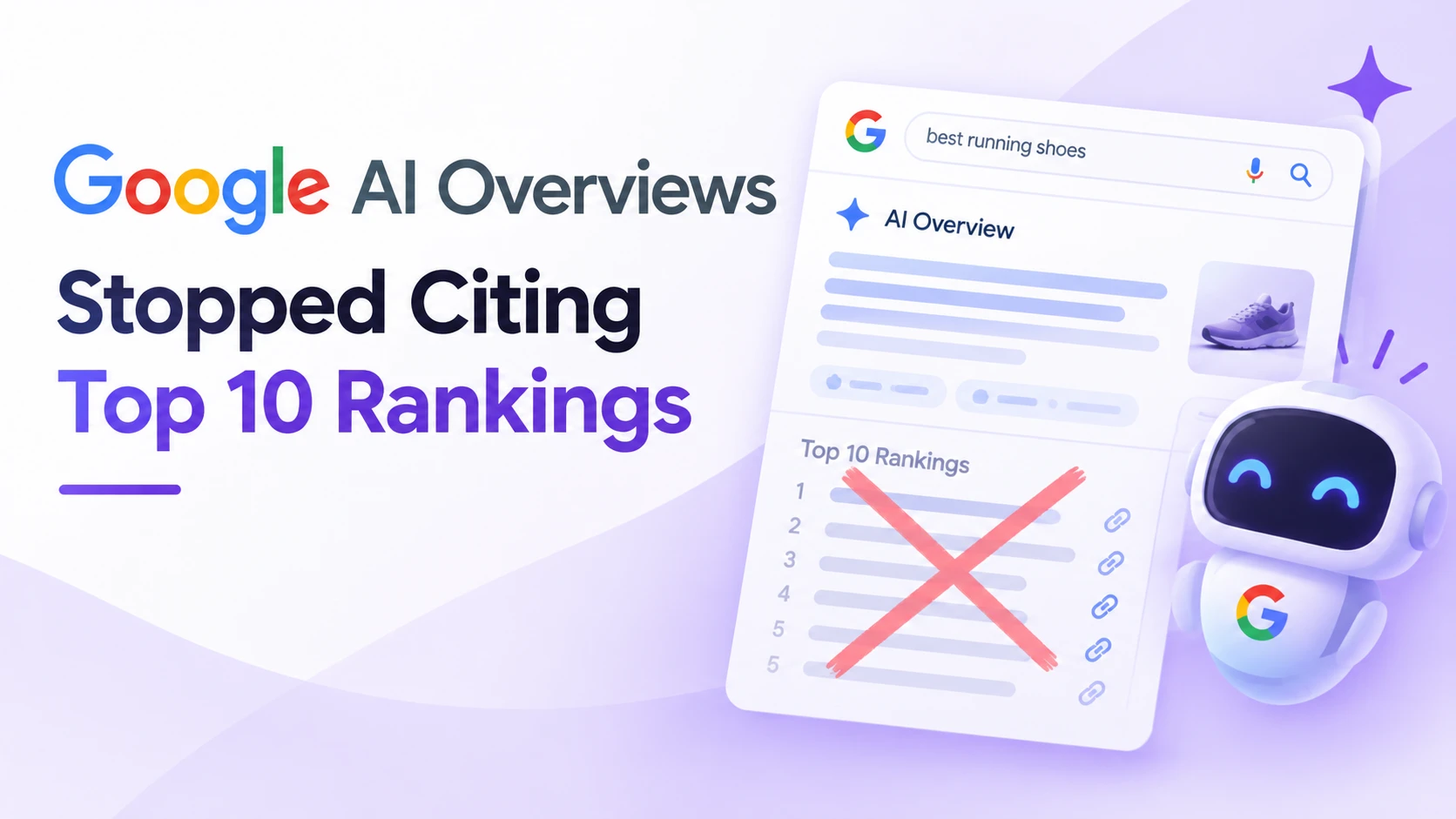
A page ranking first on Google used to be the closest thing SEO had to a guarantee: if you held position one, you got the click, and if an AI summary quoted anyone, it quoted you. That guarantee is gone. Ahrefs analyzed 863,000 keyword searches and 4 million AI Overview citations and found in March 2026 that only 38% of the pages Google’s AI Overviews cite also rank in the top 10 organic results for that same search, down from 76% in July 2025.
That’s not a small drift. It’s a reversal: in mid-2025, most citations came from the first page of results. Now, most of them don’t.
What actually changed
The remaining citations aren’t scattered randomly across the web. Ahrefs found they split almost evenly between two groups: 31.2% come from pages ranking positions 11 through 100, and 31% come from pages that don’t appear in the top 100 organic results at all for that query. In other words, a full third of what Google’s AI cites right now, you would never find by scrolling through the search results page for the term you’re tracking.
Source: Ahrefs
Why query fan-out breaks the old rule
The likely driver is query fan-out, which Google appears to be leaning on harder since Gemini 3 became the default model for AI Overviews on January 27, 2026. Instead of answering your search as one query against one ranked list of pages, the system splits it into several related sub-questions, runs each one separately, and pulls together whichever pages answer each piece best.
That means a page you’d never rank for the exact phrase you’re tracking can still get cited, because it was the strongest match for one of the sub-queries the system generated internally. And the reverse is just as common: your page can hold position one for the broad term and still get skipped, because it doesn’t directly answer any of the narrower questions fan-out actually asked.
This is the same structural gap AmICited’s Citation-Ranking Gap report is built to surface for every engine, not just Google: the queries you already rank first for that no model ever cites, side by side with the pages getting cited despite a mediocre or absent rank. Fan-out is simply the clearest documented mechanism explaining why that gap exists in Google’s case specifically.

Ready to Monitor Your AI Visibility?
Track how AI chatbots mention your brand across ChatGPT, Perplexity, and other platforms.
Who gets cited instead
A separate Ahrefs study of citation share by domain , published in September 2026, shows where a meaningful share of those non-top-10 citations are landing. YouTube leads at 22.9% of all citation share, Reddit is second at 18.5%, and Facebook, Google’s own properties and Instagram round out the top five.
Video and community platforms carry nearly half the citation volume between them. That’s not because YouTube and Reddit rank first for most searches, it’s because fan-out’s narrower sub-questions are often best answered by a specific video timestamp or a specific thread reply, not a brand’s broad category page.
Rank and citation are different jobs
None of this means organic rank stopped mattering. It’s still correlated with citation, and it’s still worth winning on its own terms: it drives the clicks AI Overviews don’t send you. What it means is that rank and citation have become two measurements of two different things, the way they already are across ChatGPT, Perplexity and Gemini, each of which draws from its own citation pool for the same prompt. Treating a page-one ranking as proof you’re covered in AI answers is the same mistake as treating a high AI Visibility score as proof of organic traffic: related signals, not the same number.
The practical shift is to stop asking “do we rank for this” as a proxy for “do we get cited for this,” and start checking both separately, for every engine that matters to your buyers, not just Google.
Stay Updated on AI Visibility Trends
Get the latest insights on AI mentions, brand monitoring, and optimization strategies.
What to actually check
Three things are worth looking at before you change anything:
- Pull the actual cited URL, not just the query. If Google is citing a different page on your own domain than the one ranking in your top 10, you have a content-structure problem, not a ranking problem, and the fix is building the narrower page, not strengthening the broad one.
- Compare citation sources across engines for the same prompt. AmICited’s Source & Citation Intelligence report shows exactly which domains each engine is citing in your category today, so you can see whether Google, ChatGPT and Perplexity are actually pulling from the same sources or three different ones.
- Watch position, not just presence. The AI Rank Tracker records per-engine standing separately rather than blending it into one score, which matters more now that “ranked well in Google” and “cited by Google’s AI” are measurably different outcomes.
If you’re building new content specifically to close one of these gaps, AmICited’s SEO Agents draft a GEO-scored page for a losing prompt behind a human review gate, and Striking Distance surfaces the near-miss pages already closest to winning the citation, so the next move is based on where the gap actually is rather than a guess.
The takeaway
In mid-2025, ranking in the top 10 got you cited in Google’s AI Overviews about three times out of four. By March 2026 it was closer to one time in three, and a third of citations go to pages that wouldn’t show up on the results page at all. That’s not a reason to stop ranking; it’s a reason to stop assuming rank and citation move together. If your SEO Playbook still treats them as one job, this is the data that says split them.