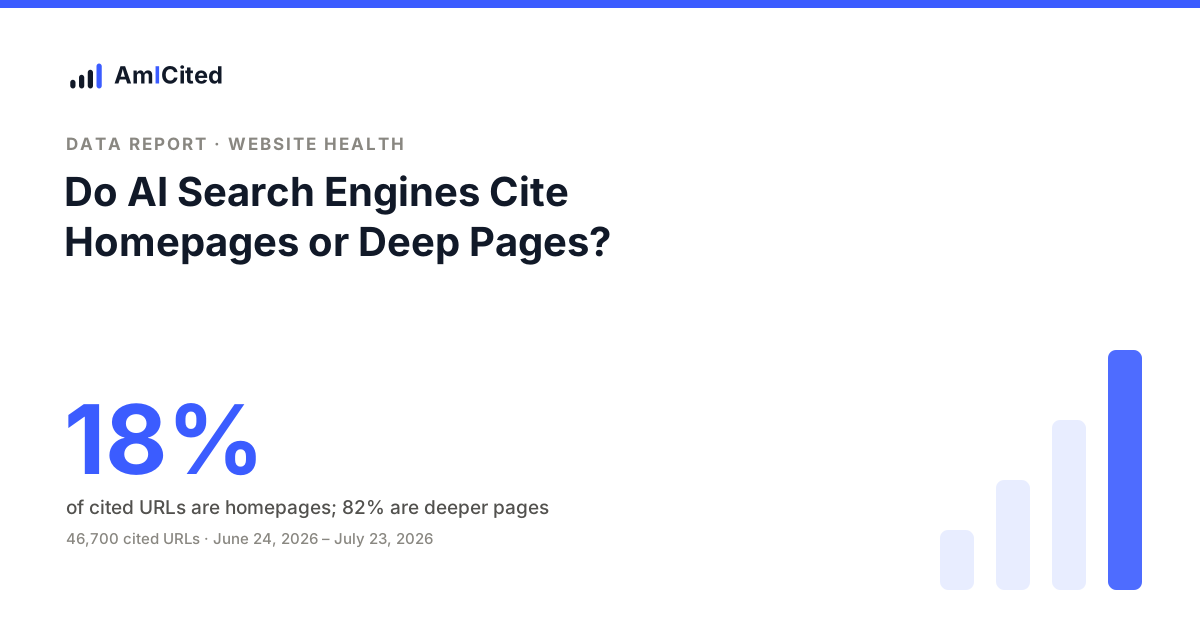
Just 18% of the URLs AI engines cite are homepages; the rest are deep, specific pages. AI search rewards depth, not front doors.
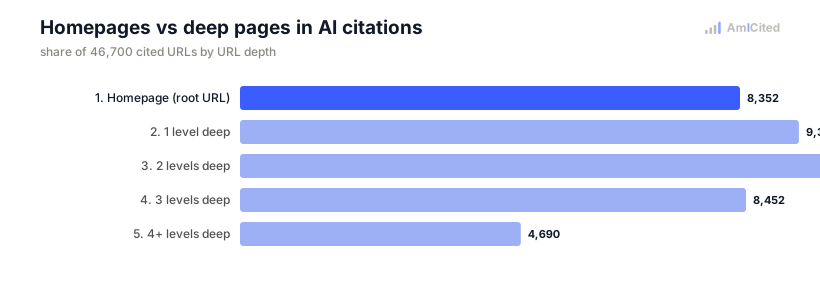
Of 46,700 cited URLs, only 8,352 (18%) point to a site’s homepage. The overwhelming majority are deep pages: specific articles, docs and product pages two or more levels into the site.
Key Takeaways
- Only 18% of AI-cited URLs are homepages; the remaining 82% are deep, specific pages.
- Pages two or more levels deep make up 62% of all citations, with two-levels-deep content like blog posts and guides forming the single largest zone.
- AI engines favor pages that directly answer a question over general-purpose pages like homepages.
- Homepages still earn citations for branded queries, but they are the wrong format for informational, non-branded questions.
- This describes traits of already-cited pages rather than a proven cause, so treat it as a pattern to match rather than a guaranteed fix.
Bottom line: Build deep, self-contained pages that each answer one specific question if you want AI engines to cite you, and use AmICited’s own citation tracking to see which of your pages are actually earning citations.
Homepages vs deep pages in AI citations
| Category | Cited URLs | Share |
|---|---|---|
| Homepage (root URL) | 8,352 | 17.9% |
| 1 level deep | 9,336 | 20.0% |
| 2 levels deep | 15,870 | 34.0% |
| 3 levels deep | 8,452 | 18.1% |
| 4+ levels deep | 4,690 | 10.0% |

Ready to Monitor Your AI Visibility?
Track how AI chatbots mention your brand across ChatGPT, Perplexity, and other platforms.
What the breakdown shows
Break the deep pages down further and the pattern sharpens: 62% of cited URLs sit two or more levels deep (29,012 URLs), the zone of specific articles, guides, docs and product pages. Only 20% are one level in. AI engines are quoting answers, and answers live on focused inner pages, not on the homepage that has to speak to everyone at once.
This is one of the more actionable findings in the whole report. A homepage is optimised for brand and navigation; an AI engine wants a page that directly resolves the user’s question. The sites that get cited most have deep libraries of specific, self-contained pages (one page per question) rather than a thin site funnelling everything through the front door.
Why this is trustworthy (and its limits)
This is measured from the cited URLs themselves (the actual strings AI engines returned), so there is no modelling or estimation involved; the shares are exact counts. The one caveat is scope: it describes the 46,700 URLs cited for AmICited’s tracked prompts ( SaaS, e-commerce and support-leaning topics), so treat it as a strong signal for that kind of content rather than a universal law. It is also a description of what gets cited, not proof that changing this trait alone would earn a citation.
Stay Updated on AI Visibility Trends
Get the latest insights on AI mentions, brand monitoring, and optimization strategies.
Takeaways
What to do about it
- Build and maintain deep, specific pages, one tight answer per page, because that is the shape of content AI actually quotes (82% of citations).
- Don’t over-invest in the homepage as an AI-visibility asset; it is cited only 18% of the time.
- Make inner pages self-contained: clear question-shaped headings, a direct answer near the top, and enough standalone context that a model can quote them without the rest of the site.
Why deep pages dominate AI citations
The 82% deep-page citation rate is not a coincidence: it is a direct consequence of how AI search engines work. AI engines are answer machines. When a user asks “What is the best CRM for small businesses?”, the engine is not looking for a brand’s homepage, which says “We make CRM software.” It is looking for a page that directly answers the question: a comparison article, a review, or a detailed guide.
This has profound implications for content strategy. A site with 50 pages, each addressing a specific question in depth, will earn more AI citations than a site with 500 pages of thin, generic content. The depth of each individual page matters more than the breadth of the site as a whole.
The 34% share for pages at exactly two levels deep (e.g., example.com/blog/article-title) is the sweet spot. These are typically blog posts, guides, and documentation pages, the content types that AI engines cite most. Pages at three or more levels deep (28%) are typically more specialized: product documentation subsections, category-specific guides, and deep-dive technical content.
The 18% homepage share is worth keeping in perspective: it is not zero. Homepages do get cited, especially for branded queries (“What is Shopify?”) and for companies whose homepage is the definitive source of information about them. But for non-branded, informational queries (which make up the majority of AI search usage), the homepage is the wrong format.
How this compares to traditional SEO
The homepage-vs-deep-page dynamic in AI search is more extreme than in traditional search. In Google Search, homepages often rank for broad, high-volume keywords because they have the most authority and backlinks. In AI search, authority matters less than specificity: the engine wants the page that best answers the question, not the page with the most links.
This flips a long-standing SEO assumption. For years, SEOs have invested heavily in homepage optimization for competitive keywords. In AI search, that investment is largely wasted for non-branded queries. The homepage is a brand asset, not a citation asset. The pages that earn AI citations are the deep, specific, answer-rich pages that live in the site’s interior.
The practical implication is clear: if you are building content for AI visibility, build it as deep, specific pages on your main domain. Each page should answer one question thoroughly. The homepage can take care of itself: it will earn citations for branded queries without additional optimization.
Practical recommendations for content architecture
Audit your content depth. How many of your pages directly answer a specific question? How many are general, overview, or navigation pages? The former earn AI citations; the latter do not.
Create one page per question. For each important question your audience asks, create a dedicated page that answers it. This is the fundamental unit of AI citation content.
Make inner pages self-contained. Each page should be understandable without the context of the rest of the site. An AI engine that extracts a paragraph from your page should be able to quote it without the reader needing to visit your homepage first.
Use clear, question-shaped headings. AI engines extract content based on heading structure. A heading like “How to Choose a CRM for Small Business” is more citeable than “CRM Selection” or “Our Products.”
Don’t neglect your homepage, but don’t over-invest in it for AI. Your homepage will earn citations for branded queries. Ensure it clearly states what your company does and includes key brand information. But don’t expect it to earn citations for non-branded, informational queries.
Methodology
Derived purely from the cited source-URL strings in AmICited’s tracking data (46,700 URLs, June 24, 2026 – July 23, 2026, 2026); no page fetching, no modelling, and no external links reproduced here. URL depth counts path segments after the host; scheme (HTTP/ HTTPS) and host (www / root / other subdomain) are read directly from each URL. The prompt set skews toward SaaS, e-commerce and support topics. Copilot is tracked but returned no citation data in this window.
 LinkedIn