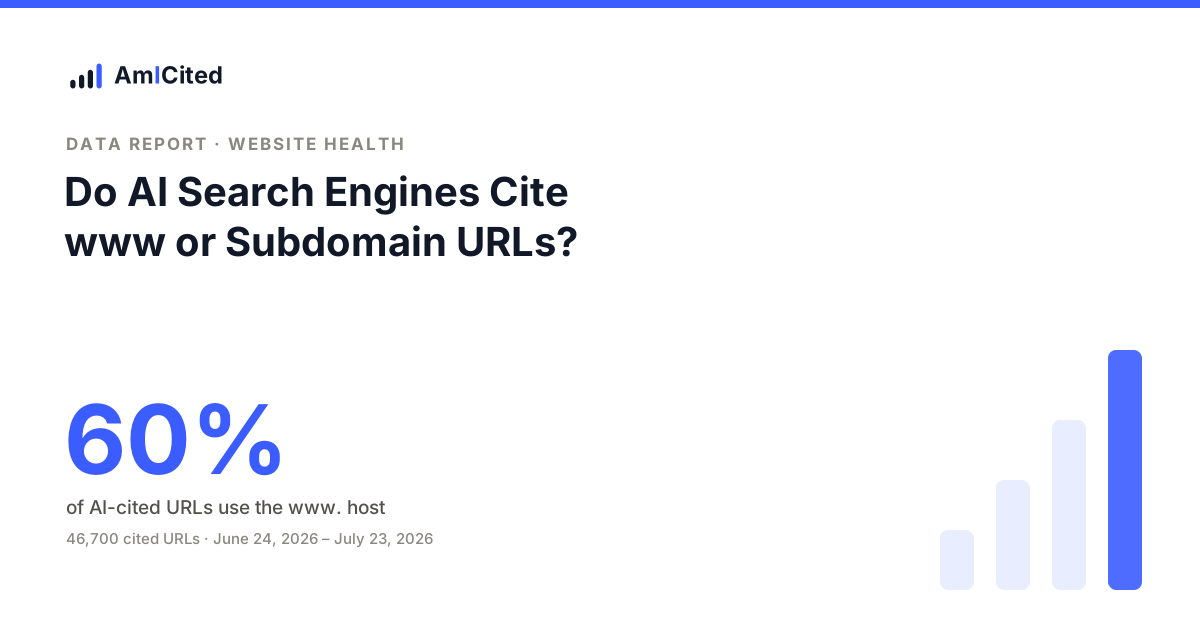
60% of AI-cited URLs sit on a www. host; only 7% live on a non-www subdomain.
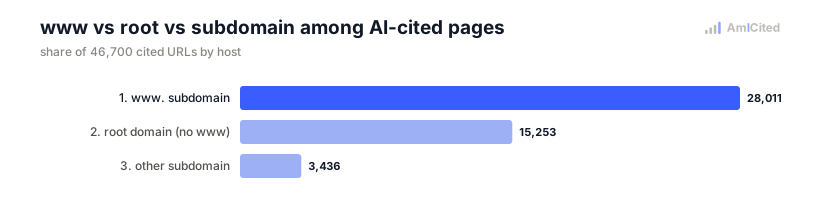
Of 46,700 cited URLs, 28,011 (60%) use www., 15,253 use the bare root domain, and just 3,436 (7%) sit on another subdomain.
Key Takeaways
- 60% of AI-cited URLs use a www. host and 33% use the bare root domain; together, primary hosts account for 93% of citations.
- Only 7% of AI-cited URLs sit on a separate subdomain like blog. or help., making subdomains a comparatively weak citation source.
- The www.-versus-root split does not reflect an AI preference; it mirrors how the wider web is structured.
- Keeping content on your primary host rather than splitting it across subdomains appears to consolidate the authority signals AI engines rely on.
- This is a description of the cited set, not proof that migrating a subdomain alone will win citations.
Bottom line: Keep content you want AI engines to cite on your primary host rather than a separate subdomain, and use AmICited’s own citation tracking to monitor whether your pages are actually showing up in AI citations.
www vs root vs subdomain among AI-cited pages
| Category | Cited URLs | Share |
|---|---|---|
| www. subdomain | 28,011 | 60.0% |
| root domain (no www) | 15,253 | 32.7% |
| other subdomain | 3,436 | 7.4% |

Ready to Monitor Your AI Visibility?
Track how AI chatbots mention your brand across ChatGPT, Perplexity, and other platforms.
What the breakdown shows
Splitting the cited hosts three ways, www. leads at 60%, bare root domains take 33%, and everything else (blog subdomains, help-center subdomains, regional subdomains) accounts for just 7%. In other words, roughly 93% of AI citations point at a site’s primary host (www or root), and content parked on a separate subdomain is cited comparatively rarely.
The likely reason is authority consolidation: a primary host accumulates the links, mentions and history that make a page a confident citation, whereas a separate subdomain often starts that trust-building from scratch. It is a structural argument for keeping cite-worthy content on your main host rather than spinning it off.
Why this is trustworthy (and its limits)
This is measured from the cited URLs themselves (the actual strings AI engines returned), so there is no modelling or estimation involved; the shares are exact counts. The one caveat is scope: it describes the 46,700 URLs cited for AmICited’s tracked prompts ( SaaS, e-commerce and support-leaning topics), so treat it as a strong signal for that kind of content rather than a universal law. It is also a description of what gets cited, not proof that changing this trait alone would earn a citation.
Stay Updated on AI Visibility Trends
Get the latest insights on AI mentions, brand monitoring, and optimization strategies.
Takeaways
What to do about it
- Keep content you want cited on your primary host (www or root), not on a separate subdomain.
- Pick one canonical host convention and redirect the other consistently, so authority isn’t split.
- If key content already lives on a subdomain (e.g. a
blog.orhelp.host), weigh consolidating it onto the main domain: the cited set favours primary hosts by a wide margin (93% vs 7%).
Why www. dominates AI citations (and why it might not matter)
The 60% www. share among AI-cited URLs is notable, but it is important to understand what it does and does not mean. The www. prefix is a convention that dates back to the early web: it was the standard way to indicate that a host served web content. Many large sites still use it, and many CDNs and hosting platforms default to it.
The 33% share for bare root domains is also substantial. This tells us that AI engines are not systematically preferring www. over bare domains. The 60/33 split likely reflects the distribution of these conventions across the web’s most-cited sites rather than an AI-specific preference.
The more important finding is the 7% share for non-www subdomains (blog.example.com, help.example.com, docs.example.com, etc.). This is the real signal: content on separate subdomains is cited far less often than content on the primary host. The likely explanation is twofold:
Authority consolidation: Links, mentions, and trust signals accumulate on the primary host. A subdomain starts from a weaker position.
Crawl prioritization: AI crawlers may prioritize the primary host and crawl subdomains less frequently or less deeply.
The practical implication is not that you should rush to move from bare root to www. (or vice versa). It is that you should keep content you want cited on your primary host, regardless of which convention you use.
The subdomain trap: why blog. and help. subdomains underperform
The 7% subdomain share is one of the most actionable findings in the URL structure data. Many organizations, especially in SaaS, put their blog on a blog. subdomain, their documentation on a docs. subdomain, and their help center on a help. subdomain. This is a common architectural pattern, and the data suggests it may be actively hurting AI citation potential.
The reason is simple: AI engines build their understanding of a domain’s authority and relevance from the content they crawl on that domain. When you split your content across subdomains, you split that authority. A blog post on blog.example.com does not benefit from the authority signals of example.com in the same way that a blog post on example.com/blog/ would.
This is not a new insight: SEOs have been arguing about subdomains vs. subdirectories for years. But the AI citation data provides fresh evidence: the pages that get cited are overwhelmingly on the primary host. If you have content that you want to be citeable, consider moving it from a subdomain to a subdirectory on your main domain.
Practical recommendations
Pick one canonical host and stick to it. Whether you choose www. or bare root, redirect one to the other consistently. Do not serve the same content on both.
Audit your subdomains. Identify subdomains that host content you want to be cited (blog, docs, help, resources). Evaluate whether moving that content to subdirectories on your main domain would improve citation potential.
If you must keep a subdomain, treat it seriously. A subdomain that has its own link profile, crawl budget, and content strategy can earn citations, but it takes deliberate investment. The 7% share is not zero; it is just much harder.
Don’t over-rotate on www. vs. bare root. The 60/33 split does not indicate a meaningful AI preference. Pick the convention that works for your infrastructure and redirect consistently.
Methodology
Derived purely from the cited source-URL strings in AmICited’s tracking data (46,700 URLs, June 24, 2026 – July 23, 2026, 2026); no page fetching, no modelling, and no external links reproduced here. URL depth counts path segments after the host; scheme (HTTP/ HTTPS) and host (www / root / other subdomain) are read directly from each URL. The prompt set skews toward SaaS, e-commerce and support topics. Copilot is tracked but returned no citation data in this window.
 LinkedIn