


How Do I Get Local Recommendations from AI? Complete Guide for 2025
Learn how to get your local business recommended by AI search engines like ChatGPT, Perplexity, and Google Gemini. Discover proven strategies to optimize for AI...
11 min read
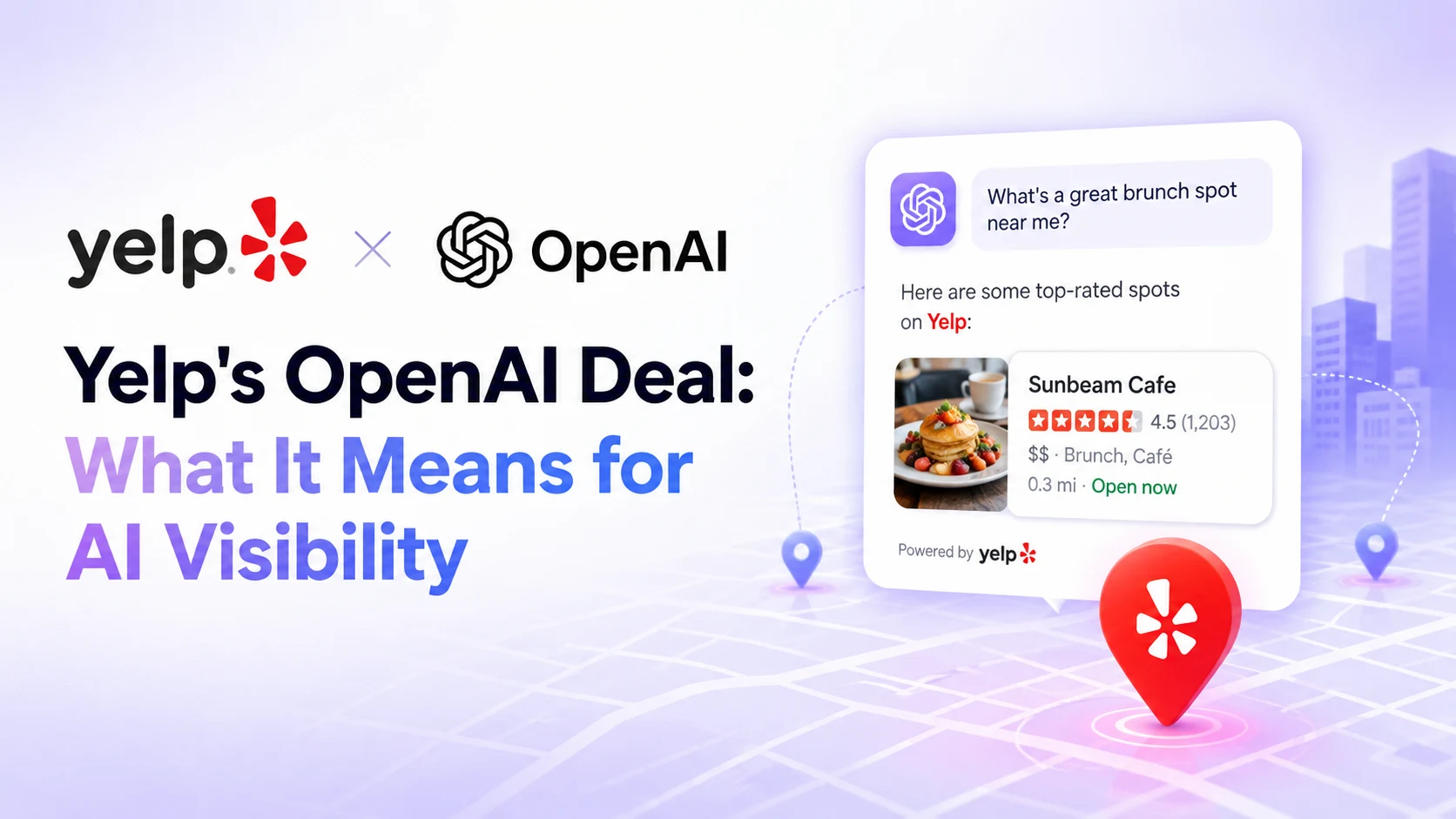
Yelp is now licensing reviews, ratings, and photos directly to OpenAI for ChatGPT’s local recommendations. Here’s what the deal reveals about how AI platforms source brand data, and what it means for your AI visibility strategy.
On July 23, 2026, Axios confirmed what Yelp had first disclosed during its Q4 2025 earnings call: Yelp is licensing its reviews, star ratings, business photos, and general business information to OpenAI. ChatGPT now surfaces this data directly inside local recommendation responses, including access to Yelp’s Request a Quote feature for home and local services. Yelp branding and links accompany the content, though OpenAI controls how it’s presented inside the chat interface.
Yelp CEO Jeremy Stoppelman framed the move plainly: the company “sees value in distributing its content beyond its own properties when it benefits consumers.” Financial terms weren’t disclosed, and the deal is not exclusive, Yelp is free to strike the same kind of agreement with any other AI platform.

Track how AI chatbots mention your brand across ChatGPT, Perplexity, and other platforms.
ChatGPT’s weakness with local queries has been an open secret since it launched. A large language model trained on a snapshot of the internet has no reliable way to know which plumber is open right now, which restaurant has a table free tonight, or which contractor actually shows up on time, because that information changes hourly and lives in structured review databases, not general web text.
Yelp’s dataset solves that problem in a way OpenAI’s own crawlers can’t easily replicate: it’s current, structured, and already organized around exactly the kind of query ChatGPT struggles with. Rather than spend years building an equivalent local dataset, OpenAI bought (or rather, licensed) its way past the gap.
The Yelp deal also puts a spotlight on something AI visibility data has shown for a while: AI platforms do not cite brands at anywhere near the same rate.
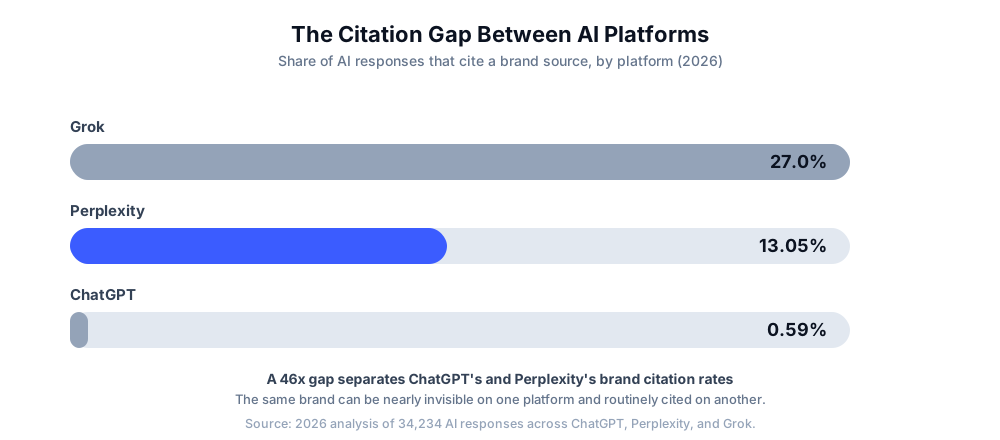
A 2026 analysis of 34,234 AI responses found ChatGPT cited a brand source in just 0.59% of responses, compared to 13.05% for Perplexity and 27.0% for Grok, a roughly 46x gap between the lowest and highest platform. Separately, an analysis spanning more than 680 million citations across ChatGPT, Google AI Overviews, Perplexity, Gemini, and Claude found that only 11% of domains get cited by both ChatGPT and Perplexity, meaning a domain that performs well on one platform often has almost no overlap with what gets cited on another.
That context matters here: a platform that cites brands as rarely as ChatGPT has an obvious incentive to license a dataset like Yelp’s, where the citation (Yelp itself) is baked into the data source rather than something the model has to decide to surface on its own.
Get the latest insights on AI mentions, brand monitoring, and optimization strategies.
The most important detail in the Yelp-OpenAI agreement isn’t the data, it’s the non-exclusivity. Yelp isn’t picking a side; it’s turning its dataset into a licensable product for any AI platform willing to pay for it. That’s a meaningful shift from the adversarial relationship data owners have historically had with AI companies (Yelp itself has sued Google over local search practices), and it sets a precedent other review platforms, directories, and vertical data owners are likely to watch closely.
If this becomes a pattern, expect a market for structured business and review data to open up across multiple AI platforms simultaneously, not a single winner-take-all deal. That’s good for consumers and for OpenAI, but it does very little for a brand that isn’t the one being licensed. Being present in Yelp’s dataset only helps you if your Yelp presence is strong enough for reviews to actually shape the recommendation , current review volume, accurate categories, and responsive engagement all factor into whether an AI system treats your listing as a credible source.
Deals like this one are happening against a backdrop where AI discovery platforms are pulling further apart, not converging on one dominant surface.
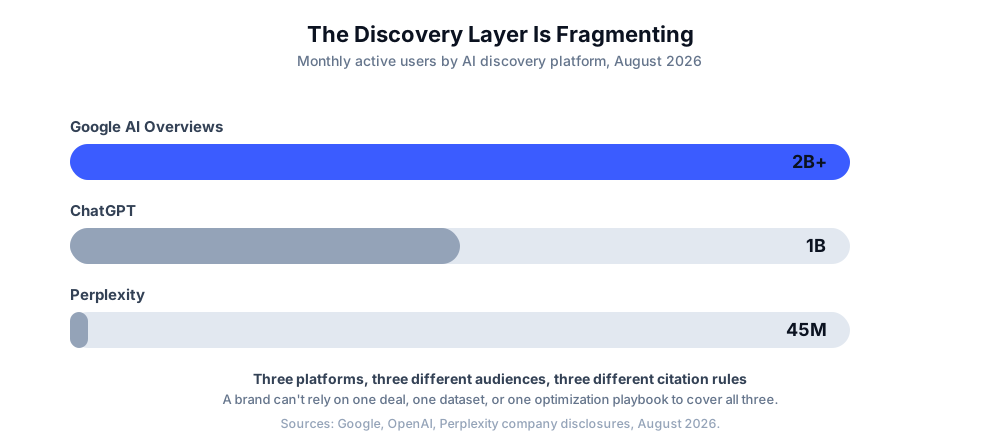
Google AI Overviews now reaches more than 2 billion monthly users across roughly half of all searches. ChatGPT has crossed 1 billion monthly active users. Perplexity, despite far smaller reach at around 45 million monthly users, has grown its annualized revenue past $750 million and reportedly has Nvidia in talks to invest at a valuation above $30 billion, signals that the platform’s influence is outpacing its raw user count. Each of these platforms sources, ranks, and cites information differently, which is exactly why a single data deal like Yelp’s only moves the needle on one of them.
Most businesses will never get the call from OpenAI that Yelp got. The realistic response is to control the inputs that make a brand look like Yelp’s dataset to an AI system, current, structured, and verifiable, on every surface an AI platform might actually pull from:
The Yelp-OpenAI deal is a preview of how AI platforms will keep closing their data gaps, not by getting better at crawling the open web, but by paying for direct access to the structured datasets that already answer the queries they’re weak on. If other review platforms, directories, and data owners follow Yelp’s non-exclusive model, the brands that benefit will be the ones whose underlying data (reviews, structured markup, business information) was already clean enough to travel well before any licensing deal made it visible at scale.
That’s the real takeaway: whether or not your data ever gets licensed, the way to show up in ChatGPT’s next local recommendation is the same as it’s always been, just harder to ignore now that a real platform has shown exactly what it’s willing to pay for.
Arshia is an AI Workflow Engineer at FlowHunt. With a background in computer science and a passion for AI, he specializes in creating efficient workflows that integrate AI tools into everyday tasks, enhancing productivity and creativity.

AmICited tracks how ChatGPT, Perplexity, Gemini, and Google AI Overviews mention and cite your brand, so you know where you stand even when you're not the one licensing the data.
Learn how to get your local business recommended by AI search engines like ChatGPT, Perplexity, and Google Gemini. Discover proven strategies to optimize for AI...
Community discussion on getting local businesses recommended by AI search engines. Real experiences from local business owners on optimizing for ChatGPT, Perple...
Understand how AI content licensing agreements with OpenAI, Google, and Perplexity determine whether your brand appears in AI-generated answers and search resul...
Cookie Consent
We use cookies to enhance your browsing experience and analyze our traffic. See our privacy policy.