


- CTV (connected TV) advertising is video advertising on internet-connected TVs, such as smart TVs or a TV with a Roku, Fire TV or Apple TV, inside streaming apps like YouTube, Hulu, Tubi and Prime Video.
- It is bought directly from publishers, through a platform’s own ad tools or programmatically through a demand-side platform, and targeted at the household level.
- Exposed-household reports overcount. A holdout or geo test shows how many visits or sales the ads actually caused.
- Viewers who want to know more pick up a phone, and more of those lookups now happen in AI assistants rather than a classic results page.
Where AmICited fits
During a CTV campaign, AmICited tracks how often ChatGPT, Perplexity, Gemini, Google AI Overviews and AI Mode name your brand versus competitors for your tracked prompts, week by week, so you can see whether the interest you paid for is going to a rival in AI answers.
See competitor analysis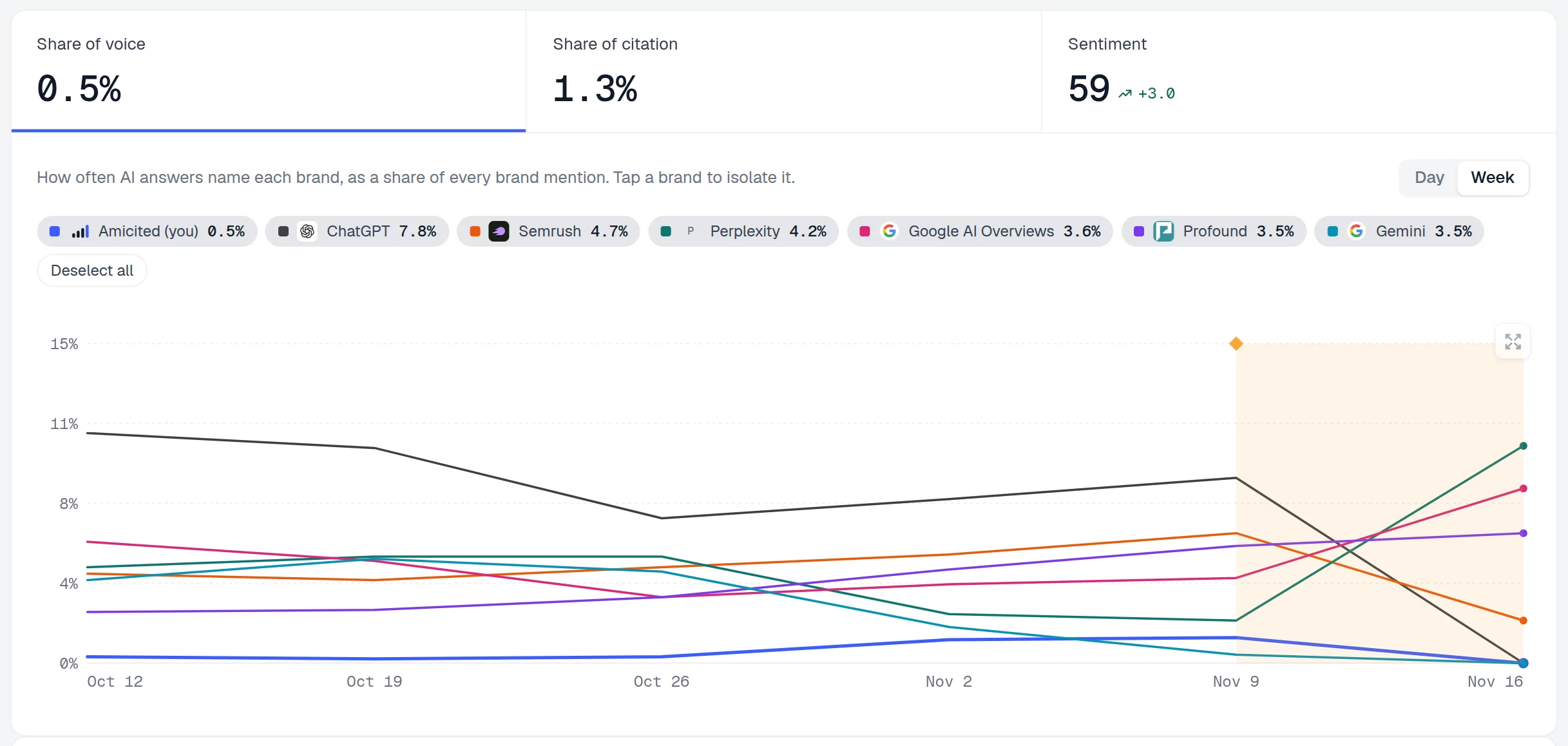
What Is CTV Advertising?
CTV advertising, short for connected TV advertising, is video advertising that plays on a television connected to the internet. The TV might be a smart TV with built-in apps, or a regular TV plugged into a Roku, Amazon Fire TV, Apple TV, Chromecast or game console. The ads run in streaming apps such as YouTube, Hulu, Peacock, Pluto TV, Tubi, Netflix’s ad tier or Amazon Prime Video.
For advertisers, CTV combines two things that used to be separate. It has the full-screen, sound-on, lean-back attention of TV. It also has the buying and measurement tools of digital: audience targeting, impression-level buying, frequency control and outcome reporting. Brands that once bought only linear TV use CTV to reach cord cutters. Direct-to-consumer and performance brands use it because they can measure what it drives.
How CTV Advertising Works
CTV ads are bought in three main ways: directly from a streaming publisher, through a platform’s own ad tools (YouTube through Google Ads, Amazon through Amazon DSP, Roku through its ad platform), or programmatically through a demand-side platform that bids on inventory from many apps. Most premium CTV is sold through private marketplaces or programmatic guaranteed deals rather than open auctions.

Targeting works at household level. The signals are the household’s IP address, data partners that link households to demographics, the advertiser’s own customer lists matched through identity graphs, and automatic content recognition (ACR) data from TV makers that shows what a screen has been watching.
Measurement is where CTV differs most from linear TV. The cleanest method is a holdout test: split target households, show ads to one group and not the other, then compare outcomes.
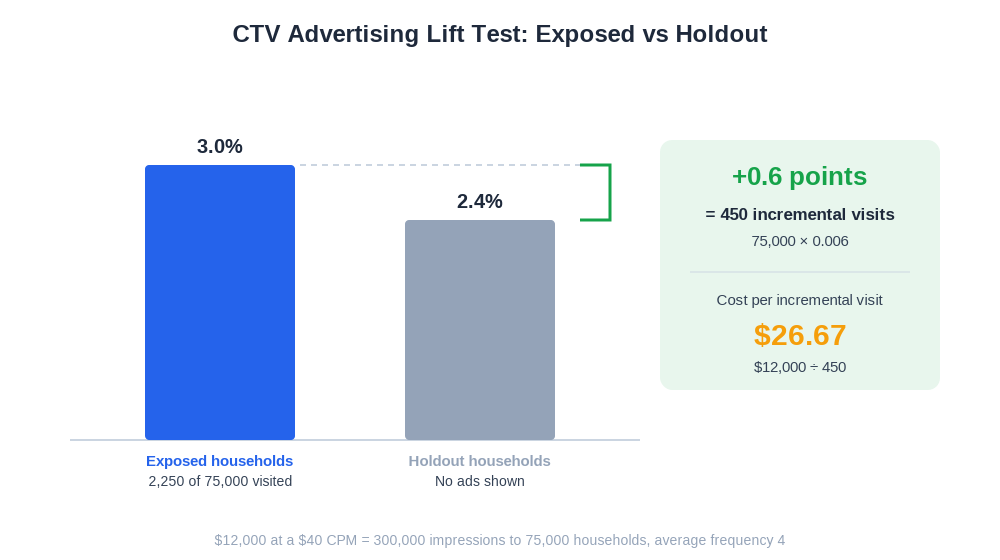
Here is a worked example. A brand spends $12,000 at a $40 CPM, buying 300,000 impressions that reach 75,000 households, an average frequency of 4.
- Exposed households visiting the website within 30 days: 3.0%, or 2,250 households.
- Holdout households visiting: 2.4%.
- Incremental visit rate: 3.0% − 2.4% = 0.6 points, so 75,000 × 0.006 = 450 incremental visits.
- Cost per incremental visit: 12,000 ÷ 450 = about $26.67.
The exposure report alone would credit CTV with 2,250 visits. The holdout shows only 450 of them happened because of the ads. That gap is exactly what incrementality testing is for.
CTV vs OTT vs Linear TV vs Online Video
| CTV | OTT | Linear TV | Online video (desktop/mobile) | |
|---|---|---|---|---|
| Screen | TV | Any streaming device | TV | Phone, tablet, computer |
| Skippable | Usually not | Depends on platform | No | Often yes |
| Viewing | Shared, lean-back, sound on | Mixed | Shared, lean-back | Individual, often muted |
| Buying | CPM, direct or programmatic | CPM | Time slots and ratings | CPM, CPV, CPC |
| Targeting | Household | Household or device | Program and region | User and device |
| Clicks | Rare (QR codes) | On mobile and desktop | None | Yes |
CTV’s strength is attention on a big screen with digital controls. Its weakness is that one impression often reaches several people in a room, and direct response depends on QR codes or the viewer remembering you.
For a small or mid-sized brand, CTV is easier to start with than linear TV. Self-serve platforms accept modest budgets, ZIP code targeting keeps spend local, and you can use one 30-second video across many apps instead of producing spots per network.
CTV Advertising and AI Search
There is no direct path from a CTV ad to an AI answer. The link is behavior: a viewer who sees an ad on TV often picks up a phone to look the brand up, and more of those lookups now happen in ChatGPT, Perplexity or Google AI Overviews instead of a classic search results page. If the AI answer recommends a rival, the interest your CTV spend created can convert for someone else. Tracking brand mentions in AI answers during a big campaign, with AmICited’s Competitor Analysis, shows whether that is happening.

Stay Updated on AI Visibility Trends
Get the latest insights on AI mentions, brand monitoring, and optimization strategies.
Best Practices for CTV Advertising
- Measure incremental lift with holdout households or geo tests, not only exposed-household conversions.
- Cap frequency across all apps and DSPs, since the same household can be reached through many sources.
- Add a QR code or short URL and keep it on screen long enough to scan.
- Ask for app-level and channel-level delivery reports so you know where your ads ran.
- Write for sound on and a shared room: say the brand name early and often.
- Feed CTV spend into a marketing mix model to see its effect next to search and social.
Common CTV Advertising Mistakes
The most common mistake is taking exposed-household conversion reports at face value. Many of those households would have visited or bought anyway, especially if the campaign targeted existing customers. Without a holdout group you cannot tell. A second is buying cheap “CTV” without placement transparency. Some inventory comes from low-quality apps or devices that are switched off while the streaming box keeps playing.
Other mistakes include using a repurposed online video that was cut for mobile, with small text and a “click here” ending, running without a cross-platform frequency cap, and judging a CTV test after only a week or two, before delayed effects on search and sales can show up.