


- A demand side platform (DSP) is software that buys display, video, audio and connected TV impressions for advertisers through automated auctions across thousands of publishers. Examples are The Trade Desk, DV360 and Amazon DSP.
- For each impression, the publisher’s SSP sends a bid request, the DSP checks it against targeting, frequency caps and budget, and the highest eligible bid wins, all before the page finishes loading.
- DSP media is priced per thousand impressions (CPM), but platform, data and verification fees come on top. Compare the full cost per viewable, human impression.
- Search ads in Google Ads or Microsoft Advertising don’t run through a DSP, and no DSP can buy a mention inside an AI answer.
Where AmICited fits
AmICited’s Media Marketing Mix report is built on Google Meridian and estimates what each ad channel adds to sales and organic search, with uncertainty ranges, so DSP spend can be judged against search and social instead of by view-through conversions.
See the marketing mix modelWhat Is a Demand Side Platform?
A demand side platform (DSP) is software that buys ad impressions for advertisers through automated auctions. Instead of signing a deal with each website, app or streaming service, you set your audience, budget and bid rules once, and the DSP bids on matching impressions across thousands of publishers at the same time.
DSPs are the buy-side core of programmatic advertising. Agencies, trading desks and larger in-house teams use them for display advertising, online video, audio, digital out-of-home and connected TV. Well-known examples include The Trade Desk, Google Display & Video 360 (DV360), Amazon DSP and Yahoo DSP. Search ads in Google Ads or Microsoft Advertising are not bought through a DSP; they run on each search engine’s own auction.
How a Demand Side Platform Works
Most DSP buying happens through real-time bidding (RTB). Each time someone opens a page or app with an ad slot, an auction runs before the ad loads:
- The page loads. The publisher’s ad code tells its supply side platform (SSP) that an impression is available.
- The SSP sends a bid request. The request carries signals such as the site or app, ad size, device, approximate location and any available user identifiers.
- The DSP decides. It checks the request against every active campaign: targeting, frequency caps, brand safety lists, remaining budget. If the impression qualifies, it calculates a bid.
- The auction runs. The SSP or exchange compares bids from many DSPs, and the highest eligible bid wins.
- The ad is served. The winning DSP’s creative loads, and the impression is logged for reporting and billing.
All of this happens in a fraction of a second, while the page is still loading.
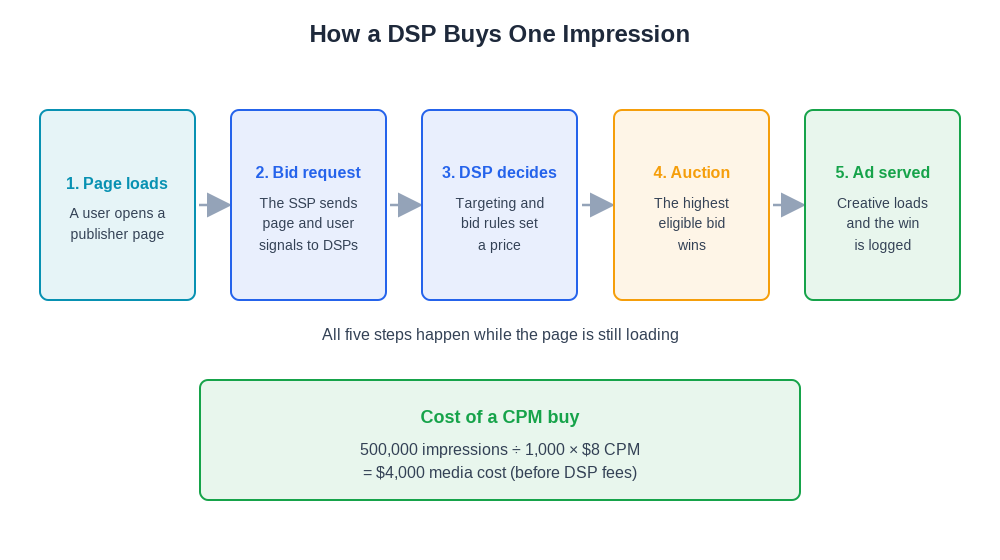
DSP media is usually priced in CPM, the cost per thousand impressions. The formula is:
Media cost = Impressions ÷ 1,000 × CPM
If you buy 500,000 impressions at an $8 CPM, the media cost is 500,000 ÷ 1,000 × $8 = $4,000. DSP platform fees, data fees and verification fees come on top of that figure, so ask for a full cost breakdown before you compare DSPs on CPM alone.
Besides open-auction RTB, most DSPs also support private marketplaces (PMPs), where a publisher invites selected buyers, and programmatic guaranteed deals, where price and volume are agreed in advance but delivery still runs through the DSP.
Demand Side Platform vs SSP vs Ad Network
The terms get mixed up because all of them sit between advertisers and publishers. The difference is who each one works for.
| Platform | Works for | Main job | Examples |
|---|---|---|---|
| Demand side platform (DSP) | Advertisers and agencies | Bid on impressions that match targeting, at the lowest price that wins | The Trade Desk, DV360, Amazon DSP |
| Supply side platform (SSP) | Publishers | Sell each impression to the highest bidder, set price floors | Google Ad Manager, Magnite, PubMatic |
| Ad exchange | Both sides | Run the auction where bids meet supply | Google AdX, OpenX |
| Ad network | Usually publishers | Bundle inventory and resell it, often with less transparency | Smaller vertical networks |
In practice the lines blur. Google, Amazon and others run tools on both sides, and many SSPs operate their own exchange. What matters to you as a buyer is how much of each dollar reaches the publisher and how much transparency you get on where ads ran.
Demand Side Platform and AI Search
A DSP buys ad slots. It can’t buy a mention in ChatGPT, Perplexity, Gemini or Google AI Overviews, because those answers are generated from sources the model trusts, not sold in an open auction. Ads that appear inside AI assistants are sold through each platform’s own system; AmICited’s ChatGPT Ads Manager, for example, runs ChatGPT campaigns next to your organic citation data rather than through a DSP.
That makes AI visibility a separate channel to measure. If your programmatic campaigns drive awareness but AI answers recommend a competitor when people research the category, you’ll see it only by tracking the answers themselves, for instance with AI visibility tracking across the engines your buyers use.

Stay Updated on AI Visibility Trends
Get the latest insights on AI mentions, brand monitoring, and optimization strategies.
Best Practices for Using a DSP
- Start with clear goals per line item. Reach, site visits and purchases need different bidding strategies and different KPIs.
- Use inclusion lists for brand safety. A curated list of sites and apps you trust is stronger than blocking a few bad domains after the fact.
- Set frequency caps. Showing the same person an ad 20 times a day wastes budget; caps by day and by week keep delivery spread out.
- Ask for log-level or supply path reporting. You should be able to see which exchanges and publishers took your spend, and what share went to fees.
- Test private marketplace deals against open auction. PMPs often cost more per impression but can deliver better placements and fewer invalid clicks.
- Measure outcomes, not just CTR. Display click-through rates are low by nature; use conversion tracking, lift studies or incrementality tests to judge real impact.
Common Demand Side Platform Mistakes
The most common mistake is judging a DSP by its headline CPM. A cheap CPM can hide high platform fees, low viewability or a lot of made-for-advertising sites, so the cost per real, viewable, human impression ends up higher than a pricier but cleaner setup. Another frequent problem is targeting that is so narrow the campaign can’t spend, which pushes teams to loosen controls in a hurry and end up on poor inventory.
Teams also tend to run a DSP without a holdout or lift test and then credit it with every conversion that happened after an impression. View-through attribution windows that are too long make programmatic look far better than it is. Finally, many advertisers never refresh creatives, so frequency builds on the same few ads and performance quietly declines.