


- Programmatic advertising is the automated buying and selling of digital ad impressions, mostly one impression at a time in auctions that finish while the page loads.
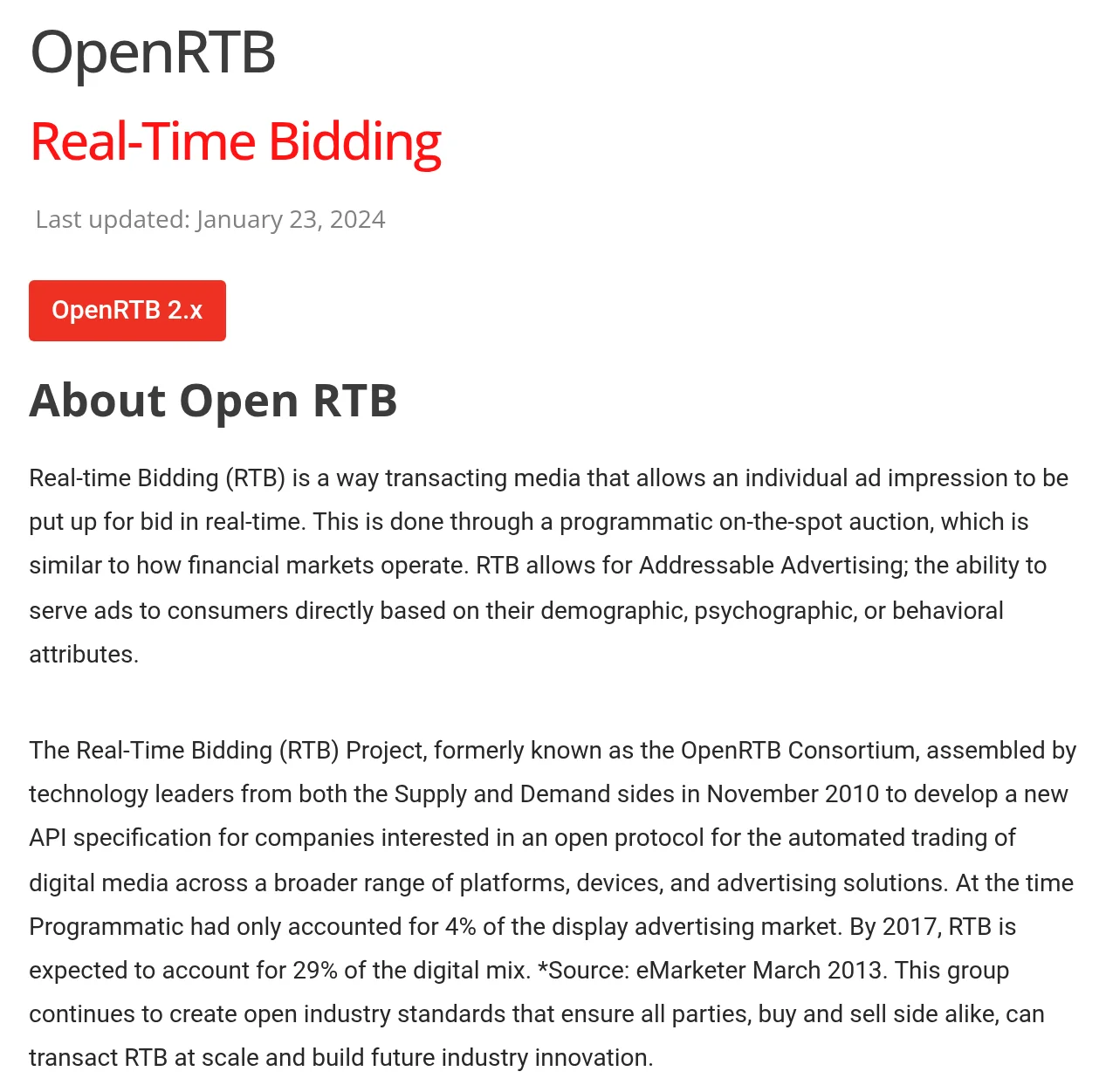
- Advertisers buy through a demand-side platform (DSP) and publishers sell through a supply-side platform (SSP). Bid requests follow IAB Tech Lab’s OpenRTB protocol.
- Deal types run from open auctions to private marketplaces, preferred deals and programmatic guaranteed, trading reach for price control and guaranteed volume.
- Part of every CPM goes to DSP, data, SSP and verification fees, so ask for a fee breakdown and judge supply on viewable, human impressions.
Where AmICited fits
Last-click reports rarely credit display or CTV. AmICited’s Media Marketing Mix estimates what each ad channel adds to sales and organic search from aggregate data, with uncertainty ranges, so programmatic spend can be judged next to search and social.
See the media marketing mixWhat Is Programmatic Advertising?
Programmatic advertising is the automated buying and selling of digital ad impressions through software. Instead of a media buyer calling a publisher and signing an insertion order, an advertiser’s software bids on individual impressions, one at a time, based on who is viewing and where. Most of those impressions are sold in auctions that finish in a fraction of a second while the page or app loads.
Programmatic covers almost every non-search digital format: display advertising, online video, audio, mobile apps, digital out-of-home screens and CTV advertising. Advertisers and agencies buy through a demand-side platform (DSP) such as The Trade Desk, Google Display & Video 360 or Amazon DSP. Publishers sell through a supply-side platform (SSP) such as Google Ad Manager, Magnite or PubMatic.
How Programmatic Advertising Works
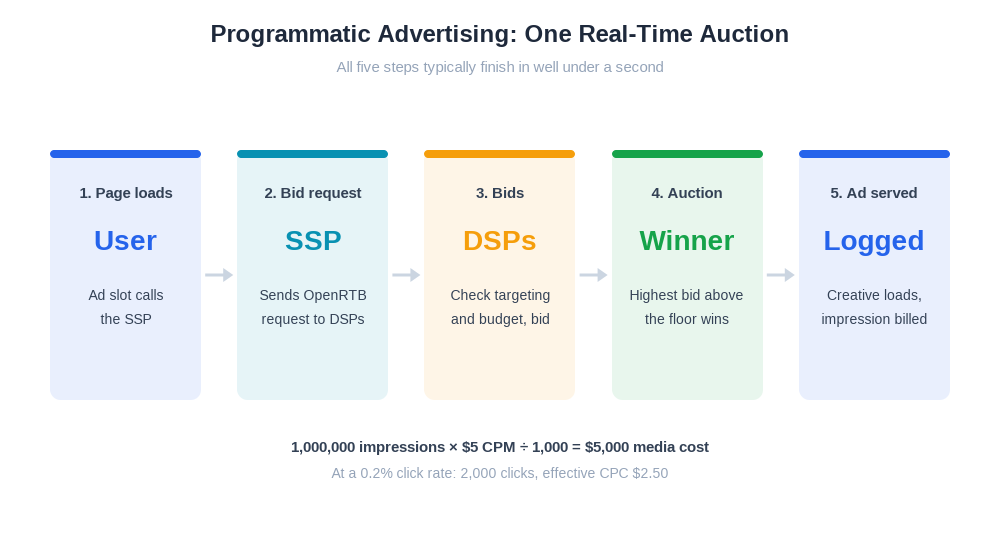
A single real-time bidding auction runs through these steps:
- A user loads a page or app. The publisher’s ad slot calls its SSP.
- The SSP sends a bid request. It describes the impression: site or app, ad size, rough location, device, and any available audience signals. The industry standard format is IAB Tech Lab’s OpenRTB protocol.
- DSPs evaluate the request. Each DSP checks it against its advertisers’ campaigns, targeting and budgets, and decides whether and how much to bid.
- The auction runs. The highest valid bid above the publisher’s floor price wins. Most exchanges now run first-price auctions, where the winner pays what it bid.
- The ad is served. The winning creative loads, and the impression is logged for billing and measurement.
All of that typically completes in well under a second. Prices are quoted as CPM, the cost per thousand impressions. The basic cost math:
Cost = (Impressions ÷ 1,000) × CPM
If you buy 1,000,000 impressions at a $5 CPM, media cost is 1,000 × $5 = $5,000. If 0.2% of those impressions get a click, that is 2,000 clicks, so the effective cost per click is 5,000 ÷ 2,000 = $2.50. Remember that the $5 CPM is often what you pay the DSP. Part of it goes to the DSP fee, data costs, the SSP fee and verification before the publisher gets paid.
Types of Programmatic Deals
Not every programmatic buy is an open auction. Deal types differ in price control, access and guarantees.
| Deal type | Auction? | Who can buy | Guaranteed volume? | Typical use |
|---|---|---|---|---|
| Open auction (RTB) | Yes, open | Any approved buyer | No | Broad reach, lowest CPMs |
| Private marketplace (PMP) | Yes, invite-only | Selected buyers | No | Premium sites, better brand safety |
| Preferred deal | No, fixed price | One buyer gets first look | No | Priority access at agreed price |
| Programmatic guaranteed | No, fixed price | One buyer | Yes | Reserved campaigns, often CTV and premium video |
The further down the table, the more it resembles a traditional direct buy, but with delivery, targeting and reporting automated.
Programmatic vs Direct Ad Buying
Direct buying means negotiating with a publisher for a placement: a homepage takeover, a sponsored newsletter, a fixed number of impressions at an agreed rate. It gives you control over context and a guaranteed slot, but it does not scale across thousands of sites and requires manual trafficking.
Programmatic buying scales across huge inventory, decides per impression and adjusts bids in real time. The trade-offs are less control over exact placement, more intermediaries taking a cut, and more exposure to fraud and low-quality sites unless you use inclusion lists, verification and supply-path controls. Many advertisers do both: direct deals for flagship placements and programmatic for reach and retargeting.

Stay Updated on AI Visibility Trends
Get the latest insights on AI mentions, brand monitoring, and optimization strategies.
Programmatic Advertising and AI Search
The connection is indirect. Programmatic ads run on publisher sites and apps, while AI answers in ChatGPT, Perplexity or Google AI Overviews are mostly not sold through programmatic auctions today. As more research happens inside AI answers, fewer people may click through to the publisher pages where programmatic ads appear.
That makes it more important to know whether a campaign drove sales at all. Last-click reports rarely credit display or CTV. A marketing mix model like AmICited’s Media Marketing Mix estimates each channel’s contribution from aggregate data, so programmatic spend can be judged next to search, social and AI-driven demand.
Best Practices for Programmatic Advertising
- Use site and app inclusion lists for brand-sensitive campaigns rather than relying only on exclusion lists.
- Run third-party verification for viewability, invalid traffic and brand safety.
- Set frequency caps so the same person does not see your ad dozens of times a day.
- Ask your DSP for a log-level or fee breakdown so you know how much of each dollar reaches the publisher.
- Prefer shorter supply paths: buy from SSPs that work directly with the publisher instead of through resellers.
- Measure with holdout tests or modeling, not only with view-through conversions.
Common Programmatic Advertising Mistakes
The most common mistake is optimizing to cheap CPMs or high click-through rates. The cheapest impressions are often on made-for-advertising sites with poor viewability, and unusually high CTR can point to accidental clicks or bots. Judge supply on viewable, human impressions and on outcomes instead.
Advertisers also overcredit programmatic by counting view-through conversions with long windows. Someone who saw a banner and later bought through branded search would likely have bought anyway. Other mistakes include running without frequency caps, ignoring ads.txt and sellers.json when choosing supply, and launching broad audience segments from third-party data without checking how they were built.