


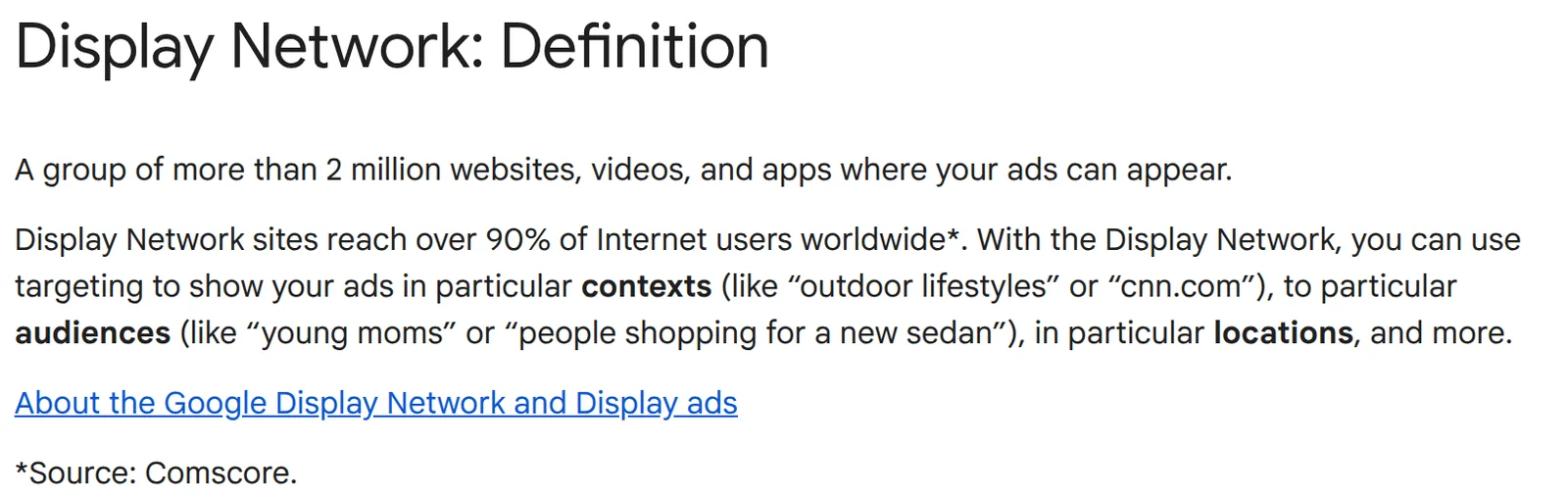
- Display advertising is image, HTML5, rich media and video ads shown in ad spaces on websites, apps and social platforms while people browse.
- It is mostly bought through the Google Display Network, Microsoft’s audience network or programmatic platforms, paid per thousand impressions, per click or toward conversions.
- Display creates demand instead of answering a search, so judge it on reach, frequency, viewability and lift tests, not on last-click conversions.
- Under the common standard, an impression is viewable when at least 50% of the ad is on screen for one second, or two seconds for video.
Where AmICited fits
AmICited’s Google Ads and Bing Ads reports show spend, clicks, impressions, CPC, conversions and impression share by campaign, so display and search campaigns can be compared in one place.
See Google Ads campaignsWhat Is Display Advertising?
Display advertising is visual advertising shown in dedicated ad spaces on websites, mobile apps and social platforms. It includes static image banner ads, animated HTML5 ads, rich media that expands or responds to interaction, and video that plays in a page. Unlike search ads, which answer a query, display ads appear while people read, watch or browse.
Most display ads are bought through the Google Display Network (via Google Ads Display, Demand Gen or Performance Max campaigns), through Microsoft Advertising’s audience network, or through programmatic advertising platforms that bid across thousands of publishers. Brands use display for awareness, to reach new audiences, and to bring back past visitors with remarketing.
How Display Advertising Works
A display campaign has four parts:
- Targeting. Choose who sees the ad: contextual targeting (pages about a topic or keyword), audience targeting (interests, in-market segments, demographics), your own data (site visitors, customer lists) or specific placements (named sites and apps).
- Creative. Upload images in standard sizes, or provide images, logos and headlines and let the platform build responsive ads that fit any slot.
- Bidding. Pay per thousand impressions (CPM), per viewable thousand (vCPM), per click (CPC) or let the platform bid toward conversions.
- Delivery and measurement. The ad serves when a matching person loads a page with an open slot. You see impressions, viewability, clicks, conversions and view-through conversions.
The core cost math:
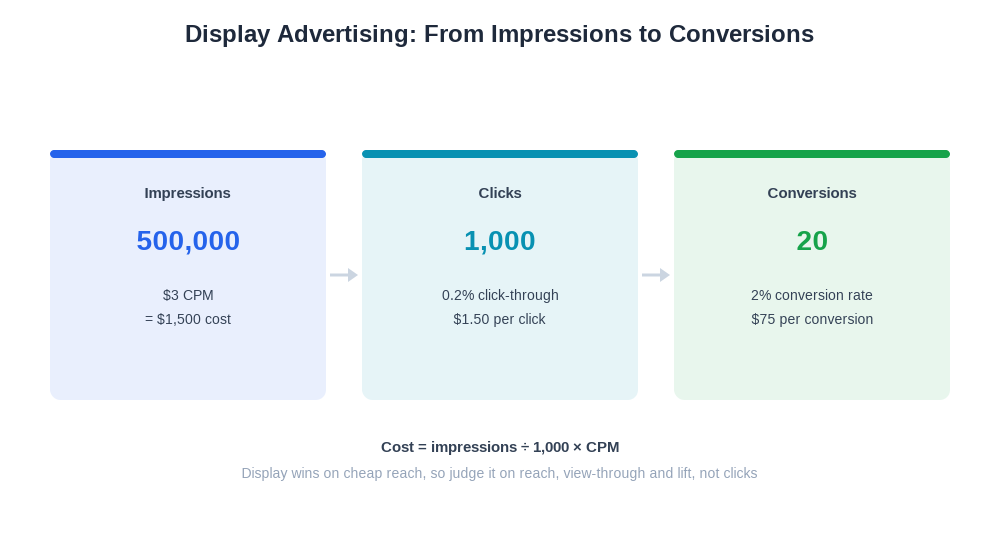
Cost = Impressions ÷ 1,000 × CPM and Effective CPC = Cost ÷ Clicks
Say you buy 500,000 impressions at a $3 CPM. Cost is 500 × $3 = $1,500. At a 0.2% click-through rate, you get 1,000 clicks, an effective CPC of $1.50. If 2% of clicks convert, that is 20 conversions at $75 each. Display click-through rates are usually well below 1%, so cost per click is rarely where display wins. Its value is reach at a low cost per impression.
Types of Display Ads
| Type | What it looks like | Typical use |
|---|---|---|
| Static banner | Image in a fixed size, such as 300×250 or 728×90 | Simple awareness and offers |
| Responsive display | Platform assembles images, logos and text to fit any slot | Broad reach with little design work |
| Animated HTML5 | Short animation in a banner slot | Showing several products or messages |
| Rich media | Expands, plays video or reacts to interaction | High-impact launches |
| Dynamic display | Pulls products from a feed, often for past visitors | Ecommerce retargeting |
| Native | Matches the look of the surrounding content | Content promotion |
| Interstitial | Full screen, mostly in apps | App monetization, high attention |
Display Advertising vs Search Advertising
Search advertising captures existing demand. Someone types “waterproof hiking boots”, and your ad answers. Display advertising creates or nudges demand. It shows hiking boots to someone reading a trail guide who has not searched yet.
That difference drives everything else. Search has high intent, high click-through rates and higher costs per click. Display has low intent, low click-through rates and much cheaper impressions. Search is judged on conversions per click. Display should be judged on reach, frequency, view-through and assisted conversions, and ideally on lift tests. Running display with search-style expectations is the most common reason advertisers decide display “does not work”.
Viewability is the other number to watch. An impression counts as viewable under the common industry standard when at least 50% of the ad’s pixels are on screen for at least one second (two seconds for video). Many display impressions never meet that bar, so buying on viewable CPM (vCPM) or checking viewability by placement gives a truer cost.

Stay Updated on AI Visibility Trends
Get the latest insights on AI mentions, brand monitoring, and optimization strategies.
Display Advertising and AI Search
The relationship is mostly about traffic. Display ads live on publisher pages, and as more people get answers directly from ChatGPT, Perplexity or Google AI Overviews, some publishers see fewer visits and fewer ad impressions to sell. Display ads themselves do not affect what AI engines say about your brand. Ads inside AI interfaces are a separate format. For brands, display is still a reach channel, and AI answers are a separate place to earn visibility.
Best Practices for Display Advertising
- Start with remarketing and contextual targeting before broad interest audiences. They usually perform best.
- Use frequency caps so the same person does not see your ad too often.
- Exclude app categories and placements that drive accidental clicks, such as mobile games, unless they convert.
- Provide several image sizes and aspect ratios so the ad can fill more slots.
- Use a clear brand and one message per ad. Display is glanced at, not read.
- Measure with view-through and assisted conversions, and run a holdout test before scaling spend.
Common Display Advertising Mistakes
The classic mistake is turning on display with automatic placements and no exclusions, then finding that most spend went to mobile apps and low-quality sites with accidental clicks. Check the placement report in the first week and exclude poor placements. Another is judging display on last-click conversions and cutting it, or the opposite, counting every view-through conversion as caused by the ad.
Advertisers also reuse one banner size and wonder why delivery is low, run the same creative for months until people stop noticing it, and let display campaigns share a budget with search, where display can quietly absorb spend.