


- Incrementality is the part of a result a campaign actually caused: the sales that would not have happened without it.
- It is measured with experiments. A test group sees the ads, a control group doesn’t, and the difference in conversion rate is the incremental lift.
- Attribution splits credit for conversions that happened anyway. Retargeting and branded search often look strong in attribution and weak in lift tests.
- Platform lift studies are designed and measured by the company selling the ads, so check them against your own order data.
Where AmICited fits
AmICited’s Media Marketing Mix report is built on Google Meridian and estimates what each ad channel adds to sales and organic search, with uncertainty ranges. Its Meta Attribution Reality report compares the conversions Meta claims with realized shop orders.
See the marketing mix modelWhat Is Incrementality?
Incrementality is the part of a result that a marketing activity actually caused. It answers a simple question: if we had not run this campaign, how many of these sales would still have happened? The sales that would not have happened are incremental. The rest would have come anyway, through organic search, word of mouth, habit or another channel.
Incrementality matters because ad platforms report attributed conversions, not caused ones. Google Ads, Meta Ads and Amazon Ads count a conversion when someone who clicked or saw an ad later buys. Many of those buyers were already on their way. Growth teams, media agencies and analysts use incrementality tests to find out how much of a channel’s reported performance is real before they move budget. It is the measurement behind concepts like true ROAS.
How Incrementality Is Measured
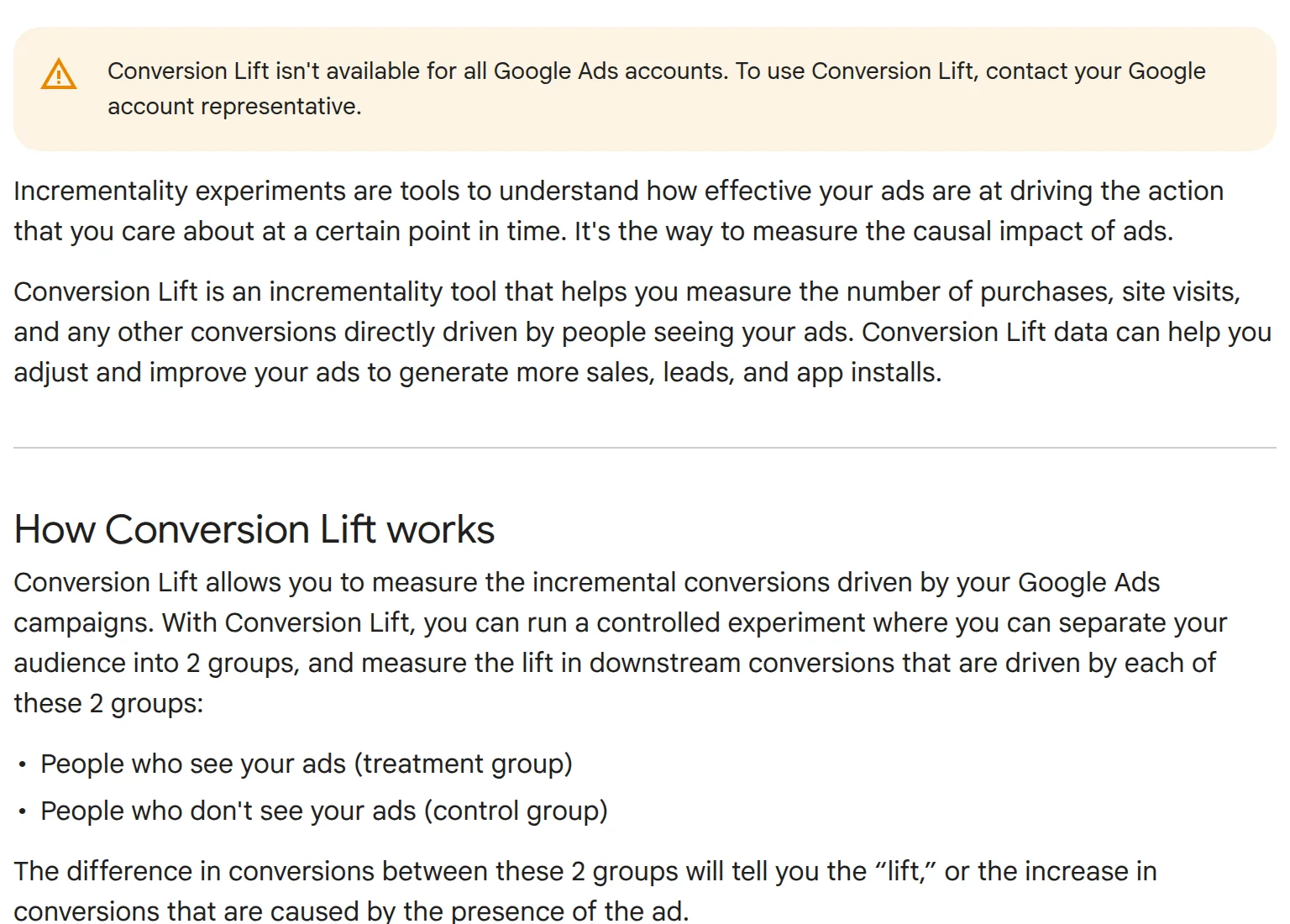
The standard method is a controlled experiment, sometimes called a holdout or lift test:
- Pick a comparable audience. Split users, households or geographic regions into a test group and a control group at random, or match regions with similar sales history.
- Expose only the test group. The control group sees no ads from the campaign, or sees an unrelated public service ad (a ghost or PSA ad) so delivery conditions match.
- Run for a fixed period. Long enough to collect enough conversions and capture delayed effects.
- Compare outcomes. Use the same conversion definition for both groups.
Incremental lift = (Test conversion rate − Control conversion rate) ÷ Control conversion rate
Incremental conversions = (Test rate − Control rate) × Test group size
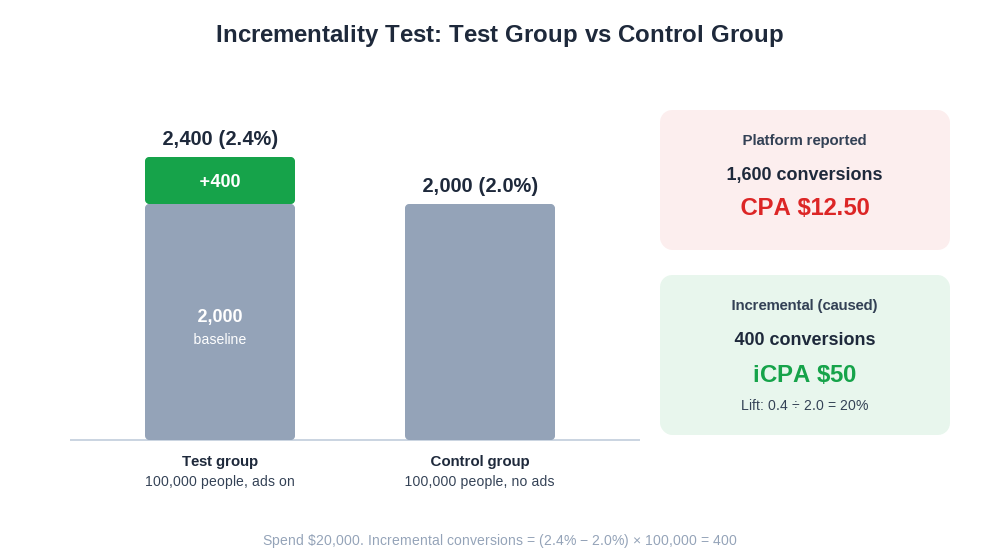
Worked example. A retailer runs a $20,000 campaign:
- Test group: 100,000 people, 2.4% convert = 2,400 conversions.
- Control group: 100,000 people, 2.0% convert = 2,000 conversions.
- Incremental conversions: (2.4% − 2.0%) × 100,000 = 400.
- Incremental lift: 0.4 ÷ 2.0 = 20%.
- Incremental cost per acquisition: 20,000 ÷ 400 = $50.
Meanwhile, the platform reported 1,600 attributed conversions, a CPA of $12.50. The real cost of each extra customer is four times higher than the dashboard suggested. The campaign still works. It is just far less efficient than reported, which changes how much you should spend on it.
Ways to Measure Incrementality
| Method | How it works | Strengths | Limits |
|---|---|---|---|
| User-level holdout | Randomly withhold ads from some users | Precise, clean comparison | Needs platform support; hard across channels |
| Platform lift study | Meta Conversion Lift, Google Conversion Lift | Easy to run inside the platform | Measured by the platform selling the ads |
| Geo experiment | Turn ads on in some regions, off or reduced in others | Works for any channel, including TV | Needs enough regions and sales volume |
| Time-based on/off test | Pause a channel for a period and watch sales | Simple | Easily confused by seasonality |
| Marketing mix modeling | Statistical model on historical spend and sales | Covers all channels at once | Estimates, not experiments; needs long history |
Many teams combine them: run experiments on the biggest channels and use those results to calibrate a marketing mix model.
Incrementality vs Attribution
Attribution models, from last click to multi-touch attribution, divide credit for conversions that happened among the touchpoints before them. They never ask whether the conversion would have happened without those touchpoints. Incrementality asks exactly that.
The two often disagree. Retargeting and branded search look excellent in attribution reports because they reach people right before purchase. In lift tests they often show low incrementality for the same reason. Upper-funnel video and prospecting look weak in attribution but can show solid incremental lift.

Stay Updated on AI Visibility Trends
Get the latest insights on AI mentions, brand monitoring, and optimization strategies.
Incrementality and AI Search
AI answers add a new blind spot. When someone asks ChatGPT or Perplexity for a recommendation and then visits your site directly or searches your brand, attribution tools credit direct traffic or branded search, not the AI answer. If your brand is recommended often, branded search campaigns may look more efficient than they are, because demand from AI answers is landing there. Watching your AI visibility next to branded search volume helps explain those shifts.
Best Practices for Incrementality
- Test your largest channels first, where a wrong assumption costs the most.
- Decide the metric, test length and minimum detectable lift before launching.
- Use the same conversion source for test and control, ideally your own order data.
- Run tests long enough to capture delayed purchases, often several weeks.
- Repeat tests periodically, since incrementality changes as audiences and spend change.
- Use incremental CPA or incremental ROAS when setting budgets, not platform-reported figures.
Common Incrementality Mistakes
The most common mistake is reading a lift study run by the platform as fully independent. Platform studies are useful, but they are designed and measured by the company selling the ads, so check results against your own sales data. Another is running tests that are too small or too short. A test that cannot detect less than a 30% lift will often report “no significant effect” for a channel that works.
Teams also compare an on/off test across different weeks and mistake seasonality for lift, forget that pausing one channel can shift conversions to another, and run a test once, then treat the result as permanent.