


Free Shipping Threshold
A free shipping threshold is a minimum order value a customer must reach to qualify for free shipping, set by a store to encourage larger baskets while still recovering shipping costs on smaller orders. It's one of the most common levers e-commerce brands use to raise average order value without offering a blanket product discount.
Definition of Free Shipping Threshold
A free shipping threshold is a minimum order value that a customer must reach before a store waives shipping charges on that order. Rather than offering free shipping unconditionally or charging a flat rate on every order regardless of size, a threshold gives the store a way to offer the customer-favorite perk of free shipping while still recovering the real cost of fulfillment on smaller purchases. It’s one of the most widely used incentive structures in e-commerce, precisely because it aligns customer motivation with the store’s own economics: a customer who’s a few dollars short of the threshold is often willing to add another item to their basket to unlock free shipping, which raises the average order value in a way that benefits both sides of the transaction.
How a Free Shipping Threshold Works
The mechanics are simple: the store sets a dollar amount, communicates it clearly during shopping and at checkout, and applies free shipping automatically once the customer’s cart total reaches that amount. The strategic part is choosing the right number. Setting the threshold too close to the store’s actual average order value means many customers already qualify without needing to add anything, which doesn’t shift behavior. Setting it too far above average order value means most customers never reach it and simply pay for shipping or, worse, abandon their cart when they see an unexpected shipping charge at checkout. The commonly used approach is to set the threshold modestly above current average order value — enough to require an incremental purchase from most customers, but still achievable enough that a meaningful share will actually cross it rather than give up.
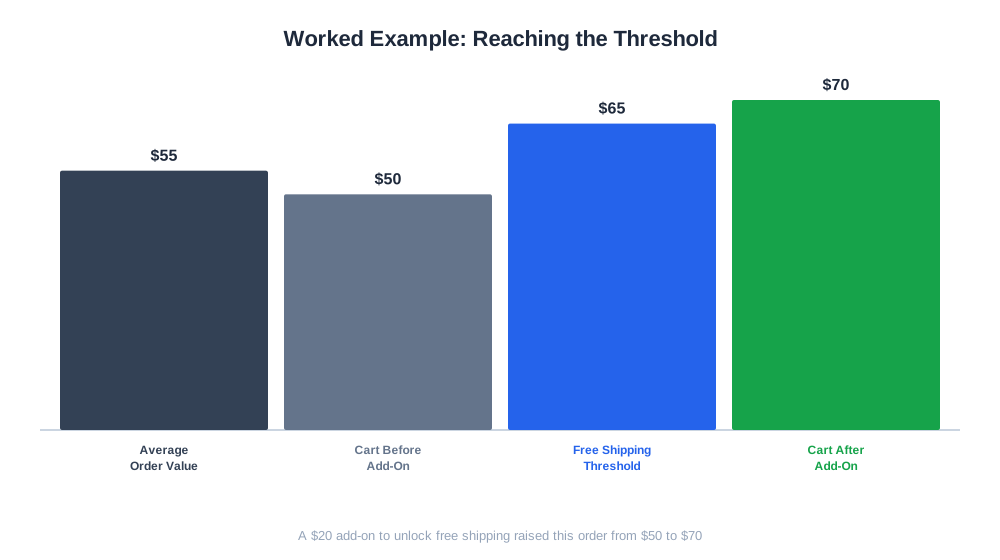
A worked example: a store with an average order value of 55 dollars sets its free shipping threshold at 65 dollars. A customer with a 50-dollar cart sees a message indicating they’re 15 dollars away from free shipping and adds a 20-dollar item to qualify, raising that transaction’s value to 70 dollars instead of 50. If flat-rate shipping on that order would have cost the customer 7 dollars, the customer perceives real savings, while the store gains 20 dollars in incremental revenue against a shipping cost it might have charged separately anyway — a trade that works in the store’s favor as long as the added item still carries a reasonable margin after absorbing the shipping cost.

Ready to Monitor Your AI Visibility?
Track how AI chatbots mention your brand across ChatGPT, Perplexity, and other platforms.
Why Free Shipping Threshold Matters for E-commerce Brands
Unexpected shipping costs revealed late in checkout are one of the most commonly cited reasons customers abandon a cart before completing a purchase, which makes a clearly communicated free shipping threshold a powerful tool for reducing that specific friction point — a customer who knows upfront what it takes to unlock free shipping isn’t surprised by a shipping line item at the final step. Beyond reducing abandonment, a well-calibrated threshold is one of the most direct levers for raising average order value without discounting products directly, since the “cost” to the store is absorbing a shipping fee it might have needed to charge anyway, rather than giving up margin on the product itself. The threshold also shapes customer expectations over time: once customers learn what it takes to get free shipping from a given store, that number becomes a mental anchor that influences basket-building behavior on every subsequent visit, not just the first one.
Free Shipping Threshold Strategies Compared
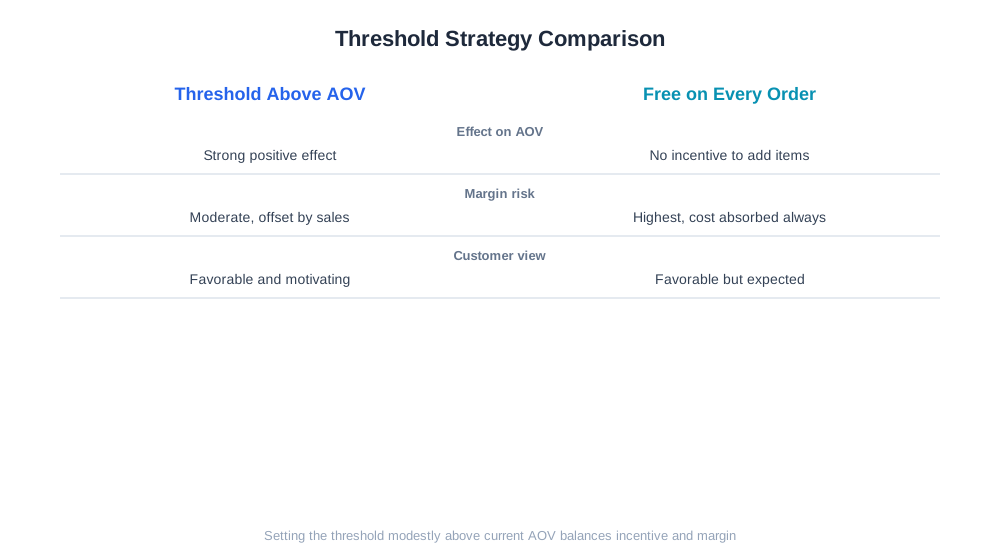
| Approach | Customer Perception | Effect on Average Order Value | Margin Risk |
|---|---|---|---|
| No free shipping offered | Least favorable; flat or calculated rate always applies | No direct effect | Lowest, cost always passed through |
| Free shipping on every order | Most favorable, but expected | No incentive to add items | Highest, cost absorbed on every order |
| Threshold above average order value | Favorable and motivating | Strong positive effect | Moderate, offset by incremental sales |
| Threshold near or below average order value | Favorable but underutilized | Minimal effect | Highest relative to benefit gained |
Stay Updated on AI Visibility Trends
Get the latest insights on AI mentions, brand monitoring, and optimization strategies.
Free Shipping Threshold and AI-Driven Commerce
As AI shopping assistants like ChatGPT Shopping and Perplexity Shopping increasingly compare offers across multiple retailers on a customer’s behalf, shipping cost and threshold terms have become part of what these systems weigh when presenting options — a store whose free shipping terms are clearly and consistently represented in its product and policy data is easier for an AI assistant to accurately compare against competitors, while unclear or hard-to-find shipping terms risk the store being misrepresented or skipped in a comparison. On the analytics side, tuning a free shipping threshold correctly requires visibility into both average order value and margin together, since raising the threshold too aggressively can suppress conversion while setting it too low erodes profit. AmICited’s eshop_get_kpis tool tracks average order value and related performance metrics together, giving a merchant the data needed to test threshold changes and see the actual effect on both basket size and profitability, rather than guessing at the right number or copying a competitor’s stated threshold without knowing whether it fits their own margin structure.
Best Practices for Free Shipping Threshold
- Set the threshold modestly above current average order value, typically enough to require one additional item without feeling out of reach for most customers.
- Display progress toward the threshold clearly in the cart, since visible progress indicators are what actually drive the basket-building behavior the threshold is designed to encourage.
- Recalculate the threshold periodically as product pricing, shipping costs, and average order value shift, rather than setting it once and leaving it unchanged indefinitely.
- Vary the threshold by shipping zone if shipping costs differ significantly by region, so the store isn’t absorbing a loss on distant or international orders that a single flat threshold doesn’t account for.
- Communicate the threshold prominently across the site, not just at checkout, so customers can plan their basket around it earlier in the shopping session.
Common Free Shipping Threshold Mistakes
A frequent mistake is setting the threshold without checking it against actual shipping costs and margin data, resulting in a number that drives incremental sales but quietly erodes profit on the added items once the absorbed shipping cost is accounted for. Another common problem is failing to communicate the threshold until checkout, missing the earlier opportunities in the shopping session where a customer could have planned their basket around it — a threshold only shown at the final step does little to change behavior compared to one shown throughout the browsing experience. Some stores also set a single national threshold that doesn’t account for the higher cost of shipping to distant or international regions, effectively subsidizing the most expensive orders to fulfill at the same rate as the cheapest. It’s also common to leave the threshold unchanged for years even as average order value, product pricing, and shipping costs shift, meaning a number that once required an incremental purchase eventually becomes trivially easy to hit, quietly losing its effect on basket size. Finally, some stores overcorrect after noticing checkout abandonment and drop the threshold too low or offer unconditional free shipping without modeling the margin impact, trading a real profitability problem for a perceived conversion improvement that isn’t actually validated against the numbers.